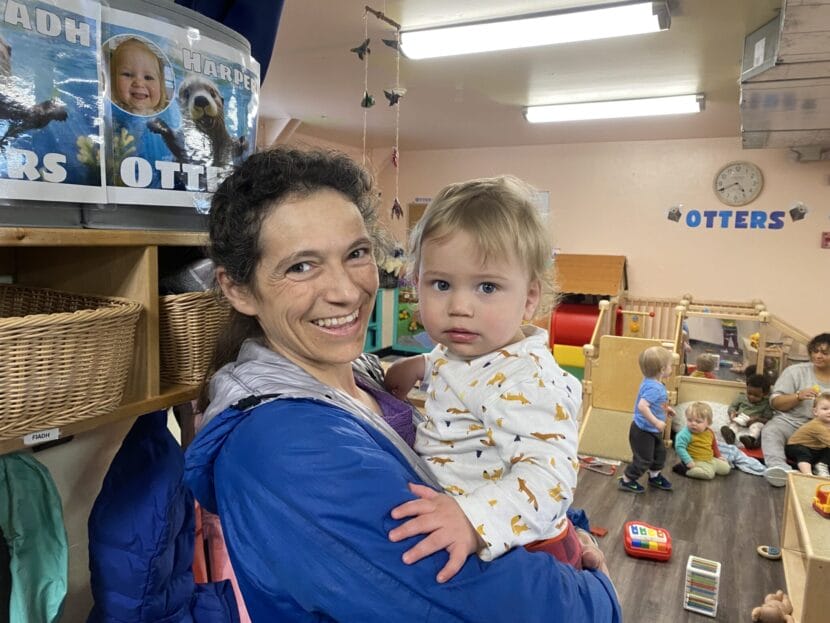
A child peeks through a scope made from a piece of paper at Meadow Lakes Head Start Center in 2023. (Photo by Lela Sieler through CCS Early Learning)
Alaska lawmakers approved legislation that would nearly double the state’s support to early childhood programs for low income families.
The boost comes amid a crisis the child care sector, where low wages suppress the number of spaces available and reduce access to care.
Mark Lackey, director of a Head Start program in Wasilla, attributes the change to the scope of the problem. “There were schools closing down, there were classrooms being shuttered,” he said.
Last year the Legislature would have given Head Starts $5 million in one-time funding, but Gov. Mike Dunleavy vetoed most of it.
The new proposal still needs Dunleavy’s approval to become law, but Lackey said this year he is optimistic. He pointed to the governor’s initiation of a task force to find solutions to the child care crunch: “He saw that the sector needed help and that he saw that families were not able to stay in Alaska.”
Alaska’s Head Start program provides child care, early education and services like health and dental care to more than 3,000 children in low-income families. The federal government funds 80% of Head Start costs and programs need to come up with the rest of the money.
The state of Alaska paid the full 20% match for the programs for decades until the price of oil sank in 2010. State support has shrunk about half of the match.
House Bill 148 includes a commitment that the state will increase its contribution to the full 20% match. This year that is a $5.2 million increase.
Lackey said that’s necessary because Head Start programs, unlike private centers, cannot increase their rates to support better wages for staff. “We’re serving parents that don’t have those resources,” he said. “So when our grants are flat for 14 years — it really hurts. So this is huge.”
The years of flat-funding, coupled with the instability of pandemic years and rising prices, took their toll on his organization. Just two weeks ago, Meadow Lakes Head Start, one of his Wasilla preschools that served about 45 students, closed for good. The board of CCS Learning cut nearly 100 spaces this year because the organization could not afford enough staff.
Now, he said they can start to rebuild.
“I’m excited about being able to advertise our vacancies at a wage that isn’t lower than Target, “ he said. “Individuals that are taking care of young children, they have a lot of responsibility on their plate and they should be compensated accordingly.”
The increase also benefits rural areas. Anne Shade, director of Bristol Bay Native Association’s child care programs, called it “life changing.”
In her region, an area about the size of Ohio, Head Start works in conjunction with the school district and is the only early childhood option. But she said Head Start often loses highly qualified workers to the district, where wages are higher. That has led to classroom closures in the past. With the increased funding, she said she can compete for the most skilled workers.
“The prices are so high out here. We’re looking at going to almost $7 a gallon for gas, milk at $10 a gallon — you can’t pay people $14 an hour, you can’t survive,” she said.
Lackey said the state’s commitment staves off future closures and allows Head Start programs to rebuild.
“I think this absolutely gives breathing room and keeps future closures from being so imminent. I know that programs all around the state of Alaska are still under-enrolled. And we are going to have to have time to hire new people at better wages to get them trained, you know, to get back to where we were pre pandemic.”
Lawmakers also included $7.5 million in the budget for grants for child care centers and a number of policy changes aimed at increasing access for families. Lackey has worked in early childhood for decades and said this support is unlike what he’s experienced before.
“I’ve been going to Juneau now for 20 years and have never felt such a successful legislative session for early childhood,” he said.
Smocks draped over an easel in a classroom at Hillcrest Children’s Center on April 18, 2024, in Anchorage. (Photo by Claire Stremple/Alaska Beacon)
About a dozen preschoolers played in the snowmelt in the yard of Hillcrest Children’s Center in Anchorage this April. Most were zipped into heavy duty outerwear against the spring chill. All of them were splattered with dirt.
“One of our values is mud,” said Christina Eubanks, the center’s director, before an exuberant and particularly mud-coated child pulled her aside to tell her about his day and offer her some of the muffin that was part of the day’s afternoon snack.
Caring for kids costs money. Eubanks had popped out into the yard after reviewing the budget the center’s board had voted on the night before. The balance sheet is riddled with negative numbers, but Hillcrest will be in the black this year. That is only possible because of nearly $200,000 in grants from federal pandemic aid that the organization used to offset tuition costs. “That is not expected in the year coming forward,” Eubanks said.
The state will distribute the last of the federal aid to child care centers this summer.
“So we’re hoping that will be enough to balance out this year’s budget. It would be great if there was some funding to go into next year’s,” Eubanks said.
Hillcrest had to increase what it paid workers just to be competitive with unemployment benefits during the pandemic. Eubanks said she knows the child care center’s costs are reaching the limit of what families can afford, but the parent-run board still voted to increase its monthly rates to up to $1,850 to keep up with the cost of operation.
It is in these tenuous conditions that Alaska lawmakers passed the child care legislation. The proposed law expands eligibility for families to get financial assistance for child care, offers tax incentives for companies to invest in child care options and gives the state the option to consider the actual cost of care, rather than the market rate, when setting its rates.
Lawmakers separately included $7.5 million in the state’s budget for grants to support child care centers.
Stephanie Berglund, the leader of a nonprofit resource and referral center for child care in the state, hailed the achievement. “This is a landmark milestone for Alaska,” she said. “What’s significant is recognizing the importance and value of working families, and the need for our state to be investing in critical child care support.”
Preschoolers play in the snowmelt at Hillcrest Children’s Center in Anchorage on April 18, 2024. (Claire Stremple/Alaska Beacon)
By her estimate, the changes could double the amount of Alaska families eligible for child care subsidies and assistance. But she said that since the pandemic, nearly a quarter of Alaska’s small child care businesses have closed and her organization has not seen new ones fill the gap. She cautioned that without movement to support child care businesses and create new ones, there may not be enough programs for newly qualifying families to apply their benefits to.
“This legislation is just one piece of what’s needed. Child care is still very much in crisis in Alaska,” she said.
It doesn’t fix everything
Rep. Julie Coulombe, R-Anchorage, sponsored the legislation, which began as House Bill 89 — and she is the first to admit that it is not a complete solution. “HB 89 doesn’t fix everything. But it’s a start,” she said. “I think it just brings a lot of people hope that maybe we can keep this momentum going.”
Coulombe serves on the governor’s child care task force and said there was celebration of the bill at its meeting this week because the changes come directly from work with state staff and care center operators from around the state.
The piece she is most excited about is the public private partnership that offers tax credits to businesses that make payments or contributions for child care and child care facilities. “In my opinion, that’s what’s going to move the needle the most, because that’s right where people are working, that’s their employers. That’s going to have a really big impact.”
Children’s coats hang in a hallway at Hillcrest Childcare Center in Anchorage o n April 18, 2024. (Claire Stremple/Alaska Beacon)
Another supporter of the bill, Rep. Zack Fields, D-Anchorage, said its language was based on legislative best practices from around the country that were successful in states with either mixed or Republican-led legislatures. “It represented what is possible in Republican legislatures,” he said.
He also stressed the need to expand child care. “It’s not enough to stabilize a sector; the sector has grossly inadequate capacity right now,” he said. So, he too has his eye on tax credits.
“The biggest question is, what is the uptake on these tax credits to expand care?” he said. “The best thing that could happen would be a bunch of companies invest in new child care facilities.”
The tax credit is the reason Kati Capozzi, president of the Alaska Chamber, was one of the bill’s most active advocates. She said it is a priority for the businesses that are her organization’s members, an indication that the businesses that pay taxes in the state would use the incentive.
“They took a look at it, saw the tax credits that are available and encouraged the chamber to support the bill, presumably because they plan on using the tax credits that are included in it,” she said.
Data shows unaffordable or unavailable child care affects Alaska’s workforce. Seventy-seven percent of Alaska parents reported missing work because of child care challenges in one study.
‘Hail Mary’
The milestone legislation did not succeed as a standalone bill. Instead lawmakers slipped it into a much larger bill at the 11th hour of the legislative session. Coulombe described it as “kind of a Hail Mary,” but said she doesn’t mind what form it takes as long as it serves its purpose.
Nora Matell picks up her child from Hillcrest Childcare Center in Anchorage on April 18, 2024. The high school teacher said child care is expensive and hard to find. “If you get in anywhere that’s great. And then if you get into somewhere where there’s not like all sorts of closures and you feel like your kids are safe and loved that’s amazing,” she said. Lawmakers passed legislation that would increase the number of families. (Claire Stremple/Alaska Beacon)
After passage by the House, HB 89 got hung up in the Senate Finance Committee. Sen. Cathy Giessel, R-Anchorage, tried to put the bill’s language in a bill that dealt with Medicaid in schools, but that proposal didn’t get enough votes. So Fields asked Coulombe for permission to add it as an amendment to a popular board extension bill. “It’s the last day, and I got nothing to lose. So let’s just try it,” Coulombe recalled saying. It passed easily in the House and the Senate concurred just before gaveling out for the year at about a quarter midnight.
Fields called the amendment’s passage a “miracle,” but there is another hurdle before the bill becomes law. The popular bill that was such a successful vehicle for HB 89 was also a successful vehicle for a wide-ranging array of other bills. The practice of adding legislation as amendments to bills likely to pass, known as “bill stuffing,” is common and widespread, but this particular instance may have stretched the limits of what is allowed. Lawmakers are restricted to keeping the amendments to a single subject. The measure, Senate Bill 189, now ranges from board extensions to child care to big game permitting and marijuana taxes.
“The governor has always said he supported HB 89,” the original bill, Coulombe said, but added that she is sure the administration is going to give it a close look.
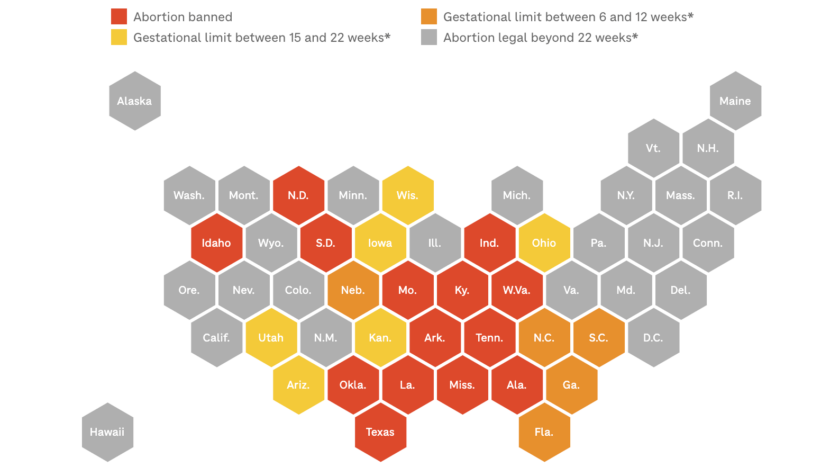
*Weeks since Day 1 of last menstrual period (Source: KFF analysis as of May 2, 2024/Credit: Hilary Fung/NPR)
In the nearly two years since the Supreme Court overturned Roe v. Wade, abortion access has been in an almost constant state of flux.
State laws keep changing – with new bans taking effect in some places while new protections are enacted in others. And there have been a slew of lawsuits and ballot measures that may motivate voters come November.
Here are 6 facts about where things currently are with abortion and the election.
1. About half of states restrict abortion.
In 14 states, there are total bans on abortion, with very limited exceptions in cases such as rape or to save the life or health of the mother. A few more states – including Florida – have six-week bans, and often that’s so early in a pregnancy most people don’t yet know they’re pregnant. Another half dozen states have restrictions that limit abortion after 12, 15, 18 or 22 weeks of pregnancy.
In the states that ban or severely restrict abortion access, the number of abortions has dropped drastically.
But legal challenges and ballot initiatives mean the map could keep shifting. So far, voters will be weighing in on the right to an abortion in four states: Colorado, Florida, Maryland and South Dakota. Six more states are in the process of getting it on the ballot, including Missouri, Nebraska, Nevada, Arizona, Arkansas and Montana.
2. Bans are affecting where doctors work.
Idaho illustrates how abortion bans can affect a state’s broader health care system. Doctors are leaving the state, and three maternity wards have closed since the abortion ban took effect there.
“We lost 58 obstetricians either to moving out of state or retiring, and in that same time period, only two OB-GYNs moved into Idaho,” says Dr. Sara Thomson, an OB-GYN in Boise. “That is not really a sustainable loss-to-gain ratio.”
It’s not just Idaho – a lot of hospital systems in states with abortion bans are having recruiting problems. The Association of American Medical Colleges earlier this month reported a decrease in medical students applying to residencies in states that limit abortion access. Essentially, these early career doctors are saying they don’t want to practice medicine with the threat of fines, jail time, and the loss of their medical license.
3. Abortions are actually increasing nationally.
Since the Supreme Court overturned Roe v. Wade, the number of abortions in the U.S. has continued to grow.
“We are seeing a slow and small, steady increase in the number of abortions per month and this was completely surprising to us,” says Ushma Upadhyay, who co-leads the Society of Family Planning’s WeCount project. According to their recent report, in 2023 there were, on average, 86,000 abortions per month compared to 2022, when there were about 82,000 abortions per month. “Not huge,” says Upadhyay, “but we were expecting a decline.”
A major factor in the uptick in abortions nationwide is the rise of telehealth, made possible in part by regulations first loosened during the coronavirus pandemic. Telehealth abortions now make up nearly 1 in 5 of all abortions in the U.S. Patients don’t need to take off work and go to a clinic, they can connect with providers over text messages, phone calls or video, no matter where they live. Abortion medication is then mailed to them at home.
John Seago, president of Texas Right To Life, is concerned with the rise of abortions and increased access through telehealth.
“I’m afraid that we are going to wake up in 20 years and just kind of realize that we won in Dobbs, and then we’ve been losing ever since,” Seago says. He told NPR his group is currently working on how to bring criminal and civil challenges to tamp down on the number of abortions.
4. Some states have moved to make abortion access easier.
Abortion was heavily regulated even while Roe v. Wade was the law of the land, and states like Michigan, Colorado, California, Minnesota and others have made moves to undo some of those regulations.
They are passing laws to get rid of waiting periods and gestational limits, and they are allowing more types of providers like nurse practitioners, for instance, to perform abortions. Some states have stockpiled mifepristone, one of the medicines that can be used for abortion, in case access is curtailed federally in the future.
New York City made an abortion hub as part of its health department, including a hotline and chat for people to find out where to get an abortion and how to get funding to cover the costs.
5. “Shield laws” create new access in untested legal terrain.
Another way some states have expanded abortion access is by passing “shield laws.” These are laws that say doctors and nurses in states where abortion is legal can’t be prosecuted by another state if they provide abortion across state lines. They apply if a woman travels to another state for an abortion or if the abortion provider mails pills to someone in a state with restrictions.
Lauren, who is 33 and lives in Utah, got a telehealth abortion from a provider in a state with shield laws. Lauren got pregnant on birth control and decided quickly that she couldn’t afford another child. (NPR is not using her last name because she’s worried about professional repercussions.)
Abortion is technically legal in Utah until 18 weeks, but access is severely restricted. It can only be performed in hospitals, for instance. So Lauren chose an online company called Aid Access, that provides telehealth abortion for people in all 50 states.
“In my situation, I felt more at ease than I would in a physician’s office and more comfortable, to be honest,” she explains. “Especially with a provider within the state of Utah – I feel like there’s always a judgmental indication or undertone.”
She filled out a form online with questions about how far along she was and her medical history, connected with a doctor via email and text messages, and received abortion medication in the mail. She had her abortion at home.
Some anti-abortion rights groups are hoping to test the legality of shield laws by bringing charges against a doctor, but that hasn’t happened yet.
6. The Supreme Court could shake things up again.
There are two major decisions on abortion pending right now before the Supreme Court.
One is about the abortion pill mifepristone. The Court could restrict this drug for the whole country and totally change access to medication abortion through telemedicine. Court watchers think it won’t go that way, but no one knows for sure.
The other case is about abortion in emergency situations and it centers on Idaho’s medical exception. It’s a fight over whether federal or state law should have priority. The oral arguments left legal analysts unsure about which way the Court was leaning.
Both of these decisions are expected in late June or early July, just a few months before the election. Regardless of what the justices decide, it’s going to catapult abortion back into the headlines a few months before the election.
On the last full day of a Bahamas excursion, Vincent Wasney had three epileptic seizures. While being evacuated, he received a bill for expenses incurred during the cruise. (Kristen Norman for KFF Health News)
Vincent Wasney and his fiancée, Sarah Eberlein, had never visited the ocean. They’d never even been on a plane. But when they bought their first home in Saginaw, Michigan, in 2018, their real estate agent gifted them tickets for a Royal Caribbean cruise.
After two years of delays due to the coronavirus pandemic, they set sail in December 2022.
The couple chose a cruise destined for the Bahamas in part because it included a trip to CocoCay, a private island accessible to Royal Caribbean passengers that featured a water park, balloon rides, and an excursion swimming with pigs.
It was on that day on CocoCay when Wasney, 31, started feeling off, he said.
The next morning, as the couple made plans in their cabin for the last full day of the trip, Wasney made a pained noise. Eberlein saw him having a seizure in bed, with blood coming out of his mouth from biting his tongue. She opened their door to find help and happened upon another guest, who roused his wife, an emergency room physician.
Wasney was able to climb into a wheelchair brought by the ship’s medical crew to take him down to the medical facility, where he was given anticonvulsants and fluids and monitored before being released.
Vincent had had seizures in the past, starting about ten years ago, but it had been a while since his last one. Imaging back then showed no tumors, and doctors concluded he was likely epileptic, he said. He took medicine initially, but after two years without another seizure, he said his doctors took him off the medicine to avoid liver damage.
Wasney had a second seizure on the ship a few hours later, back in his cabin. This time he stopped breathing, and Eberlein remembered his lips being so purple, they almost looked black. Again, she ran to find help but, in her haste, locked herself out. By the time the ship’s medical team got into the cabin, Wasney was breathing again but had broken blood vessels along his chest and neck that he later said resembled tiger stripes.
Wasney was in the ship’s medical center when he had a third seizure — a grand mal, which typically causes a loss of consciousness and violent muscle contractions. By then, the ship was close enough to port that Wasney could be evacuated by rescue boat. He was put on a stretcher to be lowered by ropes off the side of the ship, with Eberlein climbing down a rope ladder to join him.
The patient: Vincent Wasney, 31, who was uninsured at the time.
Medical services: General and enhanced observation, a blood test, anticonvulsant medicine, and a fee for services performed outside the medical facility.
Service provider: Independence of the Seas Medical Center, the on-ship medical facility on the cruise ship operated by Royal Caribbean International.
Total bill: $2,500.22.
What gives: As part of Royal Caribbean’s guest terms, cruise passengers “agree to pay in full” all expenses incurred on board by the end of the cruise, including those related to medical care. In addition, Royal Caribbean does not accept “land-based” health insurance plans.
Wasney said he was surprised to learn that, along with other charges like wireless internet, Royal Caribbean required he pay his medical bills before exiting the ship — even though he was being evacuated urgently.
“Are we being held hostage at this point?” Eberlein remembered asking. “Because, obviously, if he’s had three seizures in 10 hours, it’s an issue.”
Wasney said he has little memory of being on the ship after his first seizure — seizures often leave victims groggy and disoriented for a few hours afterward.
But he certainly remembers being shown a bill, the bulk of which was the $2,500.22 in medical charges, while waiting for the rescue boat.
Still groggy, Wasney recalled saying he couldn’t afford that and a cruise employee responding: “How much can you pay?”
They drained their bank accounts, including money saved for their next house payment, and maxed out Wasney’s credit card but were still about $1,000 short, he said.
Ultimately, they were allowed to leave the ship. He later learned his card was overdrafted to cover the shortfall, he said.
Royal Caribbean International did not respond to multiple inquiries from KFF Health News.
Once on land, in Florida, Wasney was taken by ambulance to the emergency room at Broward Health Medical Center in Fort Lauderdale, where he incurred thousands of dollars more in medical expenses.
He still isn’t entirely sure what caused the seizures.
On the ship he was told it could have been extreme dehydration — and he said he does remember being extra thirsty on CocoCay. He also has mused whether trying escargot for the first time the night before could have played a role. Eberlein’s mother is convinced the episode was connected to swimming with pigs, he said. And not to be discounted, Eberlein accidentally broke a pocket mirror three days before their trip.
Wasney, who works in a stone shop, was uninsured when they set sail. He said that one month before they embarked on their voyage, he finally felt he could afford the health plan offered through his employer and signed up, but the plan didn’t start until January 2023, after their return.
They also lacked travel insurance. As inexperienced travelers, Wasney said, they thought it was for lost luggage and canceled trips, not unexpected medical expenses. And because the cruise was a gift, they were never prompted to buy coverage, which often happens when tickets are purchased.
The resolution: Wasney said the couple returned to Saginaw with essentially no money in their bank account, several thousand dollars of medical debt, and no idea how they would cover their mortgage payment. Because he was uninsured at the time of the cruise, Wasney did not try to collect reimbursement for the cruise bill from his new health plan when his coverage began weeks later.
The couple set up payment plans to cover the medical bills for Wasney’s care after leaving the ship: one each with two doctors he saw at Broward Health, who billed separately from the hospital, and one with the ambulance company. He also made payments on a bill with Broward Health itself. Those plans do not charge interest.
But Broward Health said Wasney missed two payments to the hospital, and that bill was ultimately sent to collections.
In a statement, Broward Health spokesperson Nina Levine said Wasney’s bill was reduced by 73% because he was uninsured.
“We do everything in our power to provide the best care with the least financial impact, but also cannot stress enough the importance of taking advantage of private and Affordable Care Act health insurance plans, as well as travel insurance, to lower risks associated with unplanned medical issues,” she said.
The couple was able to make their house payment with $2,690 they raised through a GoFundMe campaign that Wasney set up. Wasney said a lot of that help came from family as well as friends he met playing disc golf, a sport he picked up during the pandemic.
“A bunch of people came through for us,” Wasney said, still moved to tears by the generosity. “But there’s still the hospital bill.”
The takeaway: Billing practices differ by cruise line, but Joe Scott, chair of the cruise ship medicine section of the American College of Emergency Physicians, said medical charges are typically added to a cruise passenger’s onboard account, which must be paid before leaving the ship. Individuals can then submit receipts to their insurers for possible reimbursement.
He recommended that those planning to take a cruise purchase travel insurance that specifically covers their trips. “This will facilitate reimbursement if they do incur charges and potentially cover a costly medical evacuation if needed,” Scott said.
Royal Caribbean suggests that passengers who receive onboard care submit their paid bills to their health insurer for possible reimbursement. Many health plans do not cover medical services received on cruise ships, however. Medicare will sometimes cover medically necessary health care services on cruise ships, but not if the ship is more than six hours away from a U.S. port.
Travel insurance can be designed to address lots of out-of-town mishaps, like lost baggage or even transportation and lodging for a loved one to visit if a traveler is hospitalized.
Travel medical insurance, as well as plans that offer “emergency evacuation and repatriation,” are two types that can specifically assist with medical emergencies. Such plans can be purchased individually. Credit cards may offer travel medical insurance among their benefits, as well.
But travel insurance plans come with limitations. For instance, they may not cover care associated with preexisting conditions or what the plans consider “risky” activities, such as rock climbing. Some plans also require that travelers file first with their primary health insurance before seeking reimbursement from travel insurance.
As with other insurance, be sure to read the fine print and understand how reimbursement works.
Wasney said that’s what they plan to do before their next Royal Caribbean cruise. They’d like to go back to the Bahamas on basically the same trip, he said — there’s a lot about CocoCay they didn’t get to explore.
Emmarie Huetteman of KFF Health News edited the digital story, and Taunya English of KFF Health News edited the audio story. NPR’s Will Stone edited the audio and digital story.
KFF Health News, formerly known as Kaiser Health News (KHN), is a national newsroom that produces in-depth journalism about health issues and is one of the core operating programs at KFF — the independent source for health policy research, polling, and journalism.
Copyright 2024 NPR
Transcript :
ARI SHAPIRO, HOST:
It’s time for our May Bill of the Month. Dr. Elisabeth Rosenthal is senior contributing editor with our partner, KFF Health News, and she’s here once again. Welcome.
ELISABETH ROSENTHAL: Hi, Ari. Good to be here.
SHAPIRO: Whose bill are you going to tell us about today?
ROSENTHAL: This month, it’s Vincent Wasney from Michigan. A couple of years ago, he and his fiance did something many Americans are planning to do this summer – take a vacation. They weren’t thinking much about health as they prepared for their Caribbean cruise. Unfortunately, when they were having fun on the ship, an emergency came up.
SHAPIRO: Ugh, sounds like a vacation ruined. Let’s hear the rest of that story from reporter Bram Sable-Smith.
BRAM SABLE-SMITH: Vincent and his fiancee, Sarah, had never seen the ocean. They had never even been on an airplane. And they did not know a lot about travel insurance, but they were thrilled when they got tickets for a Caribbean cruise as a gift.
VINCENT WASNEY: In the beginning, it was a couple hundred bucks, ’cause we just had to pay port fees.
SARAH: Yep.
WASNEY: And the cruise and room and everything were covered.
SARAH: Yep.
SABLE-SMITH: The cruise included a day on CocoCay, a private island that has balloon rides, a water park and even an excursion to swim with pigs. The next morning is when things took a turn. In their cabin, Sarah heard Vincent make a pained noise.
SARAH: I turned my head, and I was going to ask him if he was OK. And he just totally locks up, fetal position, and he starts seizing.
SABLE-SMITH: Vincent had had seizures in the past, but it’d been a while. Sarah ran out the door to get help. In the ship’s medical center, a doctor gave Vincent anticonvulsants and fluids. They observed him, then sent him to his room. There, Sarah noticed something alarming. Vincent’s thumb was moving back and forth on his phone like he was in a trance. It was another seizure.
SARAH: Oh, this one – I might cry, (crying) I’m sorry. He stopped breathing completely. His lips were almost black they were so purple.
SABLE-SMITH: He had a third seizure not long after – a grand mal. He needed off the ship. A rescue boat came to take them to land. But Sarah says, before they disembarked, cruise employees told the couple they had to pay their bill. She remembers feeling trapped.
SARAH: I’m like, OK. So, like, are we being held hostage at this point? Because, obviously, he had three seizures in 10 hours.
SABLE-SMITH: They got the cruise as a gift, so Vincent and Sarah had budgeted just a few hundred dollars for Wi-Fi, drinks and tips. But now, their bill also included $2,500 for medical expenses.
WASNEY: I’m still groggy, and I’m still kind of combative. So I’m like, I can’t pay this. So that’s when they’re like, how much do you have?
SABLE-SMITH: Sarah and Vincent drained their bank accounts and maxed out Vincent’s credit card. Ultimately, they were allowed to leave the ship, but Vincent says he later learned his card was over-drafted to settle what the couple owed. Royal Caribbean did not respond to requests for comment.
Back on land, Vincent was transported to a hospital. This all happened back in 2022. He’s fine now, and the couple are not deterred from traveling again.
WASNEY: I definitely – like, anyone who would wonder – I would suggest a cruise. It’s fun.
SARAH: For sure.
SABLE-SMITH: They still want to go back to CocoCay.
SHAPIRO: That was reporter Bram Sable-Smith. And we’re back with Dr. Elisabeth Rosenthal. Dr. Rosenthal, most people going on vacation are not planning for a medical emergency when they’re packing their bags. Is there research people should be doing ahead of time?
ROSENTHAL: Unfortunately, yes, you should ask before you go. Different cruise lines have very different billing practices. But generally speaking, passengers are required to settle their bills before they disembark, no matter the circumstances. You know, the bills for the drinks, special excursions and – if you end up needing medical care – a sizey (ph) medical bill.
SHAPIRO: What about health insurance? If you are covered, should that protect you from medical bills on a cruise ship?
ROSENTHAL: Well, back in ’22 when this happened, Vincent was uninsured. But even if he had been, it might have been tricky to get reimbursed. In this case, it was a Royal Caribbean cruise. That company says on their website that they do not accept, quote, ‘”land-based health insurance plans when on board.” The cruise line suggests that passengers can try to submit their paid bills to their health insurer for possible reimbursement, but you never know.
SHAPIRO: So if somebody does get off a cruise ship and submit a bill like that, what are the chances that the health insurance company will say, yeah, I’ll pay you back?
ROSENTHAL: Ah, well, many health plans do not cover medical service on cruise ships. Medicare will sometimes cover that if it’s medically necessary – but, again, not always. They don’t pay if the ship is more than six hours away from a U.S. port – not something a passenger is likely to keep track of, right?
SHAPIRO: Right. Well, we also heard a mention there of travel insurance. If somebody buys that ahead of a vacation, is that likely to cover them?
ROSENTHAL: Travel insurance can cover a lot of things, including medical expenses. Some plans also cover an emergency evacuation, for instance, or transport back home in a medical crisis. Those plans can be purchased individually, and some credit cards offer travel medical insurance as a benefit. But, again, you have to check.
And all plans have limitations. Some don’t cover care associated with preexisting conditions or associated with activities deemed risky, like rock climbing. So especially if you have health issues, take the time to look into whether you need a medical insurance policy.
SHAPIRO: Dr. Elisabeth Rosenthal, thank you.
ROSENTHAL: Thanks for having me.
SHAPIRO: And if you have a confusing or outrageous medical bill that you want us to review, please go to NPR’s Shots blog and tell us all about it. Transcript provided by NPR, Copyright NPR.
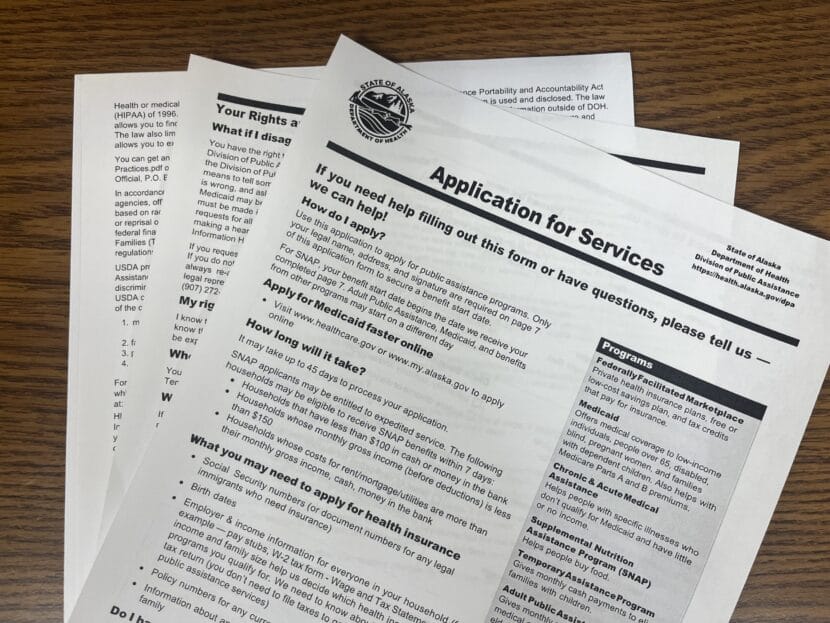
Application for Medicaid for Alaska Residents. (Rachel Cassandra/Alaska Public Media)
Alaskans applying for Medicaid, the government-run insurance program for low-income people, are facing long wait times as the Division of Public Assistance struggles to keep up with demand. Some 15,646 applications are pending, according to the state health department.
But in most cases, eligible Alaskans are still able to access care as long as they’ve submitted an application, said division director Deb Etheridge. Coverage for Medicaid-eligible people takes effect the first day of the month an application is submitted. For example, a doctor’s visit on May 1 would be covered by an application submitted May 31.
“Even if we haven’t provided an eligibility determination, Medicaid will go backwards and pay those medical expenses back to the date of application,” Etheridge said in an interview. “And in some circumstances, we can look retroactively an additional three months if you had medical expenses.”
That’s true for most regular medical care like doctor visits, hospital stays and the like, Etheridge said. But to book medical travel, fill prescriptions or other urgent services that require payment up front, people have to call the division to have their application expedited. Etheridge said applications can then be approved in a matter of hours. Applications can also be processed same-day at many state public assistance offices, she said.
The reason for the backlog is somewhat complex. Etheridge said the issue stems from federal requirements during the so-called “unwinding” process in the wake of the pandemic. The state’s eligibility system was geared to evaluate households, not individuals, as was required, Etheridge said. That presented roadblocks when, for example, looking at families with children — the children should be continuously eligible for Medicaid, but the parents were required to renew. Etheridge said that led the division to stop closing applications that didn’t provide the right information, leading to the backlog.
Many state public assistance employees work on several different aid programs, and while the state paused work on many Medicaid applications, Etheridge said that freed them up to help with a backlog in the Supplemental Nutrition Assistance Program, or SNAP.
But she said the situation is improving. Etheridge said her staff is working overtime and on weekends, and the state is hiring 15 new staff to focus on shoring up the Medicaid program. She said they’re also automating as many tedious and time-consuming tasks as possible.
“To the extent that we did leverage staff who used to be working on Medicaid to help us in our SNAP backlog, we’re also growing that staffing pattern and doing those efficiencies in our processing so that we hope that we will, it’ll be sort of even as we move forward,” she said.
Additionally, she said people who are eligible for SNAP are automatically eligible for Medicaid. And many Medicaid applicants can have their applications processed at the federal healthcare marketplace on Healthcare.gov.
Etheridge said she also expects a recently passed bill loosening eligibility requirements to speed up processing, but she said that’ll have to wait until after computer system upgrades are complete in July 2025.
Rep. Genevieve Mina, D-Anchorage, stares at a pile stack of budget amendments on Tuesday, April 9, 2024. (Photo by James Brooks/Alaska Beacon)
More Alaskans will be able to access food stamps following lawmakers’ vote to expand eligibility for the Supplemental Nutrition Assistance Program on Wednesday night.
The change comes after more than a year of extreme delays in food stamp distribution across the state that left thousands of vulnerable Alaskans without aid for months at a time, driving many into debt and inundating food pantries with food insecure families. State workers caught up on the backlog in March.
Alaska will join 42 other states in using an approach called “broad based categorical eligibility” to streamline applications for the program. The move eases the requirements to get benefits and should reduce the administrative burden that contributed to a backlog in the state’s Division of Public Assistance.
Ron Meehan, director of government affairs for Food Banks of Alaska, said he shared the news with fellow advocates and food bank managers in a flurry of late-night text messages.
“We are feeling really relieved and excited about the implications of this,” he said. “This is something that has been a pretty significant priority for the Alaska Food Coalition and the Food Bank of Alaska, not just in the two years since this latest significant backlog, but really for at least a decade.”
Broad based categorical eligibility makes households with incomes less than twice of the federal poverty line eligible for the program. Previously, the threshold was 30% more than the poverty line in Alaska. It is a priority for food advocates because it allows more people to qualify and save up enough money to gradually exit the program. The bill also removes a component called the asset test, which kept people with more than $4,000 in savings from accessing food aid. That meant anyone with a car or a house would have to liquidate those assets and spend down cash before qualifying, Meehan said.
There was just such an opportunity in the midst of all of that chaos to really step back and think, ‘What are the things that we can do to make sure that this doesn’t happen again?’
– Rep. Genevieve Mina, D-Anchorage
Rep. Genevieve Mina, D-Anchorage and the bill’s sponsor, has pushed for the legislation since last winter, when the state was still in the midst of the backlog. Her proposal, House Bill 196, was rolled into another piece of legislation, House Bill 344, on the last day of the session. The Senate passed it unanimously, while the House voted 26-14 to agree to the final version of the bill. Some lawmakers have lauded its success as one of the session’s major accomplishments.
“We have the ability to feed thousands and thousands of more Alaskans. It also allows more kids to have access to free lunch. And I think that is a great thing in terms of the food crisis that is in our state,” she said on the House floor Wednesday night.
Mina saw the inception of the current food stamp backlog as a legislative staffer after the number of jobs handling applications were reduced in 2021. Now, as a lawmaker, she is responsible for a policy change that she says will streamline the process. She said her efforts as a member of the House minority were boosted by support from veteran Sen. Cathy Giessel, R-Anchorage, the Senate majority leader — and because the problem affected every region in the state.
“There was just such an opportunity in the midst of all of that chaos to really step back and think, ‘What are the things that we can do to make sure that this doesn’t happen again?’” she said.
Since 2022, the state government has been scrambling to address the backlog and Gov. Mike Dunleavy has added more than $70 million to state budgets over the last two years to fight the crisis. The money has gone to computer upgrades, new staff and direct aid to food banks. Supporters say the new legislation marks a turning point to a proactive response to food instability in Alaska.
Though the changes could dramatically increase food aid to Alaskans, they will cost the state only about $140,000 because the SNAP benefits are paid for by the federal government.
Mina worked with the program’s state manager, Division of Public Assistance Director Deb Etheridge, to make sure the changes would help workers get through food stamp applications more efficiently. She credited the state administration with investing in new technology and said it is also important to retain staff at the Division of Public Assistance.
“Those are all just pieces that are starting to come together,” she said. “Hopefully by next year, we’ll see more Alaskans being able to eat and also more Alaskans able to transition off the program.”
Close
Update notification options
Subscribe to notifications
Subscribe
Get notifications about news related to the topics you care about. You can unsubscribe anytime.