Crosses represent opioid overdose deaths in Alaska at a 2023 event in Anchorage organized by the David Dylan Foundation. (Rachel Cassandra/AKPM)
More Alaskans died from an opioid overdose last year than ever before, according to preliminary data, and the state reported the nation’s highest per capita increase in opioid overdose deaths.
The numbers are heartbreaking, said Lindsey Kato, the director of Alaska’s Division of Public Health. She said overdose deaths can have a ripple effect of grief, especially in smaller communities.
“I’ve lost many friends to the opioid epidemic, family members, etc.,” Kato said. “Personally these numbers are absolutely heartbreaking. Professionally, these numbers are heartbreaking. But I also know that we’re up against a lot.”
There were 342 fatal opioid overdoses reported in Alaska in 2023, according to the division. That’s about a 45% rise from the year before. The increase comes as Alaska scrambles to respond to an epidemic that continues to shift form.
The first wave of the opioid epidemic stemmed from overprescription of painkillers, and in the second wave, people already addicted shifted to heroin when prescription pill supply was reduced. This current, third wave is driven by synthetic opioids like fentanyl. It’s up to a hundred times more potent than morphine and supply is seemingly unlimited compared to drugs like heroin or cocaine which rely on crops and are limited by growing seasons. In a state without enough access to substance abuse treatment, Alaskans remain vulnerable to both addiction and overdose.
But organizations throughout Alaska are working to reduce the number of people dying from overdose, through education, connection to services and distribution of Naloxone and Kloxxado, which can reverse an overdose temporarily.
Kato said the state gave out more than 46,000 overdose reversal kits last year and without those, she said, the number of people dying would have been higher.
“I don’t want those that have been working so hard in this space to feel like they have not accomplished something,” Kato said. “I think the one thing I found out in this field is that we hardly [ever] get to know the number of lives that we save.”
Kato said opioid reversal drugs are essential for reducing deaths; most overdoses happen with someone else present.
Dr. Sarah Spencer, an addiction medicine specialist in Ninilchik, said she’s noticed most of her patients now combine methamphetamine with fentanyl, which can be more risky. She said it’s a common misconception that stimulants like methamphetamine can keep someone from overdosing on opioids.
“Fentanyl in particular is like a very incredibly potent, super fast acting respiratory depressant,” Spencer said. “A stimulant [is] not able to make a difference in that. It’s just not strong enough to actually help to keep the person awake.”
Spencer said people sometimes take fentanyl in a powder form but most often in counterfeit blue pills. Seven in 10 counterfeit pills in the country now have a potentially-lethal dose of fentanyl and she said people can overdose when smoking fentanyl too.
Spencer said many populations within Alaska don’t have enough access to addiction treatment including people who are incarcerated. She said the state doesn’t do a good job of getting medications for treating opioid addiction to them and it would be one of the biggest ways to reduce overdose rates in the state.
“They are 120 times more likely to die [in the] first two weeks that they’re released,” Spencer said. “It would reduce our state’s entire overdose rate if we had universal availability of medication for opioid use disorder throughout a person’s incarceration, and that warm handoff to treatment afterwards.”
In 2022, 11% of overdoses in the state were people recently released from incarceration and those numbers haven’t been released yet for last year.
Kato said that’s something on the Division of Public Health’s radar and they hope to strengthen relationships with the state’s Department of Corrections. She also said the state needs to think beyond just reducing deaths, and look at prevention.
“How are we focused on helping people thrive, not just keeping people alive?” Kato asked. “How do we go a little bit more upstream in our prevention, and think more about how we can keep people healthy?”
The state plans to release final data on opioid overdoses in Alaska in September, including which demographics were hit hardest. Kato said she also wants to look carefully at how youth are impacted.
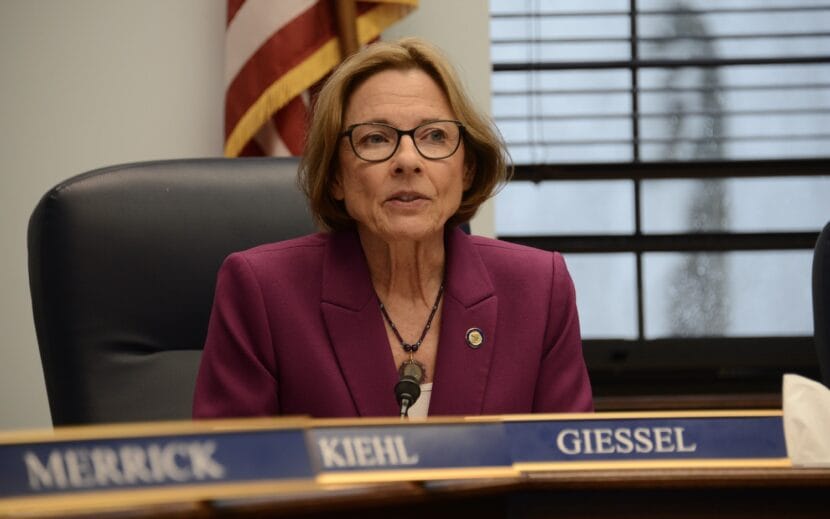
Sen. Cathy Giessel, R-Anchorage, speaks about Senate Bill 88, the Senate Majority’s new public employee pension proposal, on Wednesday, March 1, 2023. (Photo by James Brooks/Alaska Beacon)
To address a surge in mental health problems among young Alaskans, the Alaska Senate is considering whether to allow 16- and 17-year-olds to seek therapy without their parents’ permission.
On Wednesday, the Senate is scheduled to vote on Senate Bill 240, a proposal introduced by Gov. Mike Dunleavy and amended by Senate Majority Leader Cathy Giessel, R-Anchorage.
Giessel’s amendment, adopted by a 3-2 vote in the Senate Health and Social Services Committee last month, would lower to 16 years old the age at which teens can get therapy — but not medication — without permission from an adult.
Thirty-three states allow residents younger than 18 to independently obtain mental health care, and four states — California, Illinois, Maryland and Nevada — allow it as young as 12.
“In real life, I’m an advanced nurse practitioner,” Giessel told members of the committee in March. “I volunteer in schools, in school-based clinics. In that venue, I screen for behavioral and mental health issues … It is astonishing to me the things that our young people today are having to deal with.”
Nationwide, surveys have found a surge in the number of teenagers and young adults experiencing mental health problems. A 2021 national survey by the Centers for Disease Control and Prevention — the latest available — found 42% of high school students “experienced persistent feelings of sadness or hopelessness,” almost double the figure from 10 years before.
More than one in five high school students said they considered attempting suicide.
Speaking about Alaska’s leading causes of death in 2022, state health data experts wrote, “Intentional Self-Harm (Suicide) was the LCOD for teens and young adults aged 15-24 years.”
Sen. Löki Tobin, D-Anchorage, said she supports the bill.
“We have heard from many of our students about the crisis they are experiencing, and that crisis stems from a lack of support for mental health services,” she said on Monday.
Giessel said that in her work at school-based clinics, she frequently hears requests from students for mental health care, but when they learn that they need a parent’s permission, “Commonly, the child’s face falls.”
Often, they’re being cared for by a grandparent, or a single parent working multiple jobs, Giessel said, and that permission never comes.
Over the past two years, Giessel said, she’s frequently heard from behavioral health organizations.
“Every one of those organizations, every one, has agreed that we need to lower the age of consent so that a 16-year-old would be able to say that yes, I need help, and I am consenting to those services,” she said.
Trevor Storrs, president and CEO of the Alaska Children’s Trust, is one of those organizations.
“We do support it. We support the concept, whether it goes with this bill or not,” Storrs said.
“We see this amendment strengthening behavioral health. We have heard from providers and parents and most specifically, youth, that one of the barriers accessing and asking for help is first having to go through parents.”
Not everyone likes the idea of lowering the age to independently receive therapy.
After Giessel’s amendment was adopted in committee, the Matanuska-Susitna Borough School District School Board passed a resolution opposing it.
The Mat-Su Frontiersman newspaper, which covered the local debate, reported that school board members were concerned about whether the idea sets a precedent for school districts offering services without parents’ approval.
“I’m glad this is being looked at, but the family and parents need to be involved,” said Sen. Mike Shower, R-Wasilla, speaking on Monday.
Giessel’s amendment does require some parental involvement: The bill says that after a teenager starts therapy, the behavioral or mental health professional “shall contact the minor’s parents and offer to provide services to the family,” unless doing so would clearly be harmful to the teenager.
The bill also forbids medication without parental approval and doesn’t apply to hospital treatment, only outpatient care.
Those clauses didn’t assuage all critics.
Sen. Shelley Hughes, R-Palmer, asked the Senate on Monday to consider a different version of the bill, one without Giessel’s amendment, but that failed on a 13-7 vote, setting up the amended proposal for a final Senate vote on Wednesday, and a successful vote would send the bill to the House for further work.
The bill doesn’t deal with other problems, including payment for services that teens might request. SB 240 was originally written to allow school districts to bill Medicaid if they treat a Medicaid-eligible student, but the state Department of Health said it believes that billing wouldn’t be possible without parental consent.
That suggests a student operating without that consent might have to navigate health care billing on their own, but the situation regarding payment is evolving and might change, a Giessel aide said.
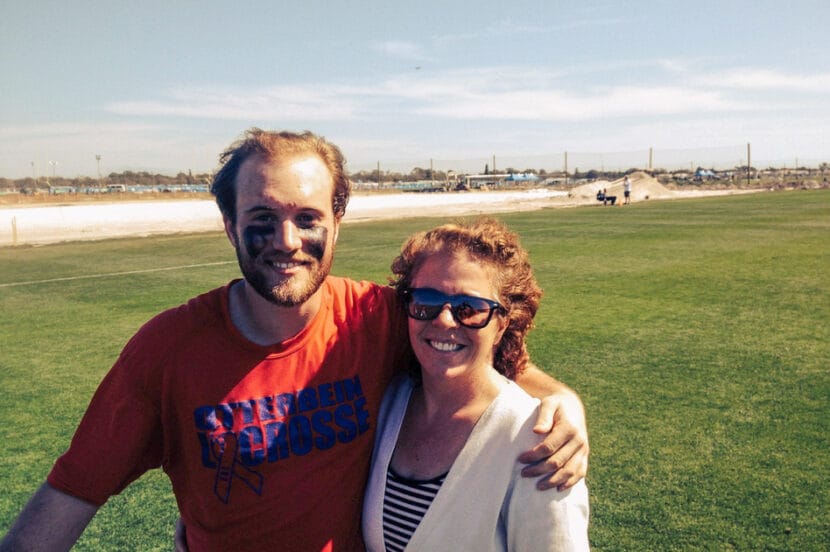
Maura Condon Umble and her son, Alex Patrick Umble. (Maura Umble)
It was an early summer morning in 2018, and Alex Patrick Umble’s family hadn’t heard from him. His mother, Maura Condon Umble, thought his absence was strange, but she didn’t panic.
“I had this important meeting that I needed to go to, I thought, and so I went to work,” Maura said.
While Maura was at work, her boss was on the phone with the Director of Public Safety at a nearby college, who reported that a young man had shot himself on the school’s athletic field.
“My boss came running down the hall, but my boss didn’t tell me,” Maura said. “He just said, ‘Maura, you need to go home right now. You need to go home. Rob needs you at home.’ And my boss kissed me on my forehead, which was very bizarre.”
Once she made it home, Maura learned that the reports were about her son. Twenty-four year old Alex had shot and killed himself days after purchasing a gun.
When gun violence in America is discussed, people typically think about mass shootings, homicides or even domestic violence. But, in fact, the majority of gun-related deaths in the United States are suicides.
Alex is one of the tens of thousands of Americans who lose their lives to suicide every year.
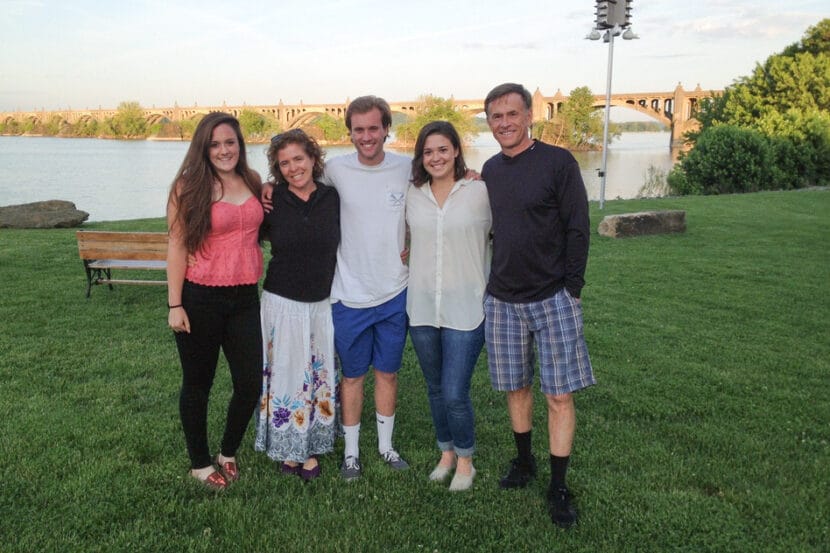
A photo of Maura Condon Umble, her son Alex Patrick Umble and their family. (Maura Umble)
Adam Garber, executive director of CeaseFirePA, a research group that advocates for stricter gun laws, says big cities have typically had the highest gun death rates. But that trend has started to shift. Last year, York, a small city in Pennsylvania, had a higher per capita gun death rate than Philadelphia, Garber said.
“It is really everywhere right now,” Garber said.
Every year, more than 900 people in Pennsylvania die by gun suicides and 48 are wounded by gun suicide attempts. Suicides make up the majority of gun deaths in Pennsylvania.
“Most people who make a suicide attempt are anyone of us,” Garber said. “They’re in a moment of crisis, they got laid off from a job, they go through a divorce or a bad breakup.”
Paul Nestadt, a psychiatrist and professor at Johns Hopkins University, is one of the country’s leading researchers in suicide and what leads to it. He says most people don’t know how prevalent suicide is because we shy away from the topic in our personal relationships and in the media.
“When there’s a mass shooting or homicides, there’s a lot more coverage, and of course, those are very tragic, but suicides kind of kind of slip under the radar a little bit,” Nestadt said. “There’s not as much willingness to talk about them. I think that’s changing. It becomes hard to ignore as the rates climb.”
Easy access to guns in America has also worsened the issue, Nestadt said.
More than 900 people in Pennsylvania die by gun suicides every year and 48 are wounded by gun suicide attempts. (HJ Mai/NPR)
Pills are more often used in suicide attempts—though most attempts involving pills are not fatal. Yet, the smaller fraction of people who use guns to try to take their lives almost never survive.
“Most suicide attempts in the U.S. are by overdose or poisoning things like sleeping pills or Tylenol or opiates,” Nestadt said. “And yet those are usually non-fatal. Only about 2% of people that make an attempt by overdose die. But firearms, which are only used in about five or 6% of attempts, are so lethal that if you happen to have access to a firearm, when that impulse comes and you use that firearm, the chance of death is 90%.”
Nestadt says the time between the impulse and act to take one’s own life is short.
“There’s a study that finds 87% of people make that decision and act on it in the same day, about a quarter of people within 5 minutes.” Nestadt said. “And so what happens in those impulsive moments is people use what they have available to them. It comes on very quickly. If there’s nothing available, the impulse can pass.”
There is another fallacy Nestadt wants to dispel.
“There’s this myth that if someone is suicidal and is thwarted in some way or is able to survive the attempt, that they’ll just keep trying, that they’ll just find some other way. But that’s not what the data shows,” Nestadt said. “In fact, the majority of people, about 94% of people who survive a serious suicide attempt continue to survive.”
As with other forms of gun violence, raising awareness around suicide means having conversations about the very sensitive and often uncomfortable topic.
And Maura is committed to talking openly about how her son’s suicide has affected herself and her family.
This past February, Pennsylvania Lieutenant Governor Austin Davis announced plans to fund a state gun violence prevention office. (HJ Mai/NPR)
Maura and her family decided to disclose Alex’s struggles with depression in his obituary. She is disappointed that suicide is a taboo topic. However, she wants to hold her local government officials accountable for having these conversations, too. So, when Pennsylvania’s Democratic Lt. Gov. Austin Davis announced plans to fund a state gun violence prevention office, she realized the proposal was missing a component.
“He did not mention gun suicide as part of the issue. I was really disappointed,” Maura said.
She thinks about what she could have done and what the state could’ve done to prevent Alex’s death. And she struggles to come up with an answer.
“I have to really give myself a pep talk that, slowly but surely, we can make some progress,” Maura said. “Maybe it will help others, even if it wouldn’t have helped Alex.”
If you or someone you know may be considering suicide or is in crisis, call or text 9-8-8 to reach the Suicide & Crisis Lifeline.
Copyright 2024 NPR. To see more, visit https://www.npr.org.
Workers construct a retaining wall at the outdoor food court location on Franklin Street on Monday, April 15, 2024. (Clarise Larson/KTOO)
An empty lot that once housed the now-demolished Elks Hall building in downtown Juneau will be getting a new life this summer.
Last week, the Juneau planning commission unanimously agreed to allow David McCasland of Deckhand Dave’s, a fish taco stand, to use the site to expand his seasonal outdoor food court on Franklin Street.
McCasland said he hopes to open the expanded food court by May. All of the staple restaurants from last year will be there, along with new food trucks like Pucker Wilson’s and Southeast Gold Mine Gourmet Popcorn.
“I’m basically doing exactly what I’ve been doing before for not quite a decade — it’s my ninth year in business — but it’s now just a little bit bigger,” he said.
McCasland bought the historic Elks Hall building last fall with hopes of restoring it to build housing. The hall was built in 1908 and hosted the first Alaska Territorial Legislature in 1913. But McCasland said that after buying it, he soon found it wasn’t financially feasible to salvage it. The hall was demolished last fall.
At the meeting, McCasland told commissioners he still wants to turn some of the land into housing later down the line.
“Right now, I’m like as broke as could be. So right now I’m just trying to make it,” he said. “But the long-term plan is to build housing.”
Planning Commission chair Mandy Cole said she’s excited about the food court project.
“I am grateful that there’s a business owner in this community who is willing to work on that site and make this area usable and lovely for the people of Juneau and for those who visit it,” she said. “And I think it’s high time and I’m pretty excited to eat a taco there.”
McCasland said he also hopes to keep the food court open for more of the year. In the past, it only operated in the summertime. He said he wants to keep it open during the spring, summer and fall seasons this year, and eventually maybe year-round.
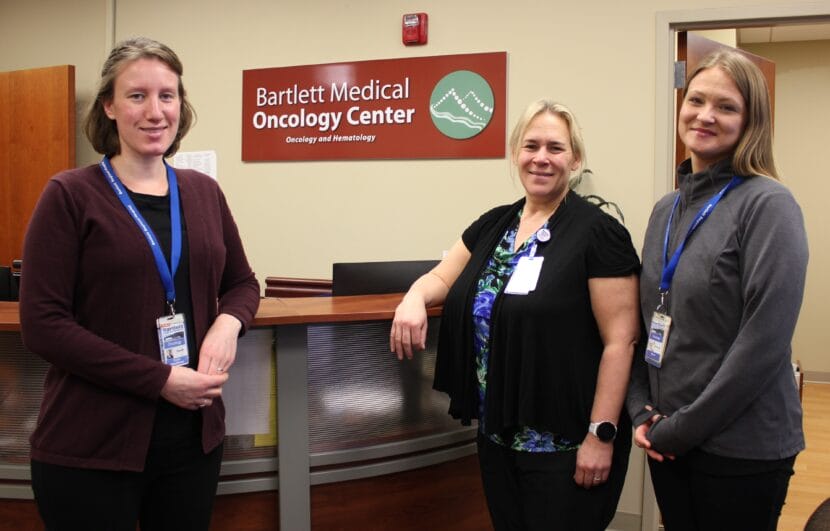
Nurse practitioner Sarah Lucas, gynecological oncologist Dr. Melissa Hardesty and registered nurse Marlowe Dunker stand in the lobby of Bartlett Regional Hospital’s oncology center. (Katie Anastas/KTOO)
When Suzanne Luken learned she had cancer, it came as a surprise.
“There was no pain. There was nothing at all — no indication,” she said. “I was tired, but I’m 77.”
Then, after other symptoms appeared, she went to the doctor.
“I thought I had a kidney infection because I started to pass blood,” she said. “So I went to the SEARHC walk-in over in Vintage Park, and they said, ‘No, that’s not what you think.'”
Instead, Luken was diagnosed with uterine cancer. Luken immediately thought of people she knew who’d had devastating experiences with cancer. And similar thoughts came up when she learned she would need to have a hysterectomy, a surgery to remove the uterus. She thought of family members who’d gone through the same procedure.
“I feel very fortunate that the terror I had seen with them did not overcome me,” she said.
Back then, hysterectomies required a large incision in the abdomen and several weeks of recovery. Today, they can usually be done with minimally invasive techniques, if a hospital has the right equipment and the right doctors. And now, Juneau’s Bartlett Regional Hospital does.
Doctors from Alaska Women’s Cancer Care are now flying down from Anchorage twice a month to meet with and operate on gynecologic cancer patients. Last month, Luken became their first surgery patient in Juneau.
Dr. Melissa Hardesty, a gynecological oncologist and one of the co-owners of Alaska Women’s Cancer Care, said Bartlett’s acquisition of the da Vinci Xi Surgical System made it possible.
“That was when we were in a position to really bring the same level of care here to town that we were providing in Anchorage,” she said.
Hardesty also operates on non-cancer patients whose surgeries might be more complicated than those typically done by an OB-GYN. She said the da Vinci Xi system allows for more precise movement for surgeons.
“The instrument has a wrist, and that allows us to do much more complicated motion,” she said. “Imagine the things you can do in life if you had wrist splints on both of your wrists or not.”
The Da Vinci Xi Robotic Surgery System unwraps a Starburst at Bartlett Regional Hospital in May 2023. (Clarise Larson for the Juneau Empire)
It also means smaller incisions — and an easier recovery — for many patients. That was the case for Luken.
“There’s four teensy-tinesy scars, that’s all,” Luken said. “It’s amazing. It truly is amazing.”
Hardesty and Dr. Joanie Hope usually travel to Juneau on Wednesday nights, see patients on Thursday and do surgeries on Friday. Hardesty said their consistent schedule means Juneau-based patients have more time to sit with the surgery recommendation and think about their options.
“In the Anchorage model, we really tried to have it be a turnaround. I’m going to see you, I’m going to operate on you the next day. That’s a lot for people,” Hardesty said. “If we’re here and it needs to be less hurried, it can be.”
Luken said, if she’d had to go to Anchorage, she might have put the surgery off.
“I think I would have been a lot more upset had I had to go to Anchorage, get a hotel, get a car, get somebody to stay with me, and then you’re there for a week,” she said. “How many people can afford to take a vacation, so to speak, with hotels and plane fare and everything else, to go for health reasons?”
Instead, after surgery, Luken got to go home and fall asleep in her own bed. She hopes other women will see how important — and now, how accessible — this kind of treatment can be.
“We now can go through a surgery that we need with no problems, and we can do it right here in our own home — well, hometown, I should say — and feel comfortable about it,” Luken said. “It’s not the big scary thing that it used to be.”
The Environmental Protection Agency announced new drinking water standards Wednesday to limit exposure to a class of chemicals called PFAS.
“There’s no doubt that these chemicals have been important for certain industries and consumer uses, but there’s also no doubt that many of these chemicals can be harmful to our health and our environment,” said EPA administrator Michael Regan in a call with reporters.
This is the first time the agency has set enforceable limits on PFAS in drinking water.
PFAS stands for perfluoroalkyl and polyfluoroalkyl substances – a large group of man-made chemicals that have been used since the 1940s to waterproof and stainproof products from clothing, makeup and furniture to firefighting foam and semiconductors.
Manufactured by several large companies including Dupont and 3M, PFAS have strong molecular bonds that don’t break down for a long time, which is why they’re known as “forever chemicals.”
PFAS from the 1940s “are still in our environment today,” says Anna Reade, lead scientist on PFAS for the Natural Resources Defense Council. “The levels of these chemicals keep building up in our water and our food and our air.”
Evidence for their harmful effects on human health have also accumulated. “Long term exposure to certain types of PFAS have been linked to serious illnesses, including cancer, liver damage and high cholesterol,” the EPA’s Regan said.
The EPA also noted PFAS exposure has been linked to immune and developmental damage to infants and children.
That’s why the EPA has finalized a rule restricting six PFAS chemicals in the water – individually, or in combination with each other or both – meaning water systems are required to monitor for these chemicals and remove them if they’re found above allowable levels. While some states have instituted their own PFAS limits, this is the first time it’s happening on the federal level.
Public water systems will have five years to address their PFAS problems – three years to sample their systems and establish the existing levels of PFAS, and an additional two years to install water treatment technologies if their levels are too high, senior government officials told reporters.
The EPA expects that excess PFAS levels will be found in around 6-10% of water systems, affecting some 100 million people in the U.S.
“This is historic and monumental,” says Emily Donovan, co-founder of Clean Cape Fear, an advocacy group working to protect communities from PFAS contamination. “I didn’t think [the EPA] would ever do it.” Donovan lives in an area of North Carolina which has been contaminated with PFAS from the Chemours chemical manufacturing plant.
She says seeing the EPA set limits is “validating.” Six years ago when her group first raised the issue of PFAS, she says they were told that the water met or exceeded state and federal guidelines. “And that’s because there weren’t any,” she says. “It really broke public trust for so many people in our community.”
“The final rule is a breakthrough for public health,” says Erik Olson, a senior director with NRDC. “We believe it’s going to save thousands of lives as a result of reduced exposure of tens of millions of people to these toxic chemicals in the tap water.”
There are more than 12,000 known PFAS chemicals. The six that the EPA is restricting “have had many animal and, in many cases, human studies, so [the EPA] feels confident that they have estimated the safe levels of these chemicals,” says Elizabeth Southerland, a former EPA official in the Office of Water, who left the agency in 2017.
Southerland says the new limits are a bold first step towards addressing the PFAS problem. And while the EPA has focused on only six chemicals, the treatments that water utilities use to remove these chemicals will also remove other chemicals of concern from drinking water.
In addition to other PFAS, “they will also be taking out all kinds of pesticides, pharmaceuticals and personal care products that are unregulated now under the Safe Drinking Water Act, but [which] we know have serious health effects,” Southerland says.
The agency estimates that it will cost $1.5 billion a year for water companies to comply with the regulation – for as long as PFAS continues to show up in the drinking water. “The costs are not just for a one time sampling and then putting in the treatment,” Southerland says. They include ongoing monitoring and maintaining equipment, for instance replacing carbon filters on a regular schedule.
The EPA says the benefits will equal, if not exceed the cost, in terms of less cancer, and fewer heart attacks, strokes and birth complications in the affected population.
The announcement comes with $1 billion in grants to help water systems and private well owners conduct initial testing and treatment. It’s part of a $9 billion funding package for PFAS removal in the Bipartisan Infrastructure Law. Companies that made these chemicals are also on the hook for more than $10 billion from a class action lawsuit – money which will go to public water systems to remove PFAS.
If water systems can’t access those funds, or if the funds run out, some of those costs may eventually get passed on to consumers, says the NRDC’s Olson.
Copyright 2024 NPR. To see more, visit https://www.npr.org.
Transcript :
STEVE INSKEEP, HOST:
For the first time, the Environmental Protection Agency is putting limits on chemicals called PFAS in drinking water.
MICHEL MARTIN, HOST:
They’re known as forever chemicals because of how long they last. They’re useful. They’re often used to waterproof and stain-proof products, but that comes at a cost to human health.
INSKEEP: NPR’s science correspondent Pien Huang is covering the story. Good morning.
PIEN HUANG, BYLINE: Good morning, Steve.
INSKEEP: OK. Why set limits on these chemicals now?
HUANG: The EPA is acting to end what has seemed like a forever debate over forever chemicals. Here’s EPA administrator Michael Regan.
(SOUNDBITE OF ARCHIVED RECORDING)
MICHAEL REGAN: There’s no doubt that these chemicals have been important for certain industries and consumer uses. But there’s also no doubt that many of these chemicals can be harmful to our health and our environment.
HUANG: Now, this follows what some states, including New Jersey and Washington, have already been doing, but it’s the first time that it’s happening on the federal level. The EPA is now putting limits on six of these chemicals in the drinking water, saying that every water system now needs to look for them. And if they’re found over a certain amount, they have to be taken out.
INSKEEP: What are these chemicals, and where do they come from?
HUANG: PFAS is a group of man-made chemicals – a rather large group that have now been around since the 1940s. They were manufactured by companies like DuPont and 3M, and they’re used to make things resistant to stains, to water and to grease – you know, everything from clothing, furniture to firefighting foam and electronics and semiconductors.
INSKEEP: Wait a minute. I’ve sometimes had pants – that the water rolls off the pants. They might have those chemicals in them. Is that right?
HUANG: Probably. Although there are a few brands now that have committed to not using PFAS in their clothing, but probably, Steve.
INSKEEP: What makes these so effective?
HUANG: Yeah. Well, the thing about them is that they have these really strong molecular bonds, which means that they really don’t break down for a long, long time. You know, PFAS from the 1940s – it’s still around today. And that’s where they get the name forever chemicals. But as they’ve accumulated, so has evidence for how they can harm human health. You know, there are now links between PFAS and certain cancers, liver damage, high cholesterol, immune problems. And now there are more than 12,000 PFAS chemicals out there. And the EPA is putting limits on six of them in the drinking water.
INSKEEP: When you say 12,000 chemicals and six of them are to be limited, that doesn’t sound like much.
HUANG: But experts like Elizabeth Southerland, who’s a former EPA official, says that it is a strong first step.
ELIZABETH SOUTHERLAND: The six that they have here have had many, many both animal and human studies in many cases so that they feel confident that they have estimated the safe level of these chemicals.
HUANG: The limits are set around four to 10 parts per trillion depending on the chemicals. And she also says that the filters or chemical treatments that water utilities are going to have to use to deal with these six chemicals are also going to remove a lot of other chemicals that people are concerned about.
INSKEEP: How much does it cost to install the better filters and take the other steps that water systems will need to take?
HUANG: Well, in total, the EPA estimates that this will cost around $1.5 billion a year for water companies to comply. And, Steve, that’s $1.5 billion every year until these chemicals stop showing up in the drinking water. The EPA does say that the benefits will exceed that cost. They say about a hundred million people are affected. And in that population, there will be less cancer, fewer heart attacks and fewer birth complications.
INSKEEP: Does my water bill go up?
HUANG: Well, maybe eventually, but there is funding that the government intends as a first resort. So the Bipartisan Infrastructure Law includes billions of dollars for PFAS removal. And companies that made these chemicals are also on the hook for more than $10 billion from a class-action lawsuit. But if water systems can’t access those funds or if those funds run out, then some of those costs might eventually get passed on to consumers.
INSKEEP: NPR’s Pien Huang. Thanks so much.
HUANG: You’re welcome. Transcript provided by NPR, Copyright NPR.
Close
Update notification options
Subscribe to notifications
Subscribe
Get notifications about news related to the topics you care about. You can unsubscribe anytime.


9(MDEwMjQ0ODM1MDEzNDk4MTEzNjU3NTRhYg004))


9(MDEwMjQ0ODM1MDEzNDk4MTEzNjU3NTRhYg004))