The Obama Administration has decided not to go after states with marijuana-friendly laws.
The Department of Justice announced Thursday that it won’t sue states like Alaska that allow medical marijuana. Not only that, it won’t sue Colorado or Washington for legalizing recreational use of the drug, something that Alaska might do next year.
That’s welcome news to Tim Hinterberger, who is sponsoring the ballot initiative to regulate marijuana like alcohol.
“I think it’s something that will reduce one of the arguments against an initiative like ours. People have said, well, it doesn’t matter what we do to change state law because the federal law would still supersede it. If they’re thinking of how they’re going to implement federal law differently, that will make a difference to us.”
Even though the Justice Department says it won’t stop legalization efforts, it still plans on monitoring states to make sure they’re staying in line with the administration’s enforcement priorities. While it will defer to states on things like sale and possession of the drugs, it wants federal prosecutors to target distribution to minors, cartel activity, drug-related violence, and underground trafficking. Hinterberger thinks the initiative language complies with those objectives.
“The point is if our initiative succeeds and is put into law, then that will eliminate underground trafficking because there will be no reason for it.”
Right now, the marijuana initiative is still in the signature gathering stage. The group behind it has collected over 15,000 names since their application was certified in June. While they have a full year to break the 30,000-mark, Hinterberger says they actually want to collect 45,000 signatures by December 1. That would give them a buffer against disqualified names and more time to focus on campaigning.
If the initiative meets all of the legal requirements, it will appear on the primary ballot next August.
A regional community health center that provides mental health services in Fairbanks says it will file for bankruptcy.
The Fairbanks Daily News Miner reports the board of the Fairbanks Community Behavioral Health Center voted unanimously Tuesday to pursue bankruptcy protection.
The center has about 60 employees but has been struggling to make its payroll.
An audit indicated the center has money to continue operating for only another three weeks.
Board President Barbara Burch says the board became aware of financial problems in May. She says heavy debt and two major medical claims affected finances and a backlog of Medicaid reimbursements affected cash flow.
The center will continue services to clients during the bankruptcy process.
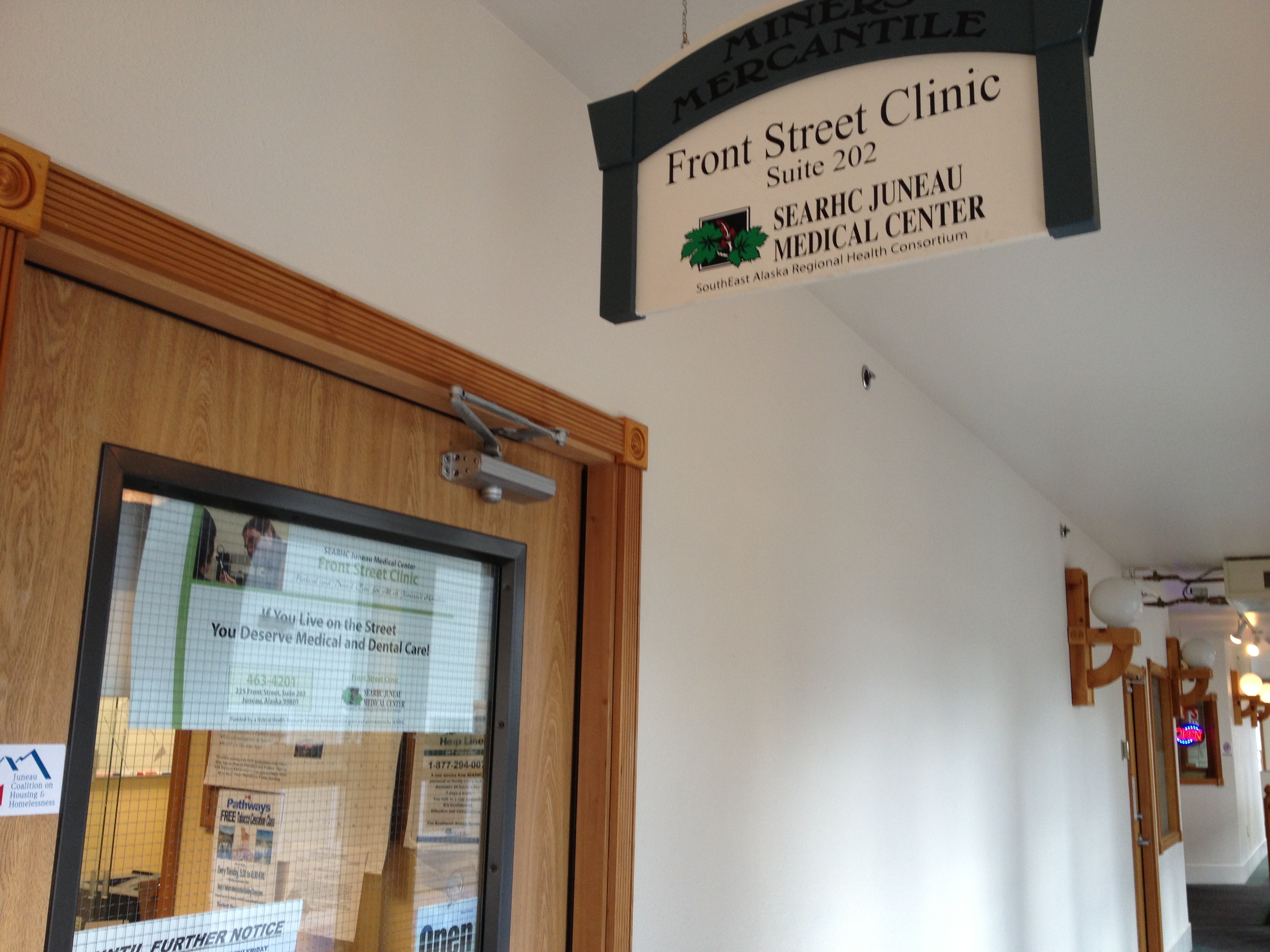
Front Street Clinic is upstairs in the Miners’ Mercantile building. It’s open Monday through Friday, 8 am to 5 pm. (Photo by Lisa Phu/KTOO)
The Southeast Alaska Regional Health Consortium plans to close Front Street Clinic on October 1, according to SEARHC COO Dan Neumeister. The decision by the board of directors comes after two days of meetings last week.
Neumeister says deciding to close the clinic geared for homeless and low-income patients was difficult. He cites budgetary constraints, including sequestration.
“I think we have reached a point where we need to make that transition. I believe that for 10 years, SEARHC has done a wonderful service for the community, but we need to find an alternative.”
According to Neumeister, Front Street Clinic costs about $600,000 a year to operate. $160,000 of that comes from a U.S. Health Resources and Services Administration grant. The remaining more than $400,000, he says, comes from SEARHC. Neumeister says SEARHC makes that money through billings at its facilities.
The HRSA grant went into effect May 1 and is good for one year. Neumeister does not know how much, if any, of the $160,000 remains, but says he is working with the federal agency on how leftover funds can be re-designated.
Neumeister plans to hold a meeting in Juneau Tuesday to facilitate discussions on how the clinic can stay open. Neumeister did not identify who would be at the meeting but the city and borough of Juneau and the Juneau Coalition on Housing and Homelessness confirm they will have representatives present.
Dan Austin with the Coalition is optimistic that the community will find a solution.
“The big issue is going to be, in the event that the HRSA grant cannot keep the doors open at Front Street Clinic, where can we go to find some additional resources? That’s a big challenge in this time, but this is a community that can step up to the plate and do that.”
Neumeister says SEARHC remains committed to taking care of Alaska Native homeless. The responsibility of the general public, says Neumeister, needs to go back to the general public. He says Juneau has other organizations responsible for the homeless.
Neumeister also plans on meeting with Front Street Clinic staff today.
For many homeless people, Front Street Clinic is the most visible form of help. It connects them to other health and social services. (Photo by Lisa Phu/KTOO)
Representative Cathy Munoz is hopeful Front Street Clinic will stay open even if the Southeast Alaska Regional Health Consortium decides to stop operating and funding it.
On Tuesday, the representative held a meeting in her office. Present were SEARHC CEO Charles Clement, Representative Beth Kerttula, Coalition on Housing and Homelessness Joanne Witta, and a representative from Senator Dennis Egan’s office.
“We were encouraged by Mr. Clement’s candor and his concern and his willingness to work with members of the homeless coalition and supporters of the Front Street Clinic on a transition plan.”
Munoz says this involves Front Street Clinic becoming its own non-profit organization or finding an umbrella organization to take it over.
“The issue really is a financial question. The grant that goes directly to Front Street Clinic is $145,000 but the total operation expense for the clinic is about $600,000 so SEARHC is in essence subsidizing the amount over $145,000.”
SEARHC COO Dan Neumeister says funding for the clinic comes from multiple sources. SEARHC is one of the main funders, U.S. Health Resources and Services Administration is another. Money from HRSA is specifically for homeless clinics.
SEARHC Board of Directors is currently meeting in Juneau. Starting yesterday and continuing into today, Neumeister says the body is discussing the organization’s entire work plan for the coming year, including Front Street Clinic.
Clinic manager and medical provider Janna Brewster says she’s nervous about what the board of directors will decide, and she’s not the only one.
“The patients are absolutely freaked out. They are scared. They’re very worried – ‘What’s going to happen to me? What’s going to happen to us?’ ‘Cause they really don’t know what their fate will be. Just everyone is on pins and needles about this.”
Brewster is also hopeful.
“It’s just a waiting game. We’re hoping that they’ll do what we would like them to do and that’s to give us time, at least. We won’t know until after the board meeting is over.”
SEARHC COO Neumeister anticipates a final decision on Front Street Clinic when the board meeting ends today.
Bartlett Regional Hospital Board of Directors has ended their ongoing personnel investigation. (Photo by Lisa Phu/KTOO)
Bartlett Regional Hospital’s CEO has been directed to take steps to address complaints made against the hospital’s senior management.
The hospital board of directors said in a statement released Wednesday, there must be better communication from CEO Chris Harff of its vision throughout the organization.
Allegations of a hostile work environment came forward last spring. The city hired Deborah Schorr of Schorr Advocacy & Investigative Service in early June to conduct an investigation. Both the CBJ assembly and Bartlett’s board of directors have held a number of closed door meetings in the past month to hear reports and discuss the investigation.
Bartlett’s community relations director Jim Strader says Harff’s plan has not been finalized yet.
“She still working with the board on working that out. They involve things like better communications, channels, making sure that that everyone is aware of decisions that are being made at the board level. There’s room to improve how we transmit a lot of that information to the staff at large.”
The board’s statement also discusses a plan to reduce 15 positions over the next year. Strader says that will not involve layoffs.
“Rather than creating the impression that certain positions are being targeted, the reduction in staff will now be focused on retirements and attrition, normal people leaving for different jobs.”
Strader says the hospital has been looking for ways to combine duties and jobs.
“For example, right now, our emergency room director is now handling cardio pulmonary rehabilitation, physical rehabilitation, as well as emergency department, so that’s three departments under one person. ”
Strader says a 15-position reduction has not been part of hospital budgets in recent years. He did not know how many positions have been eliminated since July 1.
“This is largely a budgetary concern based on our increased cost, our flat patient volumes, competition that we’re facing. This is what hospitals all over the country are going through. We’re trying to provide the best care we can as affordably and sustainably as possible.”
The statement released yesterday also said the hospital will remain a CBJ-owned and operated hospital. This was in response to rumors of a possible hospital sale.
This spring, state legislators considered a controversial bill that would define what counts as a “medically necessary” abortion for the purpose of Medicaid reimbursement. Now, the Alaska Department of Health and Social Services is considering regulations tackling the same issue. That proposed rule would require doctors to get specific on why they think the state state should cover the procedure.
Commissioner Bill Streur (DHSS)
Abortion policy in Alaska is a war of inches. Because of a privacy clause in the state constitution, most of the fights don’t involve prohibitions of the procedure. They play out at the margins. And the question of whether the state should cover abortions for low-income women for medical reasons is one of the most contentious fights.
The latest battle comes in the form of physician paperwork. The Department of Health and Social Services wants doctors to fill out a sheet checking off why an abortion should be reimbursed. Commissioner Bill Streur says the point is to make doctors reflect on whether an abortion is medically necessary or elective. He wants the state reduce the number of payments for abortions he thinks are in the second category.
“We hope so. We don’t know, because I thought the last one would have helped, but it didn’t help. In fact, our numbers seem to be up this year from previous years.”
When Streur says the “last one,” he’s referring to a form that doctors have been filling out for a year now. That form puts abortions in two categories: ones the federal government pays for because the pregnancy could kill the woman or because it’s the result of rape or incest, and ones that the state pays for because they could have a dangerous effect on a woman’s physical or mental health.
The new form gets even more detailed. It would make doctors check off a specific medical condition — like epilepsy or heart disease — as a reason for getting a reimbursement. While opponents of the new regulations have privacy concerns, Streur says he doesn’t see an issue with patient confidentiality.
“For instance, if a recipient has diabetes or if a recipient has a heart condition, if they have other issues — a cancer– if they’re on special medications that preclude or make it dangerous to continue with a pregnancy, we already have that information because we’ve been paying for their care.”
Planned Parenthood has already come out against the regulations, saying that if the goal is to limit state payment for abortion the Department is putting a de facto restriction on access for low income women. They also say the proposed rule could violate the equal protection clause by placing different requirements on women who get abortions instead of taking their pregnancies to term.
Other providers describe the regulations as a form of bullying, meant to discourage doctors from getting Medicaid reimbursement by making them feel like the state is scrutinizing them more intently. One physician, who didn’t want his name used, says he personally thinks the regulations are intimidating:
“This actually happened to me about 15 years ago. But if someone from the enforcement branch basically said, ‘I don’t think you’re exercising due clinical oversight, and you’re essentially billing the state for things they shouldn’t be paying for, and you’re breaking the law.’ So from that practical point, that’s chilling to me.”
This provider added that he sees the regulations as intruding on the doctor-patient relationship.
For his part, Commissioner Streur says he doesn’t think the new form would be much more burdensome than the previous one, and that it would give the state a better data set to work with when trying to curb the number of abortion payments.
But Streur says the proposed regulations have stirred up some controversy. Since the rules were first introduced on Friday, he’s gotten a mixed response. The e-mails have broken down along political lines, with opponents of abortion being especially supportive:
“[They’ve been] very nice, very complimentary because of the direction that we’re going in terms of right to life … and not very nice from those I’m denying care,” says Streur. “I’m not denying care. I’m denying reimbursement for the services performed that are not medically necessary. That’s the only thing we’re doing. We are not denying care. We can’t deny care.”
The Department is taking public comment on the proposed regulations until September 27.
Close
Update notification options
Subscribe to notifications
Subscribe
Get notifications about news related to the topics you care about. You can unsubscribe anytime.