Juneau’s Head Start program will be delayed 20 days this fall, due to federal budget cuts.
The so-called sequestration that went into effect last spring is affecting Head Start throughout the state.
Tlingit & Haida operates the pre-school programs in Juneau. The budget is taking about a 5 percent hit.
Instead of early September, classes will now begin September 23rd.
Kids Corp Alaska Director Dirk Shumaker said the cut to Head Start programs in Alaska is $1.5 million dollars.
“There are 15 Head Start grantees in Alaska, nine of those also provide early Head Start services in 100 communities in the state,” he said. “And all of those programs will be affected by sequestration in all those communities in one way or another.”
In a news release, Tlingit and Haida says the impact on families of children in Head Start will be great, including access to health, dental and developmental screenings usually provided.
Due to the budget cuts, Head Start employees also will go back to work three weeks late.
This is a developing story. Please check back for updates.
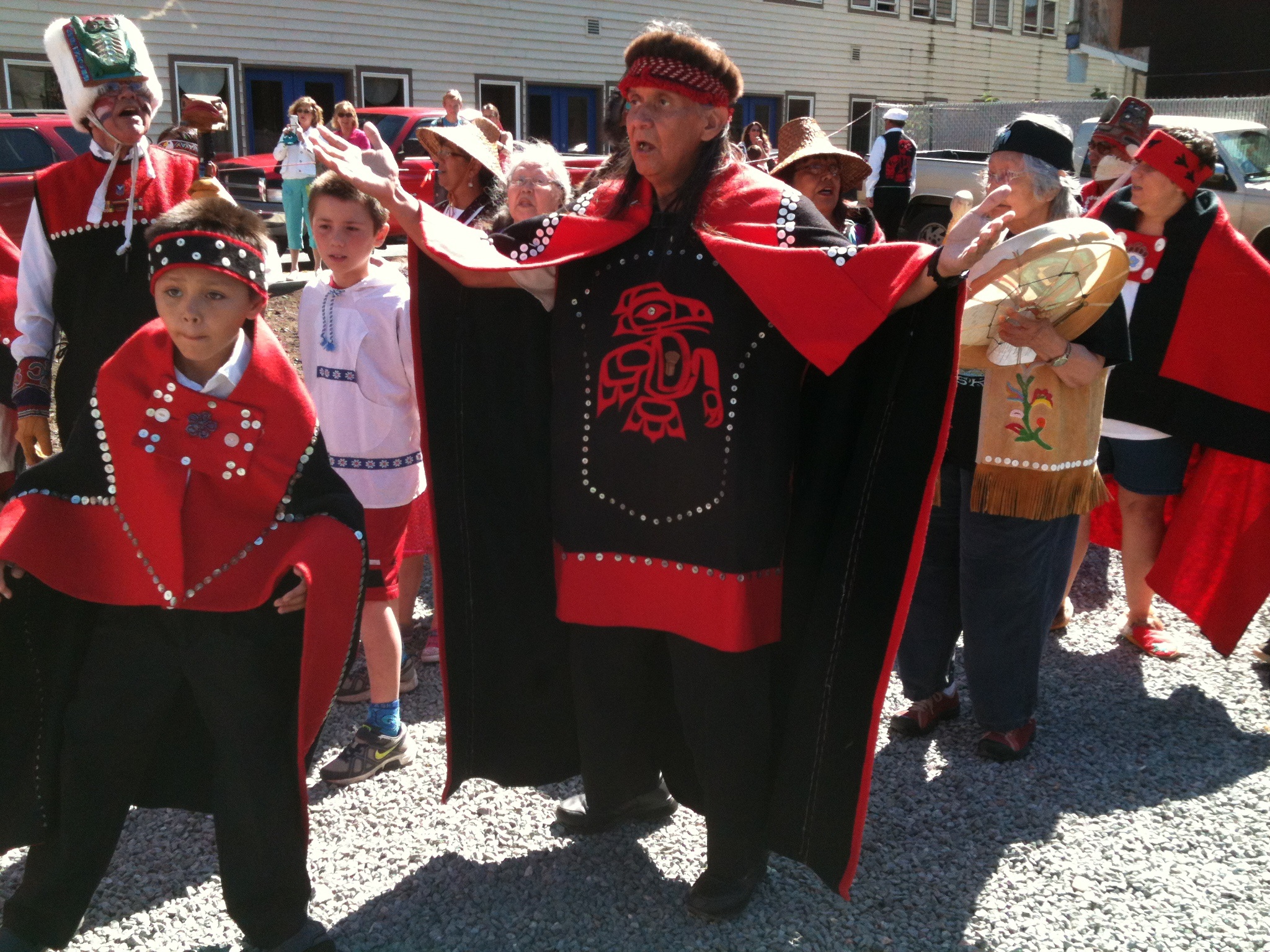
Members of the Yees Ku Oo dance group perform before and during the groundbreaking for the Walter Soboleff Center at Seward and Front Streets in downtown Juneau. Photo by Matt Miller/KTOO News
Local, state, and Native officials, and Native elders donned hard hats and picked up shovels on Thursday afternoon to break ground on a new cultural center planned for downtown Juneau.
Former Juneau mayor and former Sealaska corporation chairman and CEO Byron Mallot heads up the group raising funds for the center’s construction.
This is what ANCSA is all about. To create another giant step in Alaska’s Native peoples contributing their strength and their essence, their beauty, their values, their traditions, and their heritage to all Alaska and even to the nation.”
First Lady Sandy Parnell spoke on behalf of Governor Sean Parnell who attended the event, but who could not speak because of laryngitis.
“Like Dr. Soboleff himself, let this center stand for peace and understanding, for mutual respect and honor, for working together to lift all people up. That, by lifting people up, it will communicate to the world the values of Alaska and the values of Dr. Soboleff.”
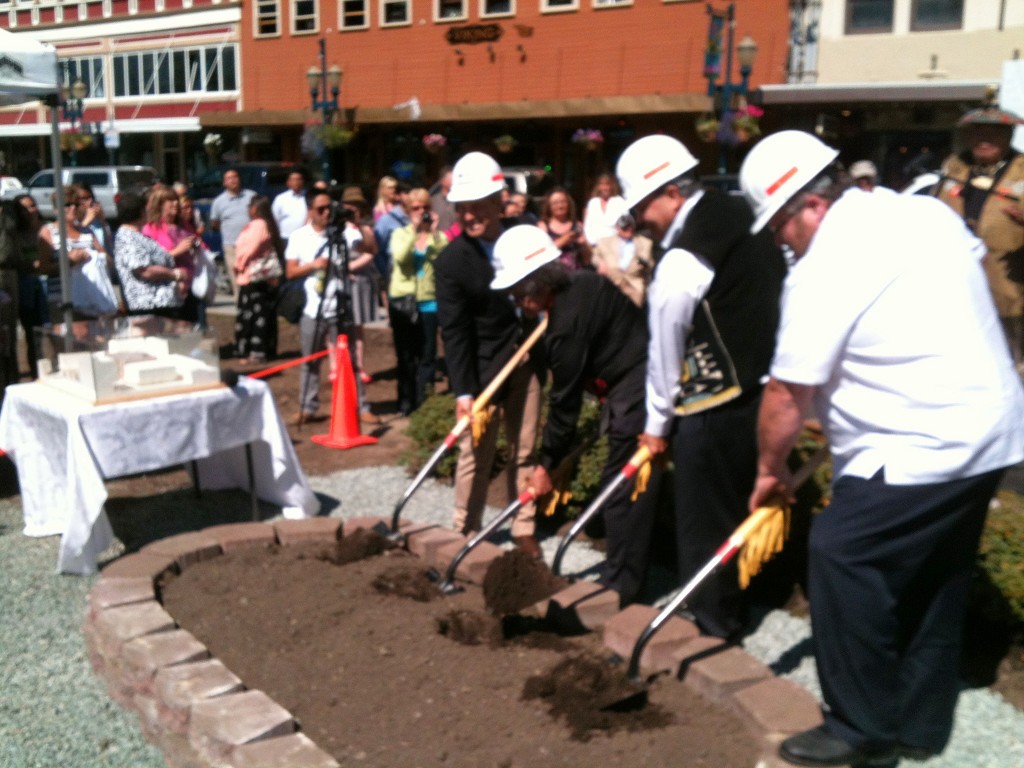
Governor Sean Parnell (from left), Sealaska Heritage Institute Trustee Chair Marlene Johnson, Sealaska CEO/President Chris McNeil, and Juneau Mayor Merrill Sanford break ground for the new Walter Soboleff Center in downtown Juneau. An architectural model of the center sits on a table at the far left. Photo by Matt Miller/KTOO News
Dr. Soboleff’s sons Ross, Walter Jr., and Sasha also participated in Thursday’s groundbreaking.
And for those things which we hold dear in our hearts, it is so grateful to have this unfold before us in the name of our dad, Dr. Walter Soboleff.”
Selina Everson, past Grand Camp president, represented the Alaska Native Sisterhood:
We have progressed from our Tlingit box of culture to a building that will carry on Dr. Walter Soboleff’s legacy. We have come a long way. We have a long way to go.”
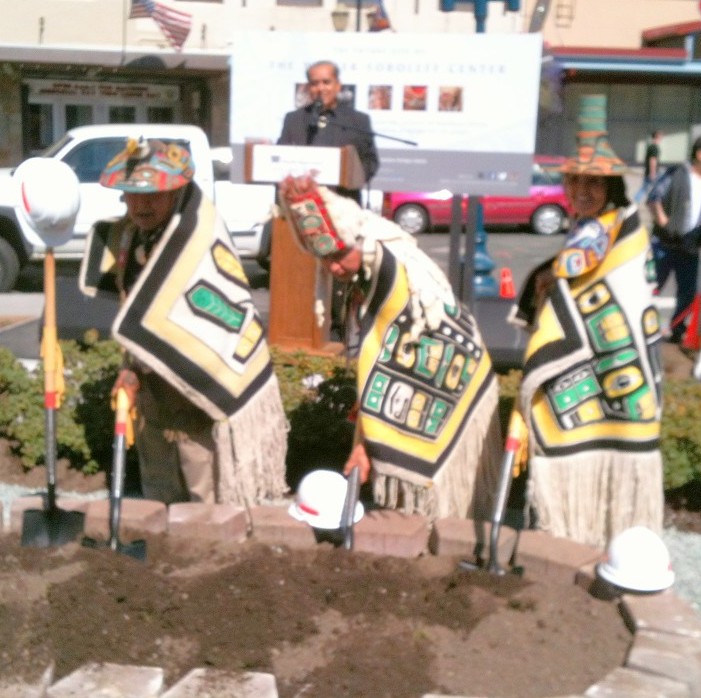
Everybody gets their digs in. Eagle Clan Leader David Katzeek (from left), Paul Marks of the Raven Clan, and Rosita Worl of the Sealaska Heritage Institute participate in the groundbreaking with their own form of Tlingit hard hats as Sealaska Chairman Albert Kookesh watches in the background. Photo by Matt Miller/KTOO News
Other speakers included Albert Kookesh, Chairman of the Sealaska Board of Directors; Chris McNeil, Sealaska CEO and President; Juneau Mayor Merrill Sanford, Juneau Representative Cathy Munoz; Ed Thomas, President of the Central Council of Tlingit and Haida Indian Tribes of Alaska; Eagle Clan Leader David Katzeek, and Paul Marks who provided the Raven response. A letter from Juneau Representative Beth Kerttula and Juneau Senator Dennis Egan, who could not attend the groundbreaking, was read during the ceremony. The Yees Ku Oo dance group performed before and during the event.
Sealaska Heritage Insititute officials say they have raised about 75-percent of the funds needed for the $20 million project. Some of that money included state and CBJ appropriations, or grants from the Alaska Native Education Program or the Cruise Industry Charitable Foundation.
Completion is expected for the end of 2014.
The center’s proposed site, previously known as “The Pit” or the “Hole in the Ground,” was turned into a temporary park after Sealaska corporation acquired the vacant lot and donated it to the Sealaska Heritage Institute. The space used to be site of the Endicott Building or the Skinner Building which burned down almost exactly nine years ago.
The Reverend Doctor Walter Soboleff was a Presbyterian minister, and spiritual and cultural standard bearer of the Tlingit people. He passed away two years ago at the age of 102.
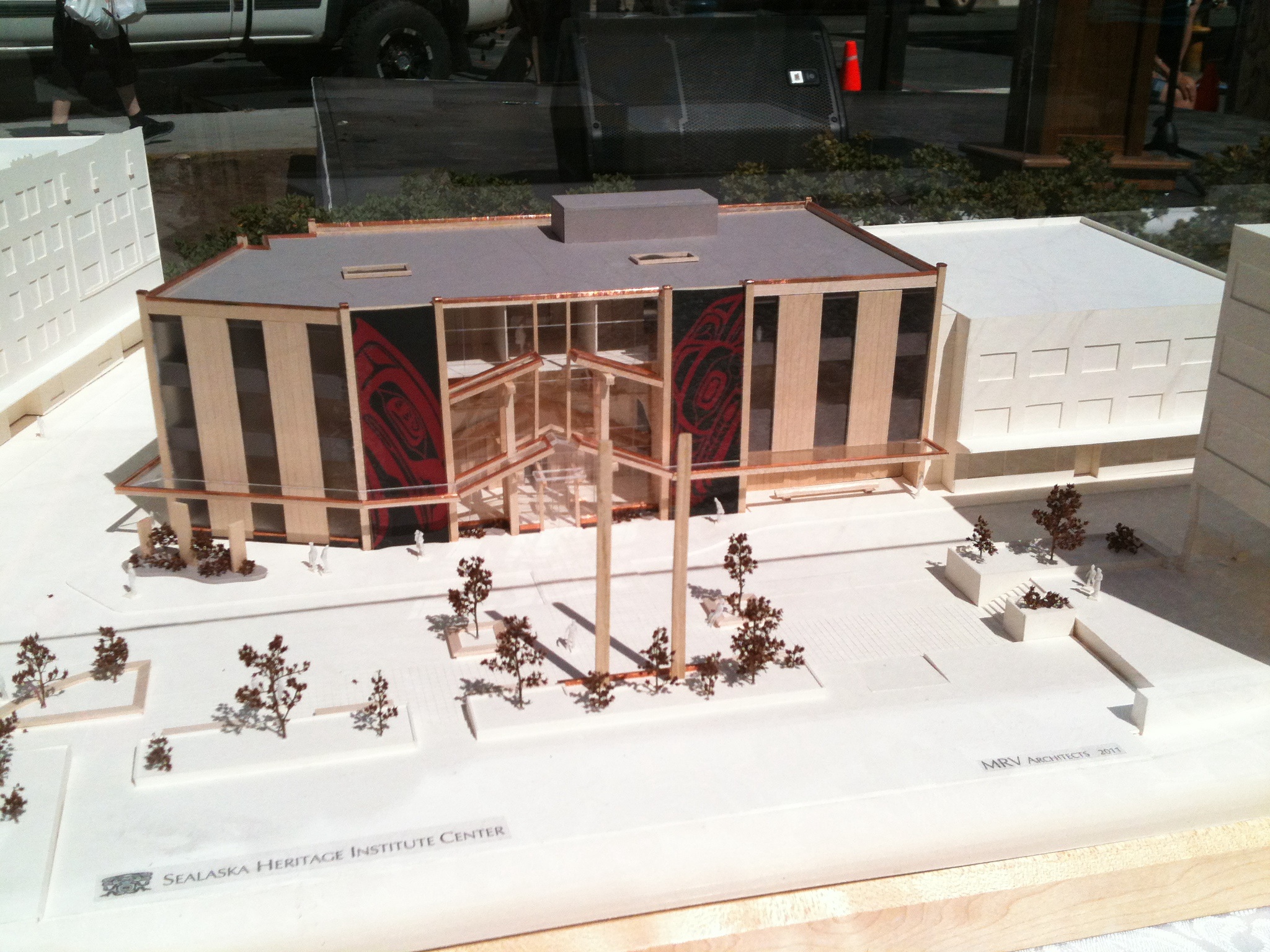
Architectural scale model of the proposed Walter Soboleff Center was on display at Thursday’s groundbreaking ceremony. Photo by Matt Miller/KTOO News
Now the corporation says it will re-evaluate the policy.
“Who says you can’t fight city hall?” asks Ron Dean. He believes his petition helped agency managers change their minds on the proposed ban.
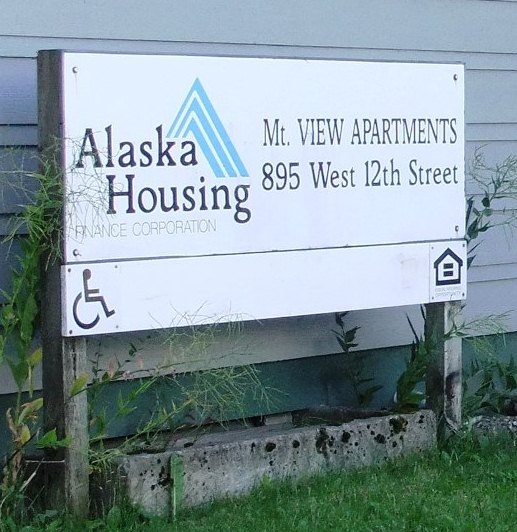
Dean and and Juneau Mountain View Apartment resident Catherine Ryan took their fight to the AHFC Board of Directors, corporation managers, a few legislators and the governor.
For now, they’ve won.
They say they will never quit smoking. Ryan helped Dean gather signatures for his petition; about half of Mountain View residents signed, including a lot of non-smokers.
Residents in Fairbanks senior housing also sent a petition to AHFC during its public comment period on the policy.
“You know it was almost a 50 / 50 split between positive and negative,” says AHFC Public Housing Division Director Catherine Stone. She was expecting public comments to track a statewide 2010 survey that showed most residents in senior and disabled facilities wanted a smoke-free policy.
“So I think it bears a little bit more thought, a little bit more analysis and a little bit more preparation before we go at it again,” she says.
Common areas in AHFC facilities have been non-smoking for years. But the proposed policy said residents would not be allowed to smoke in their own homes.
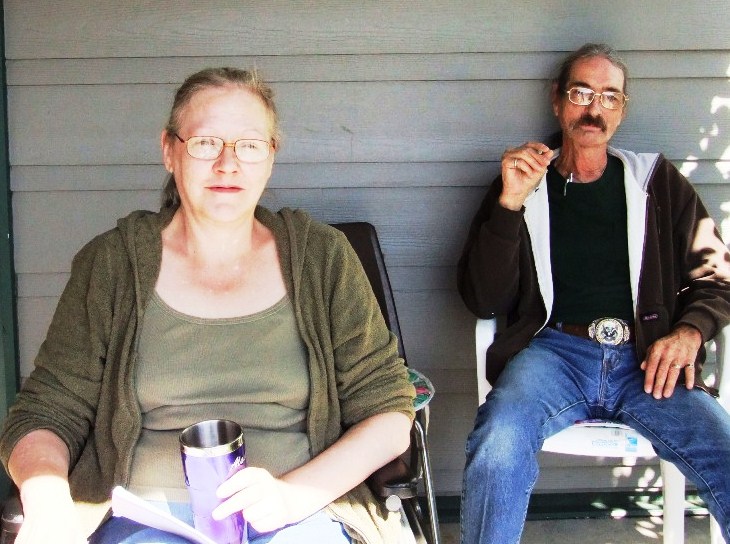
Catherine Ryan and Ron Dean enjoy a smoke outside AHFC’s Mountain View Senior Center in Juneau. A plan to ban smoking in residents’ apartments was to take effect in August. It has been postponed.
When AHFC Operations Director Michael Courtney came to Mountain View last week, Ryan and Dean — Ryan in her wheelchair – were smoking outside the back door.
Courtney says his visit was to “walk the area and chat with residents.”
It was raining so Ryan and Dean were under cover, close to the rear entrance. The cigarette butt receptacle was at least 10 feet away, in the rain.
Dean likes to think that scene may have helped the smokers’ cause.
“A picture is worth a thousand words,” he says.
Maybe, says Courtney.
“Well, honestly their comments do have something to do with it and the petition has something to do with it.” But Courtney says managers and the AHFC Board have been debating the policy for a while, and realize now is not the time to implement.
It will be his job to work with local property managers on a place outside where residents can smoke and still be protected from bad weather, for example, Juneau’s Taku winds or a downpour.
“So we’ve got to have some discussions on what exactly we should do to keep it safe and at the same time not enclose the smoke so it’s going to get into the front of the building,” Courtney says.
That’s one of the reasons Mountain View resident John Monroe signed the petition two months ago. He doesn’t smoke and feared this scenario:
“You come in through that bay, there’s 10 people out there smokin’. We’ve got to walk through them,” he says, pointing to the front entrance.
For now, residents in AHFC senior housing across the state will still be able to smoke at home.
Housing Division Director Stone says the agency will take the next few months to set up outdoor smoking areas and provide smokers with some help on quitting.
“You know we can have tobacco-free people come and hold classes, or we can provide patches or whatever resources they need and readdress this in the spring,” she says.
Ryan says it’s not tobacco that will kill her. She has multiple sclerosis and bone disease.
She’s already digging in her heels for the next time the smoking ban comes around.
“It’s the only vice I got left and I’m enjoying it tremendously,” she says.
Stone expects AHFC will conduct another survey before rewriting the no-smoking policy.
The Juneau Pioneer Home offers some assisted living space, but the waiting list is long.
The CEO of a large non-profit organization that operates senior housing across the country is looking at Juneau as a possible site for an assisted living center.
Retirement Housing Foundation offers services for older adults, people with disabilities and low-income families in 170 communities, but none in Alaska. A Juneau group developing an assisted living center proposal contacted RHF.
Sioux Douglas of Juneau Community Foundation is hopeful the company could become part of a public / private partnership for a facility.
“We don’t know a lot yet about their expectations and the various ways they have invested in communities across the nation. That’s part of the reason for the site visit, and to enlighten them on the things that could be possible here and the challenges,” she said. “It’s more expensive to operate here. It’s more expensive to build here. That’s why I’m so hopeful that we can find donated land.”
Douglas outlined the effort for an assisted living home Thursday to the Juneau Chamber of Commerce.
The Community Foundation, Juneau Commission on Aging, Juneau Economic Development Corporation and Senior Citizens Support Services are spearheading the quest.
A kick-off meeting last month brought out more than 120 people and about half said they would be interested in serving on a senior-housing task force.
That list is being whittled down. Douglas said the first job of the task force will be to identify land for a facility.
“You know my dream would be that we would have that figured out by the time our first visitor comes up to check Juneau out. I doubt if we can move that quickly, but if anybody is listening and wants to contact me with a few acres of land we’ll be happy to talk,” she said, with a chuckle.
Douglas has been talking to the city and borough, private land trusts and others who could offer a site.
An assisted living facility was the top concern identified by senior citizens responding to a 2010 Juneau Commission on Aging Survey. Such facilities are an intermediate level of care for people who need help with medications, meals, housekeeping, and other daily routines, but not nursing care.
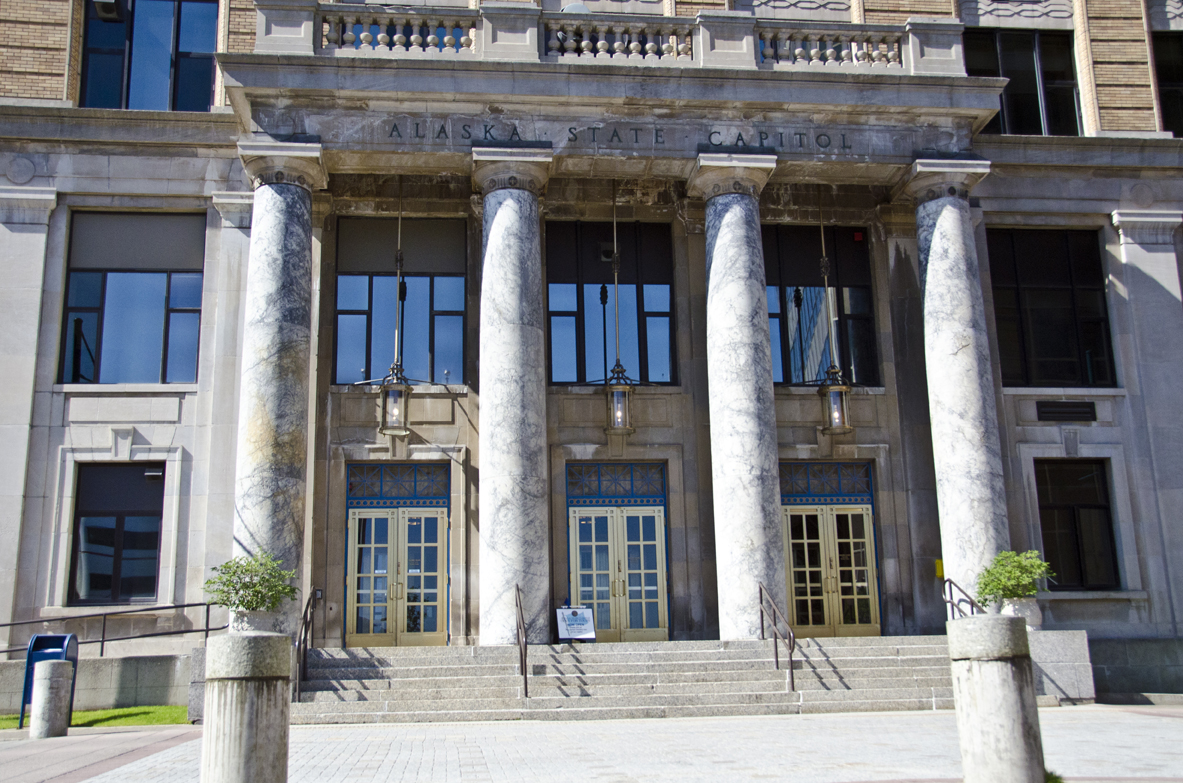
Alaska Capital Building. (Photo by Heather Bryant/KTOO)
The state is keeping a tight lid on a study it commissioned last year on expanding Medicaid under the Affordable Care Act. The expansion would provide health care coverage to about 40,000 low income Alaskans. The federal government would pay most of the bill. Governor Sean Parnell has decided not to expand Medicaid, for now. The study it won’t release is meant to inform the Governor on whether to reconsider that position.
The Medicaid expansion study was supposed to be complete last December. In May, APRN filed a Freedom of Information Act request for the study. The state denied it.
Matt Buettgens is a senior research associate at the nonpartisan Urban Institute. He says it’s unusual for a state to be unwilling to share the Medicaid expansion study with the public.
“Certainly most states have commissioned such analyses and the vast majority of them have released them publicly,” Buettgens said.
The decision on whether to expand Medicaid is a huge one, with implications far beyond low income Alaskans. It would flood hospitals and providers with new revenue. Combined with other Affordable Care Act provisions, it would cut the number of Alaskans who are uninsured in half. And the expansion would pump hundreds of millions of federal dollars into the state. That’s according to a study Buettgens wrote on the Medicaid expansion that was commissioned by the Alaska Native Tribal Health Consortium. He says over the first five years of the expansion, a small amount of state spending would yield a lot of federal dollars.
“There would be about $78 million more state spending on Medicaid in Alaska and that would actually draw $1.1 billion additional federal spending. So the state would only be paying a small fraction of the total spending on Medicaid,” he said.
Buettgens says much of that state spending would be offset by savings to the state because some low income programs it currently administers would no longer be necessary.
The state won’t say if its own study agrees with the Urban Institute’s overall assessment.
Josh Applebee is the state’s deputy director for health care policy. He’s spending the majority of his work days reviewing the Medicaid expansion study and preparing a recommendation for Governor Sean Parnell. He says the study will be released when he finalizes that recommendation, in a few months. In the meantime, he says the decision making process would be compromised if the state released the study.
“When you get into different policy alternatives, you end up creating a chilling effect on candid policy debates that happen within governmental organizations,” Applebee said.
The study itself doesn’t contain any policy alternatives, only basic information on how the Medicaid expansion is likely to impact Alaska. But Applebee maintains it needs to stay private. He says the Governor’s decision may seem like an easy one, because of the huge amount of federal dollars involved, but it’s not.
“This is a decision that he wants to get right,” Applebee said. ”So it’s being as thorough as we can with the data that we have, the reports that we have, the discussions we’re having among the divisions to get this decision right.”
“And to make our recommendation is the best possible one for the Governor.”
State Representative Andy Josephson, a Democrat from Anchorage, tried to rally support for the Medicaid expansion during this year’s legislative session. He didn’t find many lawmakers who were similarly passionate about the issue. Now he’s suggesting the Parnell administration could have something to hide.
“That undermines the democratic process and makes one wonder, what is it that the administration fears? What is it from the report that the administration is afraid to share with us?,” Josephson said.
Josephson introduced a resolution urging the Governor to expand Medicaid that got no traction in the legislature. He says with so much at stake, he wants to put pressure on Parnell to make the right decision. Governor Parnell has said his next “decision point” on Medicaid, as he puts it, will be when he sends his budget to the state legislature, which is required by December 15th.
This story is part of a reporting partnership between APRN, NPR and Kaiser Health News.
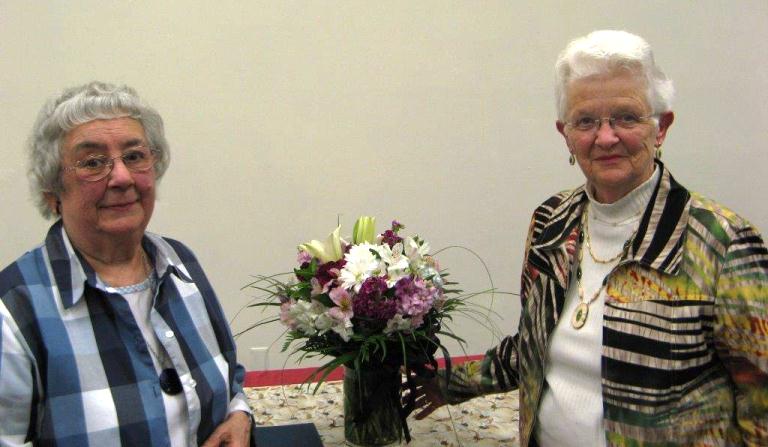
Marie Darlin (left) was honored by the CBJ Assembly for her many years of volunteer service in Juneau. AARP’s Liz Lucas (right) also presented flowers to Darlin. Photo courtesy Liz Lucas.
Juneau’s Marie Darlin is 88 and still advocating for causes she’s worked on for years – including services for senior citizens.
Darlin was honored Wednesday night by the CBJ Assembly at a meeting she helped organize to discuss an assisted living facility for the capital city.
She also was surprised at the recognition. Mayor Merrill Sanford delivered the proclamation, which aptly describes her energy and passion for volunteering. Sanford said Darlin’s “volunteering in organizations that make Juneau and the entire state of Alaska better places to live make her an exemplary model for all citizens to follow.”
Darlin belongs to the fastest growing segment of Alaska’s population – senior citizens.
She’s well beyond the baby boomer group. The first of that generation started turning 65 in 2011.
“A lot of them moved up to Alaska, which means that Alaska actually has the fastest growing senior population of any state,” says MaryAnn VandeCastle, chairman of the Juneau Commission on Aging. Darlin is one of its most active members.
The Commission on Aging has joined with Juneau Community Foundation, Juneau Economic Development Corporation and Senior Citizens Support Services to come up with a plan for an assisted living center.
The idea has been discussed for years and nothing has happened. But 110 people attended Wednesday’s meeting, including officials from state of Alaska senior programs, legislators and Assembly members, folks over and under 65, and adults concerned about caring for aging family members. Organizer Sioux Douglas says it’s a good cross-section of Juneau for a topic that needs community balance.
About 45 people signed up to serve on a task force. Douglas says they will be contacted to reaffirm their interest.
The city has little support for elderly people who need special services, but not full-time care.
Alaska Pioneer Homes, including Juneau’s, offer assisted living, but the waiting lists are long. Wildflower Court near Bartlett Regional Hospital is 24-hour nursing care. Independent senior housing is offered at Fireweed Place and Mountain View Apartments downtown, and Smith Hall in the Mendenhall Valley.
Assisted living facilities are an intermediate level of care for seniors who need help with medications, meals, housekeeping, bathing or dressing, exercise and other daily routines, but not nursing care.
Douglas says the task force should be comprised of people who are strong community stakeholders, including developers, builders, philanthropists, businesses, and citizens who anticipate the need for assisted living for themselves or family members:
“So we want a really good cross-section of folks willing to stick with this project until its completion. And we know it’s in the community. We have a wonderful, generous, talented and smart community. There’s no reason why we can’t do this. It’s just a matter of pulling the right resources and people together to make it happen.”
Douglas says the best option could be a collaboration with an organization that operates assisted living facilities elsewhere. She hopes an assisted living center is reality in Juneau within a couple of years.
Close
Update notification options
Subscribe to notifications
Subscribe
Get notifications about news related to the topics you care about. You can unsubscribe anytime.

 Juneau’s Head Start program will be delayed 20 days this fall, due to federal budget cuts.