School begins Tuesday in Juneau, so watch out for kids on bicycles — and Juneau’s police chief.
He’ll be riding his bicycle this week throughout Juneau to raise awareness of bicyclists.
Since June 1st, the Juneau Police Department has had five reports of vehicle and bike collisions. The problem seems to be drivers who fail to give bicycle riders the right of way.
Chief Bryce Johnson wants to encourage drivers to watch out for bicyclists on the road. He’s participating in a contest called “Spot the Chief for a Ten Spot.”
He may be easy to see in a spotted shirt and helmet. The first ten callers to JPD will get a 10-dollar bill, but you need to call within two hours of seeing him on his bicycle and also when you’re not driving!
The Capital City Chapter of the Alaska Peace Officers Association is putting up the cash for the prizes. All the ten dollar winners will be entered into a drawing for a bike tune up from Cycle Alaska.
For many homeless people, Front Street Clinic is the most visible form of help. It connects them to other health and social services. (Photo by Lisa Phu/KTOO)
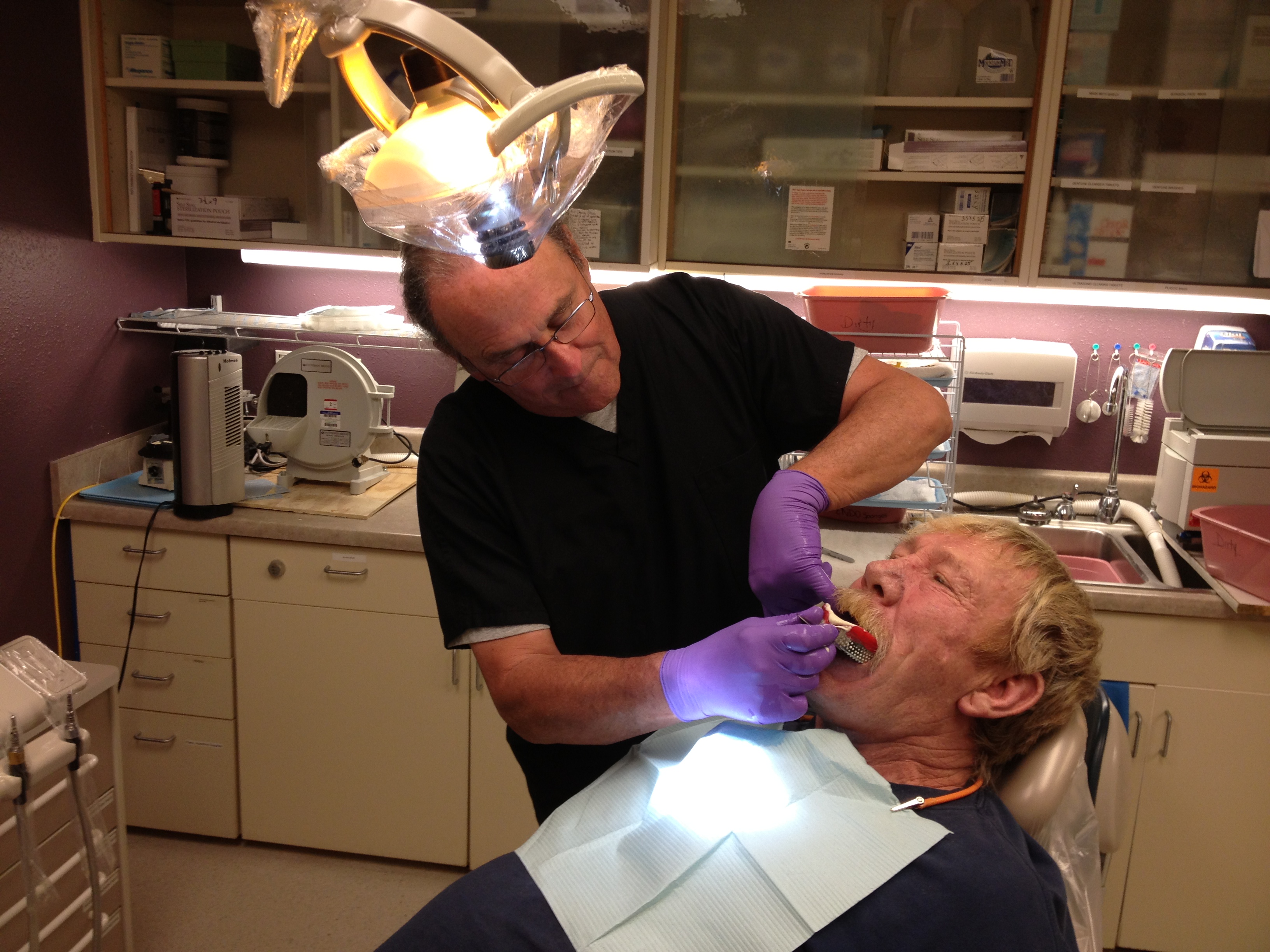
Dentist Ed Linsell takes an impression of Michael Needham's teeth for dentures. Linsell sees about 70 patients a month. (Photo by Lisa Phu/KTOO)
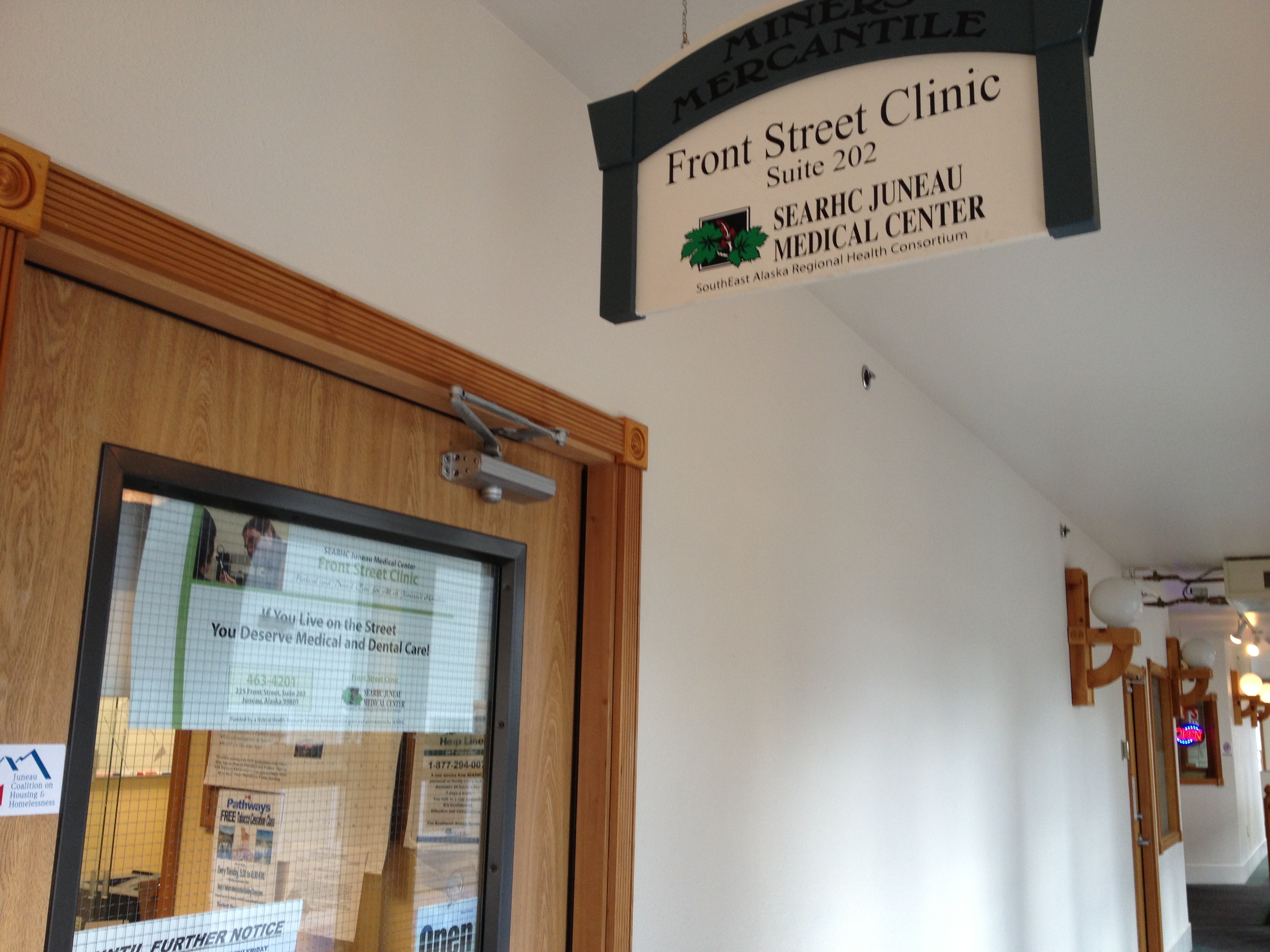
Front Street Clinic is upstairs in the Miners' Mercantile building. It's open Monday through Friday, 8 am to 5 pm. (Photo by Lisa Phu/KTOO)
One of the examination rooms at Front Street Clinic. (Photo by Lisa Phu/KTOO)
Juneau’s Front Street Clinic is in danger of shutting down due to fiscal reasons.
Up to 25 people a day visit Front Street Clinic to receive medical, dental, and behavioral health services. 59-year-old veteran Michael Needham is one of them.
He’s having impressions made for dentures. “They’re very thorough with what they’re doing and I thank god every day for them,” Needham says.
Needham has been going to the clinic for three years and likes the way the staff treats him.
“Like I’m special right now, this is your time. That’s just what it’s all about. They don’t get interrupted or nothing. It’s really cool the way they do that,” he says.
Needham also has cancer, “See these things, little red dots are all cancer spots and I’ve been coming here for them.”
Janna Brewster is Front Street Clinic manager and medical provider. She says the health condition of clinic patients range. Some of them are very ill with diabetes, high blood pressure, lung disorders, cancer.
“Without Front Street, undoubtedly, some of these folks will die because they’re not going to have the day-to-day care that we can help them with.”
SEARHC communications director Michael Jenkins says the possibility of shutting the clinic down is based on federal budget cuts, including sequestration, as well as a reorganization of the regional health consortium.
Ten percent of Front Street patients are Alaska Native. They can go to SEARHC’s Ethel Lund Medical Center if the clinic closes. Brewster doesn’t know where the others will go.
“We have a very small number of patients that do have full disability services; we’ll be able to find other doctors in town that can take them. The largest portion will end up with no medical care at all,” Brewster says.
Dentist Ed Linsell has been practicing at the clinic for nearly all ten years of its operation. He says Front Street staff members are determined to do what it takes it keep the clinic open.
“I’m pretty outraged at how a whole population is going to be – they’re on the street to begin with but they’re going to be thrown out even deeper,” says Linsell.
The group of SEARHC employees has taken their fight to various people and organizations, including the Juneau Coalition on Housing and Homelessness. Dan Austin is a founding member.
“We consider this to be the most important, immediate issue for us. And so we will play whatever role we possibly can to keep Front Street Clinic open, whatever it takes,” he says.
Austin says closing the centrally located Front Street Clinic would take away more than just medical services.
“It serves as one of the main portals in this community to link homeless people on the street to possible services that might be available to them to help make positive changes in their lives. It’s a critical doorway for us.”
Clinic manager Janna Brewster says it’s her duty to tell the patients about Front Street’s possible closure. As soon as patient James Bouschor heard, he immediately started a petition. Within a week, he already has 500 signatures.
“I’m going to try and gather as many signatures as I can because you know not only me who’s needed help, but people that require daily medications and stuff that won’t be able to get it if Front Street closes,” he says.
SEARHC’s Michael Jenkins says the Board of Directors will decide whether Front Street Clinic will stay open or shut down at an upcoming meeting.
—
Editor’s note: This sentence has been updated – “Up to 25 people a day visit Front Street Clinic to receive medical, dental, and behavioral health services.” The original story had cited the number of patients as being ten, but that only accounted for medical patients. The updated number of 25 includes dental and behavioral health patients as well.
Officials of a nationwide non-profit housing operator are looking at Juneau as a possible site for an assisted living center. But it’s just the beginning of the process of finding the right provider for the capital city.
Two Retirement Housing Foundation executives visited last week to meet with a task force dedicated to building a facility here.
The feasibility tour included various sites, but co-chair Sioux Douglas says the task force is still looking for suitable, affordable property for a senior center that is near commerce and on the bus line.
“Juneau actually has more land than some people think. But the fact is a lot of it’s wetlands, a lot of it’s forested, some of it’s too steep, so finding the right buildable property that is more flat than anything for accessibility is really critical,” Douglas says.
State labor department statistics indicate 20 percent of Juneau residents will be over age 65 by the year 2025.
120 people are on the list to get into the Juneau Pioneers Home as soon as possible. The inactive list is more than a thousand.
A 2010 survey identifies senior residential housing as a top priority as more senior citizens choose to stay in Juneau. Even if the Juneau Pioneers Home adds beds, Douglas says another facility will be needed.
“There isn’t any question that the need is here and is going to get huge faster. We have to quantify that and verify in a proper market analysis, which will then define for us truly the number of beds that are required. Right now we’re talking between 40 and 60 and that may not be enough at all,” she says.
Douglas says the task force has a list of assisted living facilities and providers to contact in Alaska and the Lower 48 before an assisted living plan can be developed.
The Juneau Community Foundation, Juneau Commission on Aging, Juneau Economic Development Council and Senior Citizens Support Services organized the effort to find a site and provider.
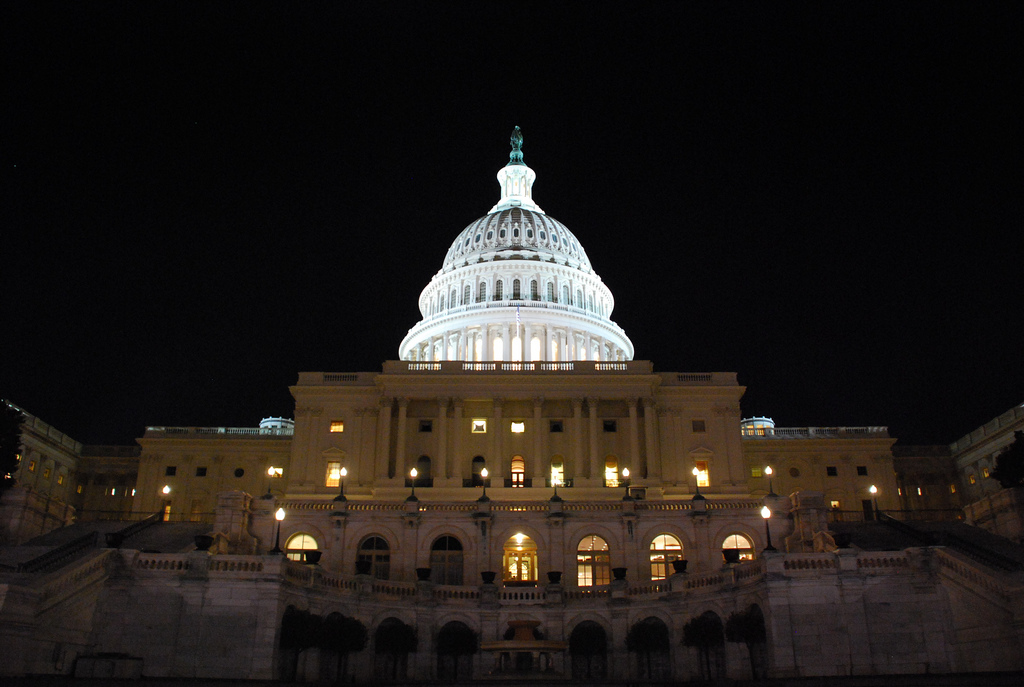
The U.S. Capitol at night. (Photo by Adam Fagen/Flickr CC)
President Barack Obama has made clear last week what he thinks of the attempts to dismantle his signature domestic achievement.
“The idea that you would shut down the government unless you prevent 30 million people from getting healthcare is a bad idea,” he said at a White House press conference last Friday.
The president recently announced the one year delay of the provision of the law that requires businesses with more than 50 employees to provide health insurance.
Republicans in Congress sensed an opportunity and pounced.
“He won’t be implementing; he won’t be enforcing the employer mandate. So hardworking Americans have to comply, big business doesn’t,” complained Utah Republican Senator Mike Lee.
Lee joined Senator Marco Rubio and Senator Ted Cruz in an orchestrated colloquy on the Senate floor.
“These laws are being cancelled on a whim. The president is deciding we’re going to enforce this part of it, but not that part of it,” Rubio declared.
And Senator Cruz wondered “Why is President Obama willing to grant a waiver for giant corporations but not for hardworking families?”
All three of those Republicans are freshmen, and both Cruz and Rubio don’t hide their White House ambitions.
When Congress returns from its five week break September 9th, it will debate a continuing resolution. That’s the bill that keeps the government paid for and open. It’s necessary because Congress will once again fail to agree to appropriations bills.
Cruz said the continuing resolution is the most plausible way to strangle the Affordable Care Act. He recognized that every attempt thus far has been pure politics.
“The past couple of years we’ve seen 39, 40, 41 votes to repeal Obamacare, all of which has been effectively symbolic because none had a real chance of passage,” he said on the Senate floor. “Mr. President, with a continuing resolution, we have a real chance of successfully defunding Obamacare.”
Without a CR the government would shutdown: The Pentagon, Social Security Administration, Homeland Security, Commerce.
“I’m praying that people will understand the damage it’ll do not only to the Republican Party but also this country,” Representative Don Young said.
Young, who called the shutdown disastrous, lived through the last of them. Republicans in the House shut down the government in 1995 and 1996. They led to Democratic gains in Washington, and then-Speaker Newt Gingrich lost his gavel.
“We went through this, and it’s not a pretty sight, especially when people don’t get their Social Security checks, Medicare and Medicaid don’t work, VA hospitals are shut down,” he said in his Washington office.
He conceded the shutdown is not an empty threat, but he predicted the junior members may be whipped into shape by voters.
“You watch those unruly members we have, they’ll come crying back here real quick when they go back to their districts,” he said with a laugh.
A whole of host of veterans in Washington are warning of major blow black. Senator Richard Burr, a close friend of Speaker John Boehner, said closing the government over a bill that will remain law as long as Obama is president is the “dumbest idea he’s ever heard.” The president would veto a CR that cuts his bill.
Senator Lisa Murkowski said members of her party can disagree on the health care bill, but there is no reason to threaten to hold the government hostage over it.
“When you’re talking about a threat to shut down the government, them’s fighting words. It has real life impact on everyone in this country.”
It’s a fight some are willing to pick. And if they don’t win, it still gets their name in the paper.
Summer is nearly over for Juneau kids. It’s back to school on Tuesday for first through 12th graders; kindergarten starts next Thursday.
That means it’s time for shots, that little poke in the arm that allows youngsters to attend Alaska public schools.
Juneau Public Health, part of the Alaska Division of Public Health, and the Vaccinate Juneau Kids Coalition will hold a immunization clinic on Saturday.
Public health nurse Catharine Boice says most vaccines for infants, kindergarten, and older students will be available.
“There’s a list of shots that kids need if they are going into kindergarten. D-tap (diphtheria, tetanus and pertussis), measles, mumps, rubella, chicken pox, hepatitis B, hepatitis A,” Boice says. “When kids are going into the 7th grade they usually need a tetanus update, so we’ll have that available.”
Boice says TB testing, also required for kindergarten, will not be available at the clinic, nor will the chicken pox vaccine. But just about everything else will.
The shots come from the federally funded Vaccines for Children program, making the clinic free to families who have no health care insurance, are eligible for Medicaid or SEARHC coverage, or those who have insurance, but it doesn’t cover vaccines.
Boice says families who have medical insurance that covers immunizations should go to their own provider.
Public health nurse April Rezendes says kids coming to the clinic must bring a parent or guardian, as well as their immunization records, so it’s clear what vaccinations they need.
“No records, no shots; no parents, no shots.”
Saturday’s clinic is from 11 a.m. to 3 p.m. at Nugget Mall.
An Airlift Northwest Lear Jet waits for a medevac call at Juneau’s airport. Airlift continues offering medevac insurance, but Apollo Medi Trans lost its state license to renew or issue policies in February. EdSchoenfeld/CoastAlaska photo.
A popular medevac insurance company says it’s close to resuming business in Alaska. Apollo Medi Trans stopped renewing policies earlier this year, leaving many customers without coverage. But there are other options.
Wrangell’s Kathy Sandness was planning a trip a few weeks ago and decided to check on her insurance.
She wanted to be sure she was covered if she or her husband had a heart attack or serious injury requiring a medical evacuation flight to a distant hospital.
Sandness knew her Apollo medevac policy was supposed to renew automatically. But she found it expired two months ago – with no notice.
She emailed the company and it confirmed she no longer had insurance.
“I did email back and was kind of curious if anything had happened in the interim would we have been covered? And their response was no, we would not have been covered,” she says.
Sandness is one of hundreds if not thousands of Alaskans who pay Apollo $125 a year to cover the expense of medevacs.
The flights cost tens of thousands of dollars, and are often not fully covered by regular health insurance plans.
“Living in Southeast, if you do have a medevac need, it’s very expensive and we felt other people need to be made aware of this,” she says. “They could have accidentally not kept track of their own policies with Apollo. And they need to make a decision whether they want to wait for Apollo to be renewed with the state or possibly seek other alternatives.”
Her policy, and those of some other covered Alaskans, was not renewed because the Fairbanks-based insurer lost its state license back in February.
Customers with active policies still have coverage. But those with expired policies are not.
Apollo officials won’t discuss why they failed to renew their license to sell insurance in Alaska. But Medical Director Dr. Eric Sterling says they’re working hard to get it back.
“We‘re doing every bit we can to be compliant and help and we’re hopeful that it will be soon,” he says.
A staffer answering Apollo’s customer-service line said medevac insurance could resume in a week or two.
That might be possible.
Marty Hester, deputy director of the state Division of Insurance, says Apollo submitted its paperwork at the beginning of the month.
“We have responded to them with the additional information that we’re seeking. And we’re waiting for them to provide that additional information,” he says.
Once that arrives, “Reviewing it should go fairly quickly. I would say 48 to 72 hours, if we have all the information that’s needed.”
Alaskans do have other choices for insurance – from the medivac companies themselves.
Seattle-based Airlift Northwest offers its AirCare membership program, which costs $99 a year for Alaska residents. And Salt Lake City-based GuardianFlight is working toward its own insurance program, though no price or date has been set.
Wrangell’s Kathy Sandness says she’s switched to the Airlift Northwest program. But she worries about others formerly insured by Apollo.
“We all say we’re very, very healthy, but we have friends here who are a little bit more on the edge of medical conditions. That’s why they have the policy. And I’m concerned that could just bankrupt someone so quickly,” she says.
Medevacs are used for a variety of medical emergencies. Among the most common are heart attacks, serious infections and problem pregnancies.
Close
Update notification options
Subscribe to notifications
Subscribe
Get notifications about news related to the topics you care about. You can unsubscribe anytime.

 School begins Tuesday in Juneau, so watch out for kids on bicycles — and Juneau’s police chief.