Sexual Abuse & Domestic Violence

Diocese of Juneau taps panel to investigate claims of sexual misconduct

The Shrine of St. Therese chapel in summer 2013. (Photo by Lisa Phu/KTOO)

The Roman Catholic Church’s historic archives in Southeast Alaska will be opened to an independent panel investigating allegations of sexual misconduct by church personnel, the Diocese of Juneau announced Wednesday.

A commission of two retired judges and a retired police lieutenant will have unfettered access to personnel files dating back to the diocese’s formation in 1951.

“We just want to bring everything to light and be transparent,” Diocese of Juneau spokesperson Dominique Johnson said. “That’s why we put the commission together to review these files so that they will know, as well as us, if there were any allegations against any ministers or people who have worked on behalf of the diocese.”

The three-person commission will be retired Superior Court Judges Patricia Collins and Thomas Schulz and former Juneau Police Department Lt. Kris Sell. According to the diocese’s press release, they’ll begin work on Jan. 7. The diocese estimates that the commission’s review will be completed by June 1, 2019.

After a full review is complete, the commission will submit a report that will include any credible claims of sexual misconduct, along with the names of those accused. That report will be forwarded to the bishop and the president of the diocese’s review board for the protection of children, young people, and vulnerable adults.

“From there we will publish that list of names for the public to see,” Johnson said.

Juneau Bishop Andrew Bellisario’s decree follows a similar move by the Archdiocese of Anchorage, which appointed its own independent panel in October.

The Diocese of Juneau counts about 10,600 Catholics within its geographic area, making it the smallest diocese in the U.S. by that measure. It oversees Catholic churches and shrines from Yakutat to Ketchikan.

Despite progress, Alaska lacks resources to handle rape kit backlog

The sample collection tools inside a SART kit, which is used for sexual assault investigations. (Photo by Anne Hillman/Alaska Public Media)

The State of Alaska is chipping away at thousands of backlogged and untested sexual assault kits. But officials with the Department of Public Safety stress that recent progress is partially due to one-time grant funds, and that it needs more resources to keep up with rising demands for DNA testing in violent and sexual crimes.

On Friday, DPS released its annual legislative report on the statewide inventory of rape kits. Though down from last year when such reporting began, the crime lab still has 2,568 kits from police departments all around the state that had not been submitted previously and remain untested for DNA matches.

One reason for that high number is that in recent years, DPS centralized protocols for how sexual assault kits from police departments statewide are tested and stored long-term. Officials with the department say the current pool of untested kits represent decades of samples from 48 law enforcement agencies all around Alaska.

Mounting national attention on rape kit backlogs led Alaska officials to audit and overhaul the state’s collection system.

“Alaska has started looking at that, as well, and it started looking at an inventory statewide of how many kits do our law enforcement agencies have, and why weren’t they submitted,” explained Michelle Collins, who supervises forensic biology for the sexual assault team.

As recently as 2017, kits would remain untested in a local police department when the victim wished to remain anonymous, if police thought DNA would not further an investigation, or when prosecutors didn’t think a case was strong enough to bring charges. Priority is generally given to cases involving serious violence or an imminent threat to the public.

According to Collins, the state will now collect and retain rape kits in a more uniform manner.

“We want to test even if it’s not needed to prosecute that case, we still want to test that kit and determine if there’s data there that may be useful in other cases,” Collins said.

Under a federal program called the Sexual Assault Kit Initiative meant to reduce sexual assault kit backlogs, 577 samples from Alaska State Trooper have been sent out of state for testing at a private lab. The money is also being used to study and implement best practices on how DPS coordinates with other police departments.

However, officials say without more staff and resources budgeted from the Legislature, the backlog in kits will grow again. In its report, the department is asking lawmakers to add around $700,500 in new operating funds for expanded forensic testing.

Local production ‘Same’ brings stories of gender-based violence to light

Director Allison Holtkamp teamed up with Juneau artists and performers for a new production that premieres at Perseverance Theater on Saturday.

The production is called “SAME: Local Stories of Gender-Based Violence.

“The way that I have conversations with people, instead of saying ‘Me too,’ sometimes I’ll say ‘Same.’” Holtkamp explained.

She says the idea of the show happened out of conversations with her friends and colleagues who were angry that stories about gender-based violence weren’t being heard.

The show isn’t based on a script, like a play. There are 10 stories that will be 6-7 minutes each.

“If people are familiar with Mudrooms, it’s a lot like that. What makes it a little bit different than Mudrooms is every story is directed. So they’ll be prepared pieces, everyone will come in with a prepared piece. Some of them will be memorized, some of them will be read, some of them are poetry, some of them have theatrical elements,” Holtkamp said.

She says the staff at AWARE, a local shelter and support center for survivors of gender-based violence, helped guide her through one of the most important parts of the process – coming up with a good title.

“It was going to be called Bloodrooms…they [AWARE] steered me a little bit away from the scarier name, for a few different reasons, because it’s kinda scary subject matter to begin with, and also I wanted people to attend,” she said.

Actor Doniece Gott will read her own story as part of the performance. Gott is an experienced actor, but this project is different.

“I am excited, I’m scared, I hope I can get through it without crying, and I hope that I can reach someone in the audience to help them have that feeling of same, or that feeling of solidarity, then maybe healing,” Gott said.

Visual artist Christine Carpenter will also share her own story on Saturday. In addition, her artwork based on diary entries she wrote about her own experiences will be on display in the theater.

“I took those and used them as a way to share my story and a way to heal and a way to visually communicate my internal pain that I was feeling, and my internal healing process.”

The team has worked hard to make both the audience and performers feel safe as these real life experiences are shared on stage. Including making a representative from AWARE available to anyone who needs support immediately.

Ultimately Holtkamp wants the audience and performers to experience catharsis, hope, and a sense of togetherness by the end of show.

“Live theater…it is a lot like church. There’s so much healing that can come in live performance.”

See images of Christine Carpenter’s work here.

“SAME: Local Stories of Gender-Based Violence” premieres this Saturday evening, September 22, 7:30pm on the Main Stage at Perseverance Theater. All proceeds from admission will benefit AWARE.

Correction: In an earlier version of this story, we indicated incorrectly that AWARE co-produced this show. AWARE services are completely confidential and they do not share any  information with outside sources. They offered advice to the director about trauma informed practices and strategies to address secondary trauma, and support to the performers and audience members. 

Actor and AWARE Equity Coordinator Austin Tagaban performs the anonymously submitted monologue "Consent" as part of the production Same. (Photo by Annie Bartholomew/KTOO)
Actor and AWARE Equity Coordinator Austin Tagaban performs the anonymously submitted monologue “Consent” as part of the production Same. (Photo by Annie Bartholomew/KTOO)

Hear Juneau actor and AWARE Equity Coordinator Austin Tagaban perform the anonymously submitted story “Consent” from “Same.”

Listener warning: this audio clip contains explicit language and descriptions of sexual assault.

This version has been edited for explicit language, but does contain descriptions of sexual assault.


Security questioned after grandma’s alleged assault during courthouse hearing

Dimond Courthouse
The Dimond Courthouse in Juneau in February 2017. An Aug. 6 assault in a courtroom has raised concerns about security. (Photo by Jeremy Hsieh/KTOO)

A 26-year-old Juneau man spent roughly six months in jail for allegedly assaulting his grandmother. Then the man, who’s diagnosed with paranoid schizophrenia, is alleged to have done it again — this time in a Juneau courtroom. And it took 11 minutes for a law enforcement officer to arrive.

The incident is raising questions about courthouse security.

On Aug. 6, Konnie Chitty was testifying in a closed guardianship hearing for her grandson Tyler Leatham on the third floor of the Dimond Courthouse. The hearing would help determine if the state would become the guardian for Leatham.

Chitty told a recent forum held by supporters of candidate for governor Mike Dunleavy what happened. She said she was testifying about the earlier assault.

“While I was standing just like this, speaking directly to the judge, my eyes not wavering, my grandson jumped from right here, beside his attorney, and knocked me out in one punch,” Chitty said.

While Leatham stopped the assault after his mother and others in the courtroom urged him to stop, it took time for help to arrive.

“There was only two of us in this, beside his attorney, the judge (and) his secretary, both pushing a panic button inside a locked room and no one came,” she said.

The courthouse had two judicial services officers, who would have been responsible for responding, but both were guarding prisoners at the time. A Juneau police officer outside of the courthouse responded and arrived 11 minutes after the alarm.

For Chitty, the incident raises two concerns. One is about courthouse security. The other is about whether the state provides enough mental health treatment to those like Leatham who need it.

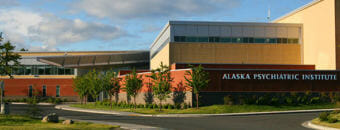
Chitty said the statewide need for in-patient mental health treatment far exceeds the capacity of the Alaska Psychiatric Institute.

“He does not particularly need prison, but a mental health institution,” Chitty said.

Chitty had this concern before the August incident. After Leatham’s first alleged assault against her in February, he was first jailed, then flown to Anchorage. His family understood that the state was seeking to move him to the state psychiatric institute. However, Chitty said that never happened and he spent much of his time in solitary confinement.

“I don’t know if we’re going to get help for our Tyler,” Chitty said.

Neil Nesheim is the area court administrator for Southeast Alaska. He was working nearby when the incident occurred. He said judicial services or Juneau Police Department officers are generally in courtrooms at the request of one of the parties or the judge.

“If somebody would be considered dangerous and a threat in the courtroom, certainly either party or either attorney could ask the court to provide some sort of JS officer or JPD officer or state trooper to be present, if that were the case,” he said. “To my knowledge, we haven’t received anything along those lines.”

Nesheim said those who work in the courthouse learned from the August incident.

“It was an unusual incident,” he said. “I don’t think anybody expected that really to happen. Certainly it’s one of those things where it’s one for the learning books in terms of what to look out for in terms of: Does someone have any mental health issues and would they be considered a danger to society or those people in the courtroom?”

Nesheim said the incident may lead to having more security in the courthouse.

“I would expect that the change would primarily result with the additional staff of judicial services officers,” he said. “Right now, they only have two. Typically in the past they’ve had three. I don’t know if that’s because of budget cuts or just the inability of being able to find somebody. But simply the presence of another judicial service officer would certainly help.”

Chitty flew down to Seattle last week to have her injuries from the incident checked out.

“It’s been horrible for our family, but we are moving forward,” she said.

Leatham has been in Juneau’s Lemon Creek Correctional Center since the incident. And Chitty said the state has been granted guardianship over him. That means the state will provide for his treatment and everyday living needs.

Western Alaska still has state’s highest rate of reported felony sex crimes

From the Crime in Alaska Supplemental Report on felony level sex offenses (Graphic courtesy Alaska Department of Public Safety)

Western Alaska has had the highest reported rate of felony level sex offenses in the state for the past three years, according to the Alaska Department of Public Safety.

The recently released 2017 Felony Level Sex Offence Supplemental Reportcompiles law enforcement data from around Alaska. It aims to provide a clearer picture of sexual violence. This is the third year the state has published its findings.

The western region includes Bristol Bay and is comprised coastal areas from the Aleutian Islands to the Northwest Arctic Borough. The department’s data shows the rate of reported felony sex offenses in these areas is more than twice the statewide rate.

The most common victim age in western Alaska was 13, two years younger than most common victim statewide. In 259 of the 321 offenses reported in the region, the victims were Alaska Native.

While the report presents statistics, it does not provide explanations for the patterns it describes.

“I think that the report exists to help folks sort of understand what the reality is on the ground for folks in many of these areas, but it doesn’t answer the questions of why their rates are what they are,” explained Jonathan Taylor, DPS communications director. “This perhaps serves as a starting point to start conversations and investigation and research into why these rates are what they are in different areas of the state.”

Graphs. One title "Western Alaska: Race of Victims" showing bars of different heights for different races (Black: 1, Asian: 6, White: 19; Unknown Race: 36; Alaska Native: 259). The other graph shows "Rate per 100,000 Population of Felony Sex Offenses" and shows the years 2015, 2016 and 2017 with the line for "Western Alaska" significantly above the line for "Statewide" for each of those years
(Graphic courtesy Alaska Department of Public Safety)

Across the Alaska, the department found that the number of incidents decreased by 4 percent over the last year. However, the number of victims increased by more than a quarter. More detailed reporting by law enforcement agencies could contribute to the apparent increase in victims. Taylor said agencies that in previous years only submitted the number of incidents reported may now be specifying how many victims were involved in each case.

Most incidents reported across the state occurred in a home and most did not involve a weapon. In more than 97 percent of cases the victim knew the suspect.

If you or a person you know is a victim of sexual violence, help is available. If you are in immediate danger, call 9-1-1. In Bristol Bay, SAFE provides shelter and advocacy for victims of sexual and domestic violence. You can contact them at 907-842-2320 or 1-800-478-2316. To report child abuse, contact the Office of Children’s Servicesat 1-800-478-4444.

Doctoral student compiles database of indigenous women who’ve gone missing

Loxie Loring walks with a group of marchers to remember her daughter, Ashley Loring, who went missing from the Blackfeet Reservation more than a year ago. (Photo by Nate Hegyi/Yellowstone Public Radio)

A storm rolls in over the Blackfeet Indian Reservation in Montana. The clouds are low and dark as distant lightning cracks over a green prairie. Wade Running Crane is starting to get wet.

“This is like a sign from Ashley that she’s here,” he says of his family friend Ashley Loring.

Ashley’s mother, Loxie Loring, is standing next to him.

“She liked this kind of weather,” she says. Her daughter also loved riding horses and writing poetry.

“She was outgoing,” Loring says. “She wasn’t scared of anything, And for how small she is, she was…”

Then Loxie holds back tears.

Ashley disappeared a year ago. At the time, she was 20 years old and had plans to live with her sister in nearby Missoula, Mont. Law enforcement believes Ashley was then taken somewhere against her will. Now the FBI, tribal police and the Glacier County sheriff’s department are all investigating.

“She’s not gone because she wants to be gone,” Loring says. “I know something happened to her.”

Ashley Loring bought a new camera and took this portrait of herself before she went missing from the Blackfeet Indian Reservation more than a year ago. (Photo courtesy of the Loring family)

Spend time in Indian Country and you’ll hear this story over and over: A niece, a daughter or a cousin who was taken quickly and violently from this world.

As many as 300 indigenous women go missing or are killed under suspicious circumstances every year in Canada and the U.S., but the exact number is unknown because the Federal Bureau of Investigation isn’t really tracking the numbers.

“I would venture a guess that if we did have the data, it would show that native women are more disproportionately represented,” Annita Lucchesi says.

She used to teach Ashley Loring at the local community college in Browning, Mont.

“She didn’t know how smart she was,” she says. “She was always so happy whenever she got a good grade. ‘Really, really, I got an A?’ ‘Yes, you did; you’re smart.'”

Lucchesi is a doctoral student at the University of Lethbridge in Canada now. Back when she was working on her master’s thesis, she tried to find the total number of indigenous women who were either killed or went missing in U.S. and Canada.

“After doing some Googling, I realized nobody has the right number,” she says.

Jonnilyn Loring leads a group of marchers down the main highway in Browning, Mont. (Photo by Nate Hegyi/Yellowstone Public Radio)

Even if a local police report is filed some of those cases never make it to the FBI’s crime database. This is because there’s no requirement to file those reports nationally unless the person is a juvenile. Lucchesi says this allows many native women to fall through the cracks.

So she’s creating her own database by filing public record requests with local law enforcement agencies. So far she’s documented more than 2,000 cases across both the U.S. and Canada. Most occurred over the last 20 years.

Luccessi says she’s shocked at how much data is missing.

“And really, it’s not just data,” she says. “That’s someone’s relative that’s collecting dust somewhere and no one is being held accountable to remember or honor the violence that was perpetrated against her.”

Canada has an ongoing federal investigation into the issue but data isn’t really getting updated. Last year, Congress introduced Savanna’s Act. It requires an annual report on the number of missing and murdered indigenous women, but since a Senate Committee hearing in October, nothing’s happened.

Frustration about all this is mounting on the Blackfeet Reservation.

On that recent stormy day, a large crowd called for justice for Ashley Loring as they marched down a main highway blocking traffic.

Ashley’s cousin, Ivan MacDonald, marched with them. He’s getting weary.

Ashley Loring has been missing for a year, along with an estimated 270 other indigenous women in the U.S. and Canada.

“We already know this is a crisis,” he says. “And we don’t need statistics to legitimize it for us. We need statistics to legitimize it for everyone that isn’t us.”

This story was produced by the Mountain West News Bureau, a collaboration between Wyoming Public Media, Boise State Public Radio in Idaho, Yellowstone Public Radio in Montana, KUER in Salt Lake City and KRCC and KUNC in Colorado.

Copyright 2018 Yellowstone Public Radio. To see more, visit Yellowstone Public Radio.
Site notifications
Update notification options
Subscribe to notifications