Sexual Abuse & Domestic Violence

Q&A: Education department transparency questioned after University of Alaska investigation

Betsy DeVos U.S. Secretary of Education Betsy DeVos speaking at the 2017 Conservative Political Action Conference (CPAC) in National Harbor, Maryland.
U.S. Secretary of Education Betsy DeVos speaking at the 2017 Conservative Political Action Conference, or CPAC, in National Harbor, Maryland. (Flickr Photo by Gage Skidmore)

President Donald Trump’s Department of Education is being questioned on its lack of transparency because it hasn’t publicized results of a major investigation into sexual harassment and sexual assault cases on University of Alaska campuses.

The university released the results, but BuzzFeed News reports the education department has not. It’s a departure from past practice.

Because the Department of Education hasn’t been answering reporters’ questions, it’s unclear if it’s a temporary side effect of the transition or true policy shift. Victim advocates are worried the Obama-era practice of releasing Title IX investigation results has ended.

I discussed the story with BuzzFeed National Reporter Tyler Kingkade, who reports on sexual violence and domestic abuse. This interview has been edited for length and clarity.


Can you sum up what these advocates were concerned with for me?

So, usually when the department would finish a Title IX investigation, it would send out a press release to reporters saying whether or not the school violated Title IX and include the voluntary resolution agreement and the resolution letter.

It’s not crazy to think that the university would have gotten these materials and decided to just push it out on their own, but what was strange was that the education department didn’t have much to say when we asked them, “Hey where’s the materials for this? Why haven’t you guys announced anything? Are you going to announce anything?” And to this week we still don’t have access to these letters on the department’s website.

And to be fair to the department, when I asked about the agreement and the letter of findings, the department promptly shared both of those documents with me, they emailed them to me. But the agency not having them available on their website, what is the underlying problem with that?

Yeah, so I talked with advocates this week, as well, just to follow up. And they’re still concerned because while the department is willing to give away these materials now to reporters who ask for them, they’re worried about what students and parents are going to have access to.

And I know that other universities when they’re under investigation, or even if they’re not and they’re just trying to stay up to date with best practices and what the federal government expects schools to do, they do read these as well. So you can bet that if a school does come under investigation next week for alleged Title IX failures, they’re probably going to look at what happened at the University of Alaska to see what the Office for Civil Rights is looking for schools to do. That’s one issue.

The other is, the advocates just want students to be aware that this is an option. They really want to push hard that students can file Title IX complaints if they think that their rights have been violated. It’s more about the advocates saying that they just don’t want to see any rollback of any transparency.

You mentioned in your report that the department didn’t answer BuzzFeed’s questions about whether the documents would be put on the website eventually. In my own experience, I made a request asking for comment on the investigation, and a spokesperson for the department, I’m quoting him, he told me the department “is not really doing interviews right now while we continue our transition and staffing up process.”

“I’m actually hearing the same thing even from insiders who work on sexual violence issues and Title IX issues, who say in previous administrations under both Democrat and Republican presidents, they’ve had much more access to speak to people in the department early on just to talk to them. And these would be off the record conversations that they’d have. What I’m hearing that they aren’t even getting their phone calls returned.

And one thing to be fair about the lack of the response from the Education Department on the University of Alaska case is that they really are still in transition. They don’t have someone appointed yet to be the … you know, in charge of the communications office. There’s not a lot of players in place yet at the education department. So, there’s a lot still unanswered.

But, I think what a lot of the advocates and activist groups on these issues on sexual assault issues are approaching this as is they’re going to be loud and boisterous early on to show that they’re paying attention. There were a lot of them that were a lot of them that were pretty opposed to Betsy Devos’ nomination because she did not pledge to continue the Obama-era policies on Title IX. And so, I think there’s a bit of them just trying to make a show of force.

All right Tyler, is there anything I didn’t ask you about that you think is important to point out on this issue?

This is definitely an issue where the questions are lying at the Education Department. It’s not necessarily with the university. The advocates, I think, were lucky in this case that the University of Alaska was so forthcoming about their investigation, and a lot of them give them credit because of the University of Alaska Fairbanks interim chancellor a couple of years ago issuing an apology for how cases were handled.

There’s still people who think the university has a ways to go but I think nationally, people are looking at the university as being a bit more transparent and wishing some more schools down in the Lower 48 would follow their lead and post more of these documents and answer more of these questions about Title IX.

Title IX investigation brings many University of Alaska failings to light

University of Alaska Southeast (Photo by Heather Bryant/KTOO
The University of Alaska Southeast on Aug. 19, 2013. (Photo by Heather Bryant/KTOO)

The U.S. Department of Education’s Office for Civil Rights said in a letter that the University of Alaska System badly failed students and staff who were sexually harassed and assaulted.

OCR began a Title IX investigation of the university system three years ago. The investigation focused on cases from 2011 to 2015. Title IX is the federal law that outlaws discrimination against, or the exclusion of, any person from a federally funded education program or activity because of their sex or gender.

The University of Alaska is trying to make its campuses safer for students and employees by doing a better job resolving sexual discrimination and assault cases. The university is following OCR’s orders to change the way Title IX cases are handled.

OCR made a list of 23 specific cases as examples of the university’s Title IX failures. The schools responsible for each case weren’t identified.

The first problem in the list is the system’s failure to investigate or finish investigating multiple reports of misconduct.

“In 2013 a student was found in a university residential building intoxicated, unconscious, and wrapped in a blanket with her clothing partially undone.  She said that she had met a soldier, but could not recall what had happened because she had blacked out. The soldier was ultimately court-martialed for sexually assaulting the student and university staff testified at the court-martial for which the soldier received three years of confinement and a dishonorable discharge.  The case records indicate that Residence Life handled the situation and the university failed to conduct a Title IX investigation or offer the student any interim measures, but it did investigate and discipline the student for underage drinking on the night of the sexual assault.”

The university has also prematurely stopped investigating employees accused of sexual harassment or sexual assault many times after the accused person resigned.

“In 2013, a student reported that a professor was sexually harassing female students.  The complainant stated that she knew at least four students with whom the professor had had a sexual relationship.  When interviewed, a female professor said that several students had complained about this professor’s conduct towards female students.  The documents provided to OCR contained a draft Title IX investigation report, concluding that the respondent behaved inappropriately with students and recommending a letter of expectations of behavior from the Dean.  The investigation was not completed, and neither a final report with findings nor a letter from the Dean was issued.”

OCR also found that investigations took too long at each of the system’s three universities. In addition, multiple times university investigations were “delayed or suspended” when law enforcement investigated.

“In 2015, university police reported the sexual assault of a female student by a member of a men’s athletic team to the university’s Title IX office and Residence Life.  Ten days later, university police reported to the Title IX office that two other students allegedly had been raped by the same respondent.  Soon after the complainants reported their sexual assaults, members of the athletic team began calling the complainants and their friends ‘whores.’ Investigation of all three cases was put into abeyance at the request of the district attorney’s office. OCR received no indication that the university resumed the investigation.”

And the list keeps going.

UAS Title IX Coordinator Lori Klein, right, and UAS Chancellor Rick Caulfeld, left, hosted a public forum to discuss the Office for Civil Rights investigation findings on Thursday, Feb. 23, 2016.
UAS Title IX Coordinator Lori Klein, right, and UAS Chancellor Rick Caulfeld, left, hosted a public forum to discuss the Office for Civil Rights investigation findings on Thursday, Feb. 23, 2016. (Photo by Quinton Chandler/KTOO)

Lori Klein was hired to be University of Alaska Southeast’s full-time Title IX coordinator in 2016. In the past, the position was part-time. OCR stressed in its findings that each university must have at least one Title IX coordinator to help their schools comply with federal law.

“I think the biggest trend that I saw when I reviewed the findings from that past time was a failure of documentation,” Klein said.

OCR found the majority of the three universities’ records were “incomplete and poorly maintained.” There were very few cases from campuses in rural communities and many files from the 2011-2012 academic year had no record of investigations.

“In OCR’s belief, and rightly so, if it’s not documented it might not have happened,” Klein said. “How are they supposed to know? How am I supposed to know? How is anyone supposed to know if it’s not documented? Did it happen or did it not happen?

OCR and the University of Alaska negotiated a list of ways the university will fix its shortcomings and on Feb. 17, university president Jim Johnsen signed it.

That agreement is long and it would take a long time to summarize everything in it, but here are a few of the requirements:

The university has to rewrite a number of policies and regulations.

Klein said, “that’ll be one of probably those priority areas that we address immediately.”

During an investigation, each university has to give equitable rights to the people reporting assault or harassment and to the people accused. For example, in some past scenarios, only the accused person got copies of witnesses’ names, their statements or other documents used in their case. And only the accused could object to people appointed to sit in on their hearing who they thought were biased.

Some of the requirements, Klein said the university system has already adopted. UAS is trying to do a better job teaching its satellite campuses how Title IX cases are handled and now rural campuses are reporting more assaults and harassment.

“While it feels counterintuitive, I think the reports are reflective of the fact people now understand the process better, that it is more transparent,” Klein said.

Now, each of the system’s three universities require all faculty and staff to take Title IX training and they provide training opportunities for students.

In 2016, all three universities entered formal agreements with local police departments and the Alaska State Troopers that establish the universities’ rights and the agencies’ rights during a Title IX investigation.

Also, students who report sexual harassment or assault, won’t be punished if they broke minor university policies like multiple students who were punished for drinking in the past.

OCR said in a letter to the university system that if the university doesn’t meet the agreement’s conditions, the office will force them through administrative or judicial proceedings.

Retrial of Kodzoff Acres homicide case rescheduled for this fall

Defendant Christopher Strawn listens to his defense attorney Eve Soutiere during jury selection in his homicide trial in Juneau in February 2017.
Defendant Christopher Strawn listens to his defense attorney Eve Soutiere during jury selection in his homicide trial in Juneau in February 2017. (Photo by Matt Miller/KTOO)

The retrial of Christopher Strawn on charges related to the death of Brandon Cook has been rescheduled for October.

After a declaration of a mistrial earlier this month, a new trial was initially scheduled for early April.

Multiple conflicts among the attorneys and the judge in the case forced a new hearing on Feb. 21 to reschedule the second trial.

Strawn faces a variety of charges including first- and second-degree murder for the death of Cook at the Kodzoff Acres trailer park in October 2015.

The prosecution was in the midst of making their case against Strawn during the trial when a key witness made an unsolicited and extremely prejudicial comment about her previous relationship with Strawn.

The prosecution witness was initially called to the stand to supposedly testify about Strawn’s ownership of a firearm that could have been linked to the weapon used to kill Cook.

In addition, recent and potential motions in the case could change the location or even the prospects of a new trial in the case.

Both the prosecution and defense have signaled their intentions to file for a change of venue, or move the second trial to another location outside of Juneau.

Both sides are concerned that media coverage of the recent trial and its abrupt end could inhibit their future ability to seat an impartial and objective jury in Juneau.

Strawn’s defense attorney also filed a motion Feb. 17 that could essentially dismiss the entire case against him.

Eve Soutiere of the Office of Public Advocacy would only say in court that her motion concerned issues of double jeopardy.

After state prosecutors file a response, it’s still unclear whether Judge Philip Pallenberg would schedule a separate hearing on that issue.

Judge Pallenberg, Soutiere and Assistant District Attorney Amy Paige all have other trials, professional conferences and personal leave that would make rescheduling a new trial for this spring and summer nearly impossible.

Strawn — through Soutiere — said in court on Tuesday that he would reluctantly waive his right to a speedy trial within 120 days to accommodate the new schedule.

Convicted murderer of Tenakee Springs woman seeks review of his case

Tenakee Springs
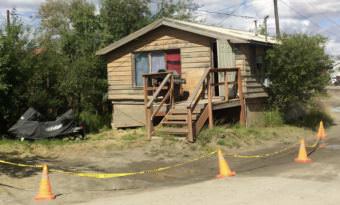
Tenakee Springs (Photo by Quinton Chandler/KTOO)

A man convicted of sexually assaulting and killing a woman in Tenakee Springs nearly 14 years ago will likely be returning to a Juneau courtroom this spring.

James Harmon is serving a 72-year prison sentence for Maggie Wigen’s murder, two instances of sexual assault, and taking $100 bills that belonged to her.

Harmon, now 38 years old, filed a petition asking for post-conviction relief alleging that he didn’t receive adequate or sufficient representation for his case. In January 2016, the Alaska Court of Appeals determined that Harmon’s petition deserved another look.

An evidentiary hearing is scheduled for April 17 that will focus on Harmon’s claims of ineffective assistance of counsel, specifically concerning public defenders David Seid and Julie Willoughby during his trial in 2005.

Among Harmon’s claims, he believed his defense attorneys were “unprepared for court on more than one occasion,” unenthusiastic or indifferent about representing him, and “failed to inform (him) about certain (false) claims by the state.”

Harmon also claims that attorney Michael R. Smith, working on contract with the Office of Public Advocacy, failed to zealously follow through with an earlier petition for post-conviction relief.

On New Years Eve in 2002, a friend of Wigen’s walked in on Harmon sexually assaulting Wigen at her cabin in Tenakee Springs. The 19-year-old Wigen later disappeared from her cabin in March 2003. Her body was found a month later in an earthen dam near her cabin in Tenakee Springs.

Investigators believe Harmon, who was 24 years old at the time, lived in Wigen’s cabin after sexually assaulting her again.

Wigen was strangled and her body was buried in the dam where Harmon had worked.

He was interviewed by investigators, but he was not placed into custody. Harmon quickly left Tenakee Springs, he said, because he feared harassment and reprisals by residents there.

The case seemed to languish for more than a year, but unknown to the public, Alaska State Troopers had arranged for an undercover officer to befriend Harmon and secretly record their conversations whenever he incriminated himself or confessed to the crime.

Harmon was arrested for Wigen’s death in May 2004 and went to trial in April 2005.

Both the prosecution and defense agreed that the secretly recorded conversations would not be introduced as evidence during the trial as long as he did not take the stand in his own defense.

Harmon was convicted of second-degree murder, first-degree sexual assault, second-degree theft and attempted first-degree sexual assault.

The jury was unable to reach a verdict on the most serious charge of first-degree murder.

In November 2005, Harmon was sentenced to 65 years in prison on the charge of second-degree murder. He was also sentenced to 10 years in prison — to be served concurrently — for sexually assaulting Wigen before her death. Another seven years — to be served consecutively — was imposed for the New Year’s Eve attempted sexual assault and stealing Wigen’s cash. Harmon’s total composite sentence of both consecutive and concurrent terms was 72 years in prison.

During an earlier appeal, Harmon argued that his sentence was excessive and that it was improper to include the earlier sexual assault charge in the case.

He also argued the trial should not have been held in Juneau because of pre-trial publicity, specifically a series of stories about the case that ran in the Juneau Empire.

The Court of Appeals denied Harmon’s appeal in an opinion handed down in October 2008.

Canadian police revisiting more than 10,000 dismissed sexual assault cases

After a newspaper investigation concluded that one-fifth of all sexual assault complaints in Canada were dismissed as “unfounded,” or baseless — a far higher percentage than for other types of crime — police forces across the country are revisiting old cases.

In total, police forces are reviewing more than 10,000 rape and assault allegations that were dismissed as “unfounded,” The Globe and Mail reports.

The newspaper previously reported that from 2010-2014, more than 27,000 such cases were given that designation, meaning they effectively disappeared from the Canadian justice system.

The Royal Canadian Mounted Police are reviewing all such cases from 2016 as well as a “sample” of previous allegations, the CBC reports. A number of local police forces are revisiting old cases, as well — sometimes voluntarily, the broadcaster says, and sometimes at the demand of a civilian oversight board.

The police chief of London, Ontario, has apologized to victims, and Prime Minister Justin Trudeau said his administration would “do more” on the issue.

The flurry of responses were prompted by an investigation published by the Globe and Mail earlier this month.

The newspaper found that the number of sexual assault cases dismissed as “unfounded” was unusually high compared with other alleged crimes. The categorization means no crime had been attempted or committed. Such cases don’t factor into a police force’s crime statistics.

Because the number of unfounded cases wasn’t made public, reporter Robyn Doolittle sent hundreds of freedom of information requests to police forces across Canada. She found that nationwide more than 19 percent of sexual assault cases were dismissed as “unfounded” — nearly twice the rate for physical assault, and far higher than the rate for other crimes.

Here’s more from the Globe and Mail‘s original report:

“True unfounded cases, which arise from malicious or mistaken reports, are rare. Between 2 per cent and 8 per cent of complaints are false reports, according to research from North America, the United Kingdom and Australia. The Globe’s findings suggest that police in Canada are closing a disproportionate number of rape cases as unfounded, a phenomenon that distorts the country’s crime statistics.

“Inflated unfounded rates create the impression that police receive fewer complaints of sexual assault than they actually do. In turn, that gives the appearance that more complaints lead to an arrest.”

The report also found “vast discrepancies” between jurisdictions — meaning that a person who reported a rape had very different odds of being believed by police officers, depending on where she or he lived.

Police in Windsor, Ontario, dismissed 3 percent of assault allegations as unfounded; in London, Ontario, police dismissed 30 percent. Winnipeg police “unfounded” just 66 of 3,483 allegations. Police in Saint John, New Brunswick, dismissed 312 of 617.

Most people whose cases were closed as unfounded were never told by police that their allegations had been dismissed. In some cases, police marked the cases as baseless without conducting interviews with witnesses or suspects.

In one incident more than a decade ago, police dismissed as “unfounded” the case of a 13-year-old girl who had been impregnated and told police the father was a 27-year-old man. Authorities discredited her account, apparently without ever conducting a paternity test.

The Globe‘s investigation opens with the 2010 story of a college student in London, Ontario, who told police she was raped — outdoors, with bystanders taking photos or videos as she told the man to stop, she said. In a videotaped interview, a police detective told her that her clothes weren’t “torn or anything,” erroneously said that her account of a sudden blackout while drinking wasn’t plausible, and suggested she “maybe the sex was consensual” and she was more upset by the voyeurism.

A suspect was contacted and “warned,” police said, but the case was closed as unfounded.

That case was reopened by police after the Globe approached the police force for comment.

Copyright 2017 NPR. To see more, visit http://www.npr.org/.

Lawmakers want new rules for testing sexual assault kits

A statewide audit of sexual assault kits that most law enforcement agencies participated in a year ago, revealed there are several thousand kits that haven’t been tested.

If you’re picturing stacks of hundreds of kits sitting in a line to be examined with police wringing their hands waiting to find out who did it, you’d be wrong.

Alaska Public Media reported that at the end of last year there were actually about 117 kits waiting for testing at the state crime lab.

Capt. Dan Lowden with the Alaska State Troopers said the audit turned up about 3,600 untested kits statewide and those are mostly kits that were never sent to the crime lab. He said the kits are just one piece of evidence used to close a case.

“So the kit by itself only establishes who might have committed this assault. In most of the sexual assaults in Alaska, we already know who did it,” Lowden said.

He said many times consent is the unknown variable and a sexual assault kit can’t help with that.

“If the kit is only there to help us with the who and we already know that, a lot of times agencies won’t submit the kit for examination because they already know that and it’s an expense that they don’t need to go through,” Lowden said.

There is an argument for testing kits even when you know the who, but more on that later.

Lowden also said sometimes evidence is collected in the kits but then the complainant decides they don’t want to go through an investigation. This is called anonymous reporting.

Law enforcement will hold onto the kits in case the person changes their mind.

Rep. Geran Tarr addresses the Alaska House of Representatives on April 7, 2014. Tarr and Andy Josephson will replace Benjamin Nageak (seated) and David Talerico as the co-chairs of the House Resources Committee. (Photo by Skip Gray/360 North)
Rep. Geran Tarr addresses the Alaska House of Representatives on April 7, 2014. (Photo by Skip Gray/360 North)

House Bill 31 would require that agencies send all sexual assault kits to labs for testing within 18 months of receiving them.

State Representative Geran Tarr said agencies would also create a system to track those kits and to monitor which ones go untested. Tarr, an Anchorage Democrat, introduced the bill during a House State Affairs Committee meeting.

“We want to keep track of this. We want to know on (an) annual basis what our backlog is, what kind of job we’re doing,” Tarr said. “What this effort to end the backlog has shown across the country is (a) very dysfunctional system – not working. Victims are not getting the justice they deserve and dangerous criminals are out on the street to commit other crimes.”

Tarr said the bill’s provisions will cost about $200,000.

HB 31 would go into effect Jan. 1, next year. She said that date is meant to give the Department of Public Safety time to chip away at the number of untested kits and time to adjust to a new protocol.

The bill would require that law enforcement and other state agencies report the status of the untested kits by Sept. 1, this year.

Capt. Lowden said in principle, he agrees that testing more kits could help law enforcement, but he doesn’t know if it will lead to a dramatic rise in solved cases.

“A lot of jurisdictions have gone through what we’re going through. They go back, they’ve retested thousands and thousands of kits and they prosecute one or two new cases,” Lowden said.

Still, he said it was important to get the additional evidence in those cases.

“If one person (or) perpetrator was caught, then that’s a success story,” he said.

Lowden said law enforcement around the country are rethinking the way they use kits. He said many times investigators get in the habit of solving one case with one kit.

“However, we recognize that there are serial predators out there and by testing the kit, even if we know who did it this time, we might be able to solve previous cases that were unknowns,” he explained.

But there’s still the question of whether every kit should be tested, even the ones collected from people who don’t want to go through an investigation and potential court proceedings.

Tarr believes the evidence from the kits can be used while respecting the victim’s wishes.

Orin Dym, forensic laboratory manager with the state crime lab gave a very rough cost estimate for testing kits. He said it varies, but a kit tested by the state lab could cost about $1,000 and a kit contracted out to a private lab could cost about $1,500.

Dym said usually kits are examined in-house, but the state will have to use private labs to process most of the 3,600 untested kits.

An official with the governor’s office said a $1.1 million federal grant from the Department of Justice will help pay for tests on almost 1,000 sexual assault kits held by the Alaska State Troopers.

The money will also pay for a cold case investigator and a prosecutor to work the cases.

The Alaska State Crime Lab in Anchorage. (Photo courtesy of the Alaska Department of Public Safety)
Site notifications
Update notification options
Subscribe to notifications