History

Sign project revives 1967 Fairbanks flood history

Almost 50 years ago, The Fairbanks area was deluged by unprecedented rainfall.  The precipitation channeled from surrounding hills into the Chena River resulting in an epic flood that devastated the interior city.

Five decades later, signs are going up around Fairbanks to remind people of what happened.
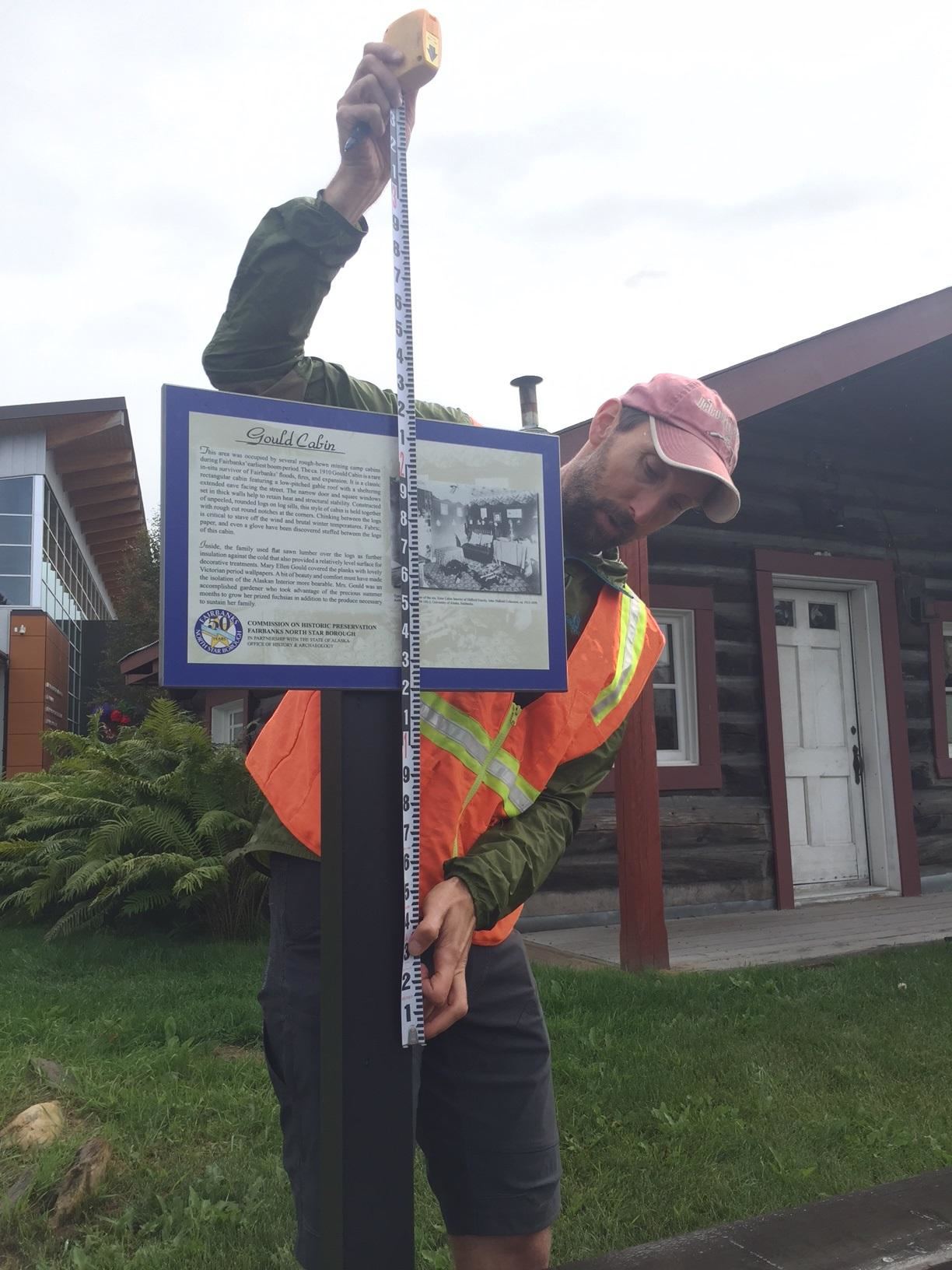
National Weather Service hydrologist Ed Plumb takes a measurement for installation of high water mark sign on an historic cabin near the Morris Thompson Center. (Photo by Dan Bross/KUAC)

Standing by the Chena River in downtown Fairbanks, National Weather Service hydrologist Ed Plumb explained how an already wet streak in August 1967, culminated with intense precipitation as the remnant of a typhoon pushed across the interior.

“Some places had 6 to 9 inches of rain during that period of time,” Plumb said.

All that rain flowed down the Chena, Salcha and Tanana rivers resulting in the great flood of August 1967. The high water displaced thousands of people, and did tens of millions of dollars in damage, a history Plumb is leading a project to share with the public.

”There’s been more than a generation that’s passed since the flood, and so a lot of people… we’ve run into some people who didn’t even know there was a flood in ’67,” Plumb said. “That piece of history is already being lost.”

The project includes placement of informational and high water mark signs around town.

Plumb and U.S. Geological Survey hydrologist Matt Schellekens are making measurements for installation of a high water sign near an historic downtown cabin along the Chena.

“Some locations like here, near the river, were looking at about 5 feet of water above ground level,” Schellekens said. “Most places throughout downtown Fairbanks were 1-and-a-half to 3 feet of water.”

Shellekens and Plumb underscore that it wasn’t just the depth of the flood water, but the huge area it encompassed.

”The Tanana was flowing approximately 250,000 cubic feet per second, when 100,000 is considered flooding,” Plumb said.  

“It’s hard to estimate because the Chena and the Tanana were one in Fairbanks — one continuous area under water,” Shellekins added.

Shellekens unfolded a flood map in the in the back of his pickup.

“We’ve got Birch Hill here, UAF here and this is Chena Ridge behind the pump house,” Shellekens listed. “The airport which is barely above flood elevation. You can see the blue numbers are the approximate water depth. Over by the library, 2-and-a-half, 3 feet deep.”

Areas of higher ground served as gathering spots for flood evacuees.

Plumb pointed to the bluff near the entrance to the University of Alaska Fairbanks.

”That was sort of a boat landing spot for people evacuating town and getting up onto the higher ground at the University,” Plumb said. “There’ll be a sign there showing how high the water was.”

Plumb noted that water will never reach such heights again due protection provided by the Chena Flood Control dam and levy built after the great flood.

The project in North Pole is the location of one of three interpretive panels marking the 50th anniversary of the ’67 flood.

Alaska Gov. Bill Walker is among officials and local residents scheduled to speak at a flood anniversary event in downtown Fairbanks August 15.
Russian adventurers honor history during Dillingham visit

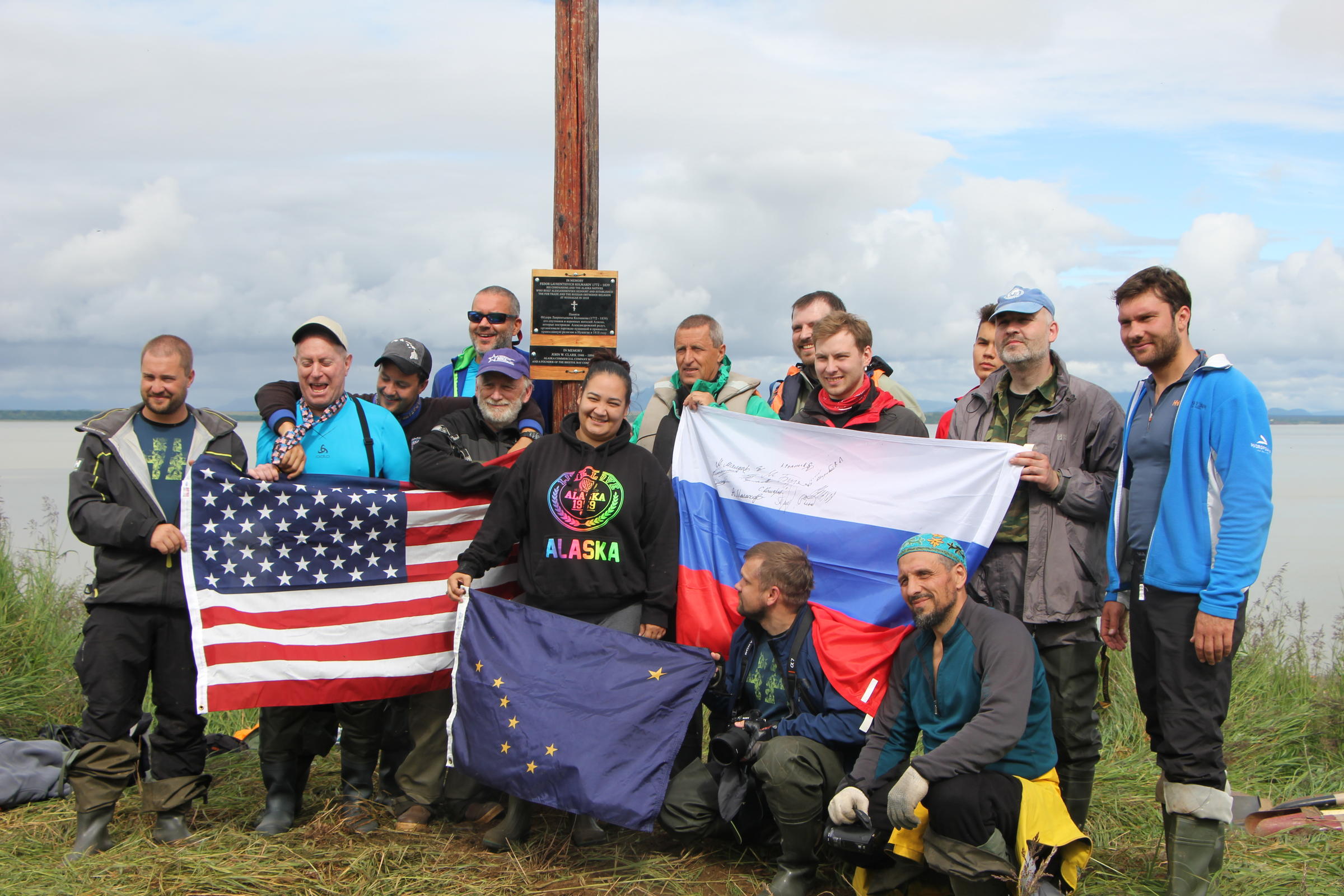
The Russian team and the Dillingham residents who helped to place the monument at Nushagak pose with the American, Russian, and Alaskan flags. (Photo by Allison Mollenkam/KDLG)
The Russian team and the Dillingham residents who helped to place the monument at Nushagak pose with the American, Russian, and Alaskan flags. (Photo by Allison Mollenkam/KDLG)

An expedition of Russian adventurers arrived Tuesday in Dillingham for their trip to retrace a route taken by historic Russian explorers.

The Russian visitors were greeted in Dillingham by that most American of rituals, a potluck dinner.

A packed house with more than 30 Dillingham residents came to meet the expedition of 12 Russians and one American.

Dillingham Mayor Alice Ruby highlighted the historical significance of the visit happening this year.

“We’re especially honored that in this year when we commemorate the sale of Alaska from Russia to the U.S. that you’ve chosen Bristol Bay for your 2017 expedition,” Ruby said.

Dr. Mikhail Malakhov, an explorer and physician, led the expedition. He led one other expedition to Bristol Bay six years ago.

This is his 10th trip to Alaska to retrace the routes taken by Russian explorers in the age of Russian America and he said planning the trips takes months.

“I am reading quite a lot,” he said. “Archives and books of professional historical people and actually it’s usually it takes many months to prepare any type of expedition.”

That research will allow Malakhov and his team to follow the exact route taken by Ivan Yakovlevich Vasiliev in 1830.

Tim Troll has helped Malakhov organize logistics while the team is in Dillingham.

He explained this year’s trip up the Wood River, through the lakes to the Kuskokwim.

“They’ll be taking off, I think probably from Snag Point, and putting their kayaks together and starting their paddle up the Wood River. Then it will take them at least three weeks to get to Aniak. So it’s a long, long… It’s a long trip and a lot of it is upriver and over the tundra.”

A trip that long requires lots of supplies. Malakhov’s younger son, Alexi Malahov told the crowd what the group will eat.

“We will catch some fish, but also in our food stuff, we have canned meat, canned chicken, and rice, noodles, and also use some different kinds of like, pilot bread yes and different delicious stuff like Nutella.”

The next morning, however they simply brought a picnic of leftovers from the reception.

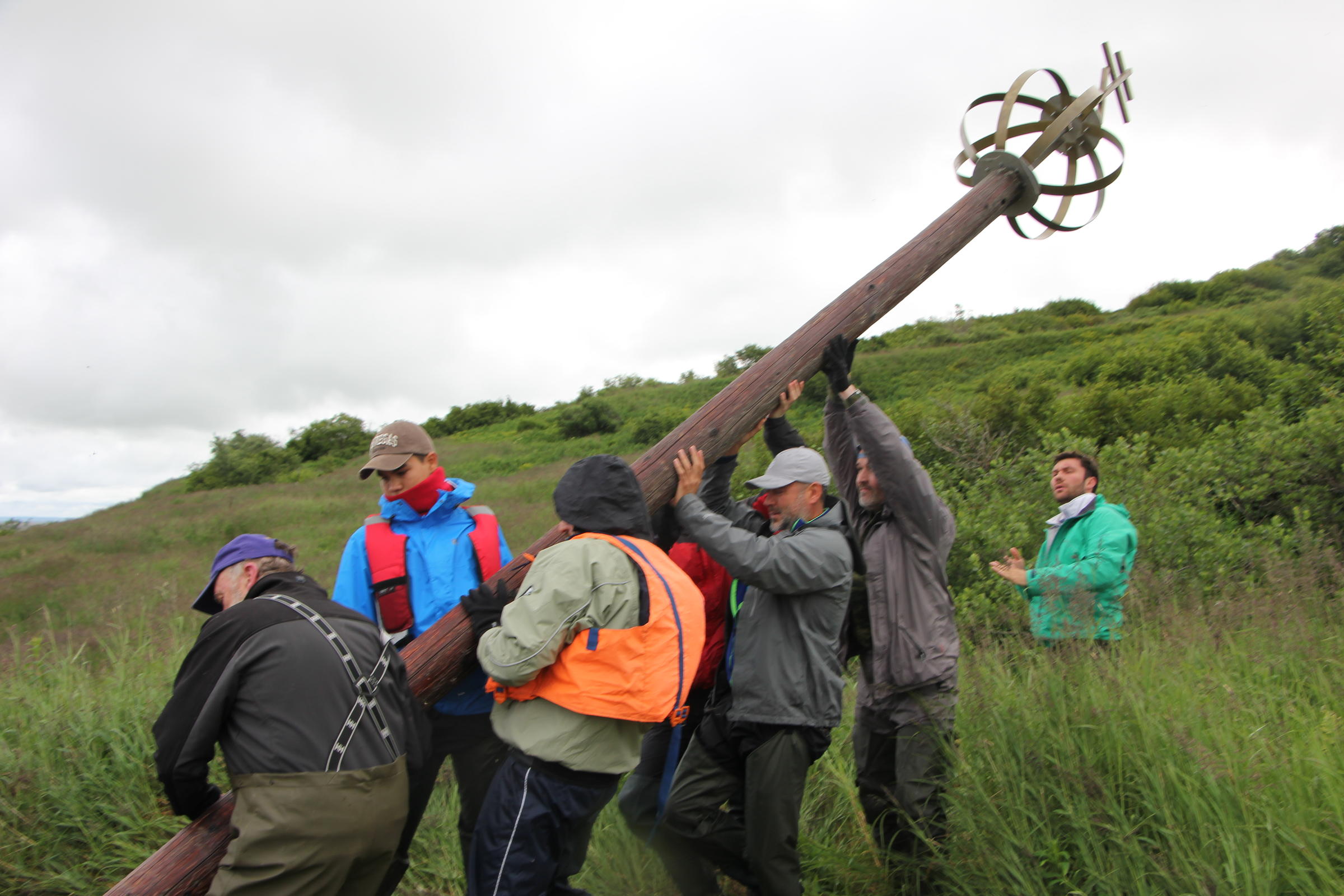
Members of the Russian expedition and Dillingham locals work to erect the monument at Nushagak. (Photo by Allison Mollenkam/KDLG)

With the help of a few locals and their set net skiffs, they went across the bay to Nushagak to erect a monument to Fedor Kolmakov and John W. Clark.

There was a similar monument to Kolmakov at the Russian trading post and orthodox church at Nushagak in the 19th century.

Local artist Pat Walsh designed the new one.

Reverends Michael Nicolai and John Nicori blessed the monument before it was taken across the bay.

At Tuesday night’s reception, Robin Samuelsen, member chief of the Curyung Tribal Council, explained John W. Clark’s significance.

“My great-great-grandfather was John W. Clark, who ran the commercial trading company over in Nushagak,” Samuelsen said. “John was the starter of the fishery here in Bristol Bay.”

Clark worked closely with the Russians in Bristol Bay then.

Malakhov hopes his trips can foster similar people to people collaboration.

“Doesn’t matter what’s going there on the political level, yeah. But between people, our relations is getting much more open and we are glad to be here again.”

During their time in Dillingham the Russian adventurers worked to create positive relationships with their American neighbors. However, that time had to draw to a close Thursday night as they launched from Snag Point.

Ivan Korobov is the youngest member of the group at just 14. As the other members of the group finished last minute packing, he was already ready, standing by his kayak in the water. He says he’s excited for the trip.

“It’s quite cool. I think it will be very difficult and we’ll, I hope we’ll not have a lot of problems, but I think it will be very cool and very fascinating, you know.”

Despite the difficulty of the trip, he appreciates the beauty of Alaska.

“Here is very peaceful and a lot of good places, very good fish that here is everywhere and we’ll always see this here.”

He’s not alone in his love of Alaskan salmon. Dr. Malakhov enjoys it too.

“Believe me, this is delicious. You can’t find such salmon, smoked salmon in middle part of Russia. Probably far east, but we live in middle part of Russia. Thank you very much Alaska for nice salmon.”

Peratrovich dollar coin will either have her likeness or a symbolic Tlingit raven

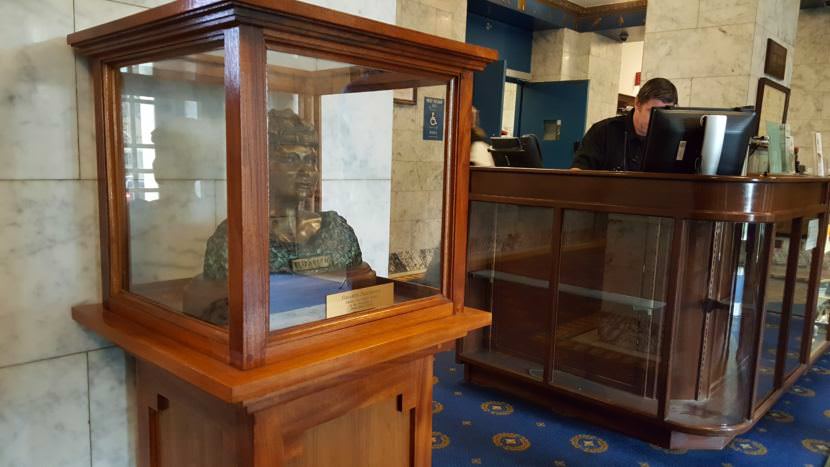
Ryan Strickland, a security and information specialist for the State of Alaska, works the front desk of the Alaska Capitol on Tuesday, July 11, 2017, in downtown Juneau. In the front lobby a bust of Alaska Native civil rights leader Elizabeth Peratrovich greets capitol visitors. (Photo by Tripp J Crouse/KTOO)
Ryan Strickland, a security and information specialist for the state of Alaska, works the front desk of the Alaska Capitol on Tuesday in downtown Juneau. In the front lobby a bust of Alaska Native civil rights leader Elizabeth Peratrovich greets capitol visitors. (Photo by Tripp J Crouse/KTOO)

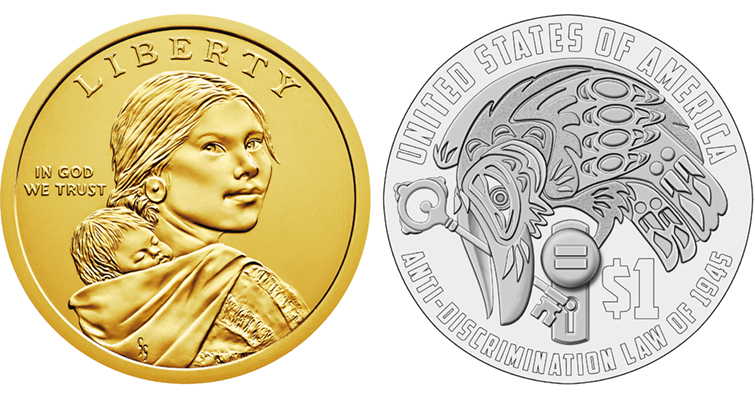
The 2020 dollar coin honoring Elizabeth Peratrovich will either have a literal image of the Alaska Native civil rights leader on it, or a Raven holding a key — a symbol of her Tlingit Raven moiety and her role in agitating for an anti-discrimination law.

The 2020 Sacagawea dollar coin design will feature one of two designs on the "tails" or reverse side: A raven unlocking a door (pictured above) or a picture of Elizabeth Peratrovich featuring her Tlingit Raven clan moiety. (Image courtesy U.S. Mint)
The 2020 Sacagawea dollar coin design will feature one of two designs on the “tails” or reverse side: A raven unlocking a door (pictured above) or a picture of Elizabeth Peratrovich featuring her Tlingit Raven clan moiety. (Image courtesy U.S. Mint)
This coin sketch shows the proposed design for the reverse of the 2020 Sacagawea gold dollar coin, which features Alaska Native civil rights leader Elizabeth Peratrovich. It is one of two designs being considered by the U.S. Secretary of Treasury. (Image courtesy U.S. Mint)

While a final decision by the head of the Treasury Department is months away, a lot has gone into getting the Peratrovich onto the flipside of the Sacagawea dollar coin up to this point.

Since 2009, the reverse of Sacagawea dollar coins has been redesigned annually to honor Native American heritage. The coins aren’t made for general circulation anymore, though coin collectors do buy them directly from the U.S. Mint above face value.

“For each year we go to our staff of artists and they generate designs,” said Mike White, who has been with U.S. Mint for 28 years. “We consult with various Native American groups,” White said. “In the instance of the 2020 (coin) we’re consulting with the Tlingit tribe.”

A team of five artists in Philadelphia worked with various stakeholders on coin designs, including the Central Council of Tlingit and Haida Indian Tribes of Alaska, the Sealaska Heritage Institute and U.S. Sen. Lisa Murkowski.

The artists want to ensure the designs fit historically and culturally.

“We’ve got a very talented group of artists that work on them,” White said. “When we go before the committees, we try to give them a real variety of designs and a good representation of whatever the theme is chosen that year.”

The organizations he’s referring to are the Citizens Coinage Advisory Committee and the Commission of Fine Arts. The coin advisory committee endorsed the Raven perched on a door handle grasping a key. The fine arts commission chose a design showing a three-quarters profile of Peratrovich with a symbol of her Tlingit Raven moiety.

Thomas Luebke is secretary of the Commission of Fine Arts. His background is in architecture. He said coins aren’t that different from designing sculptures and buildings.

“It’s sort of graphic and it’s sort of 3-D at the same time,” he said. “It’s interesting to try to convey the meaning in a symbolic way on a very small medium. I think that everyone likes to see the mint stuff.”

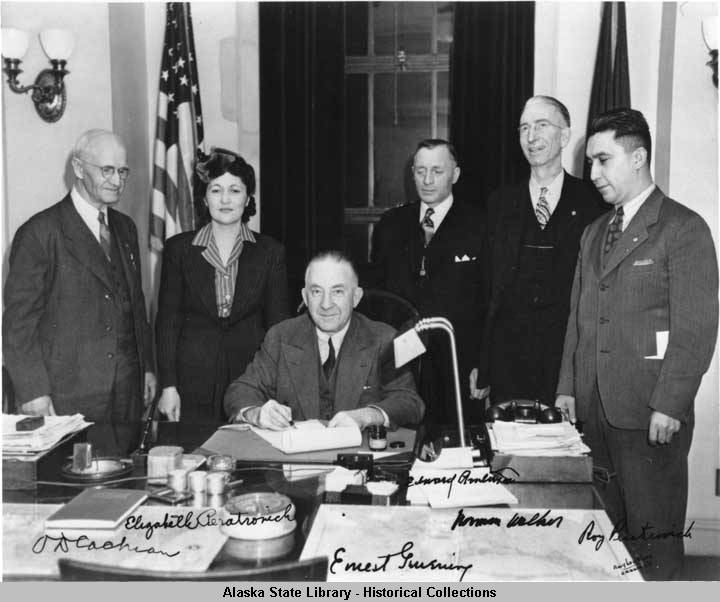
Then-Alaska Gov. Gruening signs the Anti-Discrimination Act of 1945, as O.D. Cochran, left, Elizabeth Peratrovich, Edward Anderson, Norman Walker and Roy Peratrovich stand behind him. (Photo courtesy Alaska State Library Photo Collection, P01-3294)

The abridged version of Peratrovich’s story begins when she and her husband moved from Klawock to Juneau in the 1930s or 1940s. As Alaska Native Sisterhood Grand President Cecelia Tavoliero tells it, the couple faced housing discrimination because they were Alaska Native.

“They found there were barriers, and they were not subtle like they are now. They were very blatant,” Tavoliero said. “They were disrespected and told that they couldn’t live in certain areas. They took objection to that and decided to do something about it.”

With the support of Alaska Native Sisterhood and Alaska Native Brotherhood, Tavoliero said Peratrovich took the fight to Alaska’s territorial legislature.

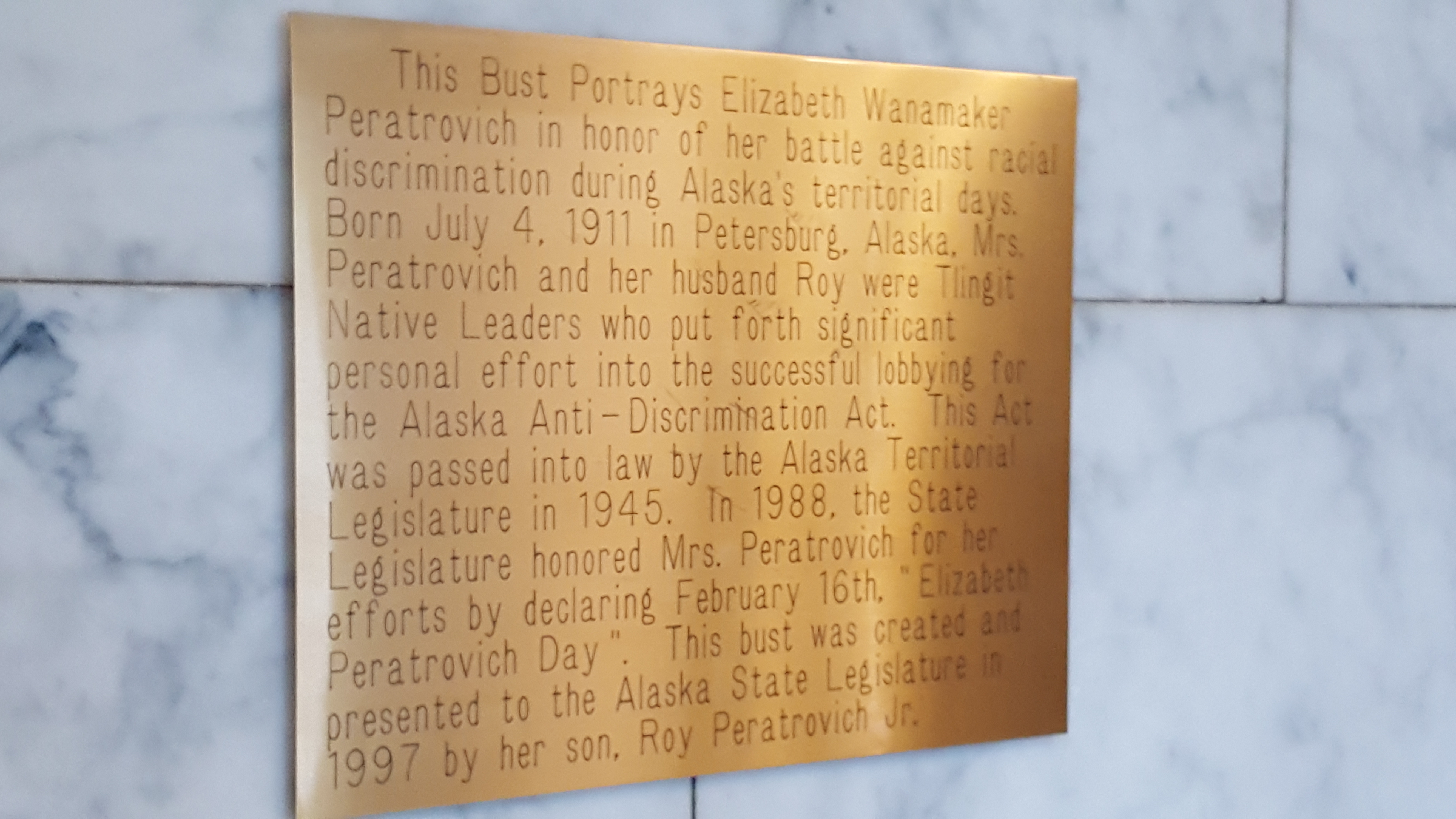
A plaque explains the importance of Elizabeth Peratrovich and the Anti-Discrimination Act of 1945 above a bust of the Alaska Native civil rights leader in the Alaska Capitol in downtown Juneau. (Photo by Tripp J Crouse/KTOO)

“Seeming like David and Goliath because there were very many of the senators speaking very blatant negative about the Native people, basically calling the Native people inferior,” Tavoliero said.

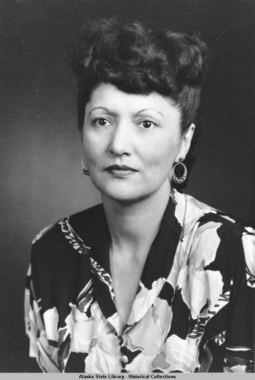
Portrait of Elizabeth Peratrovich. (Photo courtesy Alaska State Library Office of the Governor Collection, P274-1-2)

Peratrovich is credited with successfully advocating for the passage of the Alaska territory’s Anti-Discrimination Act of 1945.

Alaska became the first U.S. state or territory with such a law, which guaranteed equal voting rights and equal access to commercial accommodations and services – years before the civil rights movement protesting racial segregation in the Lower 48.

“With her testimony, even though there were other folks involved in trying to get the bill passed, the anti-discrimination bill, she’s the one that pushed the final stone over the mountain,” Tavoliero said.

Raeanne Holmes, the communications coordinator for the Tlingit and Haida Central Council, said the coin is an exciting recognition.

“It’s the perfect way to mark the 75th anniversary of the state of Alaska’s Anti-Discrimination Act of 1945. We can’t think of a better way to honor the memory of her as our civil rights leader and that landmark passage.”

Seward statue unveiled in front of Alaska Capitol

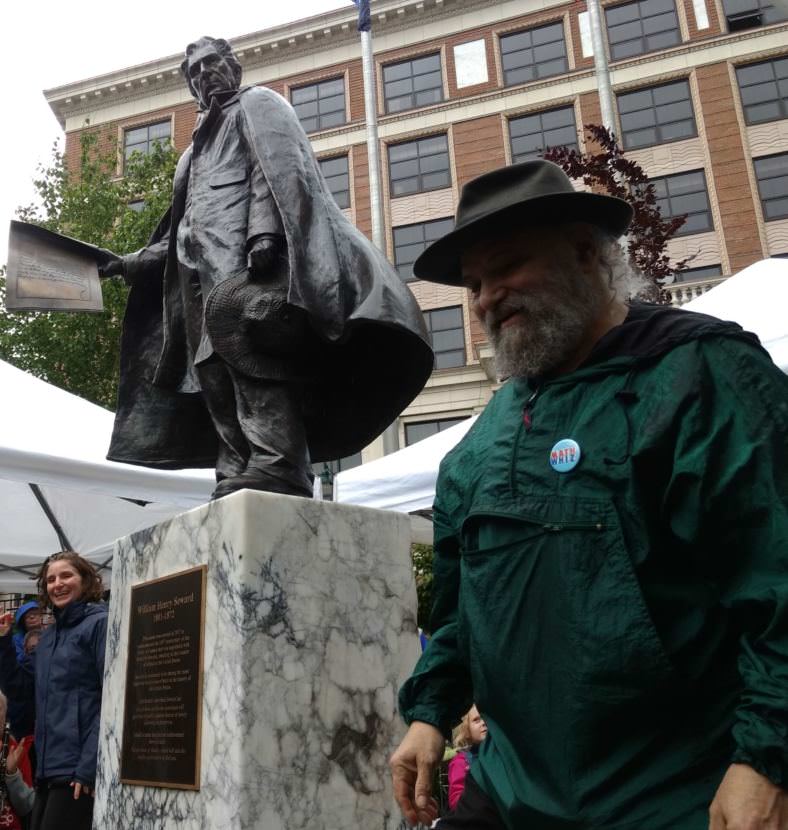
Sibling sculptors Judith, left, and David Rubin flank their 6-foot bronze sculpture of William Seward unveiled July 3 in front of the Alaska Capitol. (Photo by Jacob Resneck/KTOO)

A statue of the U.S. statesman behind Alaska’s 1867 purchase from Russia now stands in front of Alaska’s Capitol building.

The plastic covering was pulled down Monday afternoon to reveal a 6-foot sculpture of Secretary of State William Seward. The work of Ketchikan-based siblings David and Judith Rubin, it was erected to mark the 150th anniversary of the transaction that shifted Alaska from being Russian-America to U.S. territory.

The Juneau Community Marching Band struck up a tune as 21st century politicians honored the 19th century top diplomat who was one of President Lincoln’s closest confidants during the Civil War.

“You know you’ve heard the history of Seward but I’d like to just recite what Seward means to me,” U.S. Rep. Don Young told the 100 people gathered. “First, he made me a congressman and and I want to thank him for that. And secondly, every time I fly into Alaska and I do this twice a month and I’d be flying either to Southeast or up around the Railbelt into Barrow or somewhere and I think, ‘My God, what a place he did for us’ when he bought us for $7 million … $200,000 or $200 million or whatever it was.”

But Steve Haycox, a University of Alaska Anchorage history professor, noted that many who lived here in 1867 resented the transaction between colonial powers.

Tlingit and Haida leaders have rightly called attention to the fact that their ancestors were not included in the purchase agreement despite their having a concept of property ownership,” Haycox said. “To my mind, it’s appropriate that as part of the sesquicentennial celebration we fully acknowledge Tlingit and Haida sensitivity on this issue.”

Lt. Governor Byron Mallot speculated that Seward would have appreciated the negotiating skills of the Alaska Native tribes when the Alaska Native Claims Settlement Act was passed in 1971.

Like selling the Brooklyn Bridge, Alaska Natives sold Alaska again in 1971 for a bit more than $7.2 million,” Mallot said. “And that was for a $1 billion and 44 million acres of land that we were allowed to keep.”

The statue was largely made possible through private fundraising from individuals and corporate donors. It stands slightly below street level next to the Dimond Courthouse.

Medication dating back to the 1800s stolen in Homer

Homer police patch
(Flickr photo courtesy scoutnurse)

Tracking down antique vials of medication dating back to the late 1800s isn’t typically on the Homer Police Department’s agenda, but it is this week. A long-time Homer resident reported a box full of antique medical supplies stolen Tuesday. Some of the items taken were destined to return to the village of Wiseman, where they were collected nearly 70 years ago.

Judith James has been gathering several items belonging to her deceased husband, Walter Johnson, to bring to the University of Alaska Anchorage’s Consortium Library and the village of Wiseman. Johnson, a former physician, attended the University of Alaska Fairbanks in the 1940s. He owned the Wiseman Trading Company store in the small village about 240 miles north of Fairbanks while he attended college.

James intended to donate several records and items he collected during that time, but when she stopped by her storage unit Tuesday, several items were missing, including the box full of antique medical equipment.

“Sealed glass tubes I remember seeing in the box with silk suturing thread and a sterile needle,” James explained. “That’s how they kept it sterile. These things are well over 100 years old, and the packaging is a little bit rough.”

Some of the medications date back to the 1880s. Johnson collected medical supplies that were sold in the store and some that had been sitting in the attic. He brought them with him when he left for medical school in 1948.

Johnson also collected several records on gold mining in the Wiseman area and has written several papers on a variety of historical topics in Alaska. The university’s Consortium Library already has several of Johnson’s papers and items in its collection.

James was preparing for a trip back to Wiseman in July to spread her husband’s ashes and return the antique medical equipment to the store, which now serves as a museum.

“They’ve the refurbished the old trading company store and there are many antique and historical items on display there,” James said.

She is upset someone would steal such sentimental items, but James is also concerned about some of the medication could be extremely toxic.

“I just started getting really worried yesterday thinking about somebody leaving these things perhaps in a place where children could access them, pull the corks or break the seal and maybe smell or ingest these things,” James explained.

James still has some of Johnson’s collection from his time in Wiseman, including business licenses dating back to the 1920s. She still intends on making the trip to donate them.

James has reported the incident to police. She asks that anyone with knowledge of the box and its contents bring it to the police department or another location where it will be safe. She has not heard if there are leads in the case. Homer Police could not be reached for comment in time for this story.

Archaeologists find Alutiiq fishing method at low tide

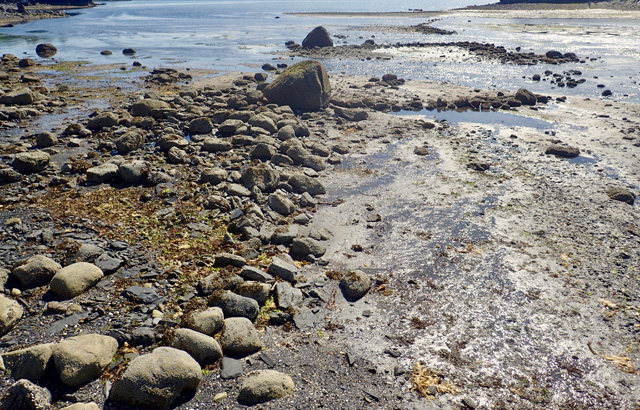
Rocks alignments representing the remains of an intertidal fish trap, Kodiak Island, Alaska. (Photo courtesy the Alutiiq Museum)

A local archaeologist says there may be the remains of a historic Alutiiq fish trap on the north end of Kodiak Island.

Those types of man-made formations are rare to discover in the region, he said.

The Alutiiq Museum is in its second year of documenting ancestral sites on Afognak Native Corporation lands. Museum archaeology curator Patrick Saltonstall noticed something while surveying one area on the shoreline at low tide.

He identified it as a fish trap, which he calls a corral.

“They’re like stone walls on the inter-tidal zone so when the tide came in, all the fish went to go up stream, would float in over the corrals or the trap, and then when the tide went out, they’d be stranded in the pens, so then you catch a whole lot of fish.”

He says it can be challenging to determine whether a corral is natural or man-made, but he sees evidence of it being a fish trap.

“I could tell that there were some boulders that they used that there were there already, but almost all of it was bringing boulders in,” he said. “It’s like a wall, like 5 feet across and maybe 2 feet high now, but it was probably much higher (back) in the day.”

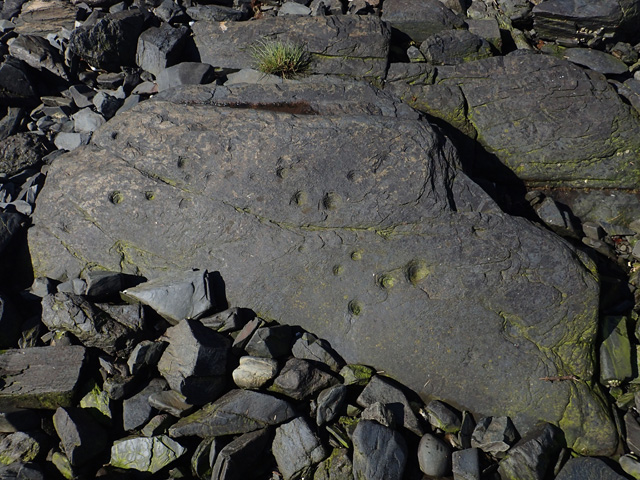
Petroglyphs carved into a shoreline boulder adjacent to the intertidal fish trap. (Photo courtesy the Alutiiq Museum)

This is the first time’s Saltonstall has ever seen a corral like this one on the island, but they’re common in southeast, which he said could because the people there used them more frequently.

“A lot of the places down there are more protected, they aren’t as open to the ocean as Kodiak is, so maybe the lower energy they tend to be preserved better,” he said. “Whereas in Kodiak after a big storm a lot of these things might get demolished.”

Archaeologists found what looks like petroglyphs nearby, he said, speckled dots and incised lines carved into slate.

“What the cool pattern is is they all seem to be associated with fishing localities,” Saltonstall said. “You look at the typical petroglyphs, you know with faces, whales, drummer, they’re associated more with whaling or with villages.”

It’s hard to determine the age of either the corral or the petroglyphs, but based on nearby archaeological sites, the carvings could be dated back to about 500 years ago.

Site notifications
Update notification options
Subscribe to notifications