Public Safety

Juneau’s firefighters union warns of delays due to ongoing staffing shortage

Capital City Fire/Rescue officials respond to a trailer fire in June 2023. (Photo by Clarise Larson/KTOO)

Juneau’s firefighters union sent out a statement Thursday warning residents that emergency response times may be delayed due to major staffing concerns.

Logan Balstad is the local Juneau Career Firefighters union president. He said this is the most understaffed Capital City Fire Rescue has been in his more than a decade with the department.

“We’re expecting that there will be more calls where you have to wait for a piece of apparatus to respond to your emergency because it’s tied up doing something else,” he said.

This warning comes as the union negotiates wages with the City and Borough of Juneau. According to wage information KTOO received earlier this year before negotiations started, some positions start at $20 per hour. That’s lower than the pay for most similar positions in the Pacific Northwest.

For years, Juneau firefighters have been working increasing hours — often mandatory overtime — to accommodate demand. That’s on top of 56-hour work weeks.

Earlier this year, union members said the lack of competitive pay means firefighters leave as the department struggles to hire replacements. Currently, the department said there are six vacancies, two injured responders, and one staff member on military leave.

“When we work overtime, we’re working 48 hour shifts,” Balstad said. “And when you start doing that repeatedly – doing 48 hours on, 24 hours off, 48 hours on – that can be really hard on the responders and their families, and you know, it’s detrimental in the long run.”

Balstad said the emergency call volume always surges in the summer. Juneau has three ambulances, but the department only has enough staff to operate two. If the department was staffed to ideal levels, they would be able to operate all three during the summer cruise rush.

He said delays mean that medical emergencies lose precious time.

“If we have a cardiac arrest, every minute you go without CPR your chances of return of circulation, of living through this experience, diminishes about 10% and I think we’re about nine minutes on average for our CPR response time,” he said. “So we’re really hoping that members of the public are out there doing good CPR.”

Balstad said it helps if residents know CPR and how to identify the signs of a heart attack or stroke when ambulances are delayed.

In 2024, the department also responded to 18 structure fires. But none of their responses had enough staff to meet the National Fire Protection Association’s standard for minimum number of staff responding.

Correction: An earlier version of this story misstated the number of ambulances in Juneau. 

Jury finds ‘The New York Times’ did not libel former Alaska Gov. Sarah Palin

Former Alaska Gov. Sarah Palin leaves Manhattan federal court on Tuesday in New York. A jury has concluded The New York Times did not libel Palin in a 2017 editorial that contained an error that she says damaged her reputation.
Former Alaska Gov. Sarah Palin leaves Manhattan federal court on Tuesday in New York. A jury has concluded The New York Times did not libel Palin in a 2017 editorial that contained an error that she says damaged her reputation. (Larry Neumeister/AP)

NEW YORK — The New York Times did not libel former Alaska Gov. Sarah Palin in a 2017 editorial that contained an error she claimed had damaged her reputation, a jury concluded Tuesday.

The jury deliberated a little over two hours before reaching its verdict. A judge and a different jury had reached the same conclusion about Palin’s defamation claims in 2022, but her lawsuit was revived by an appeals court.

Palin was subdued as she left the courthouse and made her way to a waiting car, telling reporters: “I get to go home to a beautiful family of five kids and grandkids and a beautiful property and get on with life. And that’s nice.”

Later, she posted on the social platform X that she planned to “keep asking the press to quit making things up.”

Danielle Rhoades Ha, a Times spokesperson, said in a statement that the verdict “reaffirms an important tenet of American law: publishers are not liable for honest mistakes.”

Palin, who earned a journalism degree in college, sued the Times for unspecified damages in 2017, about a decade after she burst onto the national stage as the Republican vice-presidential nominee.

Her lawsuit stemmed from an editorial about gun control published after U.S. Rep. Steve Scalise, a Louisiana Republican, was wounded in 2017 when a man with a history of anti-GOP activity opened fire on a Congressional baseball team practice in Washington.

In the editorial, the Times wrote that before the 2011 mass shooting in Arizona that severely wounded former U.S. Rep. Gabby Giffords and killed six others, Palin’s political action committee had contributed to an atmosphere of violence by circulating a map of electoral districts that put Giffords and 19 other Democrats under stylized crosshairs.

The Times corrected the article less than 14 hours after it was published, saying it had “incorrectly stated that a link existed between political rhetoric and the 2011 shooting” and that it had “incorrectly described” the map.

During the trial, former Times editorial page editor James Bennet tearfully apologized to Palin, saying he was tormented by the error and worked urgently to correct it after readers complained to the newspaper.

Palin testified Monday that death threats against her increased and her spirits fell after the editorial was published.

In his closing argument Tuesday, Palin’s attorney, Kenneth Turkel, had urged the jury to find the Times liable for defamation on the grounds that Bennet either knew what he was publishing was wrong or acted with “reckless disregard” for the truth.

He asked the jury to award Palin compensatory damages for the harm done to her reputation and private mental anguish, adding that they should “find a number and let her get some closure to this thing.”

“To this day, there been no accountability,” he said. “That’s why we’re here.”

He told jurors not to be deceived by Palin’s “bouncy” persona on the witness stand.

“She doesn’t cry a lot,” Turkel said. “It may have been to them an honest mistake. For her, it was a life changer.”

Felicia Ellsworth, an attorney for the Times, told jurors in her closing that there was not “one shred of evidence showing anything other than an honest mistake.”

Ellsworth said Bennet and the Times “corrected the record loudly, clearly and quickly” once the error was discovered.

The lawyer pointed out that several Times editors testified consistently about the effort to correct the error and the importance they placed on accuracy while Palin’s claims were “supported by nothing other than her say so.”

“To Gov. Palin, this is just another opportunity to take on fake news. To James Bennet, the truth matters,” Ellsworth said.

In February 2022, Judge Jed S. Rakoff rejected Palin’s claims in a ruling issued while a jury deliberated. The judge then let jurors deliver their verdict, which also went against Palin.

The 2nd U.S. Circuit Court of Appeals in Manhattan restored the case last year.

The appeals court said Rakoff’s dismissal ruling improperly intruded on the jury’s work. It also cited flaws in the trial, saying there was erroneous exclusion of evidence, an inaccurate jury instruction and a mistaken response to a question from the jury.

Turkel said as he left the courthouse that the legal team will evaluate whether to appeal again.

Lyrissa Lidsky, a University of Florida constitutional law professor, told The Associated Press that the verdict Tuesday “was certainly not a sure thing” amid widespread distrust of news media.

And, Lidsky added, Palin put the newspaper’s mistake in the public eye.

“Even if Sarah Palin didn’t win a jury verdict, she did, by bringing suit, achieve some likely goals,” Lidsky said.

Juneau swim class teaches parents and babies water safety skills

Swim instructor Katie McKeown blows bubble with students at the Dimond Park Aquatic Center pool in Juneau on April 19, 2025. (Photo by Jamie Diep/KTOO)

Listen here:

Learning to swim is an important skill, especially in Alaska. The state has the longest coastline and the highest rates of drowning in the country. One way to reduce that risk is through swim lessons. And in Juneau, babies can start learning as young as six months. 

The city’s Parent and Tot swim classes do more than give babies playtime in the pool. Juneau’s Aquatics Programming Coordinator Ellen Johnston said it teaches both parent and child how to be safe in the water. 

“The parent is learning how to make the water a safe and fun place and introduce basic swim concepts like buoyancy and breath control through blowing bubbles,” she said. “And the child is learning that the water is a safe, fun place to be, but also a place where, you know, there are limits and safety considerations.”

Southeast Alaska has the third highest drowning rate in the state, according to the most recent state report. Johnston said these classes can teach children life-saving skills. 

“Water is an unavoidable fact of life in Juneau, and making sure that kids know how to avoid unsafe incidents in the water and what to do if they see or [are] involved in a dangerous water incident can really be the difference in saving a life,“ she said.

Johnston said this class is one of the most popular ones the city pools offer. She said they’re currently running four classes, but that number changes throughout the year depending on staffing.

Katie McKeown is one of the swim instructors for the class. She got certified to teach in January because she thought the city needed to offer more classes.

“I noticed there were less and less swimming lessons available to my own kids, and I just saw that demand,” McKeown said. “And instead of complaining about it anymore, I really just wanted to do something.”

McKeown put her own kids through swim lessons at the local pool and wanted to make sure other parents had the same opportunity she did. She said it’s rewarding to teach classes for some of the pool’s youngest patrons.

“There are babies on the first day that are completely terrified, so mad about being there, and they’re crying, and then by the last class, like today, they’re completely relaxed in the water,” she said. “They’re going under with their parents, they’re all just so excited, and everybody is so supportive of all the other babies.”

Swim instructor Katie McKeown pushes a small boat in the pool at the Dimond Park Aquatic Center in Juneau on April 19, 2025. (photo by Jamie Diep/KTOO)

Amanda Ryals is in the class with her nine-month-old son T.J. Ryals said she’s learned a lot from the class on how to be safe in the water with her baby.

“It’s not something that I know how to teach him, necessarily, without instruction,” Ryals said. “So the instructors are pretty awesome and working with us, and he’s doing great in the classes.”

She said they’re signed up for another session of classes and hope to keep coming back to the pool.

“He’s going to be a water baby, we think. So we want him to get as much time in the water as he can and enjoy it,” Ryals said. 

The current session of classes will keep running through May and June, and Johnston said they typically offer more year round.

Trial again delayed in sexual assault case against former Juneau chiropractor

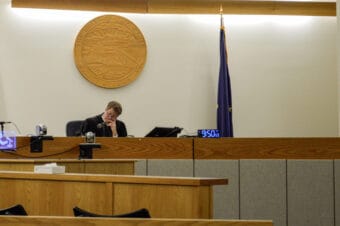
Courtroom A at the Dimond Courthouse in Juneau on Dec. 11, 2024. (Photo by Yvonne Krumrey/KTOO).

The trial for a former Juneau chiropractor accused of assaulting more than a dozen patients has once again been delayed. It was scheduled to start this week, but was pushed back at a pre-trial conference because a member of the defense team is having severe health issues. The court plans to hear the case later this year. 

Police arrested Jeffrey Fultz four years ago on three charges of sexual assault. More women have come forward since. A total of 14 women, a majority of whom are Alaska Native, have now accused Fultz of assault.

The charges are based on accusations that he assaulted patients who sought chiropractic care while he worked for Southeast Alaska Regional Health Consortium. 

Some of the charges date back more than a decade. 

The case has seen years of delays in the pre-trial process. Now the court is attempting to set a trial date for the third time. The delays have left the alleged victims in limbo, waiting for justice.

At a pre-trial conference last week, Fultz’s defense attorney, Anchorage-based James Christie, reported that his co-counsel, Wally Tetlow, is experiencing life-threatening health problems and has been advised not to travel for at least one month. Christie argued that Tetlow’s in-person participation is vital.

“So I think, I think we’re in a position where there’s, there’s really, unfortunately, we have to identify a new window for a trial date,” Christie said.

State Prosecutor Jessalyn Gillum told the judge that her team opposes the delay. 

“Given the age of the case, the number of victims, and the fact that the victims have been very clear on wanting their day in court, the state is in no other – has no other choice but to oppose this request,” she said.

Gillum acknowledged Tetlow’s health concerns, but pointed to the fact that Tetlow is not the attorney named in the case for Fultz’s defense — Christie is. She argued that his inability to participate in person shouldn’t derail the trial schedule. 

This is not the first time that the health of the defense has delayed the trial. Fultz’s previous attorney had health problems that caused delays for the majority of a year.

Several other factors have also contributed to the long wait for a trail. The investigating Juneau police officer died, then the first judge assigned to the case retired, and later Fultz’s first attorney was deemed “mentally unable” to continue with the case. 

Victims have repeatedly said in hearings that each time they have to call in to advocate for the case to go to trial, it’s traumatizing.

Fultz has been out on bail, living in Colorado with some pre-trial monitoring since 2021. He appeared in court in person once last year. 

Judge Larry Woolford, who is presiding over the case, said he was reluctant to reschedule, after the dozens of witnesses had set aside time for what is expected to be a long and complex trial. 

“I mean, certainly the parties are aware that it has been the court’s intention that this matter would be ready to go on April 21,” he said. “And we have been, I think it’s fair to say, marching steadily, if imperfectly, toward that for some time now.”

But he said Tetlow’s emergency health issues are within the bounds of what constitutes an appropriate reason for further delays. 

“This is obviously not something anybody could have predicted nor prevented,” Woolford said. 

Woolford cited recent orders from the Alaska Supreme Court to limit delays in older court cases, and said this situation abides by those new rules as well. Under that order, the defense and prosecution can request delays for up to 90 days each, and a court can consider delays for up to 90 days for “good cause.” 

Multiple witnesses who called into a hearing last week said this delay will impact the prosecution.

“I just want to remind the court that there are 14 victims that have cleared the next five weeks to make this happen,” one alleged victim said. Victims who called in did not identify themselves by name. 

Another cited the disruptions this is causing her own life. 

“I’m a therapist, and have to cancel my clients,” she said. “And it, you know, that’s a big deal too.”

Woolford said in the hearing the court is willing to extend the case into the summer, and no further. 

“The windows that I’ve outlined strike me as a reasonable compromise between the unfortunate situation in which your team finds itself, and the, I think, compelling need to get this matter to trial,” he said.

But both the prosecution and defense expressed that their teams and witnesses may not be available for much of the summer. 

A hearing to determine a future trial schedule is set for April 28. 

Skagway likely to lose nearly $20M in FEMA rockslide mitigation funds

A recent rockslide in November 2024 briefly closed down Skagway’s Railroad Dock. (Melinda Munson/KHNS)

Skagway was slated to be Alaska’s first recipient of grant funding under a Federal Emergency Management Agency program. But recent changes at the agency have put nearly $20 million in funding in question.

It’s a lot of money to lose for a community that hoped to use the funding to fix its unstable mountainside.

The title of the press release wasn’t encouraging: FEMA Ends Wasteful, Politicized Grant Program. That press release is how Skagway found out it likely won’t receive federal Building Resilient Infrastructure and Communities funding to mitigate rockslides above its busiest cruise ship dock.

FEMA is cancelling all BRIC grants awarded from 2020 to 2023. Skagway was recently approved for phase one of its grant in 2022. Borough Manager Emily Deach said she was just about to send a project bid to the Assembly. Phase one, which is $1.3 million from the federal government, is for project planning. Phase two is the actual construction.

“It looks like we may still get phase one funding, because it’s already been awarded and obligated,” Deach said. “But it seems as though phase two for construction is not going to be funded. And we’re sort of, we’re sort of waiting on this to get more information.”

In 2023, Skagway spent a little over $3 million installing safety mechanisms on its mountainside. Last year, it cost just over $1 million to mitigate the site. Deach estimates that this year, the municipality will spend $2 million.

The BRIC grant was meant to help the borough find a long-term solution.

What happens if phase two funding doesn’t come through?

“I don’t think there’s a need to panic at this point,” Deach said. “I think the project will be done. I think, if anything, maybe it will delay it a little bit because we’ll have to accumulate funding, or look at other options.”

Deach said that Skagway collects $13 per passenger on its two municipal docks and $8 per passenger on the privately owned Railroad Dock. That money goes into the vessel impact fee fund.

“We could potentially spend maybe a few years accumulating funding that would go towards this project,” Deach said.

But she acknowledged that losing the federal funding isn’t best case scenario, with all of the other capital improvement projects Skagway currently faces.

Kenai trooper assault trial delayed to 2026

Alaska State Troopers Sgt. Joseph Miller (left) and Jason Woodruff (right) pleaded not guilty to assault in Kenai District Court on Tuesday. (Ashlyn O’Hara/KDLL)

Two Alaska State Troopers facing assault charges over alleged conduct during their arrest of the wrong man in Kenai last year won’t go to trial until next February, after a judge pushed the trial date back Wednesday.

Former trooper Sgt. Joseph Miller Jr., 50, and Jason Woodruff, 43, each face a felony assault charge in Kenai Superior Court. The state charged the officers last summer after body-worn camera footage appeared to show them beating and Tasing as well as siccing a police dog on Benjamin Tikka near Kenai’s Daubenspeck Park last spring. Troopers later said they’d been attempting to arrest Tikka’s cousin, who shares the same last name, for failing to appear for a 10-day jail sentence.

Miller and Woodruff were initially charged with, and pleaded not guilty to, a misdemeanor assault. Then a Kenai grand jury upped those charges to felony assault, to which they also pleaded not guilty.

The troopers’ trial was originally scheduled for this June. But on Thursday, their lawyers asked for more time. Superior Court Judge Thomas Matthews scheduled a pretrial check-in hearing for later this year, and a new tentative trial date of February 2026.

If the case goes to trial next February, it will be almost two years after the assault is alleged to have occurred.

“As you’re all aware, there’s certainly emphasis on trying to get all cases to trial,” Matthews said. “This one is not certainly the oldest one in the court system, but I’m sensitive to the right of the victim, to the desire to get these cases moving forward.”

Thursday’s hearing comes amid a statewide backlog of trial cases and lengthy pretrial delays. An investigation published earlier this year by the Anchorage Daily News and ProPublica found some cases delayed as long as a decade.

Shortly after, the Alaska Supreme Court put new limits on how long a criminal case can be postponed. The order takes effect May 12 and limits delays to 270 days for cases filed in or after 2022.

Darryl Thompson, who’s representing Tikka in the case, said during the hearing he’s not surprised the delay was requested.

“Well, we’ve been sad for the victim that he has to be out there even longer to get their day in court, to be heard and to have that justice be met,” Thompson said. “But as a defense attorney, I do understand that lots of things can happen.”

Clint Campion, Woodruff’s attorney, said in response to Thompson that he and his client spent three full days reviewing case material.

“This is not a matter where we haven’t been diligently working through discovery, but there’s a lot of material to discover,” Campion said. “It’s a relatively novel case for the state.”

Matthews says he hopes to set a firm trial date at the August hearing. Matthews is based in Anchorage. He was assigned the case after all of Kenai’s three superior court judges recused themselves from the case.

A trooper spokesperson said Wednesday via email that Miller is no longer employed by the state of Alaska. Woodruff is still employed by the state, but was taken out of service when the department learned about the Tikka arrest. The police dog deployed in the arrest is no longer with the department.

Miller and Woodruff’s lawyers each said Thursday they’re preparing motions to dismiss their clients’ respective indictments.

Site notifications
Update notification options
Subscribe to notifications