Public Safety

Troopers find 2 missing dogs dead in Southeast Alaska crab pots

French bulldogs Whiskey (top) and Yoda (bottom) were found dead in March 2025, in crab pots near Southeast Alaska’s Thorne Bay. (Courtesy of Esther Rose Martin)

Content warning: this story includes details of possible animal abuse that some readers might find disturbing.

The remains of two French bulldogs that went missing on Southeast Alaska’s Prince of Wales Island over a month ago were found in a pair of crab pots on Friday.

The dogs belonged to Prince of Wales residents Esther, Kane, and Shane Martin. According to Kane Martin, the dogs disappeared just before Valentine’s Day. He’d taken them to work at a logging operation near Thorne Bay.

“We take the dogs to work with us every day and they just run back and forth between us while we’re working,” Martin said. “At about 9:30 a.m., we didn’t see them anymore. We figured they just went up and stayed at the pickup but they didn’t. Somebody came by and picked them up.”

Martin said he thinks someone abducted the dogs from Sandy Beach Road near the timber site. They were about a year old.

“They were great little dogs, I mean, just lovable as hell. I’m sure that’s why they just jumped in somebody’s rig with them,” he said.

Martin and his family posted flyers with pictures of the missing dogs – named Whiskey and Yoda. They advertised a $500 reward for their return. After a couple weeks without a lead, they doubled the reward.

About a month later, Alaska Wildlife Troopers were doing routine inspections of shellfish pots around Thorne Bay Harbor. They hauled up two crab pots that each had the remains of a dog in them. Troopers compared photographs and information from the Martins. They identified the dogs as Whiskey and Yoda.

According to Martin, law enforcement dropped the pots back in the water to see if their owner would come back for them, but someone came in the middle of the night and took the pots.

Trooper spokesman Austin McDaniel declined to share more information on the crab pots or their potential owner. He said the case is being investigated and troopers are attempting to corroborate information from potential witnesses before sharing it with the public.

Martin said he is also offering a $2,500 reward for information on the people involved.

“The troopers told me they thought it was something personal. I mean, there’s only one person on this island that has any kind of vendetta against me at all and it’s not even that much that I know of. I mean, I’ve lived here my whole life,” he said.

Anyone with information regarding the disappearance of the bulldogs are encouraged to contact the Prince of Wales Trooper Post at 907-826-2291.

NTSB says plane to Nome that crashed, killing 10, was overweight

The Cessna Caravan is a mainstay in Bering Air’s fleets. Caravans were parked at the Nome Airport on Friday, Feb. 7, 2025, as a massive search was ongoing for the plane that went missing the day before on its way from Unalakleet. (Ben Townsend/KNOM)

The passenger plane that crashed near Nome last month, killing all 10 people on board, was hundreds of pounds overweight according to a preliminary report from the National Transportation Safety Board.

The NTSB released its first report Wednesday on the crash of Bering Air Flight 445. The Cessna Caravan was en route from Unalakleet to Nome. A massive search extending into the next day found the plane on an ice floe, which had been moving up to 10 miles per day, at a location 34 miles southeast of Nome.

The dead include:

34-year-old Chad Antill of Nome (pilot)
52-year-old Liane Ryan of Wasilla
58-year-old Donnell Erickson of Nome
30-year-old Andrew Gonzalez of Wasilla
41-year-old Kameron Hartvigson of Anchorage
46-year-old Rhone Baumgartner of Anchorage
52-year-old Jadee Moncur of Eagle River
45-year-old Ian Hofmann of Anchorage
34-year-old Talaluk Katchatag of Unalakleet
48-year-old Carol Mooers of Unalakleet

At the request of U.S. Sen. Dan Sullivan, NTSB Chair Jennifer Homendy visited Nome soon after the crash, one of the deadliest in recent Alaska history. Residents of the region came together to support families of the victims as well as Bering Air, which has flown in Northwest Alaska for 45 years.

‘A tremendous amount of information’

Clint Johnson, the NTSB’s Alaska chief, said Wednesday that investigators haven’t yet determined why the plane was overweight.

“There’s no way around that. Unfortunately, our estimations are that the airplane was about 1,000 pounds over gross (weight),” Johnson said.

Still, Johnson said, it isn’t yet clear what specific role the weight might have played in the plane’s crash and whether other factors were involved.

Johnson noted that investigators have recovered several avionics components from the plane, with data from them still being assessed.

“That has given us a tremendous amount of information,” he said. “We’re still poring over that information at this point.”

According to the report, the flight originated in Nome and headed to St. Michael and Unalakleet, before taking off on a return leg to Nome at 2:37 p.m. on Feb. 6. It headed to Nome at a cruising altitude of 8,000 feet, under instrument-only flight rules for a time, then began a planned descent to 6,000 feet just before 3 p.m.

At about 3:15 p.m., an air traffic controller informed the Caravan that the Nome airport’s runway was closed for about 10 to 15 minutes due to deicing.

“The controller added that if the pilot wanted to ‘slow down a little bit’ to prevent the flight from arriving before the runway reopened, that would be fine, and the pilot acknowledged,” investigators wrote.

A minute later, the controller asked the plane to descend to 4,000 feet, which the pilot acknowledged.

In about 15 minutes, between 3 p.m. and 3:15 p.m., the plane’s airspeed gradually fell from a peak of about 160 knots to 112 knots and continued to decrease. It had also turned from a westerly heading to a southerly one.

“At (3:19 p.m.), the autopilot disengaged,” investigators wrote. “At that time, the airplane’s airspeed was 99 knots. About 19 seconds later, the airspeed had decreased to about 70 knots, and the altitude was about 3,100 (feet above sea level) which was the end of the data available from the onboard avionics.”

A final data point from the plane’s avionics, at 3:20 p.m., showed it 32 miles east of Nome and 12 miles offshore over Norton Sound. Third-party satellite data eight seconds later showed it at an altitude of 200 feet.

“(One second later), the controller transmitted a low altitude alert to the pilot,” investigators said. “The controller’s efforts to contact the pilot were not successful, and no further communications were received.”

Plane was 969 pounds overweight, NTSB says

Antill’s pilot records showed that he had about 2,500 hours of flight time, including just over 1,000 hours in Cessna Caravans. He had flown with Bering Air since 2022, completing a Cessna cold-weather operations course in October and recurrent ground training in January.

The crashed Caravan was fitted with a TKS ice protection system, which Johnson called a “weeping wing” designed to dispense deicing fluid from wing and tail surfaces’ leading edges in flight. That system was mechanically functional based on examination of the wreckage, he said.

The plane was also fitted with a fuselage cargo pod, according to the NTSB. Preliminary calculations found that the plane’s gross takeoff weight was about 9,776 pounds.

“This was about 969 (pounds) over the maximum takeoff gross weight for flight into known or forecast icing conditions under the TKS system supplement,” investigators wrote. “It was also about 714 (pounds) over the maximum gross takeoff weight for any flight operation under (a) flight manual supplement.”

The report says Bering Air’s load manifest estimated that the plane was carrying about 709 pounds of baggage and cargo. A post-accident examination found that approximately 798 pounds was aboard at the time of the accident.

A weather report from the Nome airport at 3:45 p.m. noted light snow for about 10 minutes shortly after 3 p.m., as well as “trace precipitation” and “trace icing” just before 3 p.m.

Searchers had said no emergency locator transmitter signal was detected from the plane, which investigators at the crash site initially confirmed.

“However, the on-scene examination determined that the ELT had become disconnected from the antenna likely during the impact sequence,” investigators said. “When a portable ELT antenna was installed, a strong signal was heard from a handheld receiver.”

Bering Air crash was ‘eerily similar’ to 2021 incident

Johnson said the flight data, and the sequence of events it depicted, has led investigators to revisit a 2021 incident near Fairbanks in which a Wright Air Service Caravan suddenly dropped thousands of feet. Nobody was injured in that incident, but a final NTSB report found that the plane was overweight when it encountered icing and suffered an abrupt loss in airspeed, with its autopilot subsequently disengaging.

Johnson called the events of the 2021 altitude drop “eerily similar” to the Bering Air crash, although the Wright Air Service plane was fitted with a less-powerful engine. Autopilot procedures often call for them to be checked during flight in icing conditions, but what happened during last month’s Bering Air crash is still not clear, Johnson said.

“We are in the process of looking to see what the sequence of events were, as far as the airspeed drop, the disconnection (of) the autopilot,” he said. “Was that pilot-induced? Was that automatically done? We don’t know, but we are drilling down into that information as we speak right now to see if we can get a little bit better of an idea and understand the final moments of this flight.”

Johnson said Wednesday that a total of 15 to 20 people are involved in the crash investigation, including NTSB officials and expert sources whom they are consulting. A final investigation report is expected in 12 to 18 months.

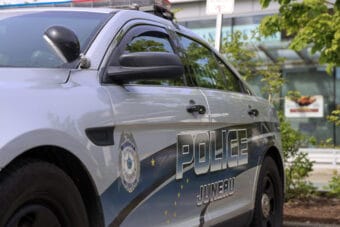
Juneau Assembly considers mandating release of body camera footage for police shootings

A Juneau police officer stands on duty in March 2023. (Photo by Clarise Larson/KTOO)

The Juneau Assembly may mandate a timeline for the release of body-worn camera footage when a police officer shoots someone. 

On Monday during a committee meeting, Assembly members discussed a proposal that would require the police department to release footage 30 days after an incident with little wiggle room for exceptions.

Assembly member Ella Adkison said the change is long overdue. 

“This is a delayed response to a community ask, and I do want to see this move forward and not stall more than it has already,” she said. 

Juneau Police Department officers have been wearing body-worn cameras since 2017. But there’s nothing on the books that dictates when body camera footage must be released to the public. 

Juneau residents have been pushing for the department to change that since last July when police publicly shot and killed a man downtown. Then in December, an officer shot and killed another resident who was wielding a hatchet in the Mendenhall Valley. 

In both cases, the police department did not release body-worn footage until the state’s Office of Special Prosecutions ruled whether the officers involved were justified in their use of lethal force or would face any criminal charges. The officers were cleared of criminal charges for both deaths. 

Last year the Anchorage police department enacted a similar body camera policy following a similar public outcry after a string of police shootings. Its policy now mandates footage of police shootings be released within 45 days of the incident. 

Angie Kemp, the director of the Criminal Division of the Alaska Department of Law, spoke to the proposed ordinance at the meeting. She said state investigations are often riddled with delays. She warned the Assembly that enacting hard-mandated timelines with little to no exceptions could taint the investigations if they’re still ongoing. 

“From my standpoint and the way that this is currently drafted, I do believe that it’s going to affect criminal prosecution in the community of Juneau — and I don’t say that lightly,” she said. “I don’t say it because I have some interest in keeping body-worn cameras from being released, other than the effect that it might have on our ability to do our jobs.”

City Attorney Emily Wright said it’s up to the Assembly to decide what policy they think is right for the community.

“It is a balance of that public need for transparency and the effect on that investigation,” she said. “There are a lot of communities and states that have said ‘We think it is worthwhile to provide that transparency to our public even if there is a risk to the future prosecution.’”

The Assembly will discuss the proposed rule once more as a committee before a vote. Residents will have a chance to give public testimony on the ordinance in the coming months. 

‘Other people’s beloveds’: The decisions and delays that preceded a fatal beating at Anchorage’s jail

Left: William Farmer (Photo provided by Robin Farmer) Right: Lawrence Fenumiai (Photo provided by Simeona Galletes-Fenumiai)

The lives of William Farmer and Lawrence Fenumiai ran parallel before merging with deadly consequences at the Anchorage jail in December.

Both men were diagnosed with schizophrenia in their 20s, their relatives say. Both families struggled to find help.

And both Farmer and Fenumiai ended up in Alaska’s correctional system, where people with mental illness make up nearly a quarter of the in-custody population but can’t always get the therapeutic support they need.

On Dec. 17, less than 24 hours after the men began sharing a cell, Alaska State Troopers say Fenumiai fatally beat Farmer, who died in early January.

Now Fenumiai faces first-degree murder charges as both families question the way the Alaska Department of Corrections handled the challenge of housing two people with diagnosed mental health disorders in a crowded jail cell.

Why were Farmer and Fenumiai placed in the same cell to begin with? Why was that cell in a transitional intake area rather than the jail’s designated mental health unit? And why was Fenumiai still there after a judge dismissed the case against him a week earlier?

Farmer’s twin sister, Robin, said her brother had been struggling with mental turmoil and hallucinations and couldn’t always make choices that were in his own best interests.

“I remember thinking, ‘Well, at least he’s safe,’” she said of his arrest in December. “That’s not true. You’re not safe in jail either.”

‘They set him up for failure’

The Department of Corrections is conducting an internal investigation that is ongoing, state officials said this week. Such investigations are standard for any death connected to a DOC facility.

“We want folks to come into our system and leave our system better, and to have a negative outcome like that, it bothers all of us,” said Adam Rutherford, the department’s deputy director for health and rehabilitation services. “None of us want to see that type of event occur.”

Farmer was 36 when he died. He came from an Anchorage family with deep Alaska roots that included a few generations of bush pilots and ownership of a Mat-Su lodge.

Police said Farmer had just entered the jail after a string of robberies at several Midtown businesses in late November and early December.

He was placed in a cell with two other men. Instead of a bunk, he was provided a plastic “boat” on the floor in a cell designed to hold two people.

Fenumiai, a 33-year-old former football standout at Juneau-Douglas High School, was already in the cell when Farmer arrived. He was awaiting release after a judge found him incompetent to stand trial.

Fenumiai had entered the correctional system in May when he was arrested in Juneau after an outburst at his family’s home. He hit his father in the head, destroyed his iPhone and damaged a cabinet, according to a police report summary included with a criminal complaint.

Fenumiai’s mother, Simeona Galletes-Fenumiai, said she doesn’t understand why their son was in a shared cell when he was held alone in Juneau over concerns he could hurt himself or others.

“They set him up for failure,” Galletes-Fenumiai said.

She said she prayed for Farmer’s recovery in the days before he died.

An ill-equipped provider

The fatal beating is the latest example of the struggle within Alaska’s criminal justice system to address the needs of people contending with mental illness in some form.

The state’s only psychiatric hospital, Alaska Psychiatric Institute in Anchorage, has come under fire for years for a lack of beds that keeps mentally ill defendants waiting in jail for evaluations or facing monthslong wait lists for treatment.

The state’s overall lack of mental-health treatment capacity bleeds into the correctional system, officials say.

About 22% of people in the state’s jails and prisons “suffer from a severe and persistent mental illness,” according to Rutherford, the deputy state corrections director.

The Anchorage Correctional Complex. (Loren Holmes / ADN)

Corrections officials would rather see many of those people treated by professionals in the community, rather than behind bars in an environment not designed to be therapeutic, he said.

“We’re the largest behavioral health provider in the state, and we shouldn’t be, and we don’t want to be,” Rutherford said.

When December’s encounter occurred, Farmer and Fenumiai shared a two-person cell with a third man on an intake area known as Alpha mod. The unit includes 16 double-occupancy cells on the east side of the Anchorage Correctional Complex.

Alpha mod is considered a “specialty management” open population housing unit, according to Department of Corrections spokesperson Betsy Holley. The area houses people with mental health or addiction issues that may set them apart from the general population.

It’s designed for people who may need more support or observation when they enter custody, according to Holley.

Nursing staff visit that part of Alpha mod at least three times a day, corrections officials said. Mental health staff visit at least once a day.

The mod is not, however, part of the jail’s designated mental health unit.

Perpetual purgatory

Robin Farmer said her brother was a bright person fascinated by aviation and the kind of animal lover who adopted senior dogs at the shelter even though he knew they might not live long.

William Farmer with his sister, Robin. (Photo provided by Robin Farmer)

His personality started to change when they were in their 20s, she said.

William Farmer found their mother dead when he and his sister were both seniors in high school, Robin Farmer said.

It was a week before final exams, a pivotal time in both their lives. She now wonders if the trauma of that time served as some kind of trigger for the mental illness that was coming.

The family noticed that William’s community was shrinking as it became harder for him to stay engaged, she said.

“These symptoms and hallucinations, over time, kept increasing more and more and more,” Farmer said. “That kind of ended up leading to him being in and out jail, in and out of API, on and off medication.”

The family struggled to find treatment, but occasionally found success, she said. During one period in custody, her brother spent three months at API and was moved into transitional housing.

“That was something that was really great: to see him get healthier, get happier and just get more back to himself,” Robin Farmer said.

Several years later, by December, he was back in jail on robbery, theft and assault charges. Police said he stole merchandise from three stores and used or brandished pepper spray before fleeing.

Less than 60 seconds

The Anchorage Correctional Complex. (Loren Holmes / ADN)

The jail cell assault happened very quickly, according to official accounts.

The third man in the cell said Farmer was lying on the floor, talking to himself with phrases like “shut up” followed by an anti-gay slur, when Fenumiai came off his top bunk, according to a sworn affidavit filed with murder charges by the Alaska State Troopers.

The other cellmate told investigators Fenumiai told Farmer to “shut the f— up” before he started punching him in the head, according to the affidavit. The smaller man was unconscious in under a minute, troopers wrote.

Corrections officers couldn’t safely get into the cell to intervene right away, the affidavit said. When they did, Farmer was limp on the floor.

He was rushed to Providence Alaska Medical Center for treatment of a traumatic brain injury.

The family didn’t get to see Farmer until more than 24 hours after the assault, his sister said. His eyes were blackened, his face was swollen, and he was breathing with help from a ventilator.

His feet were handcuffed to the bed even though he was unconscious, she said.

Christmas week passed with no change in his status. The hospital classified Farmer’s condition as critical.

Robin Farmer said the family made the decision to take her brother off the ventilator on Friday, Jan. 3. William Farmer wanted to be an organ donor but too much time lapsed between the ventilator’s removal and when his heart stopped beating, his sister said.

He didn’t die for another three days, nearly three weeks after the attack.

“We had to go through the trauma of experiencing the fact that somebody did this to him and killed him but we also had to go through the weight and heaviness of having to choose to let a family member go,” Robin Farmer said. “Both of those things are pretty unbearable on their own, let alone compounded on top of each other.”

She visited daily and stayed in her brother’s hospital room until 10 p.m. on Jan. 5.

He died early the next morning. Their mother’s ashes sat nearby.

Sharing a crowded cell

Various decisions and delays factored into the paths that put Farmer and Fenumiai together in that cell.

Lawrence Fenumiai appeared in court in Anchorage on February 19, 2025. Fenumiai is charged with murder after the death of a fellow inmate at Anchorage Jail in December. (Marc Lester / ADN)

After his arrest in May, Fenumiai was housed in a segregation unit at Lemon Creek Correctional Center in Juneau, Department of Corrections records show. He was flown to Anchorage in June for assessment and stayed in custody in Southcentral after that.

None of the three men sharing that Anchorage cell on Dec. 17 met the criteria for segregation at that time, according to Holley.

Asked how any decisions to house Farmer and Fenumiai together were made, corrections officials said they couldn’t provide specifics due to confidentiality requirements and safety policies.

Generally, decisions about where to house inmates are made by mental health clinicians who assess people in custody and then make recommendations in collaboration with security staff, Holley said.

Given the limited number of jail cells and the fact that prisoners in specialty management can’t be housed with others, prisoners with similar custody or segregation levels often end up together, she said.

“We do try to avoid assigning three prisoners to a cell but occasionally it happens, especially in specialty housing situations,” Holley said.

Released too late

A Juneau judge dismissed Fenumiai’s charges in a hearing Dec. 13 but the paperwork ordering his release from jail and transport out of custody didn’t get to the right desk for days.

Juneau District Court Judge Kirsten Swanson found Fenumiai was not competent to stand trial in the assault case involving his father and dismissed the charges effective Dec. 16, according to a signed order. She wanted Fenumiai released to his family in Juneau instead of in Anchorage where he didn’t have a support network, state courts officials say.

Such a transport would generally involve at least one escort on a non-commercial flight.

While releases like this usually take two or three days, the court system and Department of Public Safety court services officials were still coordinating Fenumiai’s transport several days later, according to Alaska Court System spokeswoman Rebecca Koford.

Any delays in Fenumiai’s release were due to the challenges of arranging transport, Koford said.

The original release order was emailed on Dec. 13 to the Department of Corrections, she said.

The judge canceled the transport order on Dec. 19 — two days after the assault.

‘Other people’s beloveds’

Fenumiai’s mother believes the system failed both her son and Farmer.

Fenumiai, one of six siblings, was a Juneau high school athlete whose football talents earned him a full ride to Arizona Western College, his mother said.

It was while he was away at school that his family realized he had changed, keeping to himself and exhibiting signs of paranoia, according to Galletes-Fenumiai. The changes led to Fenumiai’s schizophrenia diagnosis.

Fenumiai left college and lived with his family in Juneau, staying in a room they built for him to provide some privacy as well as supervision.

The family managed her son’s diagnosis by trying to keep him on his medication, providing support, and remaining sensitive to his moods, Galletes-Fenumiai said. When he started getting irritated or ramping up, they would let him be alone until he was ready to rejoin them.

Galletes-Fenumiai said during December’s competency hearing process, the family was told her son needed treatment. There was a 140-day waitlist to get into API.

She and her husband traveled to his home country of Samoa for an important ceremony after the mid-December competency hearing. They had listened in by phone from Juneau. They didn’t realize he wasn’t released. They were excited he was coming home.

Galletes-Fenumiai learned about the December assault from an Anchorage Daily News reporter.

She said she is struggling to come to grips with the circumstances that left her son in a position to hurt someone so badly.

There’s a word in Samoan that means “other people’s beloveds,” Galletes-Fenumiai said.

“These people that work at DOC, in mental health and all that, this is what they have,” she said, becoming emotional. “I wish they would just take that thought of other people’s beloveds that are in their hands. Because this could have been avoided.”

This story was republished with permission from the Anchorage Daily News. 

Alaska volcano’s eruption ‘likely,’ could send ash to state’s population centers within weeks

Summit of Mount Spurr, as seen during a gas measurement flight on March 7, 2025. (Mitch Mitchell/Alaska Volcano Observatory)

The likelihood of an Alaska volcano’s explosive eruption not far from the state’s largest city has increased, according to researchers.

Officials with the Alaska Volcano Observatory reported Wednesday morning that flights over the volcano on Friday and Tuesday detected increased gas emissions from Mount Spurr, about 80 miles west of Anchorage and the closest active volcano to Alaska’s population centers. The gas emissions show that new magma has formed under the volcano, which “indicates that an eruption is likely, but not certain, to occur within the next few weeks or months,” the researchers’ update says.

That follows months of unrest, during which the researchers detected an increase in the number of small earthquakes at Mount Spurr, starting in the spring of 2024. That caused the Alaska Volcano Observatory to raise its code for Spurr to yellow, or “advisory” status, in October. In February, researchers said the earthquakes and deformation of the volcano continued, but they said at the time there were equal chances the volcano would erupt or not.

Mount Spurr remained in advisory status Wednesday, but the researchers now predict the most likely outcome of the unrest at the volcano is “one or more explosive events” that could last as long as a few hours and produce ash clouds carried for hundreds of miles.

“More often than not, we have explosive eruptions that fragment magma and shoot ash, you know, 50,000 feet into the atmosphere,” said Matt Haney, who’s in charge of the Alaska Volcano Observatory.

Similar eruptions occurred in 1953 and 1992, when roughly a quarter of an inch of ash fell on Southcentral communities. The 1992 eruption resulted in the Anchorage airport closing for 20 hours.

A checklist of signs

Scientists like Haney have had their eyes on Mount Spurr for months.

“It started almost a year ago, with increased amounts of earthquakes beneath a volcano, and we’ve been tracking that closely,” he said.

Then came the increase in gases, the melting of snow and the inflating surface.

“It’s almost like we have a checklist of the usual signs that volcanoes give us before they progress to an eruption,” he said. “And now we’re seeing all four of those are giving us those indicators.”

Researcher Matt Haney shows eruption models for Mount Spurr at the Alaska Volcano Observatory in Anchorage. (Wesley Early/Alaska Public Media)

Haney said the most likely scenario is an eruption not from the summit of Mount Spurr, but at an opening about 2 miles away called Crater Peak.

“The eruptions of Mount Spurr in 1953 and in 1992 were from Crater Peak,” Haney said. “And when they flew around Crater Peak, they did not measure sulfur dioxide gas in excessive background there, but they did measure carbon dioxide, which is indicative of magma intruding beneath Mount Spurr in Crater Peak in particular.”

Ash could pose hazards

Haney said the explosive eruption that researchers are now predicting could last for as long as a few hours and produce ash clouds carried for hundreds of miles.

That ash is known to shut down jet engines and cause severe damage to plane exteriors, and Ted Stevens Anchorage International Airport is one of the busiest air cargo hubs in the world. In December 1989, a KLM 747 jet flew through ash from another nearby volcano, Mount Redoubt, and the plane’s engines shut down, forcing an emergency landing in Anchorage with 231 passengers aboard.

On the ground, the most immediate hazard to nearby residents from a Mount Spurr eruption would be from ashfall, which could be carried by winds, State Division of Homeland Security and Emergency Management spokesman Jeremy Zidek said.

“Ash is not good for people to breathe,” Zidek said. “It’s not good for your skin. So what we want people to do during the volcanic eruption is really minimize their exposure to that ash as much as possible. Mask up if they do have to go outside.”

The ash can also impact visibility on the roads and damage vehicles, so residents should limit their driving in the event of an eruption, Zidek said.

Eruption could occur with ‘little or no additional warning’

Haney, the volcano researcher, said an eruption could come with “little or no additional warning” and pose a risk to people closer to the volcano, within about 15 or 20 miles.

“There would be more proximal hazards, like hot flows of ash and gas called pyroclastic flows that would go down the slopes of the volcano,” Haney said. “There can also be volcanic mudflows called lahars.”

Though the eruption has the potential to temporarily impact air travel, Zidek said he doesn’t anticipate widespread impacts.

“While we need to be mindful of it and take steps to prevent breathing it, we don’t anticipate we’re going to see widespread power outages (or) our water supplies being contaminated,” Zidek said. “We don’t anticipate that air travel will be canceled for weeks.”

So, while Mount Spurr’s unrest comes with some risks, Haney said there should be ways for residents to see the eruption from a safe distance at Anchorage’s Point Woronzof.

“When it comes into Anchorage, it will be almost like a sandstorm with dark ash,” Haney said. “It will, if it occurs in daylight, it’ll block out the sun.”

If it comes at night, Haney said onlookers can be in for a different visual spectacle

“It can produce a large amount of lightning,” Haney said. “We call it volcanic lightning. It’s due to charges getting set up by the the ash particles scraping up next to each other.”

More information on how residents can prepare for an eruption is available on the state emergency division website.

This story has been updated. 

Former Dunleavy aide files libel lawsuit against news organizations, reporters

Jeremy Cubas, pictured May 23 at Gov. Mike Dunleavy’s Alaska Sustainable Energy Conference in Anchorage. (Nathaniel Herz for Alaska Public Media)

Note: This story contains hypothetical references to sexual assault. 

Jeremy Cubas, a former policy adviser to Alaska Gov. Mike Dunleavy, has filed a libel lawsuit against two reporters and three news organizations, according to an Anchorage Superior Court filing dated Feb. 24.

In 2023, Cubas resigned from the governor’s office after the reporters questioned him for an article about a podcast in which he made multiple inflammatory comments, including that divorce was worse than rape and that it was impossible for a husband to rape his wife.

Cubas, representing himself in court, alleges in his filing that reporters Nat Herz and Curtis Gilbert acted with malicious intent when they paraphrased Cubas as having said “it’s fine for a man to force himself on his wife.”

In court filings, Cubas states that he said, “‘I don’t think it’s possible to rape your wife. I think that that’s an impossible act,’ but then immediately clarified that violent penetration of a wife is wrong.”

Cubas taught philosophy classes at the University of Alaska Anchorage for four years and his podcast was devoted to discussions of philosophy. He said by phone on Tuesday that what Herz and Gilbert wrote isn’t the same as what he said.

“One is an ontological claim, a claim of reality, while he then says that I made a normative claim, or a moral claim,” Cubas said.

Cubas also claimed in the filing that a second section of the article incorrectly characterizes his position on rape.

“What’s more important for me than any of the money that I’m asking for is really — I want an apology,” he said by phone. “I want a public apology from them.”

Cubas’ filing did not dispute sections of the article that discuss Cubas’ defense of Adolf Hitler, casual use of a racial slur, disparaging remarks toward transgender activists, and his labeling of Martin Luther King Jr. as a “loser.”

By phone, he said that those conversations involved discussions about the dichotomy of good and evil and how historical figures have more nuance. While he doesn’t agree with the articles’ description of them, “I find that part to be a little more difficult to (legally) argue,” he said.

The filing is taking place two years after his resignation, Cubas said, because he needed to take care of personal matters first. He has nine children, and having lost his job, he said his family took priority.

In his filing, Cubas said his children “suffered emotional distress due to targeted harassment” as a result of the news articles, and claimed the articles gave information about the school that they attended. The article Cubas referenced in his filing does not identify his children’s school. 

In his filing, Cubas seeks $5.3 million in compensatory damages, punitive damages, and attorneys fees. In addition to Herz, an Alaska journalist who worked on the article for Alaska Public Media, and Gilbert, who co-wrote the article while working for American Public Media, the lawsuit also named three organizations as defendants: Alaska Public Media and American Public Media, which co-produced the story, and the Anchorage Daily News, which republished the article.

Reached by phone in Norway, Herz declined to comment on the lawsuit. An editor at American Public Media also declined comment. The Alaska Beacon regularly republishes articles by Herz and his newsletter, Northern Journal.

Attorney John McKay is representing Alaska Public Media and the Anchorage Daily News. The ADN had no comment on the case, McKay said, but on behalf of Alaska Public Media, he said, “We are confident this suit is without merit and will defend it vigorously.”

McKay has represented the Alaska Beacon in other matters.

The case has been preliminarily assigned to Judge Christina Rankin. No court date has been set.

Correction: This article has been updated. Cubas’ disparaging remarks were directed toward transgender activists, not transgender people. In addition, Cubas claimed the articles gave information about the school his children attended. The article Cubas referenced in his filing does not identify his children’s school. 
Site notifications
Update notification options
Subscribe to notifications