Public Safety

Family, ACLU sue Alaska Department of Corrections for man’s death due to untreated ear infection

Goose Creek Correctional Center is seen in fall. (Photo courtesy of Alaska Department of Corrections)

The family of Lewis Jordan Jr. and the American Civil Liberties Union of Alaska filed a wrongful death lawsuit this week against the Alaska Department of Corrections and several staff.

The lawsuit filed on Tuesday charges that antibiotics and medical care for an acute ear infection would have saved the life of the 53-year-old Jordan, while incarcerated in Goose Creek Correctional Center in Wasilla in March 2023.

The lawsuit alleges that corrections staff displayed “deliberate indifference,” repeatedly ignoring Jordan’s pleas for medical treatment, leaving him in extreme pain with flu-like systems for several days. His condition progressed into a fatal case of bacterial meningitis — he was hospitalized, in a coma for several weeks, until his family removed him from life support, according to the lawsuit. The family said Jordan was otherwise in good health.

A spokesperson with the Department of Corrections declined to comment, and said the state’s attorney will respond in court.

The lawsuit is filed in federal court by the estate and family members of Jordan, represented by the ACLU of Alaska and Colorado-based attorney Zachary Warren.

“He was a son, a sibling and a cherished member of his family, and he unfortunately got tied up in the criminal legal system,” said Megan Edge, director of the ACLU of Alaska’s Prison Project, in an interview Thursday.

“When he was returned to custody, it was for a traffic infraction, and they revoked his parole,” she said. “And that’s such a ridiculous thing to have to die for. His family is absolutely devastated.”

The family is seeking justice for his death, including compensatory and punitive damages, as well as raising awareness around systemwide concerns with DOC policies and treatment of inmates, Edge said.

Edge emphasized people in prison are at the whim of corrections staff in accessing medical treatment. Although Jordan repeatedly submitted requests to visit the medical unit and receive evaluation and treatment, he was never permitted the opportunity to see a medical provider, according to the lawsuit, which charges staff with a pattern of “gate-keeping medical care.”

“Oftentimes what we see is this distrust from staff to inmates when incarcerated people ask for help,” Edge said. “But having an ear infection is so common, it is something that we know how to treat. But incarcerated people don’t have power over their medical care, and so they are at the mercy of this massive system.”

The lawsuit said other detainees pleaded for him to get care, and were also ignored by staff. For days, he became “visibly weaker, sicker, and unable to even get out of bed.” When he was found unresponsive in his cell, prison staff “instead fixated on the unsupported idea that Jordan was experiencing an overdose,” administering Narcan, according to the suit. That caused him not to receive the proper diagnostic treatments in the following hours.

DOC staff placed Jordan in shackles and a spit hood, despite being unconscious, according to the lawsuit, and transported him to the Mat-Su Regional Medical Center.

“Absolutely dehumanizing,” Edge said of the DOC practice of using the restraint device on unconscious people. “Unfortunately, this is something that we see. He is not the only person who has passed (in-custody), and who has been transported to the hospital while they are unconscious and shackled and with a spit hood. It’s so inhumane and disturbing to visualize.”

Additionally, staff’s incorrect identification of an overdose severely delayed proper care at the hospital, the lawsuit charges. The severe progression of meningitis led to medical staff to place him in a medically induced coma, with no recovery. His death was “entirely preventable,” the lawsuit charges.

During the several weeks Jordan was in a coma, he was paroled from DOC, which the lawsuit alleges “uses this power to shield from scrutiny for deaths that are a result of its inadequate medical care.”

“He was paroled while he was unconscious. I have a hard time wrapping my head around that, because it’s so hard for people in the state of Alaska to get parole, and especially after a technical violation, but even more so, like, without applying for it. So, you know, we do have questions there,” Edge said.

“What we would like to see is the department taking responsibility for the death of people, even if they’re in a hospital bed, even if they’re a month later because they’ve been on a ventilator for a month, but if they die because of what happened while they were in the care of the Department of Corrections, the Department of Corrections should absolutely be taking responsibility for their death.”

The lawsuit cites the deaths in outside hospitals that DOC similarly attributed as not being in-custody deaths, including Jimmie Singree and Angelena McCord in 2023.

Since 2022, at least 42 people have died while incarcerated in DOC custody, with at least nine identified as suicides, according to the department. 

So far this year, there have been two deaths — the most recent was announced on Tuesday as Reginald Eugene Childers, Jr. who was being held pretrial at the Anchorage Correctional Complex.

“Our interest is ultimately reducing deaths in-custody,” Edge said. “And the only way to be able to problem-solve that, is to have an accurate picture of what actually happened. Where are the gaps in care, where are the issues? And then how can we all work together to solve those? Because, like I said, those are valuable people in our community. They’re someone to someone.”

Edge emphasized the need for further transparency and likely policy changes around the quality of medical care, particularly detox protocols, as well as changes to allow those with serious medical issues to be paroled.

“We do have those mechanisms, but because of how those are designed, they’re very inaccessible to people,” she said. “So there are people who are very sick, who are trying really hard to come home, but their discretionary parole is denied for arbitrary reasons, or they don’t know that they can apply for geriatric or medical parole. So I think, like we do have some of the systems, but they need improvements, and they’re totally achievable.”

This is the third wrongful death lawsuit filed by the ACLU since 2023. The civil rights group is seeking restitution and damages for the families of James Rider and Mark Cook Jr., who died in pretrial custody, without being convicted of a crime.

The Department of Law did not return requests for comment about the status of those lawsuits.

“Many of the people that we have seen die are pretrial defendants who are accused of low-level crimes,” Edge said.

“Alaska does not have the death sentence, but by sending people to our jails and prisons, we’re sending them to a really dangerous place where death is totally possible for things that are entirely out of control,” she said. “Overcrowding, staffing shortages, limited access to medical care, and, like, all of that becomes sort of a dangerous cocktail for people that are stuck there. And they have no ability to advocate for themselves for the conditions that they live in.”

Heli-skiers killed in avalanche near Girdwood all had Minnesota ties

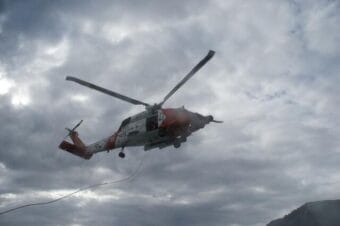
Chugach Powder Guides flying near Girdwood in January 2023. (Photo courtesy of Dave Bass)

Alaska State Troopers have named the three heli-skiers killed in Tuesday’s massive avalanche near Girdwood, with recovery efforts still pending due to dangerous conditions in the area.

In an updated report Thursday morning, troopers said David Linder and Charles Eppard, both 39, and Jeremy Leif, 38, were killed in the slide near the west fork of Twentymile River. The men were from Florida, Montana and Minnesota, respectively.

They were on a backcountry ski trip with friends, Minnesota Public Radio reported, with a fundraising page describing it as a trip of a lifetime in Alaska. The men were skiing with Girdwood-based Chugach Powder Guides.

Minnesota ties

Linder most recently lived in Miami but was born and raised in Mankato, Minn., according to the Minnesota Star Tribune. He co-owned several radio stations across Minnesota and leaves behind a wife and three young sons. His managing partner at Radio Mankato, Matt Ketelsen, described Linder as an experienced skier and devoted father.

“Whenever we would talk on the phone, we would just talk about each other’s kids,” he told the Minnesota newspaper. “First and foremost he was about his kids.”

The Star Tribune said the other two skiers also had ties to the state: Leif was a Minneapolis resident and Eppard had attended a college in St. Peter.

Eppard is survived by his wife and their daughter. A fundraising page set up for his family describes him as “a loving father, devoted husband, incredibly thoughtful and hardworking employee and an overall amazing human being.”

The three skiers were buried in a huge avalanche Tuesday afternoon in an area that’s only reachable by air, just northeast of Girdwood. Troopers said guides with the heli-ski company attempted to rescue the men but they were buried between 40 and 100 feet deep.

A fourth skier who was in the group and not caught in the avalanche was safely rescued, according to a lawyer representing the heli-ski company.

The lawyer could not be reached Thursday and an employee who answered the phone at the company declined to comment.

Initial efforts to revisit the avalanche site Wednesday were prevented by poor weather. Troopers said they, along with avalanche and recovery experts, were again attempting Thursday to conduct an aerial assessment of the slide.

Dangerous conditions continue

Meanwhile, avalanche danger persists.

The Chugach National Forest Avalanche Information Center’s Thursday forecast for the area indicated very dangerous avalanche conditions at elevations above 1,000 feet. Additional snowfall Wednesday had overloaded a weak layer of snow, creating the possibility of both natural and human-triggered avalanches.

“Travel in avalanche terrain is not recommended,” forecasters wrote.

Andrew Schauer, a forecaster at the center, said Thursday morning that the situation posed the threat of sudden avalanches at any time.

“We are concerned with those dangerous conditions, since it won’t be immediately apparent to people out there for the recovery or people in the area,” he said.

Pretrial delays leave everyone in Alaska’s court system waiting

Courtroom A at the Dimond Courthouse in Juneau on Dec. 11, 2024. (Photo by Yvonne Krumrey/KTOO).

In a Juneau courtroom in January, a man calling in from Lemon Creek Correctional Center begged to go to trial. Phillip Drummer was charged with a domestic violence assault in December of 2023. The prosecutor was ready for trial, too. Drummer’s “right to a speedy trial” timeframe was closing. 

But his defense attorney, Rex Butler, didn’t have any space in his schedule because of all his other cases. 

Juneau District Attorney Whitney Bostick, who is prosecuting the case, said if Drummer wasn’t willing to wait six weeks for his attorney, he could represent himself.

“Ms. Bostick raised the possibility, Mr. Drummer, of you proceeding pro se, without an attorney, in this matter,” presiding Judge Larry Woolford told the defendant.

Drummer didn’t like that idea. 

“Your honor, this is totally not fair to me. I don’t understand why the court won’t make sure that I’m adequately represented,” he said. “Here I am pretty much being forced to have to either represent myself or wait another two months in jail.” 

At the end of the hearing, Judge Woolford decided it would be best to wait. 

“I think the only thing that makes sense is to set this for a date-certain trial to start March 3,” Woolford said. 

Pretrial delays leave victims and defendants in limbo

This hearing was a snapshot of how pretrial delays have affected Alaska courts: victims, witnesses and defendants are often waiting years for a resolution, and their lives are put on hold in the meantime. 

It also leaves untried defendants – people accused of crimes but presumed innocent until found otherwise by the court – sitting in jail.

Anchorage Daily News and ProPublica reported in January that these delays amount to extreme wait times for felony trials. The average wait to resolve felonies has almost tripled in Alaska in the past decade, from just over one year on average to close to three years.

The Sixth Amendment to the U.S. Constitution says “In all criminal prosecutions, the accused shall enjoy the right to a speedy and public trial, by an impartial jury.”

It has two time limits: that an indictment, when a grand jury formally accuses the defendant of the crime, or an arraignment, when the defendant is told of what they are being charged with, must happen within a month of arrest, and that a trial must start within 120 days of the indictment or arraignment.

But the Constitution also allows for exceptions. 

Roughly half the people sitting in Alaska prisons are awaiting trial. It’s been that way for several years now – especially after the pandemic halted most jury trials for two years. 

Thatʼs about 2,000 individuals who are legally innocent. And according to the Alaska Department of Corrections, incarceration costs the state $200 per person per day. It costs the state roughly $400,000 per day to incarcerate people who have yet to be convicted. 

In February, more than half of the inmates in Juneau’s Lemon Creek Correctional Center hadn’t been sentenced yet. 

Alaska courts’ response to ‘extraordinary’ delays 

In her State of the Judiciary address last month, Alaska Chief Justice Susan Carney acknowledged the extremely delayed cases highlighted in recent media coverage. 

“The delays in those cases are extraordinary,” she said.

She said C and B level felonies — the kind Drummer has been charged with — typically resolve within 10 months. Since his initial arraignment, Drummer has waited about 14 months. 

Carney said Alaska’s court system is  working to limit pretrial delays. 

“Presiding judges in each judicial district have issued orders limiting the number of continuances in a case and limiting the number the entire time that a case can be delayed absent truly extraordinary circumstances,” she said. 

Overburdened defense attorneys … or intentional delays?

Meanwhile, Drummer’s Anchorage-based lawyer, Rex Butler, has over 300 active cases across the state. He says his caseload is so high because he takes on cases that the state’s Public Defender Agency can’t represent due to conflicts of interest, like Drummer’s. 

Butler sometimes gets cases that have been in the court system for a few years already. 

“We pick up the case file, and now the file is on fire,” he said. 

Even though the case is new to Butler, the court is eager to see it resolved.

He said that sexual assault and domestic violence cases have become a lot more complex in his 40 years as a defense attorney. 

Felony cases take a lot longer to prepare for, with the risk of conviction carrying greater consequences, and they don’t move through the trial system nearly as quickly.

That causes them to pile up on attorneys’ desks. 

“The practice of criminal law has gotten much more complicated, involved and it’s tedious,” Butler said. “It’s always been very emotional.”

Butler says fewer and fewer lawyers want to take on cases that involve alleged heinous crimes, like murder and sexual assault. 

According to Juneau’s District Attorney Whitney Bostick, delays make it harder for prosecutors to prove to a jury “beyond a reasonable doubt” that a defendant committed a crime.

“In general, the state’s ability to prove a case becomes more difficult the longer the case is delayed,” she said.

She said witnesses get frustrated with delays, or their memories fade. Sometimes, witnesses die before a case reaches trial.

Some cases now take more time to both defend and prosecute, Bostick said, as technological advancements mean many cases have more evidence than they did even 10 years ago.

The ADN/ProPublica investigation found that, in some instances, pretrial delays are a tactic on the part of a defense team to stall a case so witnesses’ memories fade.

And, Bostick said, these delays take a toll on the victims. 

“They’ve gone through the unthinkable, and every time there’s a hearing, whether it be a bail hearing or a continuation of the case,” she said. “It brings that trauma that they experienced back front and center.”

Sometimes, victims don’t want to continue with the case after years of delay, she said. They lose hope. 

Phillip Drummer – the defendant who was begging to go to trial –  has multiple previous assault and DV charges starting in the late 1990s. In this case, though, he hasn’t been found guilty. 

And he’s still in jail in the meantime, even though he’s not serving a sentence.

For now, Drummer’s case continues in court limbo. His eleventh pre-trial conference is scheduled for March 28.

Correction: an earlier version of this story incorrectly reported the amount of time a trial must start under Rule 45 in Alaska. 

3 heli-skiers killed in avalanche near Girdwood, troopers say

A heli-skiing operator near Girdwood in January 2023. (Photo courtesy of Dave Bass)

Alaska State Troopers say three heli-skiers are presumed dead after they were caught in a massive avalanche Tuesday near Girdwood.

Troopers said in an online dispatch that the avalanche caught the skiers at about 3:30 p.m. near the west fork of the Twentymile River, about 8 miles northeast of the Girdwood airport in an area only accessible by air. Guides from the heli-skiing company they were flying with immediately tried to locate them.

“Using avalanche beacons, the guides identified a probable area where skiers were buried between 40 feet and nearly 100 feet deep,” troopers said.

Troopers spokesman Austin McDaniel said the heli-skiing flight was operated by Girdwood-based Chugach Powder Guides. A person who answered the company’s phone Wednesday declined to comment. A Homer lawyer specializing in recreation and adventure law, who told the Anchorage Daily News she was acting as a spokesperson for the heli-skiing company, refused to comment to Alaska Public Media.

Troopers have not yet released the skiers’ names.

McDaniel said in a text message Wednesday morning that none of the skiers are thought to have lived.

“Based on the information provided by the operator, unfortunately, we do not believe that any of the three missing persons survived the avalanche,” he said.

No other recovery efforts were made Tuesday due to avalanche risk and limited daylight, troopers said. The scene will be assessed Wednesday to determine whether further work to recover the skiers can be safely conducted.

Tracey Knutson, the lawyer acting as a spokesperson for Chugach Powder Guides, gave the Anchorage Daily News a detailed account of what happened in the slide, from the heli-ski company’s point of view.

Knutson told the ADN that the skiers were on a regular run for the company and that witnesses saw all three skiers activate avalanche airbags when the slide started, at an elevation of about 3,500 feet. One person who was in the group and not caught in the avalanche was safely rescued, Knutson told the ADN.

Three guides reached the debris, which had slid about 2,800 feet, and detected three signals from beacons the buried skiers wore, Knutson told the ADN.

The Chugach National Forest Avalanche Information Center reported considerable avalanche danger in the area Tuesday at elevations above 1,000 feet. Its forecast noted the possibility of human-triggered avalanches, with up to 2 feet of wind-blown snow atop a frost layer. The forecast advised avoiding steep slopes.

Knutson refused to answer any questions from Alaska Public Media, including about what safety measures the guides took, how they decided to take clients skiing with “considerable” avalanche danger in the area or what decisions led to three skiers, an uncommonly high number, getting caught and buried. She said such questions were inappropriate as the recovery effort was still under way.

According to the Alaska Avalanche Information Center, the state’s last avalanche that killed three people occurred on Bear Mountain near Chugiak in February of 2021. Troopers said at the time that three climbers ascending a technical route of the mountain were found dead, beneath what appeared to be a recent avalanche.

In its Wednesday forecast, Chugach National Forest avalanche forecasters said the Twentymile River slide was accompanied by other human-triggered avalanches Tuesday. Staff offered their condolences to friends and family, urging people to “avoid traveling on or below steep or consequential terrain” due to dangerous avalanche conditions.

Calls to the forecasters went unreturned Wednesday morning.

This is a developing story. Please check back for updates.

Damaged subsea cable apparent cause of internet and cell outage in Juneau, other communities

A raven perches on a satellite dish on the KTOO roof in downtown Juneau on Friday, Feb. 28, 2025. (Photo by Clarise Larson/KTOO)

Juneau residents who use certain cell phone and internet carriers experienced an outage Thursday night that continued Friday. 

The outage began around 9:15 p.m. Thursday with ACS and AT&T customers reporting limited or no service throughout the area. Residents in Haines, Skagway and Gustavus also reported interruptions.

In an email Friday afternoon, ACS media contact Heather Marron confirmed that there was damage to a subsea cable system that connects Juneau, and a repair ship is on its way to restore it. Last fall, Sitka was similarly without internet for more than two weeks due to a broken subsea fiber optic cable.

Marron wrote that the company does not have a timeline for when services would be restored, but is looking at alternative ways to restore connection.  

“This is our top priority and we deeply apologize for the inconvenience. We know how important staying connected is and we will not rest until this is fixed,” Marron wrote. ” We will continue to share updates as we have more information.”

Juneau’s Deputy City Manager Robert Barr said the city’s phone lines are down, but the impacts of the outage to city functions are  “significant but not debilitating.” He suggests residents email city officials rather than call in the interim.

Juneau School District is still holding classes as normal. Superintendent Frank Hauser said Friday morning that all district schools have a copper phone line that can be used to make phone calls, but the internet has been impacted.

“Teachers are still teaching, students are still learning,” he said. “It’s just kind of going back to, the books and the manipulatives in the class. We’re just continuing to focus on educating the students, working with them and doing what we do best.”

The Juneau Police Department posted on Facebook that its administrative phone systems were affected by the outage, though 911 calls appear to be functioning normally. 

Capital City Fire/Rescue posted that some cell phones may not be able to call 911, but connecting to wifi might help. 

State employees at the State Office Building downtown and in other parts of the state reported that the outage was affecting them. The alaska.gov website was also down Friday, restricting access to a number of state resources.

Business appeared to be operating as usual despite limited phone and internet access at the Alaska State Capitol.

Today’s Senate and House floor sessions are expected to meet as regularly scheduled. #akleg

— Gavel Alaska (@gavelalaska.bsky.social) February 28, 2025 at 9:53 AM


This is a developing story. Check back for updates. 

8-year-old boy helps save his family from White Mountain house fire

Colton Koonooka-Kowchee. (Photo courtesy of Photo courtesy of Venessa Marie Koonooka)

Roseann Titus was getting ready Thursday morning when she saw flames coming from a bathroom at the front of her house in the Western Alaska village of White Mountain. Her granddaughter and great-grandson were still in bed.

Titus said she tried unsuccessfully to put out the fire and then rushed to wake them up. But the flames spread into the hallway, blocking the way out of the house.

That’s when her great-grandson, 8-year-old Colton Koonooka-Kowchee, sprang into action.

“We didn’t know how to contain it, so he kind of jumped out the window and ran for help,” Colton’s mother, Venessa Marie Koonooka, said.

A multigenerational home in White Mountain burns in the early morning of Feb. 20, 2025. (Photo courtesy of Venessa Marie Koonooka)

She said her son plunged 10 feet from the window into a snowdrift below. Then he ran through deep snow to get help – which came in the form of Shane Bergamaschi, a volunteer firefighter.

Bergamaschi helped pull Titus through a window and rushed her to the local clinic to await a medevac.

“They helped us right away when we got in there with my grandma’s burns and smoke inhalation,” Marie Koonooka said. “I only had a popped knee and a few frostbites on my toes. I was okay.”

Titus was flown to Anchorage, where she was treated for burns on her shoulder and arm. The home was a loss, including personal belongings and two moose legs from a recent hunt.

Roseann Titus at work at the White Mountain School. (Courtesy photo)

Colton’s grandmother, Nora Brown, who was not in the home at the time, credited her grandson with keeping the situation from getting much worse.

“If it wasn’t for Colton jumping out on his own, we would have probably lost my mother, and the houses nearby probably would have caught fire,” Brown said.

Titus has worked for the Bering Strait School District since 1988. Bering Air is ferrying donations to the family, and a GoFundMe has been set up.

Site notifications
Update notification options
Subscribe to notifications