Search & Rescue

Inquiry into the fatal Scandies Rose sinking begins in Seattle

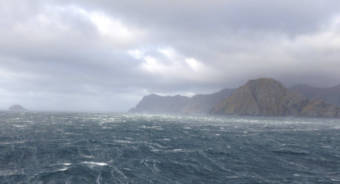
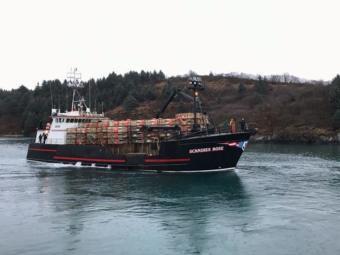
The F/V Scandies Rose sank west of Kodiak on Dec. 31, 2019. (Photo courtesy of Bret Newbaker)
Approximately 43 separate witnesses, including the survivors, other professional mariners and officials from a number of government agencies, are scheduled to testify over the next two weeks in the sinking of the Scandies Rose. (Photo courtesy of Bret Newbaker)

A two-week federal inquiry into the fatal sinking of the F/V Scandies Rose — lost on New Year’s Eve 2019 west of Kodiak Island — opens today in Seattle.

The U.S. Coast Guard and partner agencies will hold a virtual formal hearing to consider evidence related to the sinking of the Dutch Harbor-based fishing vessel until March 5.

The 130-foot crab boat sank near Sutwik Island, Alaska around 10 p.m. on Dec. 31, 2019 with seven crew members aboard. Two fishermen were rescued wearing gumby survival suits in a life raft, but five others were never found.

The search spanned over 20 hours, 1,400 square miles, and included four MH-60 Jayhawk helicopter crews, two HC-130 Hercules airplane crews and crew aboard the Coast Guard cutter Mellon.

The hearing will focus on the conditions before and at the time of the sinking, the Coast Guard said in a statement. This will include weather, icing, fisheries, the boat’s condition, owner and operator dynamics, the regulatory compliance record of the vessel and testimony from the survivors and others.

Approximately 43 separate witnesses, including other professional mariners and officials from a number of government agencies, are scheduled to testify over the next two weeks, according to Capt. Gregory Callaghan, chair of the Marine Board of Investigation, which was convened to investigate the tragedy.

“It is an administrative hearing,” Callaghan said during a press conference Friday. “This is not criminal in any nature. It is very much an administrative proceeding to gather the facts of the case.”

The National Transportation Safety Board is still investigating the incident and is joining the Coast Guard in what they call a “fact-finding phase.” The NTSB will analyze the facts to prepare and publish a separate report.

The joint inquiry will not conclude the investigation, according to Callaghan. And it does not rule out future hearings, he said.

“This is merely a way that we can put all this information on the record and continue to gather facts surrounding the case,” he said. “Once we have that, we will go into an in depth analysis of everything that we’ve gathered so far [and] the testimony that we hear at this hearing. And then we will start to come up with some conclusions and develop some potential recommendations with the hopes that we can make meaningful recommendations to help prevent further loss of life and improve the safety of the maritime industry.”

The full-day hearings are scheduled to convene daily at 7 a.m. Alaska time on weekdays, Feb. 22 through March 5.

To ensure public access and participation, the hearing will be streamed live each day at https://livestream.com/uscginvestigations, and the sessions will also be archived on the web at a later date.

The Coast Guard has created an email address for people interested in providing information, asking questions or making comments related to the ongoing investigation. The email address is: ScandiesRoseMBI@uscg.mil.

‘Frustrating’ investigation into fatal 2019 medevac crash ends with no clear answers

Sitkans held a vigil on February 19, 2019 for those lost in the crash. An event was also held in Juneau where the three crew members lived. (Photo by Katherine Rose/KCAW)

Federal aviation safety investigators have closed the book on the Guardian Flight fatal crash that killed three crew members.

The twin-engine medevac plane was en route to the Southeast village of Kake to pick up a patient the evening of Jan. 29, 2019. During its approach over Frederick Sound, the turboprop veered to the right and plummeted 2,575 feet in just 14 seconds.

A final report released Jan. 28 by the National Transportation Safety Board says there isn’t enough evidence to explain how or why.

“A loss of control for reasons that could not be determined based on the available information,” the 13-page report said.

Most of the wreckage of the King Air 200 was recovered in about 500 feet of water. The bodies of the Juneau-based crew members were never found despite extensive effort by the U.S. Coast Guard and private contractors.

This one was a little bit frustrating for us,” NTSB’s lead investigator Clint Johnson told CoastAlaska. “It’s not for the lack of trying, but unfortunately, it didn’t give us any definitive answers of exactly what happened.”

He says there was initial hope after the cockpit voice recorder was found. But a forensics lab determined the recorder hadn’t worked since 2015.

We were definitely hoping that we were going to be able to glean some information as far as what happened in those last final moments,” Johnson said on Friday. “Unfortunately, it did not help us at all.”

A radar track of the Guardian Flight and its communications with air traffic communications during its final approach clearance. (Graphic courtesy of NTSB)

All but one of the crew seats were recovered with the harnesses unbuckled. But the NTSB says that because none of the crew members were found, it couldn’t conduct autopsies or toxicology tests on any of the crew members. The pilot had cleared an FAA medical exam about four months before the crash.

The three killed were 63-year-old pilot Patrick Coyle; 43-year-old paramedic Margaret Langston and 30-year-old nurse Stacie Rae Morse. Morse was more than six months pregnant at the time.

Her fiancé, Dylan Listberger, filed a wrongful death suit against the Utah-based medevac company and plane manufacturer last month, shortly before the crash’s two-year anniversary.

But Listberger’s Juneau attorney Sheldon Winters says it’s unclear whether the civil suit will proceed.

“Mr. Listberger filed suit to preserve potential claims in light of a possible two-year statute of limitations, while we waited for the NTSB probable cause report,” Winters wrote in a statement. “We are currently evaluating the recently issued NTSB report.”

A Guardian Flight representative says it’s aware of the lawsuit — which has been moved to federal court — but had no further comment.

NTSB: Cessna ran out of fuel between Ketchikan and Port Angeles in fatal crash

The NTSB says a review of the radar data revealed that the plan was on a southerly track, reaching the edge of the northly land mass at 4:34 p.m. local time. The radar hits continued south at an altitude of about 1,200 ft. About four minutes later, the plane reversed course and heading north-northeast. (Image courtesy of NTSB)

The Kodiak man killed while trying to pilot his small plane from Ketchikan to the Lower 48 apparently ran out of fuel a few miles from an airport. That’s according to federal aviation investigators who on Thursday released preliminary findings of the fatal January 26 crash near Port Angeles, Washington.

Authorities haven’t named the pilot of the Cessna 170A. But the aircraft’s registration and family speaking to the Kodiak Daily Mirror identified the plane’s owner and pilot as 38-year-old Sean M. Hayes of Kodiak.

The National Transportation Safety Board says the pilot had taken off from Kodiak the day before and had stopped in Ketchikan to refuel.

It says he’d sent multiple text messages to his mother indicating strong headwinds and dense cloud cover over the Inside Passage. Those were slowing his progress, and he was worried that the plane did not have enough fuel.

“The pilot stated that his estimated time of arrival kept changing on his GPS because of the fluctuating wind, turbulence and cloud avoidance,” the four-page report said.

The report says the pilot reversed course and started to slowly descend around 1,200 feet. He broadcast a mayday call around 4:40 p.m., saying he was “ditching” the aircraft and could see a boat towing a barge. The NTSB says he’d texted a photo to his mother of the area which radar records indicated was less than three miles from the closest land.

Coast Guard vessels from the U.S. and Canada used infrared cameras and radar to search for the lost plane over two days. By the end, searchers had scoured nearly 1,200 square miles before calling off their effort without finding the plane.

The NTSB says the pilot’s intended destination was Lake Havasu, Arizona.

Coast Guard says area-wide VHF outages mostly resolved

A map showing VHF signal coverage areas in Southeast Alaska.
A map showing VHF signal coverage areas in Southeast Alaska. (Graphic courtesy of U.S. Coast Guard)

A technical breakdown causing recent outages to the Coast Guard’s emergency VHF radio towers across Southeast Alaska has been fixed, reports Coast Guard Commander Lyle Kessler.

“The network issue that was causing intermittent communications issues throughout the entire area was resolved,” Kessler said Friday. “But there are still all the ongoing issues that we’ve had with a couple of sites.”

The Coast Guard’s network of VHF towers allow its search and rescue command center to hear distress calls over Channel 16. But breakdowns in the relays can prevent mayday calls from being received.

Kessler said Friday there are still problems with four towers across Southeast: Mt. McArthur, Deception Hills, Sukkwan Island, and Althorp Peak. There are also problems with two repeaters near Kodiak Island on Cape Gull and Raspberry Island.

Mariners are always encouraged to carry a secondary form of communication like an Emergency Position Radio Indicating Beacon (EPIRB), satellite phone or cell phone.

The Coast Guard Sector Juneau can be reached at 907-463-2980.

Haines man mauled by bear while backcountry snowboarding

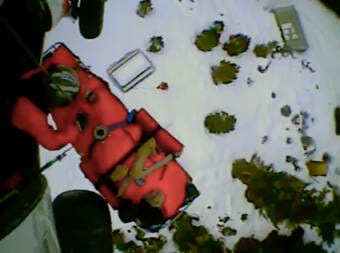
Screen grab from a video of a U.S. Coast Guard rescue of a man mauled by a bear in the mountains near Haines on Saturday, February 6, 2021. (USCG)

A Haines man was mauled by a bear while backcountry snowboarding near Chilkoot Lake over the weekend. State troopers said he was attacked after encountering a bear den while backcountry snowboarding with two others.

The bear attacked Haines resident Bartek Pieciul on Saturday afternoon while he was climbing a mountainside with a group of friends about 10 miles northwest of Haines. Troopers said the group unknowingly came upon a den occupied by a brown bear sow and possibly some cubs about 1,600 feet above Chilkoot Lake.

Alaska Department of Fish and Game Biologist Carl Koch said it can be very difficult to spot a bear den, particularly in the middle of winter. Although bears are less active during the winter, they aren’t asleep the whole time.

“They are very lethargic, their body temperature does drop, but they are absolutely capable of being disturbed in a den site,” Koch said. “It’s not like they’re in this immobile state.”

The sow exited the den and mauled Pieciul before leaving the area. The attack left him unable to walk back downhill. The other skiers in the group used a satellite communication device to call for help.

Due to the remoteness of the area and the steep terrain, state troopers requested assistance from the U.S. Coast Guard. A Jayhawk helicopter crew from Air Station Sitka responded to transport the man to a hospital.

The skiers provided GPS coordinates and used brightly colored fabric to signal the helicopter as it approached. The air crew successfully hoisted Pieciul into the helicopter and provided medical care while in transit.

According to Koch, it is unlikely that Fish and Game will try to find the bear that mauled Pieciul because it was acting defensively, not aggressively.

“It would be very tricky to get to logistically and since it’s not an aggressive bear we’re going to let it well enough alone and probably a good idea for folks to stay out of the area,” Koch said.

Troopers said Piecieul is being treated at a hospital in Juneau. He suffered a broken arm, puncture wounds and other injuries. Sources close to him said he is now stable and may be discharged as early as Tuesday.

GoFundMe page has been created to support Pieciul’s recovery.

Editor’s note: This story has been updated with more information. 

Correction: A previous version of this story stated Piecieul is being treated at a hospital in Anchorage. He is being treated in Juneau.

Coast Guard suspends search for missing pilot flying from Ketchikan to Port Angeles, Washington

U.S. Coast Guard graphic shows a pattern flown by an aircraft searching for the missing plane. (U.S. Coast Guard via Twitter)

Authorities called off  Wednesday’s search for the pilot of a missing Cessna airplane that went down near Washington state’s Olympic Peninsula. The U.S. and Canadian coast guards helped scour more than 1,000 square miles for the small plane that had taken off from Ketchikan the day before.

The Coast Guard said the aircraft was flying from Ketchikan to Port Angeles, Washington.

A man piloting a single-engine Cessna radioed for help around 4:40 p.m. local time Tuesday. He reported he was about five miles north of Port Angeles, Washington and could see the boat traffic below.

“Right in the middle — I’m out here by — there’s a boat going by. There’s a tanker getting drug. I’m out in the middle. I’m going down now. I’m going into the water,” the man said.

U.S. Coast Guard spokesperson Petty Officer Steve Strohmaier said Wednesday that units were activated to help search both from the air and water.

“We also received help from our Canadian partners up north and as well as a Naval Air Station helicopter from Whidbey Island,” Strohmaier said by phone.

He said Coast Guard vessels from both nations used infrared cameras and radar to search for the lost plane overnight. But as dusk fell Wednesday, Strohmaier said the search was called off.

It’s very unfortunate and tragic that we have not been able to find any parts of the plane or anything in regards to the missing man,” he said.

He added the search may resume if more information becomes available.

Authorities have not released the name of the missing pilot or the Cessna’s tail number. But Strohmaier said authorities are in touch with the man’s family.

Site notifications
Update notification options
Subscribe to notifications