Subsistence

2015 Marks a summer of flexibility for Kuskokwim subsistence fishermen

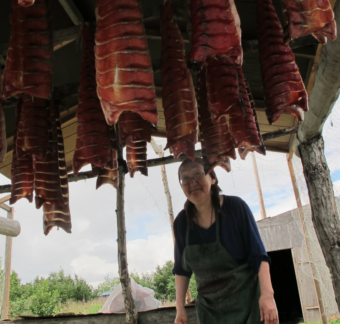
Marie Andrew was busy this July at her Napaskiak fish camp. (Photo by Ben Matheson/KYUKl)

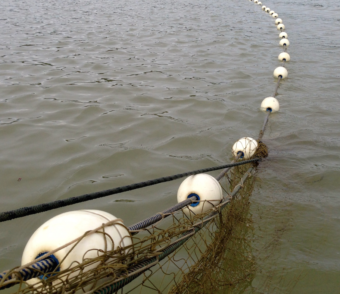
Subsistence fishing is open indefinitely on the Kuskokwim River. But that hasn’t been the norm this summer, as the river underwent two management regimes —state and federal—and strict closures for two species. Lower river fishermen are adjusting to the new reality of Kuskokwim subsistence, where conservative management is now the status quo.

On a sunny Saturday after a four-hour subsistence opener, Joe Green and his two children shuttle salmon up the steep banks at the Bethel small boat harbor from the skiff to the back of their pickup.

These openers are critical for Green as he fishes for four families.

“This year we’re shooting for anything. The feds and the government shock you. They screw up everything for you. So we get what we can,” said Green.

On top of his chums, he caught just shy of a dozen red salmon and says he’ll be freezing fish for the first time this summer. It’s a summer of flexibility on the Kuskokwim. Unprecedented king salmon restrictions were followed up by more closures to protect a weak chum run, which so far at the Bethel Test Fisheryranks among the lowest in recent history.

Alissa Joseph works on the fisheries staff for Bethel’s Tribe, Orutsararmiut Native Council , and is traveling the river to talk with fishermen in fishing camps throughout the Bethel area.

“We don’t go to fish camps to look at their racks, we go to get their information and how they did. We don’t need to know how many fish they got. We just want to know how subsistence is going, how it’s working for them, and how we can be of assistance as advocates for them,” said Joseph.

The information goes to state and federal managers and the Kuskokwim Working Group.

Joseph was checking in on subsistence fishermen like Nicholai Evan. At his Napaskiak fish camp, his whole family is cutting and preparing caught in the opening. He normally catches 100 kings every summer. So far this year, he’s only caught 10. How he plans to make up the deficit?

“Caribou, moose, seal, geese, swans. My part of life is subsistence, I hardly go to the store, once in a great while,” said Evan.

Nearby David Nicholai reports that his family also got significantly fewer kings than normal—but it’s enough for them to get by.

“Enough, good enough for fish, there are lots of fish out there. Lots of chums, lots of reds, some king salmon,” said Nicholai.

Besides being large, rich and historically abundant, king salmon are also prized for their immaculate timing. They’re first, when the weather is clear and dry. But this point in the season, it’s clear that things have changed.

Under the roof of Marie Andrew’s drying rack, the Napaskiak resident is busy putting chums and reds up to dry. The Kuskokwim red salmon fortunately this year came on strong, and relatively late. But this time of year, Andrew is starting to see flies.

“During that smoky time, when the wild fire smoke was around there wasn’t that much, but lately I’ve seen lots, like today when the sun was out,” said Andrew.

She says that she’s typically done by now in a normal king year. Near Bethel, Sugar Henderson is looking forward to silvers. She says her family took part in the limited community permit system at the start of the year and was allocated a dozen kings.

“I normally do strips with my kings and dryfish with my silvers. But knowing I’d only get 12 kings I did all dryfish. And then with our pressure cooker, we figured we would try strips with silvers. Kind of backward,” said Henderson.

After several rocky years of poor king returns and the stop and go restrictions, Henderson has had to adapt.

“We’ve learned to adjust to what we get. I’m not one yelling and screaming ‘we need our kings, we need our kings’! We do need our kings, but I understand the fact they need to replenish, so we’ve just adjusted ourselves, our lifestyle, to what we could get,” said Henderson.

And as long as Kuskokwim salmon runs and regulations defy prediction, summer fishing plans will remain a moving target.

Federal bill would change rural designation process for subsistence

Subsistence fish camp on the Koyukuk River. (Public Domain photo by U.S. Fish and Wildlife Service)
Subsistence fish camp on the Koyukuk River. (Public domain photo by U.S. Fish and Wildlife Service)

Saxman resident Lee Wallace testified Wednesday in Washington, D.C., during a hearing in front of the House Subcommittee on Indian, Insular and Alaska Native Affairs.

The subcommittee is chaired by Alaska Rep. Don Young, who has sponsored a bill that would change the Federal Subsistence Management Program’s process for designating a community’s rural status, which allows community members to harvest subsistence food.

Wallace heads up the Saxman IRA, and has been outspoken about reinstating the Organized Village of Saxman’s rural designation.

Saxman lost its designation during a 2007 Federal Subsistence Board review. The board decided that Saxman’s connection to the larger community of Ketchikan meant that Saxman can’t be considered rural.

Saxman has about 400 residents, compared to about 7,000 in the City of Ketchikan.

Wallace recalls coming home after the board’s vote to make Saxman non-rural.

“Upon arrival, the Cape Fox dancers and elders, they came and met the plane from Anchorage,” he said. “They knew I was sad and downhearted. They wanted to lift me up. They greeted me with a song and prayer for encouragement that we should continue on to fight our battle to regain our rural determination status.”

Since then, the Federal Subsistence Board has proposed a rule change that would allow more flexibility when determining rural designations, and has conducted public hearings on that rule. Numerous Southeast Alaska residents – including Wallace — commented during those hearings in support of Saxman’s claim to subsistence rights.

The Saxman Clan House. (Photo courtesy KRBD)

Wallace told the subcommittee that while a rule change would be a step in the right direction, Young’s proposed bill would provide more security.

“Saxman supports this legislation because it creates permanent and procedural protections for rural communities,” he said. “It eliminates the fear and anxiety caused by the unnecessary process in which the FSB essentially evaluates whether we can carry on our traditions and our way of life.”

Young’s bill would require congressional approval before a community’s rural designation could be removed in the future. Alaska Sen. Lisa Murkowski has sponsored a similar bill in the U.S. Senate.

Young said during Wednesday’s hearing that removing Saxman’s rural status didn’t make any sense.

“Saxman was a Native village long before Ketchikan was ever created. And then Ketchikan became a fishing town and a timber town and sort of grew up next to them,” Young said. “Then for some reason, someone had an issue that they weren’t rural anymore, because the city grew to them.”

Rep. Don Young’s bill has not yet passed out of subcommittee. If it does, its next stop would be the House Natural Resources Committee.

Kuskokwim subsistence fishermen face low chum run, schedule restrictions

Chum salmon numbers are well below average. (Photo by Shane Iverson / KYUK)

The Kuskokwim River is experiencing a poor chum salmon run, according to state managers, and with it, a restrictive fishing schedule.

The Department of Fish and Game plans to eventually move to a 24/7, 6-inch mesh gillnet fishing schedule, but they’re still moving with caution and have not yet set a date. Gillnet restrictions on the lower river last year were relaxed June 30th.

On Wednesday at a meeting of the Kuskokwim River Salmon Management Working Group — an advisory body for fish management — fishermen supported a cautious approach.

“I talked to several fishermen over here; they were concerned about the very low numbers of chums showing up. Some said they hardly caught any. The majority catch is always chums and a few small chinook,” said John Andrew from Kwethluk. “We could recommend they be cautious for the next two weeks until the silvers pick up.”

Biweekly subsistence fishing periods are underway now. State officials are not considering a chum salmon commercial fishing period.
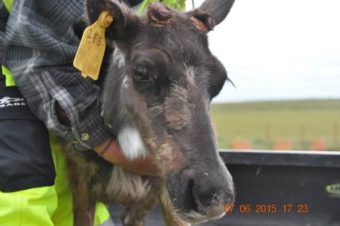
The working group wanted state officials to allow other opportunities to put away fish. They passed a motion recommending state managers lift the ban on 4-inch mesh set nets. Mike Williams of Akiak said he and other dog mushers rely on whitefish during the summer to feed their teams. The nets can still catch salmon species.

They also asked for longer fishing periods upriver, noting that there are far fewer fish and fishermen in the river. They passed a motion asking that the next fishing above the Holitna be at least 24 hours. The state then announced after the meeting that 50 fathom gillnet fishing above the Holitna opens Wednesday night until further notice.

Members noted that more people downriver are done fishing compared to the middle and upper river, where many are just starting. Red salmon will be the mainstay of the middle and upper river and many are also planning on taking advantage of the silver salmon run as the summer progresses.

First reindeer arrive in Port Heiden to re-establish herd

The first of 60 reindeer arrived in Port Heiden last week. The Native village is working to re-establish traditional reindeer herding in the community. (Photo courtesy of Village of Port Heiden)

The first of 60 reindeer began arriving in Port Heiden last week after a several month delay.

Adrianne Christiansen is the business development director for the Native Village of Port Heiden which has been working to reinstate a long-dormant tradition of reindeer herding. She said the reindeer began arriving Friday via charter plane from Stebbins/St. Michael’s.

“And we are really excited to re-establish reindeer herding in Port Heiden,” says Christiansen.

It’s going to be a big community learning experience, says Christiansen. For the next three months, an experienced herder will stay in Port Heiden to teach everyone about the reindeer.
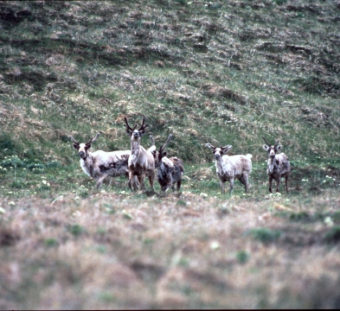
“We have a pen built for them, and we have a traditional reindeer herder down to train our young people to learn how to herd reindeer … so they’ll be in the pen until we all learn how to herd the reindeer.”

Christiansen says about 100 community members, including 30 school-age children, will be trained.

Once the herd is well-established in the area, the community plans to harvest some for food. Christiansen says that may be four or five years down the road.

Caribou emigrate from Adak; feds struggle to stop the spread

Caribou on Adak in 1985. (Credit: USFWS)

Every summer, a team of federal exterminators set up shop in the southwest corner of the state. Their job is to root out non-native animals that might disturb the Alaska Maritime Wildlife Refuge.
In addition to the usual rats and foxes, the refuge managers decided to target a new pest this season.

It’s no mystery how caribou wound up on Adak Island. They were imported in the late 1950s so Navy personnel would have something to hunt.

Nowadays, the Navy is gone and the island is a prime spot for big game hunters. But not enough of them, says Steve Ebbert.

He’s a wildlife biologist for the Alaska Maritime National Wildlife Refuge. As he stands on the deck of their research vessel, sailing less than a half mile from the rocky shores of Adak, Ebbert says the caribou herd is now seven times its former size. And it’s starting to spread.

Ebbert points to a gently sloping beach just across the way on Kagalaska Island.

It’s not clear when the caribou started to swim across the channel to Kagalaska. But Ebbert thinks he knows why. The island is still covered in thick, white lichen — the same plant that used to grow naturally on Adak.

If the caribou are willing to travel for food, Ebbert says they probably won’t stop at Kagalaska when there even more islands to graze on nearby — all federally protected, refuge land.

After an environmental assessment, the U.S. Fish and Wildlife Service decided the best way to prevent that outcome was to organize a hunt on Kagalaska.

The team bagged nine male caribou. But Sen. Lisa Murkowski isn’t impressed with their haul.

The hunt cost $58,000, plus another $13,000 to butcher and salvage the meat. That part was specifically requested by Murkowski and other officials. But going forward, the senator wants to see a different approach.

The Senate Appropriations committee recently (on June 18) approved a new rule that would keep the refuge from using federal money to sponsor more caribou hunts at Kagalaska.

A similar ban would apply to two other islands, where wild cows have escaped from old ranches. Murkowski and her colleagues also suggest a $2 million cut in funding the Fish and Wildlife Service but a million-dollar bump for the refuge system’s budget. The entire package has been sent to the full Senate for consideration.

Elaine Smiloff has lived and hunted on Adak Island for years. She had her own doubts about trying to control the spread of caribou.

But Smiloff also says that this year, it got harder for local hunters to track down caribou in their own backyard. Without a boat — which most residents don’t have — their options seemed to shrink.

Usually, Kagalaska wouldn’t be one of them.

That’s one reason why Smiloff jumped at the chance to help federal hunters move huge slabs of meat off that island. More than a half-ton was distributed to local families.

Smiloff would be glad to help get more. But wildlife managers haven’t decided if they’ll try to conduct another hunt before the Senate takes action on the proposal to shut it down.

For now, the Alaska Maritime refuge is more focused on finding out if the first big control effort was a success.

They may have a chance to investigate in August, when refuge staff are scheduled to sail past Kagalaska aboard their research vessel.

Eventually, Steve Ebbert says he wants to find a method for tracking the number of caribou that reach the island. First, he’d have to mark them — with paintballs, or by branding.

But then again:

“You’re capturing the animals, drugging the animals in the case of branding, and marking them permanently — and just releasing them? It doesn’t seem as efficient. If you can shoot them with a dart, you can shoot them with a rifle,” Ebbert says.

The biologist says he wouldn’t call that hunting — more like counting. By elimination.

Infected salmon just another problem for Yukon subsistence fishermen

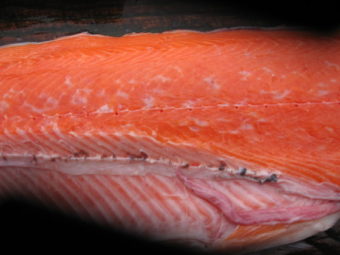
A severe case of ichthyophonus in a Yukon Chinook filet. (Photo courtesy of RapidResearch.com)

As Yukon salmon continue their summer runs, subsistence fishermen are expressing frustration about gear restrictions, closures, and now potentially infected fish.

When managers and fishermen met for their weekly teleconference Tuesday, they heard reports of discoloration and pus in chum salmon from callers in Pilot Station, Russian Mission and Fairbanks.

Stephanie Schmidt, summer season area management biologist for the Yukon for the Alaska Depart of Fish and Game, says the parasite ichthyophonus could be the culprit

“Folks here complaining about summer chums having white patches and pus sacs … A lot of these fish have pus in the meat, so that’s a bummer … Kind of little pockets of pus when you fillet the fish. That’ll be about the size of a pea or maybe a little smaller. And I know that in warm water, which is what we have right now, that ichthyophonus really grows rapidly if the fish is infected.”

Fish and Game says the pathogen is not harmful to humans, and Schmidt invites fishermen to submit samples for testing if they’re concerned.

The summer chum run is now estimated at 1.3 to 1.5 million fish, which is average but below Fish and Game’s preseason predictions. The first pulses are passing through Tanana, Koyukuk, and Kaltag, but many stragglers are still lingering in the lower river. Schmidt says that’s led to record numbers for commercial fishermen.

“There have been record catches of summer chum salmon with dipnets this year in district one and district two. To date, the dip net and beach seine commercial fishery in these lower districts have caught 185,700 summer chum salmon and they’ve released just over 8,000 Chinook salmon,” Schmidt says.

Meanwhile, subsistence fishing has been a mixed bag. Abundant chums on the lower Yukon have helped fishermen in Nunam Iqua to fill his racks. But fishermen upriver have struggled to meet their subsistence needs, citing plenty of activity but little production.

Fish and Game is continuing efforts to protect the kings through strategic closures, but Chinook numbers are still weak. More than 80,000 kings passed through Pilot Station by the end of June — about 20-thousand fish fewer than the historical average.

The possibility for incidental harvest of Chinook has been discussed and even allowed for short periods in areas with strong passages of chum. But the general call for immediate release, coupled with gear restrictions, hasn’t allowed for much.

Schmidt says it’s possible that king escapement goals will be reached this year, but conservative management strategies will continue to ensure that happens.

Site notifications
Update notification options
Subscribe to notifications