Subsistence

AFN looking into blood quantum requirement for marine mammal subsistence users

At the Alaska Federation of Natives convention earlier last month, the AFN Subsistence Committee delivered a report on their work. Subsistence Committee Co-chair Rosita Worl said blood quantum is an emerging issue that the committee is looking into. She said that the Marine Mammal Protection Act requires that marine mammal hunters be at least one-quarter Native.

“One of the issues that really has been emerging is the issue of blood quantum,” said Worl. “We are now hearing from parents (and) grandparents that they are no longer able to take their children, grandchildren with them hunting. We realize that under the Marine Mammal Protection Act that the regulations state that you have to be one-fourth Alaska Native blood.”

Worl reported that the AFN Subsistence Committee is working on a memorandum of agreement with the Indigenous Peoples Council on marine mammals. She also said AFN will be coordinating a study on the issue and holding focus groups in villages to learn more.

Dip in Kenai brown bears linked to liberalized harvest quotas

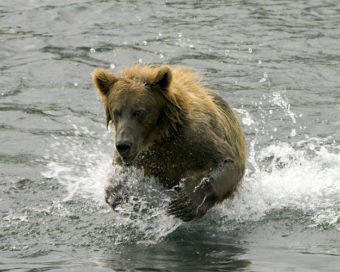
A 2010 federally sponsored study is the first to deliver a reliable count of the Kenai Peninsula’s brown bear population. Last week a Kenai National Wildlife biologist explained the study during a presentation at the Pratt Museum in Homer. The Museum is preparing to launch a new summer exhibit all about bears, specifically brown and black bears.

The number of brown bears on the Kenai Peninsula fell from about 582 to fewer than 500 between 2010 and 2015. That’s according to John Morton, a Kenai National Wildlife Refuge biologist.

“It has to do with the fact that harvests have been liberalized by the Board of Game since 2012. So our harvests [have been] higher in the last couple of years, particularly in 2013 and 2014,” said Morton.

The U.S. Fish and Wildlife Service and the U.S. Forest Service paid for Morton and his team to spend part of their summer counting brown bears using a method called mark recapture. Mark recapture is pretty much what it sounds like. The researchers caught the animals, marked them, released them and then they tried to recapture the animals they’d marked. Morton’s team marked the bears by collecting their hair and analyzing their DNA.

“And the key here is it’s not the number of animals we detect with DNA it’s actually our recapture rates. That goes into a model and we base our population estimate not on the number of bears we detect but actually on the number of bears we mark,” said Morton. “Obviously you can see from the slides it was pretty complicated both logistically and statistically.”

Morton says before this count there had never been an “empirically based population estimate of Kenai brown bears.” The dense tree cover on the peninsula made “conventional” aerial surveys impractical.


Gov. Walker announces new tribal advisory council

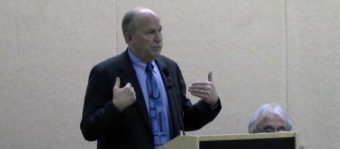
Governor Bill Walker addresses the 4th annual Alaska Federation of Natives and National Congress of American Indians conference at the Egan Center in Anchorage. (Photo by Jennifer Canfield/KTOO)
Gov. Bill Walker addresses the fourth annual Alaska Federation of Natives and National Congress of American Indians conference at the Egan Center in Anchorage. (Photo by Jennifer Canfield/KTOO)

Gov. Bill Walker announced Wednesday the creation of an 11-member tribal advisory council.

“We need to do things differently. We need to do things collaboratively. We need to have the vehicle to have a discussion and bring things to us, and so when we have an issue we have a mechanism to go out to the village leaders to solicit your input,” Walker said.

The council will advise on education, health care, subsistence, energy, public safety, justice, wildlife and fisheries, economic development, housing, language and culture and transportation. There will be one representative for each issue.

Richard Peterson, president of the Central Council of Tlingit and Haida Indian Tribes of Alaska, said he was excited about the announcement. Of all the issues covered by the council, Peterson said energy should be a priority, but land into trust is also something he’d like to see addressed before too long. He thinks it’s an issue of the state recognizing the tribes’ rights.

“Obviously they recognize tribes and our importance, but there’s never been a formal recognition and I think that needs to take place,” Peterson said. “What I would hate is to have all this great forward movement under this administration and then another administration comes in and just ignores (it), and it’s back to the way it was previously when tribes didn’t have the impact that we have now.”

Walker made the announcement Wednesday at the Alaska Federation of Natives and National Congress of American Indians annual conference in Anchorage. Several cabinet members addressed the conference that morning. Walker said he’d like for the meeting with AFN and NCAI to become an annual event for his administration.
High number of illegal moose kills could end season early for Petersburg and surrounding areas

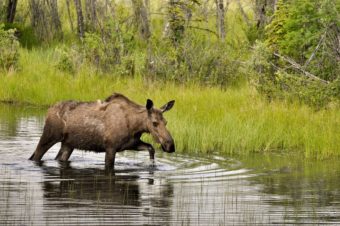
moose
(Photo by Heather Bryant/KTOO)

The first week of moose hunting in the Petersburg, Wrangell and Kake area has seen a harvest of 35 moose. Seven of those moose were illegal kills.
Rich Lowell, the Alaska Department of Fish and Game’s Area Management Biologist, says that those seven did not comply with the existing antler restrictions. And he says it’s cause for concern.

Typically, illegal kills make up about 10 percent of the season harvest but the first week of this season saw twice that. If the trend continues, Lowell says the state might have to close portions of the hunt early.

The antler restrictions are in place to protect younger bulls of a breeding age.

Most of the catches in the first week happened on the Stikine River. Twelve moose were taken there. Nine were killed on Mitkof Island, seven on Kupreanof Island, Five in the Thomas Bay area, one at Virginia Lake near Wrangell and one on Woewodski Island.

If the hunt does continue, it looks like it could be a high harvest year. Thirty-five moose in the first week matches the record year of 2009 when hunters totaled 109 bull moose.

Last year, hunters harvested a neared that record with 106 moose.

The season runs September 15 through October 15. It includes the several units: the Unit 1-B mainland, the Unit 3 islands, and the extreme southern portion of Unit 1-C.


WWOOFers bring transient farming culture to Alaska

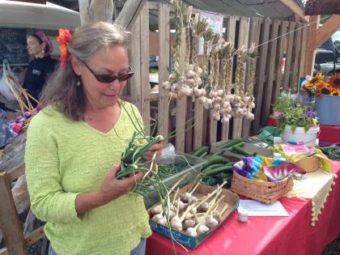
Lori Jenkins of Synergy Gardens holds garlic scapes her WWOOFers helped harvest. (Photo by Shady Grove Oliver/KBBI)

Every summer, Homer and the surrounding area is inundated by a transient population that’s come to work for eco-friendly businesses. They’re called WWOOFers and they spend weeks in different places around the world learning how to live sustainably.

Across Kachemak Bay from Homer, in the small community of Little Tutka, Emma Bauer is setting up kayaks on a beach.

“Today we have a bigger group of guests,” says Bauer. “I think they’re all a big family but it’s seven people. Like the other day we just had a tour of two people. So sometimes the guides and the volunteers outnumber the guests but today we have to take out the majority of our kayaks. So it takes us a little bit longer to get everything ready.”

She’s a college student from Huntington, West Virginia, who has spent the last several weeks working for an eco-friendly lodge and tour company as an all-purpose helper. She assists with kayak tours around the bay, washes dishes, collects seaweed for organic soup, and turns down bedding when guests leave. She’s not paid, but in exchange she gets to stay in a cabin with an ocean view nestled in a scenic coastal forest, and do things she otherwise wouldn’t have the opportunity to do.

“I had not traveled much before, so this is my first big adventure,” says Bauer. “I had never flown commercially so that was a big thing. This whole trip was a bunch of firsts for me.”

She’s part of the WWOOF program, which stands for Worldwide Opportunities on Organic Farms. Emma is one of the nontraditional WWOOFers doing something aside from farming.

“I thought it would be really neat to learn about sustainable living,” says Bauer. “I’d like to do another WWOOFing experience where I’m farming because here it’s a little different where I’m doing the kayak tours with them but I’m still learning a lot about the environment and things that go on here.”

Most of the WWOOFers here are like Noel Krasomil. He’s been working at Synergy Gardens on the Homer side of the bay. Today, he’s helping out at the farmers market booth.

“Today we are selling our wonderful garlic, first of the season harvest braids,” says Krasomil. “We have scapes. We had tomatoes, they’re about out, cucumbers, flowers, everything — really great stuff all-around.”

He says he’s wanted to learn how to farm organically his whole life. For the past three weeks he’s seen the inner workings of an independent growing operation from every side.

“Oh, it’s different every day,” says Krasomil. “It all depends on the needs of the farm. Some days I’ll harvest kale and arugula. I’ll harvest garlic, hang it to dry. I’ll run around town getting beer waste for the compost. I’ll go grab manure. I’ll dig ponds … any number of things — whatever they need me to do.”

“A lot of people think WWOOFers just weed, but it’s just way more,” says Lori Jenkins, owner of Synergy Gardens and Noel’s host. “Each person’s going to have different strengths and different weaknesses. So I ask them every day, ‘What do you want to learn today?’ And then I have my goals of what I need to achieve, as far as whether we’re replanting, what needs irrigating, what needs harvesting, what needs weeding.”

She says she likes to have WWOOFers in residence for at least two weeks, so they get the rhythm of day-to-day operations. That may sound like a very short time, but quick turnover is one of the ideas behind WWOOFing.

It was started in the 1970s by an English secretary named Sue Coppard who lived and worked in London. She wanted to spend more time in the country without leaving her job, so she coordinated with a farm in Sussex to let her come out for the weekend. Thus began Working Weekends on Organic Farms, its first title.

Since the seventies, it’s spread to more than 50 countries, from Ghana to Poland, New Zealand and Bangladesh. In 2010, the most recent year with WWOOFing stats, nearly 12,000 host organizations filled more than 80,000 positions. Many of the WWOOFers jump from farm to farm every few weeks to spend an entire year traveling and working.

Jenkins says having new people in the house every few weeks has taken some adjustment.

“I’m getting used to communal living, and that’s been a shift,” says Jenkins.

It’s also not free. She says she’s done the math and it costs her about $500 per month to house, feed, and provide water for her WWOOFers.

Despite the cost, Jenkins says it’s worth it.

“So here, I have an educated college grad, coming to my place, and then they’re often world traveled. It’s not for everybody, but with the attitude of give and take, I think it’s awesome,” says Jenkins.

It’s like-minded people coming together for a common cause and mutual benefit. And Jenkins asks, really, what’s better than that?

Site notifications
Update notification options
Subscribe to notifications