Subsistence

On the hunt for salmonberries in Dillingham

Credit Hannah Colton/KDLG

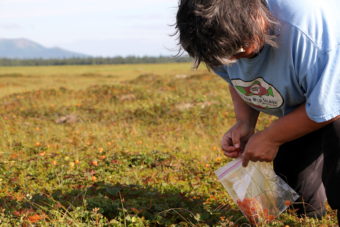
Each July and August, dozens of Bristol Bay residents take to the berry flats. Some are casual gatherers, picking handfuls here and there. Others set out to harvest enough salmonberries to rival the year’s salmon harvest.

Kim Williams, her sister-in-law Liz Johnson and aunt Judy Samuelson are the latter.

Around 9 a.m., the three women embark on their tenth day of salmonberry season. Williams says it’s been a good haul so far.

“How many bags you put away?” she asks the group. One says 37; another says 40.

They load plastic buckets and quart-sized Ziploc bags onto their four-wheelers. Williams leads the group onto the tundra, picking her way between swampy patches. She’s heading toward one of their closely guarded berry spots.

“We have spots that we regularly look at beause we’ve been [going] there for at least 30 years,” She says. “We have spots that we go back and check. Some years they’re there and some years they’re not.”

Last year was an off year with no salmonberries to be found. Williams says heavy wind and a late frost killed the delicate blossoms.

“These berries are really fragile,” she says. “They’re a white blossom – a lot of rain can knock the blossom off [or] the wind … a lot of things can happen so they don’t berry.”

This time around the conditions were right and the berries early. Williams says they started scouting for June 9, more than a week earlier than usual.

“We always know that when you hear the cranes out on the berry flat, berries are ready. And when the fireweed is blooming, berries are ready. That’s the sign to tell you to go look,” she says.

Judy Samuelson, Liz Johnson and Kim Williams take a mid-afternoon rest after leaving one patch of berries picked nearly clean. Credit Hannah Colton/KDLG
Judy Samuelson, Liz Johnson and Kim Williams take a mid-afternoon rest after leaving one patch of berries picked nearly clean.
Credit Hannah Colton/KDLG

Today’s destination is a prime berry spot the ladies have visited before. We arrive to find the flats thick with the big, bright orange berries that Williams says they favor.

“We want them big. We leave the small ones,” she says. “We don’t like them white, we don’t like them with black dots, we we don’t like them hard so you have to clean ‘em … they have to be just right.”

Kim Williams with part of a day's haul. Credit Hannah Colton/KDLG
Kim Williams with part of a day’s haul.
Credit Hannah Colton/KDLG

These flawless berries could sell for $100 a gallon or more, but Williams says they won’t put them on the market.

“We never sell. I did sell one year, my old ones, when I had like 80-some bags,” she laughs. “We’re not hoarders!”

William’s says her berries will go straight into her father’s freezer. Her family will enjoy a year’s worth of akutaq, a dessert made with berries mixed into shortening and sugar.

“Usually for my family we take out two bags when we’re going to have a meal of salmonberry akutaq, and I take blackberries or blueberries and I add it and it stretches it,” she says. “Now auntie Judy, she likes just strictly salmonberry akutaq. But she’s a picking fiend!”

The three women pick the area for several hours, with a light breeze keeping the bugs off. Before leaving for new territory, they try to tally up their haul from this one spot…

“Forty-four!” she exclaims. “Eleven gallons! That’s really good! … That’s lots, no wonder our backs are hurting!”

By late afternoon, they’re running low on Ibuprofen and freezer space, making it about time to call it the end of a successful salmonberry season.

Slow fall chum run leaves Yukon smokehouses empty

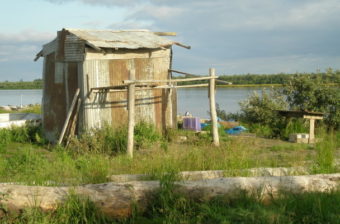
A smokehouse and fishrack in Emmonak. (Photo courtesy of Alaska Department of Fish and Game)

Slow fall chum runs have kept subsistence fisherman from being too active on the Yukon River this past week, but as Chinook continue crossing the border, officials say their numbers are well above escapement goals.
“As far as I know, everybody’s smokehouse is empty, waiting for fall chum,” said Fred Huntington in Galena.

It was a sentiment echoed by many calling into the weekly teleconference for fishermen and managers along the Yukon last week. That wait has been going on for two weeks now—ever since fall chum officially started running around July 18, creating a midseason lull for many fishermen between summer and fall chum runs. Bonnie Borba, the fall chum research biologist for the Alaska Department of Fish and Game, said the first pulse of fall chum would be making its way upriver by the end of July and into the first week of August.

In all, the fall chum run on the Yukon is expected at between 700,000 to 800,000 fish. It’s a moderately-sized run that Fish and Game’s Jeff Estensen said may be slow, but they are on their way.

“[Fall chum] certainly will be getting there,” he told callers. “They’re making their way up. I did get a chance to talk to a fisherman in Holy Cross a couple of days ago; he mentioned there are definitely signs … so by all accounts it seems like we have a pulse of fish going upriver.”

The fall chum run should be enough for escapement, subsistence and commercial needs, Estensen said; already, commercial harvesters in the lower river have caught nearly 27,000 fall chum.

But Huntington pressed managers to loosen gear restrictions for mid and upper-river fisherman who are still trying to meet their subsistence needs. Right now, he said, he has to travel downriver to Koyukuk to catch the fish he needs.

“It would be helpful to us, because (of the) price of fuel here, and the lack of fish in our smokehouses, it would help quite a bit if we were able to just go out here with our 5 gallons of gas that we could possibly have [Districts] 4B and C open for drifting,” he asked. “Get our 10 fish or whatever we want to get, rather than going to Koyukuk and trying to get a hundred.”

While fall chum slowly move upriver, the Chinook continue moving into spawning grounds in Canada. As of last week, nearly 65,000 kings have now crossed the border. Stephanie Schmidt, the summer season manager for Fish and Game who oversaw the king salmon run, said beating the upper-limit escapement goal of 55,000 fish is a victory for everyone involved.

“This run is still well below average, well below what we used to see a couple of decades ago,” she began. “However, thanks to the tremendous conservation efforts on behalf of fishermen up and down the river, we’ve been able to achieve escapement goals on all of our Alaska drainage projects so far. And we’ve now achieved the upper end of the escapement at the border. And thanks for working to make sure these fish get on the spawning grounds so we can try and rebuild this run for the future.”

Four Western Alaska communities to receive large halibut donation after dismal walrus harvest

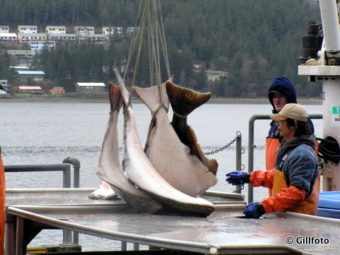
Four communities affected by this spring’s poor walrus harvest will soon receive 10,000 pounds of halibut from a nonprofit that supplies seafood to hunger-relief efforts.
Nearly 200 boxes of the fish were delivered to Nome July 29, according to Kawerak senior planner Donna James. She said the delivery is being sorted and will soon be distributed to Diomede, Gambell, Savoonga and Wales.

The halibut comes as a donation from SeaShare, a nonprofit based in Washington state. All four communities declared states of economic disaster after a spring harvest that Vera Metcalf called significantly worse than usual.

Metcalf is director of the Eskimo Walrus Commission and has worked with the communities through the food shortage. She said the commission reached out to the State of Alaska and the governor’s office for help through Rep. Neal Foster and Sen. Donny Olson

“Their staff (was) really good about following up with our concerns, making sure the communities were aware that the State of Alaska and Walker’s administration were aware of the situation,” Metcalf said.

The U.S. Coast Guard brought the frozen halibut to Nome free of charge, and James said Kawerak is working with Bering Air, Erickson Helicopters and Ravn Alaska to organize free freight delivery to the four communities.

Although the donation is good news, Metcalf said it’s only a temporary solution as climate change makes hunting more difficult.

“In the event that another disaster is declared, what do we do? And how do we move forward? We need to come up with a long-term plan,” she said.

For now, Metcalf said the donation will be a big help, even if it doesn’t completely solve the food shortages.

“I know it won’t fill the nutritional value that a walrus or other marine mammals provide, but it’s there and it’ll be put to good use,” she said.

The halibut will ship out as soon Kawerak can coordinate delivery with the different airlines. Kawerak will then distribute the fish equally to households in each community.

Subsistence Board vote makes Saxman rural again

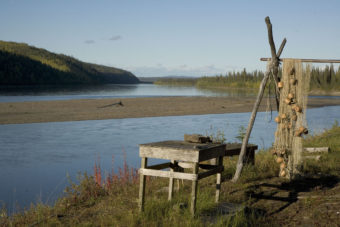
Subsistence fish camp on the Koyukuk River. (Public Domain photo by U.S. Fish and Wildlife Service)

The Organized Village of Saxman is now officially rural again.

The Federal Subsistence Board voted during a work session Tuesday in Anchorage to return communities to the status they held before 2007. That’s the year the board decided to make Saxman non-rural, an action that Saxman residents and other Native leaders have fought against ever since.
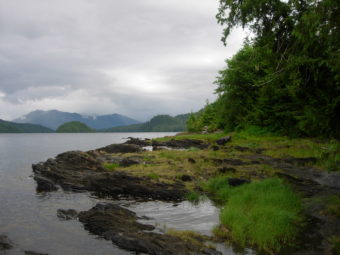
Theo Matuskowitz works for the Office of Subsistence Management in Anchorage. He says the board took three actions Tuesday related to rural determination.

The first adopted a proposed rule that simplifies the rural determination review process. The third action starts the ball rolling on options for determining communities’ rural statuses in the future.

The middle action is the one that makes an immediate difference to Saxman.

“They decided to go back to the pre-2007 final rule because, basically, everyone seemed pretty happy with the non-rural determinations there. It was after the 2007 final rule that people expressed unhappiness with their action. So, by the board deciding to go back to the pre-2007 rule, this makes Saxman rural once again.”

Matuskowitz says there are still some administrative actions that need to be taken before the action is published, but Tuesday’s vote makes it official.

Rural status for an Alaska Native community allows residents to subsistence hunt, fish and gather traditional foods and other materials.

Conservationists declare victory in court’s Tongass road ruling

The 9th Circuit Court of Appeals struck down a 2003 exemption Wednesday that would have made it possible to build roads through the Tongass National Forest.
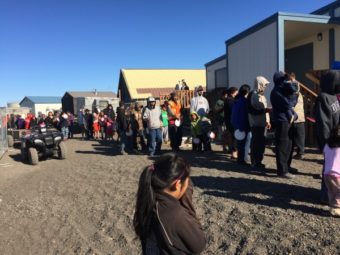
Malena Marvin, Director of the Southeast Alaska Conservation Council, says this decision underscores management that’s already happening.

“The Forest Service is already not planning sales in roadless areas and proceeding in the same direction as the rest of the country in preserving these areas for future generations,” Marvin says. “So we’re really seeing the final legal decision just guaranteeing that direction.”

Tongass National Forest near Ketchikan, Alaska. (Creative Commons photo by Mark Brennan)

“Roadless areas” are habitat for endangered species, subsistence hunting and fishing, outdoor recreation and sacred sites.

In 2001, the Department of Agriculture created the Roadless Rule, which limits road construction and logging on nearly 50 million acres of wilderness. The Tongass National Forest was exempted two years later when George W. Bush was in office. “Economic hardship” for timber-dependent Southeast communities was given as the reason.

Earthjustice attorney Eric Jorgensen says a coalition of conservation groups and Alaska Native tribes challenged that ruling. Earthjustice provided legal representation.

“(We) argued that the agency hadn’t adequately explained its rationale for reversing course and deciding to exempt the Tongass from the protection,” Jorgensen says.

In a press release, Sen. Lisa Murkowski called the ruling a “setback for the economies of Southeast Alaska.”

Owen Graham of the Alaska Forest Association echoed that sentiment. He believes the Forest Service has a “monopoly supply” over the timber industry in the region.

“They won’t allow enough timber sales to keep our industry alive and we’re dying,” Graham says. “It’s hindering all kinds of development for no good reason other than pacifying environmental groups but we hope to get it overturned eventually.”

The state could still petition the Supreme Court to exempt the Tongass from the Roadless Rule. The Supreme Court, however, declined to hear an appeal of the rule in 2012 when the State of Wyoming and the Colorado Mining Association challenged it.

As subsistence foods become scarce, Kivalina celebrates a new store

Kivalina’s new store, owned by Seattle-based Alaska Native Industries Cooperative Association, celebrated its grand opening with hot dogs and hamburgers for the community. (Photo by Janet Mitchell)

It’s been a festive day in the Northwest Arctic community of Kivalina as residents celebrate the grand opening of a new store. It’s an end to eight months of struggle with limited supplies after Kivalina’s store burned to the ground Dec. 5.

Janet Mitchell is Kivalina’s city administrator. She says the village doesn’t have firefighting equipment so men cut a hole in the ice of the local lagoon and pumped water on the fire, mainly to keep it from spreading to nearby teacher housing. Mitchell says a temporary store was established but it was a very small space.

“They ran out of things very quick and that posed a difficulty for young babies or young families, families that need formula,” Mitchell says.

She says eggs cost more than $8 per dozen and pilot bread $7 because of limited supplies. Mitchell says the temporary store was in a storage structure built in the early 1900s and mainly sold staples of eggs, flour and rice.

Seattle-based Alaska Native Industries Cooperative Association, or ANICA, owns the store. The new store is two or three times bigger than the old structure, she says, and on Tuesday company officials flew in for the grand opening.

Kivalina’s population of 468 includes a high percentage of young people. Mitchell says close to half are 18-years-old or younger and many of them don’t care for traditional foods. Subsistence resources are also harder to get in a changing climate. Mitchell says the ice went out in early June and with it went the subsistence mainstay, ugruk, also known as bearded seal.

“It’s our winter food (and) we didn’t have an opportunity to hunt the bearded seal. So it’s going to be a very, very lean year in terms of Native foods,” she says.

Mitchell says her large extended family normally harvests between 15 and 20 large adult seals. This year they got one small seal. She says fewer than 20 have been harvested by the entire community and they haven’t seen many caribou either. She says even older Kivalina residents who normally rely heavily on subsistence hunting will have to include more Western food in their diet.

“The store is going to be very important to have if we don’t have the capability of hunting the foods we normally do.”

Although she prefers Native food, Mitchell says she buys supplies at places like Costco when she can get to Anchorage.

“But we have families that (include) up to 20 (people) in one household, so that can be quite a challenge to keep them fed, especially when they don’t hunt,” she says.

Mitchell says her community continues to fight development to protect subsistence food, but that the store will be increasingly important in the future.

Site notifications
Update notification options
Subscribe to notifications