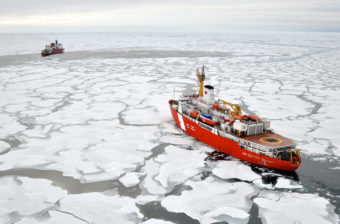
The Canadian Coast Guard Ship Louis S. St-Laurent makes an approach to the Coast Guard Cutter Healy in the Arctic Ocean. (Photo by Patrick Kelley/U.S. Coast Guard)
The University of Washington School of Law is hosting policymakers from Alaska and around the country for discussions on Arctic security and politics, development, transportation and shipping, environmental protection, and climate change.
Elected Alaska officials, academics, municipal and Native corporation representatives, and some of the Coast Guard’s top officers are expected to attend.
Bethel Rep. Bob Herron is part of a panel that will discuss development of a port system, and improving communications and mapping of the Arctic. He said they’ll also talk about reducing heating costs, developing adequate water and sewer systems for Arctic communities, and responding to the effects of climate change.
“I think that we have to remind them that maybe we are the best to be deeply involved, and not to take us for granted,” Herron said.
Lt. Gov. Byron Mallott, Anchorage Sen. Lesil McGuire and Craig Fleener, the Walker administration’s Arctic policy adviser, are some of the other Alaskans participating in panel discussions or addressing the conference.
Herron is attending again this year in his role as chair of the House Economic Development, Tourism & Arctic Policy Committee. He admits to being annoyed whenever he hears comments from nonresidents that imply that Alaska needs saving from Alaskans.
“We’re not someone’s convenient snow globe so they can look inside the snow globe and see all these little fur-clothed, subsistence people living in a zoo, in a museum, in an environment where they must protect it,” Herron said. “There’s a couple times where I’ve felt that I’ve been patted on the head and they’ve said, ‘Don’t worry. We’ll take care of you.'”
Alaska Sen. Lisa Murkowski and Washington Sen. Maria Cantwell, co-chair and ranking member of the Senate Energy and Natural Resources Committee respectively, will also attend the symposium.
Herron said it’s good that the symposium is being held in Seattle this year.
“We’ve got to bridge this Pacific Northwest, western Canada future,” Herron said. “You can’t separate Alaska from the Arctic. You can’t separate Alaska from our Canadian neighbors. And, even though we’re not directly connected to the Pacific Northwest, we still have all that history.”
Interior elder Sidney C. Huntington died Tuesday in Galena. He was 100 years old. He leaves behind not only a long list of accomplishments but an entire philosophy of life.
Sidney’s biography could go on for hours. His story is so intertwined with the story of Alaska over the past century.
His dad came to the territory of Alaska during the Klondike gold rush. He watched the villages of the middle Yukon and lower Koyukuk valleys transition from isolated, subsistence-based settlements to communities with satellite dishes, snowmachines, and multimillion dollar schools.
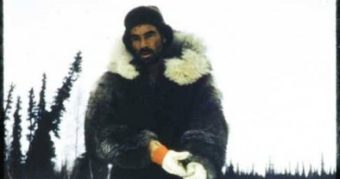
Sidney Huntington on the trapline, 1958. (Photo courtesy of Alaska State Library, Keller Family Photo Collection)
But like the villages themselves, Huntington never abandoned subsistence. As he explained in a 1996 interview for the oral history series “Raven’s Story,” Sidney took pride in living close to the land, even after his trapping days were over.
“The change in life has been dramatic. For me to say that I have changed very much … I imagine I have, to quite a degree to keep up with the times. But my variety of food, and what I do, has not changed very dramatically, only I have adapted myself to the new methods of harvesting wildlife resources. And I have a deep respect, probably a deeper respect for wildlife resources than anybody in the country.”
Never lacking in confidence, Sidney did many different kinds of work during his life: hunting, fishing, trapping, boat building, carpentry, mining, fish processing. He served on the Board of Game for 17 years and helped create predator control programs and controlled-use areas to protect moose populations in the Interior. He had a huge family.
He leaves a legacy in Galena not only in terms of what he did but how he did it.
Sidney insisted on the value of hard work and despised government handouts. He was legendary for starting his work early in the morning, working late into the night, and doing it all again the next day.
Though he only had a third-grade education, he was a strong supporter for public education in rural Alaska. Someone else in his position might say, “You don’t need to go to school. I only went through third grade and look at me now.”
He took the opposite approach. He wanted rural kids to have the formal education that he never had. He loved meeting students at Galena’s boarding school and considered himself a father to all of them. The Galena K-12 school is already named after him and has been for 10 years.
But what I think is the most interesting legacy that Sidney Huntington leaves behind is the new Alaska identity that he forged. He was half Alaska Native, half white, and didn’t consider himself a full member of either of those camps. He drew lessons from books, boarding schools and Native elders alike to build a lifestyle based on practicality, preparation, and respect.
Each of those values is on display in this outtake from “Raven’s Story,” in which he describes his wolf trapping techniques.
“I wouldn’t tell anybody how I trap wolves. That is not the historic way of doing it. They say you give your luck away and you can’t catch them anymore,” Huntington said. “Well, I’m about over the hill anyways so it doesn’t make much difference. I generally trap on glare ice, and wolf trapping I’ve found is a lot of work, a lot of work. Dedicated work. You are trapping a very cautious, wary animal. The only thing that gets him, he’s like you and me, he wants to know what is on the other side of the fence.”
Clever, iconoclastic, and ultimately — practical. That was Sidney Huntington.
And of course, Sidney left us his book, “Shadows on the Koyukuk.” It’s become more a reference book than a biography at my house, and I try to reread every year. It never ceases to be a fascinating look back at how Alaska used to be, but also an inspiration to the challenges that lie ahead of us.
I never managed to have Sidney autograph it. But we have a table he built in our cabin, and that seems good enough.
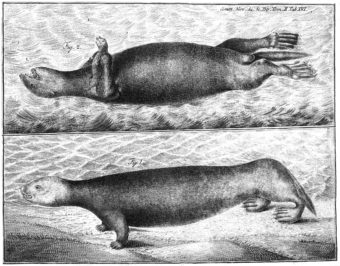
Sea otter illustration by Naturalist Georg Wilhelm Steller (Wikipedia commons photo)
What many Americans consider to be a cute, back-floating mammal is a pest, even a thief, to some Southeast Alaskan fishermen.
Humans and sea otters enjoy consuming the same bottom-dwelling seafood: Dungeness crabs, clams, sea cucumbers and urchins.
But in some areas these organisms have completely disappeared, according to Phil Doherty, director of the Southeast Alaska Regional Dive Fisheries Association (SARDFA).
This has increased competition between dive fishermen and sea otters.
Harriet Wadley has been a commercial sea cucumber diver for 27 years. She dove for abalone until the dive fishery closed in 1996.
“We had an abalone fishery here until the otters ate us out of it,” she said. “And then I switched about the time that the abalone fishery was dying, the sea cucumbers started up.”
A paper published by the U.S. Fish & Wildlife Service in 2014 says the sea otter population is growing by 12 to 14 percent a year, which equates to 3,000 more animals in 2015 than 2014. And more otters mean an expansion of their range.
Before reintroduced in the 1960s sea otters were absent in Southeast for over a century, driven to extinction by the Russian fur trade.
But now they seem to have the leading edge on humans.
In 2011, a study by SARDFA documented $22.4 million dollar losses to commercial fisheries as a direct result of predation by otters.
“We harvest at a very, very low rate: 2-4% of the population of the species per year. And in areas where sea otters have expanded into they eat just about everything,” Doherty said.
Many sea cucumber, clam and urchin dive fishing areas have been closed to commercial fishing because sea otters have eaten the areas bare, he said.
It wasn’t easy starting out as a female fisherman, Wadley said. She was inexperienced — green but eager. A diver with a good reputation eventually agreed to take her out for abalone.
“I ended up getting more poundage than the rest of the divers put together,” she said.
Now Wadley owns her own 45-foot boat named “Vulcan.” She has a sea cucumber quota and manages her own personal dive fishing operation. Wadley and one other person take her boat out for seven-hour fishery openings.
She swims to the ocean bottom with four empty bags and a tank of oxygen on her back. Her partner waits on the boat. He will pull up the heavy bags packed with cucumbers.
“Boy, once you get underwater, I mean, it’s beautiful down there,” Wadley said.
But the last few times she went out, cucumbers were pretty “skinny.”
“When you get into an area where there are sea otters it looks like a World War II bombed out zone,” she said. “There’s dust everywhere. They do a lot of damage to the bottom.”
A sea otter floats on its back. (Photo by Theresa Soley/KTOO)
Wadley said sea otters like abalone best, so that fishery closed first. Next it was urchins, and then cucumbers. Geoduck clams are next, she said.
“They’re totally eating us out of house and home.”
But in 2014 another fishing group, the Southeast Herring Conservation Alliance (SHCA), wrote in a public comment that the herring fishery benefited from a greater abundance of sea otters.
SHCA wrote that an increase in sea otter harvest by Natives could trickle down to a reduction in herring spawning habitat, in turn reducing herring abundance.
Federal law prohibits hunting of marine mammals in American waters; Alaska Native subsistence hunters are exempt from the law.
177 sea otters were reportedly taken in Sitka, down from 349 animals in 2014 and 550 in 2013. In the past, Sitka has documented more harvested otters than any other city in the state. Over the last 25 years, Hoonah reported less than a third of the harvest by Sitka, and Ketchikan a sixth.
But this year, Hoonah’s reported harvest more than tripled from 49 sea otters in 2014 to 180 animals so far in 2015.
Nathan Soboleff is a contracted sea otter tagger for Fish and Wildlife in Juneau. He is also a Tlingit-Haida marine mammal hunter of the Raven-Dog Salmon clan.
Soboleff said that after a hunt, Natives have 30 days to bring the otter’s hide and skull to an office for tagging. To legally document the animal, he places a tag through the nose of the hide. He also removes a pre-molar tooth from the skull and keeps it for research.
“It’s like a growth ring on a tree. So they will sand down the tooth and read the growth rings on them,” Soboleff said.
In 2011 and 2013, bills were introduced by federal and state lawmakers to create incentives for Natives to hunt more sea otters. The proposed bills were supporting the declining commercial Dungeness crab and dive fisheries.
In 2013, state Sen. Bert Stedman, (R-Sitka), introduced a bill proposing a $100 bounty for each sea otter harvested by an Alaska Native.
The bill did not pass.
Mike Miller, chair of the Indigenous People’s Council for Marine Mammals (IPCoMM), said that Natives were mostly opposed to the bounty bill.
Miller, who lives in Sitka, said his group supports legislation that encourages economic opportunity for Native communities, but “the one thing we didn’t want to do was inadvertently to change from that goal to a predator control issue which is more just about getting rid of the animal.”
But Phil Doherty, SARDFA, said that Native subsistence and commercial fishing interests aligned.
“It is a win-win,” he said.
According to Doherty, the bill proposal was about “trying to help the Native hunters pay for some of their expenses.”
But Miller said that the enacted bill could have caused a flood in the market of sea otter pelts, which would drive their value down and ultimately harm Native communities.
According to Doherty, the fate of Southeast dive fisheries lies in the hands of politicians in Washington, tied up in the federal Marine Mammal Protection Act.
Harriet Wadley said she doesn’t understand why the government prohibits hunting of sea otters by non-Natives.
“We control every other population: deer, bear, wolves. We keep every population in control and under balance,” she said. “Why is it because this creature is cute that we can’t maintain a balance and open up a hunting season on them?”
Wadley estimates the sea cucumber fishery has six years of life left if nothing is done about otters.
After that, she says she’ll be done diving.
Wadley said she doesn’t know what will come next. Maybe winter kings, or perhaps vacation.
Charges against three Southeast subsistence fishermen — including former Sen. Albert Kookesh — have once again been dismissed. In an opinion issued Friday, the Alaska Supreme Court found that because the regulation used to cite the men was not created lawfully, it’s unenforceable. The decision could have a major impact on Department of Fish and Game bag limits across the state.
Estrada v. the State of Alaska concerned three men accused of taking more fish than their permits allowed. A fourth man, Scott Hunter, eventually pled guilty to an amended charge of fishing without a permit.
Hunter, Rocky Estrada, Stanley Johnson and former Angoon Sen. Albert Kookesh were cited in July 2009 for harvesting 148 fish; their permits only allowed for 15 sockeye salmon harvested per family from Kanalku Bay near Angoon. Kookesh — who’s served in both bodies of Alaska’s Legislature and as chairman of Sealaska — says he wasn’t even fishing that day.
“When I saw Fish and Game come in and start giving them citations, I was looking for something that would challenge the bag limit,” Kookesh said. At the time of the citations, he was representing Senate District C, which included a number of Southeast villages. “When I saw them giving my brothers a citation, I went over and said, ‘Here’s my permit; I want to get a citation, too.’”
The charges were dismissed by a judge at first, but the state appealed.
The fishermen saw the citations as unfair. Kookesh said no one in Angoon recalled the Department of Fish and Game consulting with locals informally — which the department claims it did — let alone officially. If they had, Kookesh says the resulting regulation that set the bag limit may have been more agreeable to locals. He says the department erred in not establishing a definition for “family” or explaining how they decided on 15 fish.
“Less than a mile away from where we got cited, commercial fishermen were fishing, catching all the fish they wanted,” he said.
In 2013, the Alaska Court of Appeals reinstated the charges. Their reasoning was that because the Legislature knew the Board of Fisheries was enacting this kind of regulation, their inaction to amend or clarify the board’s power indicated that they believed the board acted within its authority.
That’s a conclusion the Supreme Court found to be beside the point.
For the justices, the question wasn’t about the authority to create regulations; it was about whether those regulations were established according to the Administrative Procedures Act — a law that defines the process for creating a regulation.
How extensively this decision will affect bag limits across the state is still unknown.
“This may not just be for the bag limit in Angoon. There are bag limits for everything in the state — for moose, for deer, for everything. And we don’t think that this is going to be such a small Angoon case; it’s going to be an Alaska case,” Kookesh said.
Fish and Game Deputy Commissioner Kevin Brooks says the department is also trying to figure out what the decision means for their subsistence management regime.
“We’re going to pull together our directors on Monday morning and with the Department of Law just walk through it,” Brooks said. “It has resource management implications and they’re pretty varied. It’s commercial, sport, subsistence and wildlife. We’ve got to spend some time and figure it out.”
A spokeswoman for the governor said the Walker administration is still reviewing the case.
Kookesh says this is just one of many issues surrounding subsistence management in the state that will be challenged over the coming years. He says this case was really about making the department consult with people in rural Alaska.
“We intended to fight this,” he said. “We intended to challenge it and we did. And today after all those years and all that heartache and all that stress, we finally got a result that we think is right.”
Correction: The Alaska Supreme Court opinion issued Friday states that the fishermen were arrested at the time of their citations. A previous version of this story included that detail, which is not true.
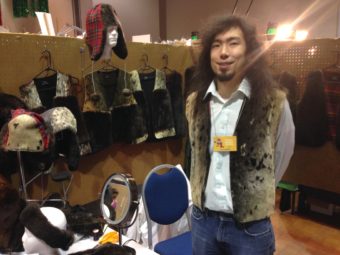
Peter Williams of Sitka displays his seal and sea otter products during the 2013 Juneau Public Market at the capital city’s Centennial Hall. (Photo by Ed Schoenfeld/CoastAlaska News)
A Southeast Alaska skin-sewer is one of four Alaska artists recently chosen for out-of-state residencies.
“I hunt seals and sea otters and I make handicrafts out of the furs of the animals that I harvest,” Williams said. “And I also do a lot of work with expressing and celebrating spiritual connections and relationships with nature.”
The skin artist will spend most of January and February at the institute. He says he’ll work on expanding the range of what he makes, which includes seal and sea otter vests, hats, earrings and headbands.
“As someone who harvests their own art material and I run my own microbusiness and I do a lot of subsistence activities in Sitka and spend a lot of time being spread thin in different areas, I don’t find a lot of time to sit down and create and design new products,” he said.
Peter Williams, right, poses with models Jerica Young, Anthony Flora and Denise Reed, at TechStyle NYC during this year’s Fashion Week. (Photo courtesy TechStyle NYC)
Williams said those include seal and leather mittens and military-style bill caps.
He also wants to expand into men’s ware, starting with scarves. And there’s more.
“I’m sewing sea otter footwear and have been researching the traditional ways of making footwear. I’m interested in both, doing the traditional sealskin boots, but also in incorporating sealskin into something more modern like a sneaker,” he said.
Seals and sea otters are protected marine mammals, but they’re not endangered in the waters where Williams hunts. Coastal Alaska Natives are allowed to hunt some species for food, clothing, art and crafts.
The Institute of American Indian Arts, where Williams will have his residency, is a four-year college that’s a gathering place of students and skilled artists from tribal groups across the United States.
“It’s a great opportunity to network with other artists that are there in residency, with the community of Santa Fe, with other organizations, and to kind of learn and grow through experience as an artist and from other artists and cultures,” Williams said.
Others chosen for next year’s Rasmuson residency program are Fairbanks printmaker Sara Tabbert, Cordova writer Rosemary McGuire and Anchorage visual artist Sheila Wyne.
Behavioral ecologist Fred Sharpe, Ph.D., gives a presentation on the importance of traditional knowledge and place names in ecological research. (Photo by Jennifer Canfield/KTOO)
Using traditional knowledge to support ecological research was the focus of two presentations Saturday at the “Sharing Our Knowledge” Tlingit clan conference.
Behavioral ecologist Fred Sharpe, Ph.D., of the Alaska Whale Foundation, explained to attendees how researchers were using Tlingit place names to help better understand the historical ecology of Southeast.
Sharpe is most concerned about the eastern North Pacific right whale, a highly endangered species with an estimated population of about 30.He said the names of traditional sites or clan houses can indicate that a particular species once populated the area; that’s information that could help researchers understand why a species is in decline.
“Place names can be very instructive,” Sharpe said. “We learned that there’s a place on Chichagof island called Sea Otter Point. And that’s super cool because sea otters aren’t there (now) but it does suggest that they were there in the not-too-distant past.”
Sharpe said Tlingit traditional knowledge has influenced how he thinks about whales.
“I think that gaining some insight into the Tlingits’ perspective has really helped me see how a people can live for centuries, millennia, perhaps even longer with these animals and appreciate them in a nonconsumptive context,” he said. “We see that they loved them and were very proud of them. We take incredible inspiration from that to see how you can intelligently manage species.”
Using Tlingit perspective and knowledge as a guide, Sharpe said he hopes to find ways to return to a more equitable relationship with Southeast’s whales.
Another presenter, Allyson Olds, focused her master’s thesis on hooligan run times in the Chilkat and Chilkoot rivers. The main goal of her research was to establish a baseline for the annual arrival of the fish. Aside from other forms of research, Olds interviewed 20 people in the area to understand how the population has changed.
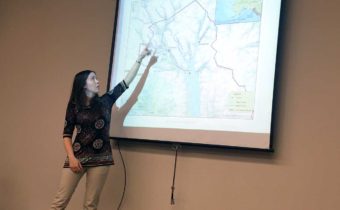
Allyson Olds points to the area where she focused her research on hooligan run times. (Photo by Jennifer Canfield/KTOO)
Little research has been done on the fish, which are not currently harvested commercially.
Hooligan is a subsistence food source in Southeast and parts of Southcentral. The small, oily fish usually arrive in Alaska streams and rivers in early summer to spawn, making them one of the first fish available for harvest by subsistence users and wildlife.
Understanding how climate change may impact run times could be key to sustainable management of the fishery, Olds said.
“There’s big implications on the influence of climate change, which not only affects run timing of course,” Olds said. “It affects everything else since so many wildlife predators rely on these.… They’re not just there, they migrate and they show up for these runs. If that run timing is changing, it can also affect their migrations as well.”
Olds said there is some concern that hooligan population decline is making its way north. On the Pacific coast, the once-prolific forage fish was listed as threatened under the Endangered Species Act in 2010. The following year, British Columbia listed the fish as endangered. Earlier this year, the Alaska Department of Fish & Game closed the Ketchikan area fishery.
Ideally, Olds said, her research would be replicated in other spawning areas to help paint a more accurate picture of the health of the hooligan populations.
Close
Update notification options
Subscribe to notifications
Subscribe
Get notifications about news related to the topics you care about. You can unsubscribe anytime.