Subsistence

Tribal council wants pre-mine ecosystem study

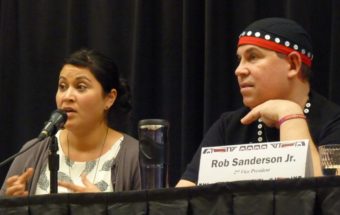
Barbara Blake, special assistant to Lt. Gov. Byron Mallott, answers a question about transboundary mining while Tlingit-Haida Central Council Rob Sanderson Jr. listens at a Native Issues Form March 9, 2016, in Juneau. (Photo by Ed Schoenfeld/CoastAlaska News)
Barbara Blake, special assistant to Lt. Gov. Byron Mallott, answers a question about transboundary mining while Tlingit-Haida Central Council’s Rob Sanderson Jr. listens at a Native Issues Form on March 9, 2016, in Juneau. (Photo by Ed Schoenfeld/CoastAlaska News)

Southeast Alaska’s largest tribal government is pressing for an intensive environmental analysis of the region’s health. It’s part of a larger push for protection of transboundary rivers, which flow from British Columbia into the region.

The Central Council of Tlingit and Haida Indian Tribes of Alaska wants to document the region’s waterways so it can measure any damage that might be caused by mines on those rivers.

Council official Will Micklin said it’s lobbying the Environmental Protection Agency and other federal offices to fund a three-year, $4 million effort.

“We believe that there needs to be a sustained environmental analysis and data collection and modeling and the development of key indicators that determines what the environmental quality and health of the ecosystem exists in Southeast Alaska,” he said.

Will Micklin of the Tlingit-Haida Central Council discusses environmental monitoring March 9, 2016, at the Elizabeth Peratovich Hall in Juneau. (Photo by Ed Schoenfeld)
Will Micklin of the Tlingit-Haida Central Council discusses environmental monitoring March 9, 2016, at the Elizabeth Peratrovich Hall in Juneau. (Photo by Ed Schoenfeld)

Micklin spoke at a recent Native Issues Forum on transboundary mines at Juneau’s Elizabeth Peratrovich Hall.

He said council officials have been meeting with the EPA, the State Department and other federal agencies.

He said the council understands there won’t be any new appropriations. But it’s come up with a plan to shuffle existing budgets to get the study going.

“We have put forward our analysis and we are expecting back from them in a very short time what sort of cooperation and collaboration we can pursue,” he said.

The central council has joined fisheries and environmental groups, as well as the Walker-Mallott administration, in lobbying the federal government to get involved in the issue.

The concerns focus on the Unuk, Stikine, Taku and other rivers that flow into Southeast Alaska waters.

Council official Rob Sanderson Jr. said mine development on the B.C. side of the border could pollute those waterways, damaging commercial fisheries and tourism.

“But the most important part, I believe, is our way of life. Protecting everything from the fish to the smallest organism in the river,” he said.

British Columbia mine developers and supporters have said they’ve built or will build safeguards to protect regional watersheds.

Meanwhile, Lt. Gov. Byron Mallott has been reaching out to Canadian officials overseeing such issues. After his election in October, Prime Minister Justin Trudeau appointed new ministers to agencies overseeing Environment and Climate Change, and Fisheries and Oceans.

Mallott said he asked about a frequent request of mine critics, that a cross-boundary water-issues panel called the International Joint Commission take up Alaska’s concerns.

Gov. Bill Walker signs a memorandum of understanding with British Columbia Wednesday as Lt. Gov. Byron Mallott watches. (Photo courtesy governor's office)
Gov. Bill Walker signs a memorandum of understanding with British Columbia in November as Lt. Gov. Byron Mallott watches. (Photo courtesy governor’s office)

He said he heard more interest in consultations and agreements already underway.

“The bilateral process that British Columbia and the state of Alaska are now engaged in would be the most likely place that an issue or question might suggest a referral to the IJC,” he said.

Alaska Gov. Bill Walker and B.C. Premiere Christy Clark signed a memorandum of understanding in November that increased the state’s role in provincial transboundary mine decisions. Work also continues on a more detailed agreement.

The lieutenant governor also said he’s also pursued International Joint Commission referral with the State Department. He said officials made it clear it’s not the direction they want to pursue.

But he’s asking for a more detailed explanation.

“We would like to have clarity, not so much for ourselves, but for all of the stakeholders engaged in this whole issue to hear a clear statement from the State Department as to their view of the place of a potential IJC referral,” he said.

Only one transboundary mine, the Red Chris, is in operation. Most others are under exploration, on hold or waiting for financing.

Early seal hunt highlights unseasonable weather, uncertainty in Northwest Alaska

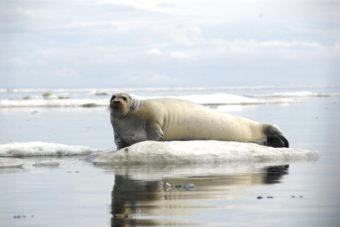
A bearded seal rests on ice off the coast of Alaska June 21, 2011. (Public Domain photo by John Jansen/NOAA Alaska Fisheries Science Center)

One of the warmest winters on record in Alaska means the spring season for bearded seals, or ugruk, has come nearly two months early for some hunters in Western Alaska. Warm weather makes the hunt a little easier, but locals are concerned about precarious sea ice and unpredictable weather.
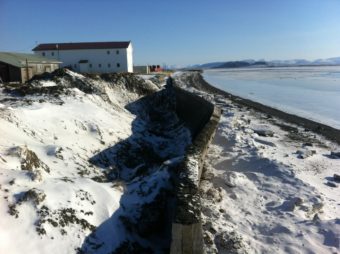
The village of Wales sits out on a point, along the Bering Strait coast, midway between Kotzebue Sound and Norton Sound.

“We live right on the bottleneck of the Strait,” explained Clyde Oxereok. He’s a seal hunter in Wales. He says hunters there are already gearing up for their spring ugruk hunt, which usually doesn’t start until April.

“Some of the hunters there are saying we have to get ready now because our leads are opening up, and when they open up, we’re hungry for the fresh meat and the fresh oil, and it’s coming earlier every year,” said Oxereok.

Ben Payana is also a seal hunter from Nome. “I’m a King Island descendant. My dad was born and raised for a little bit on King Island, and he brought me up doing all the ocean hunting, marine mammal hunting and that’s what I do now, every year.”

Payana explained the basics of hunting a seal. “Right now, if I were to go seal hunting, I would try to get up somewhere high and look out on the ice and try to find some leads, and then you’d go load up your snow machine and little row boat or whatever you’re going to retrieve the seals with,” he explains. “(Then you) try to find your way to that lead and then hang out on the edge of the ice there until some seals swim by, and then hopefully you’ll see one, shoot one, and be able to retrieve it in time,” he said.

Seal hunting can happen year-round and there are many species. Hunters usually wait until April to hunt ugruk, but the weather has been unseasonably warm this February.

As Payana stood along the coast in downtown Nome, he looked out over the sea ice.

“I see a lot of jumbled up, not very good ice for traveling,” he said.

Only a few days ago, steam rose from a large swath of open water, but a north wind blew big chunks of ice back up against the coast, so today, the bumpy, blocky edges peak out from windblown snow that seems to stretch for miles. Payana says there’s another problem with this ice.

“ … (it’s) not very thick ice out there for the seals to be denning in, because they should be having their pups in March and April, too,” he said. “I’m not a seal, but I would imagine they would prefer some thicker ice and more snow cover so they can have a nice safe den for their pups,” said Payana.

The story of this year’s sea ice up and down Alaska’s northwest coast is, well, jumbled.

“It’s a complicated picture,” said Becki Heim. She leads the Sea Ice Program for the National Weather Service in Alaska. There is no shore fast ice at Unalakleet to the south, or up in Kivalina to the north this year. Residents along the coast have posted photos and videos of thin ice and open water on social media sites all winter. Heim blames offshore winds.

“(The winds) have continued to blow the thickest ice that keeps refreezing out into the deeper waters offshore,” explained Heim. “What it’s doing is it’s leaving very thin, new ice near shore, so that’s why there’re more leads and thinner ice and access to the water,” she said.

Heim said it’s not rare for wind and sea ice to interact this way. But Clyde Oxereok said in recent years, not only is the ice less reliable but so is the weather.

“We can’t predict the weather,” he said. “We’re not going to 60 or 80 miles, even 30 or 40 miles anymore, which we used to do, because we knew the weather would hold. Now, we can’t predict that anymore. So that being said, we have to harvest what’s there when it’s there when we have the opportunity to go and get it.”

Otherwise, said Oxereok, they could miss out on the ugruk harvest entirely.

Dennis Davis of Shishmaref has also seen the weather become more unreliable in the winter.

“When I was growing up with my grandpa in Kotzebue in the late 80s and early 90’s, when they had dog teams and stuff like that,” said Davis, “you had to know how to read the weather or wonder what it’s going to do. Nowadays, it’s either hit or miss. You never know what’s going to happen,” he said.

People like Davis understand that the Arctic is always changing. But what’s unclear is how best to adapt to the increasing uncertainty of what change means for the sea ice, the weather, and a subsistence lifestyle.

Angoon mayor unsatisfied with state response to tainted subsistence seal

Hawk Inlet is healthy according to state officials. That’s the message Angoon received about three weeks after concerns were raised about high levels of mercury found in a subsistence seal. But Angoon’s mayor doesn’t feel comforted by the report.
In the 20-page document, the state agencies say they appreciate the “citizen science” used to determine the seal had high levels of mercury.

The letter cautions children, the elderly and pregnant woman against eating certain parts of of an older seal, like the liver. For everyone else, the department recommends limiting consumption. Other traditional foods, it says, are safe to eat.

But Angoon’s Mayor Albert Howard said he doesn’t feel heard by the agencies, and the information isn’t practical.

“When you spend 40-something dollars for gas in Angoon to go hunting, you’re going to make the most of it,” Albert said. “If you see one seal and it happens to be the older one, that’s a risk people are taking and no one’s going to eat only 4 ounces of seal meat.”

Ali Hamad, an environmental public health program manager with the health department, said older seals store up more mercury in their organs. They can swim far distances.

“So chances are that seal picked up some of the mercury from Hawk Inlet and from outside Hawk Inlet, depending on where that seal spent its life,” Hamad said. “Most of the mercury leaves the body but some of it stays in the body and with age it keeps accumulating.”

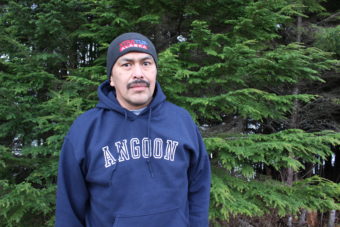
Angoon's Mayor Albert Howard is trying to protect his village's way of life. (Photo by Elizabeth Jenkins/KTOO)
Angoon’s Mayor Albert Howard is trying to protect his village’s way of life. (Photo by Elizabeth Jenkins/KTOO)

The place where the seal was harvested is also home to Hecla’s Greens Creek Mine, which, according to the letter, is meeting its permitted conditions. But it doesn’t discount the origin of the metals could have came from there — historical mining could be a factor. So could natural occurrences, like drainages and streams.

K.J. Metcalf says he found some parts of the letter puzzling. He’s part of the environmental advocacy group that took the tissue sample of the seal. And he said some of his concerns weren’t addressed. His group and Angoon questioned why a 1981 baseline study, before the mine was up and running, isn’t being reproduced to test the quality of the water.

“And I’m really curious as to why there’s such reluctance to use it because I think it’s the gold standard that’s going to be the gold standard that’s going to give a definitive determination as to the health of the inlet,” Metcalf said.

Metcalf said the study, which was lost and rediscovered in an old Forest Service files, offers a better glimpse of the pre-mining conditions.

“I’m not discounting the value of a baseline study of this nature,” said Allan Nakanishi. He oversees wastewater discharge permitting for mining facilities for the state’s water division.

He said the testing that’s done now is more streamlined, less broad. The 1981 version would require more resources, and the state could have difficulty imposing and monitoring it under the mine’s current permit.

“And at this point we feel that, based on the data that we have on hand, that the environmental monitoring required under that permit is adequate to make the determination if harm is being caused,” Nakanishi said.

The small village of Angoon is the home to about 400 people.
The small village of Angoon is the home to about 400 people. (Photo by Elizabeth Jenkins/KTOO)

He said the 1981 baseline study wasn’t brought up in the letter because it’s been addressed in the past. The letter’s focal point was the safety of subsistence food, gathered near Hawk Inlet.

But when it comes to where the seal picked up so much mercury, Nakanishi isn’t sure.

“That’s a difficult question.”

He said yes, the most obvious source appears to be the Greens Creek mine. But mercury is persistent, and the mercury that ended up in this seal could have come from almost any discharge into the Pacific Ocean.

“Some of which probably isn’t under U.S. jurisdiction for regulation under the Clean Water Act. It’s difficult to say or pinpoint what is the source,” Nakanishi said. “It could be an accumulative source from other countries, from the United States, from illegal dumping, it’s difficult to pinpoint.”

The Alaska Environmental Public Health Program has offered hair sample tests to Angoon’s residents to determine their levels of mercury. The state is considering the possibility of testing more seals.

Scientists find PSP, other toxins in most marine mammal species

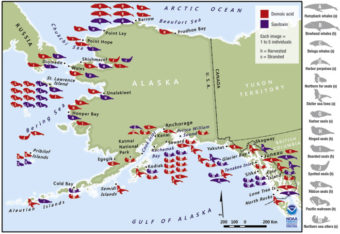
Whales, otters and other marine mammals were found with two algae-carrying toxins along most of the Alaska coastline. (Map courtesy Northwest Fisheries Science Center)
Whale, otter and other marine mammal carcasses were found with evidence of two algae-carrying toxins along most of the Alaska coastline in a study released Thursday. (Map courtesy Northwest Fisheries Science Center)

For the first time, scientists have documented the prevalence of two biotoxins in Alaska’s marine mammal population above the Arctic Circle.
That’s according to a new study out Thursday in the Journal Harmful Algae. But it’s not clear if algal toxins have always existed in the Arctic, because scientist never looked before now.

Scientists did not expect to find algal toxins in ocean water or marine mammals that range north of the Gulf of Alaska and the state’s Southeast region.

“This is really important, because these are animals that are integral to the culture and the community and food security here in Alaska,” said Frances Gulland, a commissioner with the federal Marine Mammal Commission. She co-authored the new study.

“There are detectable levels that have actually been measured of two different biotoxins: domoic acid and saxitoxin and both these toxins are produced by harmful algal blooms,” Gulland said.

The two are known to cause amnesic shellfish disorder and paralytic shellfish disorder in people.

“Now that we see that algae is there,” said Gay Sheffield, a biologist with the Alaska SeaGrant Marine Advisory Program and a study co-author.

“What would be the best coarse of action to make it comprehensive knowledge is to find out how our Russian neighbors have seen any of these unusual algaes or if they have any unusual concerns and more importantly is there traditional knowledge on shellfish poisoning or algal blooms or is there strange behavioral events with marine mammals,” she said.

After algae dies in the ocean, what’s left gets consumed – or filtered – by shellfish like clams and mussels, staple foods for many marine mammals. So, if there are algal toxins present they could end up in the gut contents of an unsuspecting Pacific Walrus, for example. Sheffield said of the 13 marine mammal species sampled over the course of nearly a decade, walrus had the highest levels of algal toxins.

“Because its such an important subsistence food item for the Bering Strait, there’s of course interest both from an animal health perspective, but a public health, human health, food security as well, but right now, there’s no problem,” said Sheffield.

According to the study, levels of algal toxins measured do not exceed regulatory limits for seafood safety in Alaska, or at the federal level. It’s also not clear if the toxins have always been present in the Far North, because scientists never tested for them before now.

Frances Gulland added that the study is not only limited in size, but the data itself can’t provide information about the magnitude of exposure, because toxins like domoic acid are cleared from an animals bloodstream and the gastrointestinal system so quickly.

“If the animal ate some food 10 minutes ago that was full of domoic acid, it would have a high level, but if its 12 hours since the animal ate, the levels will be lower,” she said.

“If it’s two days since the animal ate, the levels will be really low,” said Gulland. “So, really the data are limited because they’re only telling you what’s in that snapshot in time.”

Research does indicate an increase in the occurrence of algal blooms in the Arctic. Gulland believes that’s due to warming ocean temperatures and changes in sea ice.

“They’re plants, they grow, they are temperature dependent,” she said, “so clearly, with warmer waters, they’re going to replicate quicker, so its sensible to assume that temperature is important, but there also changes in micro-nutrients – things like iron and different components of water – that will affect how they bloom as well.”

Funding for study sampling came from the U.S. Fish and Wildlife Service, the National Marine Fisheries Service and the Alaska Department of Fish and Game. Additional money came from the National Institute of Health and the National Science Foundation.

Angoon calls for help after discovering high mercury levels in subsistence seal

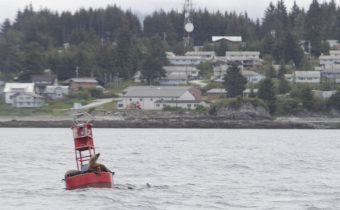
Sea lions on buoy in front of Angoon
Sea lions sit on a buoy in front of Angoon, May 31, 2014.
(Creative Commons photo by James Brooks)

The City of Angoon believes high levels of mercury have been discovered in subsistence food caught near Hawk Inlet and that Hecla’s Greens Creek Mine could be responsible.

Angoon’s tribal government is asking for changes with the monitoring and processing of mine waste. Albert Howard, the city’s mayor and tribal president, said dead crab initiated the concern.

Last year, a seal was harvested at Hawk Point and brought back to the village to share. Howard said a sample of the tissue was sent to a lab to be inspected.

“And the lab results came back and it’s one of the highest levels of mercury seen in the state of Alaska since the seal sample program has taken place,” Howard said.

Howard said the Friends of Admiralty Island also found elevated toxic metals in seaweed, clams, mussels, shrimp, cockles and crab. It’s such a concern that Angoon has warned tribal members not to collect traditional foods in the area.

Howard said he would like to see the city and the mine work together to clean up the water.

“I understand that the mine is important to a lot of people for jobs and revenue into the City and Borough of Juneau, but there’s also a responsibility to the community health. And what I meant by that is the city council and the tribal council understand the importance of the community’s health and our children,” Howard said.

Greens Creek spokesperson Mike Satre said the mine reports a sample on an annual basis.

“We meet all the permitted conditions that are put on us by the state for the discharge of our water into Hawk Inlet,” Satre said.

While the reports are annual, Satre said they’re based on continuous monitoring and sampling of the discharge water, supplemented by quarterly bio-monitoring and additional sampling of seawater and sediment.

Angoon has requested that Lt. Gov. Byron Mallott and Alaska’s Department of Health and Social Services look into the matter.

Editor’s note: Comments by Greens Creek mine spokesperson Mike Satre about annual reporting have been expanded and clarified. 

3 Togiak men die in boating accident after successful hunt

Coastline in Togiak, March 2015. (Photo courtesy of City of Togiak)

Families were gathered to mourn Sunday in Togiak after the bodies of three men lost in a boating accident had been recovered from beaches near the village.

James Toots, 39, Eric Coopchiak, 31, and Larry Arnariak, 29, died Saturday after their skiff overturned in heavy seas crossing the bay from the Togiak River back to the village. The men were returning from a hunting trip upriver and had three moose onboard, according to family.

When word spread Saturday evening after dark that the men were overdue, a local search effort cobbled together by family and village law enforcement was launched. Alaska State Troopers were notified, but flights from Dillingham were grounded on account of the winds. At 11:00 p.m. a request was made for US Coast Guard assistance. An MH-60 Jayhawk helicopter was launched from Air Station Kodiak at 11:40 p.m., and a HC-130 fixed-wing aircraft joined the search. The Coast Guard assets eventually waived off for the night on account of low visibility and high winds, measured at 40 miles per hour.

The body of Eric Coopchiak was found late Saturday, on the beach by the old school. Word was passed by VHF Sunday morning that the bodies of James Toots and Larry Arnariak had been found as well.

“Everybody is still in shock,” said Darryl Thompson, who, along with other elders, was going house to house of the families of the three men. Thompson said it was a small relief to hear early Sunday that the remains of all three men had been recovered before they were carried out to sea.

“Please keep Togiak in your prayers,” said Francesca Kam. “This is a tragic loss for our community.”

Dangerous return from successful hunt

The area 17A winter moose was scheduled to close at the end of the day Sunday, but on Friday, it was extended out another month on account of poor winter travel conditions. For three consecutive winters, state and federal authorities have allowed extra winter hunting time, each year hopeful that snow will eventually come.

Togiak hunters are skilled at tracking game by snowmachine in the snowy hills to their north. But the tundra lays bare and the mountains nearly so, and creeks and rivers are open and uncrossable. Not hunting is not an option for most, so locals have turned to non-traditional means. “Now we’re going out with four wheelers and boats, and having very hazardous terrain to travel and waves to contest with,” said Thompson.

“Whether it’s our sea wall falling down or trying to do our subsistence winter hunting, this warming weather has caused us a lot of serious problems,” he added.

Hunting the Togiak River and its tributaries by boat is customary in the fall, not the winter months. But since the winter of 2013, hunters have been boating up the open river for a chance to get into the field beyond where ATV trails allow.

While the river may be largely ice free, that doesn’t make the trip necessarily safe or easy. Elder Pete Abraham believes Toots, Arnariak, and Coopchiak came down river and attempted to cross the bay in a boat overloaded for the weather and surf conditions.

“They were too heavy I think,” he said. He described their boat as a homemade welded aluminum skiff with a flat bottom but steep sides, bigger than an 18-foot Lund. “You can’t carry three moose in a Jon boat. That boat can probably carry that much, but it was too rough.”

Abraham said the winds were blowing at least 30 miles an hour, and the waves in the bay between the mouth of the river and the village were probably four feet high.

“That boat can’t handle that, or maybe they couldn’t maneuver with the small motor.”

It’s not normally a tricky crossing, he said, but doing so at night, during the winter, can be hazardous.

“In the dark, you can see the village lights, but you can’t always see where you’re going, or where the ice is at,” said Abraham.

How the boat was swamped, and what happened to the men next, may never be known. Abraham believes this was probably a tragedy that could have been avoided. “We need more elders to talk to the younger generation about being cautious, whether boating, or snow machining, or whatever. We try, but sometimes the young people don’t listen.”

Troopers say none of the men were wearing life preservers.

On Sunday, what was most important in the village of 800 was gathering again to mourn with the families who had lost loved ones, and remembering the lives James Toots, Eric Coopchiak, and Larry Arnariak.

“I believe they left behind 11 children between the three of them,” said Darryl Thompson. “But they died doing something they loved, working to provide for themselves and their families.”

Site notifications
Update notification options
Subscribe to notifications