Subsistence

Cheering on the competition: Sportsmanship takes center stage at Native Youth Olympics

Jeremy Roberts set a personal record on the final day of NYO. During the male seal hop event he traveled 128 inches. (Photo by Emily Kwong/KCAW)

Mount Edgecumbe High School sent 15 students to the Native Youth Olympics in Anchorage April 21-23. The event draws Alaskan Native teens from around the state in three days of intense competition. KCAW was at the Alaska Airlines Center on the last day, cheering on the Braves from the sidelines.

Jeremy Roberts is from Quinhagak, near Bethel and he’s been training for the male seal hop event all year. “You can’t be slouchy. You have to be straight. And you have to hop: use your feet to help you go forward and just go until you can’t go anymore,” he explains.

Roberts flips over his fingers. On each knuckle is a rounded callus. They’re hard earned. He says, “I used to get my knuckles cut up but now they’re all scarred.” Jeremy is a senior, so this is his last year to compete. He’s gunning for first place.

Kneeling along the edge of the gym are fellow Edgecumbe students, wearing cardinal and gold colors, ready to cheer. Rachel Teter watches Jeremy from the sidelines. “He goes really fast too. There will be other guys that go pretty far. But he’s just way ahead of them in no time. And then it will take them a while to just catch up to catch up.

The seal hop event has its foundations in seal hunting, mimicking the animal’s movement on the ice and how the hunter sneaks to the edge to capture the seal. Rachel says hunters do more of an army crawl nowadays, but the point of the seal hop is the honor the strength and stamina needed for a subsistence lifestyle. “It’s a good way to incorporate the competitive side and the traditional side and the fun side into one event,” she tells KCAW.

The 2016 male seal hop event begins and pretty soon, it’s Jeremy’s turn. There are nervous teens on sides, shaking out their arms and legs and checking their own calluses. All eyes are on them.

NYO Official: Three, two, one…
Edgecumbe students: Go Jeremy!! Keep going, Jeremy!

And they’re off.

In a bent push up position, elbows at right angles, Jeremy pushes off those knuckles like springs.

Rachel Teter: Push yourself! Push yourself!

Rachel’s right. He’s fast and quickly gains the lead. Teammates plead with him to remember to breathe.

Edgecumbe students: Breathe! Breathe!

And then, Jeremy drops. He’s done. He hopped the full court, but after turning around didn’t make it back to half court. A Dillingham competitor got well beyond that, but Edgecumbe Coach Archie Young is nonetheless proud. “That’s the farthest he’s gone in the competition. Last year, he went 112 feet. So that’s a very good improvement.”

Jeremy’s distance today is 128″ 4.25 inches. He places third in the overall contest. Young is Edgecumbe’s PE teacher and has been training students for NYO for four years. Seal hop is his favorite event. “I love the grit of it and I love that it’s just how strong a mind and how far can I go,” Young said.

Pushing yourself, beyond what you think you can do, is at the core of the NYO Games and other games steeped in Alaskan Native traditions. Most teens are trying to back their personal records, not world records. And in a survey last year, 75 percent reported that NYO is an incentive to stay in school and get good grades.

Laura Ekada competes in Indian Stick Pull, which symbolizes grabbing a slippery fish out of the water. “To me it means I’m carrying on my tradition and I’m keeping things going. Because times are changing and things are getting lost. And I’m just so glad to be part of this,” Ekada said. She wants to go to med school one day.

Rachel Teter remembers the first time she competed in Indian Stick Pull. She was 12, at the World Eskimo-Indian Olympics in Fairbanks. And she was surprised standing before her competitor, each one holding the end of a wooden dowel, trying to wrestle it away from the other.

Rachel recalls, “She must have been 70 or something and she was like, ‘Wow! Youngest and the oldest. You’re just a baby.’ And I was like, ‘Uh, huh.’ And she was like, ‘Let’s see. New and old. Let’s see how this goes.’

They ended up tying and trading big hugs. Rachel says sportsmanship is a huge part of these competitions. You have to cheer as loudly for other teams as you do for your own.

Federal board closes caribou hunting to non-locals in the Northwest Arctic

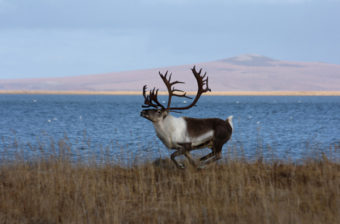
Male caribou running near Kiwalik, Alaska. (Photo by Jim Dau/ADF&G)

In the Northwest Arctic, caribou hunting has been contentious for years. Alaska’s largest herd continues to decline while tensions have emerged between rural subsistence users and outside hunters.
Last week, the Federal Subsistence Board voted to close the vast area to all but local caribou hunters. The closure will last for one year, but biologists aren’t sure it will make much difference.

From Kotzebue to Kobuk, from the Chukchi Sea coast to the northern Seward Peninsula, Game Management Unit 23 covers thousands of acres of federal public lands. Earlier this year, the Northwest Arctic Subsistence Regional Advisory Council called on the Federal Subsistence Board to close them to all non-federally qualified caribou hunters.

The Council argued the closure was necessary to conserve the dwindling Western Arctic Caribou Herd and to stop outside interference with subsistence.

“There’s a long history of user conflicts in Unit 23,” said Chris McKee, the Wildlife Division Chief at the Office of Subsistence Management (OSM). “We hear repeatedly from federal subsistence users: Outside hunters camping on traditional hunting grounds and a lot of other issues surrounding perceptions of wasting meat. It’s something we’ve heard about for many, many years.”

McKee oversees the team of biologists in charge of analyzing potential changes to federal wildlife regulations. The Board takes their analysis into consideration when approving or rejecting proposals.

“But this is a case where the Board actually went against our recommendation,” he said. “OSM’s recommendation was to oppose the closure.”

That’s because McKee and his biologists don’t think the closure will help conserve the herd. Hunters harvest about 13,000 caribou in Unit 23 each year, with local residents accounting for approximately 94 percent of the total take. That means outsiders only harvest about 600 animals on average.

“You’re looking at 5 percent or less of the entire harvest in the unit,” said McKee. “From a biological perspective, eliminating that 500 or 600 animal harvest is going to do nothing to change the trajectory of the herd.”

Currently, biologists estimate the Western Arctic Caribou Herd has about 200,000 animals. That’s less than half the population of 10 or 15 years ago. Biologists aren’t exactly sure what has caused the decline, but they say natural aging, decreased calf survival and climate change are likely contributors.

Meanwhile, McKee said some rural residents blame outside hunters for flying over the herd and changing its migration patterns. Biologists aren’t sure if that’s true. But even if it were, McKee said closing federal lands wouldn’t stop that problem because people can still fly to hunt other species or sightsee.

Still, the Board voted 5 to 3 in favor of the closure because of support from the regional advisory council and public testimony. In their analysis, OSM biologists wrote that at a February hearing in Kotzebue, the “vast majority of those present … were in support of the special action request.”

McKee said another factor was that the Board can only close Unit 23 to outsiders for one regulatory year. The council would have to propose another special action request to close it again next year.

“I think that was another consideration that played in the board’s mind, like, ‘Well, let’s see if it helps this one year and re-evaluate,” he said.

McKee said he has been fielding frustrated calls from outside hunters who have already booked their trips and are now out of luck. The closure will also bar caribou hunting by Alaskans from urban areas and rural Alaskans who have since moved away. The closure will be in effect from July 1 to June 30, 2017.

First wood bison calves spotted near Bethel

Wood bison calf
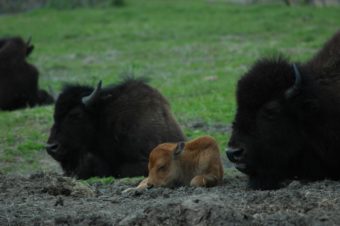
A wood bison calf elsewhere in Alaska in June 2007. (Creative Commons photo by pbarbosa)

Wood bison, recently reintroduced by the Alaska Department of Fish and Game into western Alaska, have been begun to roam throughout the region and spotted near Bethel.

The first sighting of wood bison calves born in the wild could mean big changes in the ecosystem of western Alaska.
The sighting last week of the newborn animals comes after Fish and Game released about 130 wood bison in 2015, an effort Fish and Game biologist Tom Seaton said has been in the works for more than 25 years.

Since the reintroduction, the herd has had its ups and downs. Though 19 of the bison born in captivity died once released, “The bison are completely functioning as wild animals and being successful at it,” Seaton said.

The true test of how well the creatures can adapt is in the survival of the calves, Seaton said.

“Most of the animals out there now spent most of their life in captivity, and they’re doing a great job of being wild bison. But they’ll never be as good as these animals that were bred and born in the wild,” Seaton said.

The deaths of the 19 bison has not been the only challenge. The bison born in captivity sometimes have trouble being independent from humans.

“First it was kind of a thrill to see them,” said Chief Ivan Demientieff of Grayling, who came home one day to find six wood bison in his yard.

“I made jokes saying that I don’t need no grass cutter anymore,” Demientieff said.

But things changed when one bison began to cause trouble.

“It got to the point where it wouldn’t leave, and I had to chase it out of the yard. Then it started living in my shop,” Demientieff said.

Eventually authorities removed the bison. But Seaton said he’s not concerned about this behavior, because the next generation of bison will most likely be more afraid of humans and able to seek out food in the wilderness instead of people’s yards.

When people start hunting the wood bison, which Seaton said will happen when and if the herd more than doubles in size, that will be the final push into the wild to make the animals feel less domestic.

The opportunity for Alaska Natives to hunt the wood bison is a big selling point, said Seaton. He hopes the bison’s progression will resemble another animal that’s become a staple food in western Alaska.

“Moose didn’t occur in western Alaska until about a 100 years ago,” Seaton said.

The animals migrated from eastern Alaska in the early 1900s.

“But today moose are a big part of the culture and food supply of people in western Alaska,” Seaton said. “And if we look 100 years in the future, it’s possible that wood bison could also be a part of the culture and food supply of people in Alaska.”

U.S. Fish and Wildlife Service considering ban on predator hunting in refuge lands

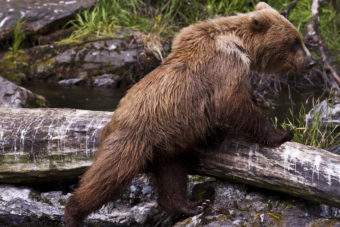
Kenai National Wildlife Refuge brown bear. (Photo courtesy Kenai National Wildlife Refuge)

The National Park Service implemented a series of changes at the beginning of this year which bans various types of predator hunting on Park Service land. The U.S. Fish and Wildlife Service is considering similar changes for refuge lands across Alaska.

The agencies say the changes are necessary to better align hunting regulations with federal management objectives. Hunters have countered that there is no biological justification for the restrictions, and that the changes are purely political.
Based on the fate of a proposal that passed the Federal Subsistence Board this month, some of the opponents may have found a way to overturn the predator hunting changes in specific areas.

It’s a complicated regulatory situation. But basically, the new regulations would prevent subsistence users and sport hunters alike from doing certain kinds of hunting on federal land – things such as taking a brown bear over bait.

The fact that subsistence hunters would be affected by the changes is not immediately obvious because the changes purportedly apply only to what the agencies call “non-subsistence take.” But what the agencies are referring to with this label is hunting that happens on refuges, parks, or preserves under state regulations where is no specific, federal subsistence hunting season to authorize the hunt.

The new federal predator hunting regulations indicate that the state regulations can no longer become the default in this way, when it comes to what the federal agencies call “highly efficient methods and means” for hunting bears, wolves and coyotes.

But what if there is a federally-authorized subsistence predator hunt in a certain area, as approved by the Federal Subsistence Board? Then the new regulations wouldn’t apply – at least for subsistence hunters.

Quite by accident, a proposal from Game Management Units 11 and 12 tested that supposition earlier this month at the Federal Subsistence Board meeting in Anchorage.

Submitted by the Wrangell-St. Elias National Park Subsistence Resource Commission, the proposal would allow federally-qualified subsistence users in the communities surrounding the Park and Preserve to hunt brown bears over bait in April, May and June on Park Service land.

Wrangell-St. Elias Subsistence Resource Commission member Gloria Stickwan says the proposal was never intended to be a push-back against the new predator hunting rules, but instead give area black bear hunters some protection.

“They incidentally took brown bears over black bear bait,” Stickwan said. “This just makes it more legal to brown bears over black bear bait.”

The Federal Subsistence Board passed the proposal, along with 33 others on its consent agenda, without a debate. Commission Chairwoman Karen Linnell wasn’t surprised, even with all the controversy swirling around the issue.

“I think it was because the regional advisories committees were in support of it, and then that there really is not a conservation concern at this point,” said Linnell.

Given that local subsistence hunters account for only a fraction of the brown bear harvest in the Wrangell-St. Elias area, the biological impact of the proposal was found to be minimal.

Though the proposal itself didn’t cause much of a splash when it passed, its success is encouraging to Jack Reakoff, who sits on the commission that helps set subsistence policies for the Gates of the Arctic National Park and Preserve, in and around the Brooks Range.

“It gives an indication that the Park Service is willing to work with the subsistence users on methods and means, to the benefit of subsistence users,” Reakoff said.

Further proof of that, Reakoff says, is the proposal that came out of his region to allow the use of artificial light when hunting bears at den sites – another practice that is targeted for elimination, with numerous exceptions, under the new predator hunting restrictions. But the Federal Subsistence Board passed that one as well.

Reakoff is also chairman of the Western Interior Federal Subsistence Regional Advisory Council, which encompasses millions of acres of Fish and Wildlife service-managed land. If the proposed predator hunting restrictions go into effect on refuges later this year, Reakoff expects that the Western Interior Council will try to reinstate any number of subsistence predator hunts when the Federal Subsistence Board takes up game proposals again in 2018.

Based on what the Board did this month, Reakoff says that the path forward has become smoother.

“The reality is the rural residents can petition the Federal Subsistence Board to continue to allow the methods and means that the State has provided on the refuges,” said Reakoff.

Hooligan make strong return to Chilkoot and Chilkat rivers

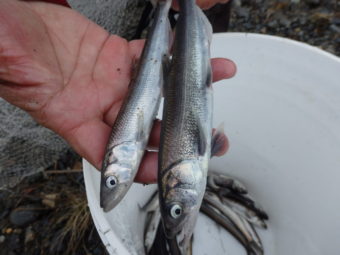
Sonny Williams holds a male and female hooligan. (Photo by Emily Files/KHNS)

The hooligan are back. After last year’s disappointing runs in the Chilkoot and Chilkat rivers, Haines and Klukwan subsistence fishermen are excited that this spring’s return has been abundant. Area biologists don’t know why the runs fluctuate so much. But they’re trying to bolster research to understand the traditionally important fish a little better.

To find out whether the hooligan are running, all you have to do is listen. The hooligan — also known as eulachon — don’t make any noise, but the thousands of gulls and other birds feeding on them do.

Sonny Williams trekked out to Jones Point Tuesday morning to pick up a bucket left behind by a friend.

“Does anybody know if there’s a bucket down there with a net in it?”

Williams says he’s already caught his fill of fish from the Chilkoot River. But as we walk along the bank and he sees the dark streaks in the water that show where the hooligan are, he can’t help himself. He goes to his truck to get a throw net and brings it back next to another fisherman, Vince Hotch.

“You ready Vince?” Williams asks, and then throws his net in the water. He reels it in, and it’s full of wriggling, little silver fish.

Sonny Williams tosses out his net. (Photo by Emily Files/KHNS)

Williams doesn’t just catch, smoke and make oil with the fish. He also keeps data on them: when the run begins, how long it lasts in the Chilkoot and Chilkat. He started doing it because no one else was.

“It’s just pretty awesome to see a giant run like this because that means four years from now probably there’ll be another big run,” Williams said. “I can’t say though really because there’s nobody that studies them. So I decided to keep track of it.”

“They’re such interesting fish, they always keep you on your toes,” said Meredith Pochardt, with the Takshanuk Watershed Council.

The watershed council is the only group that formally studies the local hooligan run, and they only have about six years of data for the Chilkoot River and none for the Chilkat.

“It’s better than nothing, but it’s not that long of data set and it’s only one river.”

Pochardt says the purpose of their catch and release study on the Chilkoot is to get baseline data.

“Hooligan are a little different than salmon. Because hooligan aren’t tied to one river, they don’t necessarily go back to one natal stream to spawn. They’re more opportunistic and they’ll kind of pick a river in a region. So the same population that spawns in the Chilkat or Chilkoot could spawn in the Ferebee or the Taiya or the Katzehin or Berners Bay.”

That seems to be what happened last year. The hooligan run was super low on the Chilkoot, only about 300,000, according to Pochardt. This year it’s up around 1.8 million. But in the Taiya River up by Skagway last year, people said it was the biggest run they had ever seen. The theory is that some unknown environmental trigger caused the hooligan to go towards the Taiya instead of the Chilkoot.

Now, Skagway is going to start to get some numbers on the hooligan run in the Taiya.

“We’re basically trying to get some baseline information about hooligan to understand when the waters are most vulnerable to activities that might affect spawning,” said National Park Service biologist Jami Belt. NPS is starting a hooligan study on the Taiya.

“The arrival of the hooligan breaks the fast for the birds and sea mammals that are getting ready for their breeding season,” Belt said. “We’ve had all kind of activity from river otters…so it’s just a really good indicator species for us of how things are functioning in that ecosystem.”

Skagway fisherman say this year’s hooligan run seemed strong but brief. Soon, the Park Service will have numbers to compare to the anecdotes.

Back at the Chilkat, Williams takes out some of the hooligan he caught a few days ago and smoked.

“I usually try to have one a day. It’s like an apple a day, I try to eat one hooligan a day,” Williams says.

He hopes next spring, the mysterious little fish will swim back to the Chilkat and Chilkoot so he can stock up for another year.

Sitka Tribe opens biotoxin lab to monitor PSP

Lab manager Michael Jamros stands with Chris Whitehead, founder of the Southeast Alaska Tribal Ocean Research group. The lab hopes to be regional testing hub for commercial and casual shellfish harvesters alike. (Photo by Emily Kwong/KCAW)

With warming ocean temperatures, the risk of paralytic shellfish poisoning can linger all year-round, and Alaska has only one Food and Drug Administration certified laboratory to test shellfish. There are no labs to protect those digging for their dinner, but that may soon change.

At the end of the month, the Sitka Tribe of Alaska will open an environmental research laboratory and – with all hope – take a bite out of the testing market.

This time last year, the room in the corner of Sitka Tribe of Alaska’s (STA) Resource Protection Department was bare. And now, it’s got a fume hood, test tubes in every color, and a $49,000 machine.

Michael Jamros is the lab’s new manager. And the “robot” in question is a plate reader, one of several machines that can analyze toxins in shellfish. After the shellfish arrive, Jamros shucks all the meat out and puts it in a blender to homogenize it. He then extracts the toxins and removes the solids using a centrifuge.

Using a pipette, Jamros will dispense the solution in 96 tiny wells on one plastic plate. Imagine filling a tray with batter for 96 muffins, but instead of putting it in an oven, he feeds it into a plate reader.

Jamros is running an ELISA assay, measuring the toxicity of each well. The results appear on his laptop. “From here we have our data that we can calculate from and figure out how much toxin is in our samples,” he said.

You hear that? Data. Cold, hard numbers that take the guesswork out of eating butter clams or blue mussels. In Southeast, there’s never been a way for subsistence harvesters to assess the risk of paralytic shellfish poisoning or measure harmful algal blooms, or HABs, which load shellfish with toxins until now.

Chris Whitehead is STA’s environmental program manager and the driving force behind the lab, set to open in May. “Native people have been harvesting clams for thousands of year. A lot of the elders I talk to don’t do it anymore because they just don’t know. So, to be able to bring that back and be able to utilize that resource is huge,” Whitehead said.

When he came to Sitka in 2013, Whitehead wanted to create a warning system for clam diggers, like in Washington state. “The Washington Department of Health has a great website so you can see what beaches are open or closed. And when I got to Alaska there wasn’t anything.”

Whitehead called up Alaska’s Department of Environmental Conservation, which tests all commercial shellfish for the state. He discovered, however, there would be a time lag to ship shellfish to Anchorage and await results. “The turnaround time for the (DEC) data – to actually be usable for us and to prevent human health issues – wasn’t going to work,” he said.

Given this, Whitehead decided to pursue a local solution by creating his own marine biotoxin program right here in Southeast. He locked in $1 million in grant funding for the next three years. He formed Southeast Alaska Tribal Toxins (SEATT), a coalition of 13 other tribes in the region and organized trainings for them with state and federal agencies, like NOAA, to be “eyes in the water,” monitoring local beaches for toxic blooms.

“So those sites will be monitored at the expense of the tribe and the resources that the tribes have every other week. So every tide cycle pretty much,” Whitehead said.

The lab uses new technology, including the ELISA and receptor binding assay (RBA), to test for the presence of toxins in shellfish, without resorting to live mice. (Emily Kwong/KCAW)

Jerry Borchert was in Sitka to lead one of those trainings. Borchert coordinates marine biotoxin management for the state of Washington.

In speaking with KCAW, he said, “My first time here was a year ago in September. It was a smaller group. I think there were six tribes at the time and for a lot of these folks, this was brand-new to them. Looking at plankton, trying to identify what a harmful species looks like, how to record it, how to share this information, and it’s those same tribes in the beginning that are now the teachers and the program is expanding. This is amazing.”

With the new laboratory, subsistence harvesters can hopefully send their shellfish to Sitka and get test results back in one business day. Eventually, the lab hopes to run tests for commercial entities – like shellfish growers and processors.

But some hurdles remain. The lab needs the blessing of an alphabet soup of agencies, like the FDA, to become a full-fledged regulatory lab, on par with the one on Anchorage. Borchert said, “Long term stability is something I’m a little concerned with. The state regulatory folks are finally coming to these workshops and I’m hoping they can recognize what can happen.”

For his part, Whitehead is taking it one step at a time. The lab is running test samples all this month and sending their results to NOAA in Seattle, for verification. If those check out, the lab will begin accepting subsistence shellfish as early as May.

Site notifications
Update notification options
Subscribe to notifications