Subsistence

St. George considers applying for national marine sanctuary status

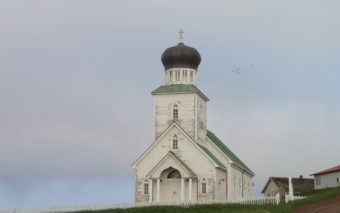
The Russian Orthodox Church in on St. George Island, Aug. 8, 2012. (Creative Commons photo by D. Sikes)
The Russian Orthodox Church on St. George Island in August 2012. (Creative Commons photo by D. Sikes)

St. George Island is taking steps to protect the marine environment in their backyard. The city council passed a resolution earlier this month that could establish a National Marine Sanctuary. Eighty people live on the island of St. George. They’re primarily Unangan and many rely on ocean resources for subsistence.

Mayor Patrick Pletnikoff says over the past five years the community has noticed a significant decline in the population of fur seals and seabirds and they need to take action now.

“There is no need to extract everything in the Bering Sea or get it down to the point where animals such as seals and seabirds can’t sustain themselves,” Pletnikoff said. “I mean, when you start seeing these kinds of die-offs you wonder if we may have allowed it to go too far without saying anything about it.”

Pletnikoff says the first step is to raise money and hire experts who will help decipher research done in the area by government agencies like the U.S. Fish and Wildlife Service and the National Marine Fisheries Service.

Then, the city will look at how best to safeguard the ocean resources. Right now, they’re considering applying for federal marine sanctuary status that would offer the area some level of protection.

“It at least makes all stakeholders have a seat at the table,” Pletnikoff said. “Everybody that has any interest in what we’re thinking about doing is welcome to that table to sit down and discuss it with us.”

The transparency of applying for marine sanctuary status appeals to Pletnikoff. Plus, he says it would protect the marine environment without automatically prohibiting fishing or reconstructing the island’s port.

As internet gets faster, Stebbins elders worry about subsistence

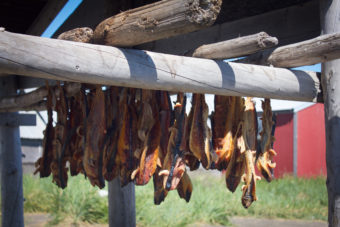
Salmon drying in Stebbins. (Photo by Emily Russell/KNOM)

From policymakers to Pokeman Go players, high-speed internet is the hot topic in Western Alaska this summer.

The Arctic Broadband Summit just wrapped up in Barrow this week. Crews are busy off the coast of Nome this month laying fiber optic cable, and GCI recently announced plans to bring high-speed internet to ten more communities in the region this year.

The village of Stebbins is on that list, and while many are excited for faster service, some fear their subsistence lifestyle could suffer. 

It’s a spectacular summer day in Stebbins. Fish racks are filling up, berries are blooming, and Bernard Abouchuk is sitting on the beach with a rifle under his arm.

“Elders wanted seal meat and a seal just happened to pop up on (the) beach and now we’re just waiting for it to come back,” Abouchuk explains.

Bernard Abouchuk sits on the beach in Stebbins waiting for a seal. (Photo by Emily Russell/KNOM)

Those elders are farther up on the beach, with their eyes glued to the horizon. Many of them were around before villages like Stebbins had stores that sold pre-packaged meals. They had to watch the horizon for seals, scan the tundra for berries, and travel long distances by dogsled for caribou.

“We lived with the seasons,” explains Charlie Kitka. “We had spring camp, summer camp, fall camp, and we lived off the land.”

Kitka grew up in Marshall, a village on the Yukon River about 100 miles south of Stebbins.

“Nowadays nobody goes out into the country anymore. Very few people do that,” Kitka explains.

Kitka says more and more people across the region aren’t learning subsistence skills like net mending and fish processing. Instead, he says, they’re turning to modern conveniences to put food on the table.

Our younger generation, all they know how to do is go to the store and get something quick that they can put into the microwave to eat.”

Morris Nashoanak says a lot of that has to do with modern distractions.

“We’ve got more kids into iPads and iPods,” Nashoanak explains.

Nashoanak is the mayor of Stebbins. Like many other village elders, he worries technology is tempting kids away from their traditional roots.
He says kids from his village would rather be home playing video games than out gathering greens.

“They’re spending nine to 12 hours per day with (them),” Nashoanak says. “We’d like to encourage the younger generation to be more active in subsistence gathering and hunting.”

That may get even harder, though, in the months to come. GCI is promising to bring high-speed internet to Stebbins by the end of this year.

Doreen Tom thinks that’s a good thing.

“Right now we have GCI over here at the (city) office and it’s really slow,” Tom says.

Tom is the city clerk for Stebbins. Internet in the city office will cut out for hours sometimes, which Tom says is a real problem when she’s under a tight deadline.

Tom isn’t just excited for faster internet at work. While she admits kids aren’t as involved in subsistence as she was growing up in Stebbins, Tom says she doesn’t mind the distraction in her own house.

“They get to stay home more if they have internet on the phone,” Tom explains. “I like it when the kids are home because I know where they’re at.”

That’s understandable in a village where bootlegging leads to binge-drinking and often violence.

On a day like today, though, it seems like nothing could keep kids inside.

Back on the beach, Bernard Abouchuk’s nephew, who can’t be more than 7 or 8 years old, comes up next to him with a toy gun in his hand.

His nephew and a few friends were pretending to be hunting seals on the beach when a real seal popped its head above the water. Abouchuk laughs as the boy pretends to load and unload the toy gun.

“It was just so funny, because they were playing ‘hunting seals’ and then a live seal came up in front of them and they just got an adrenaline rush and happy,” Abouchuk says.

It’s that happiness and rush of adrenaline that Abouchuk says can’t be conveyed over the internet, no matter how high-speed it is.

New caribou restrictions stir controversy in the Arctic

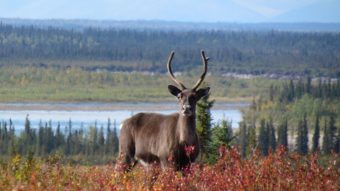
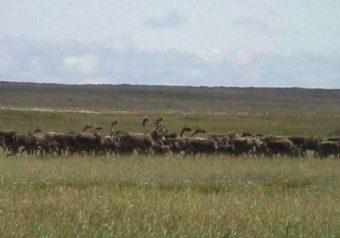
Thousands of caribou like this one traditionally cross the Kobuk River near Onion Portage in the fall. People have been harvesting caribou near this spot for about 9000 years. (Public Domain photo by the National Park Service)
(Public Domain photo by the National Park Service)

For the first time ever, hunters who live outside the Northwest Arctic will not be allowed to hunt caribou on federal lands. The Federal Subsistence Board has closed Game Management Unit 23 starting July 1 in an effort to conserve Alaska’s largest herd and protect subsistence.
But the yearlong ban has created some controversy and confusion surrounding the hunt. Just last week, the State of Alaska petitioned U.S. Secretary of the Interior Sally Jewell to intervene in the decision.

It’s breakfast, and Victor Karmun is having biscuits and gravy at one of his favorite spots in Kotzebue. With fall fast approaching, though, he said he has been thinking a lot lately about another favorite food.

“Caribou: One of the most used animals in the region,” he said. “Been controversial ever since I got back.”

Karmun’s originally from the village of Deering, but he has lived in Kotzebue since 1979. That’s when he returned to Alaska after serving in the military. That’s also when he started noticing the region was a little busier when he boated up the Noatak River each season to hunt caribou.

“All of a sudden, the transporters and outfitters found out about this region,” he said. “We’ve been really locking horns with them for about 20 years or better.”

Some locals say outside hunters are disrespectful, wasting meat or leaving trash at their camps. Others claim that outsiders have an unfair advantage because they can afford to fly and land near the herd, while local families pool their money for boat fuel and wait for caribou to cross the rivers.

No matter whom you talk to, though, Karmun said one thing is clear: It has gotten harder for people to fill their freezers each fall. The Northwest Arctic Caribou Herd has shrunk by half in the last 10 or 15 years, and the animals have stopped following many of their traditional migratory routes.

Outside hunters may not be to blame, but Karmun said taking them out of the equation for one year is certainly worth a try.

“Right now, we’ve got a little breathing room,” he said. “Maybe the village of Noatak will get a little reprieve and get some animals this fall. Who knows?”

But that attitude is frustrating for outside hunters — and the bush pilots and guides who rely on their business.

Jared Cummings owns Golden Eagle Outfitters, a transporter service that has operated out of Kotzebue for nearly 10 years. Since the closure was announced in April, he says the company has lost around $250,000, refunding money to caribou clients who had booked trips this season.

That’s a big chunk of his business, but Cummings said it’s not really about the money.

“It’s about what’s right or wrong,” he said. “These people are United States citizens. They want to come up here and shoot one caribou. They should be allowed to.”

Cummings points to population estimates from the Alaska Department of Fish and Game. The state hasn’t finished a full caribou survey since 2013, but a recent rough estimate puts the herd at 206,000 animals.

That number would indicate the herd is stabilizing after years of decline. And if that’s true, Cummings said “conservation” may be masking the real motive behind the closure.

“It’s not biological at all, and I think everybody knows what that means,” he said.

Namely, prejudice against outside hunters — which some say is unfounded. According to guides and transporters, outside hunters don’t waste meat or mess up migration routes by flying in. Instead, they argue that outsiders donate extra meat to elders and that caribou are changing their own patterns in response to a changing climate.

So for many of those who work with outsiders, it really boils down to one thing.

“They resent people coming in with new Cabelas camo on,” said Jake Jacobson. He has been a hunting guide since the 1970s, and now he splits his time between Kodiak and a camp north of Kotzebue.

“They just resent outsiders coming in that way, and I can understand that,” he said. “That’s territorialism, and I think that’s part of human nature. But that’s just something that if we live in a civil society, we have to accept.”

Jacobson said his business will take a big financial hit this season. He has lost six clients, who won’t make the trip if they can’t hunt caribou. But he said his main concern is that the closure will set a dangerous precedent for future restrictions.

“This is an unnecessary infringement of public access to a public resource on public lands,” he said.

The problem with that thinking is that the resource has a very different significance for local hunters than it does for outsiders. At least, that’s how Pete Schaeffer sees it.

“Caribou is still the mainstay of our diet, so it’s pretty much a no-brainer,” he said. “We have to be able to gather the animal and use it.”

Schaeffer is from Kotzebue, and he has hunted caribou since he was a teenager, primarily on the Kobuk and Selawik Rivers. Unlike outside hunters, he said most local families don’t have an easy grocery alternative if their hunts don’t pan out.

“When you go to a village where a bag of precooked chicken is upward of $20 and then you go to Anchorage where it’s $4.99, you can better understand what I’m talking about,” he said.

So as caribou have gotten harder to hunt, regardless of the reason and how the herd may rebound, Schaeffer said the closure makes sense right now. He says hopefully, it’ll take some pressure off local hunters and give them a better chance at gathering a major diet staple.

“To [outside hunters], it’s a recreational need,” he said. “In some cases, they use the meat. But it inadvertently raises the question as to whether people who hunt for sport have just as much right as people who have a critical need for the meat.”

Back at breakfast, Victor Karmun said someday, he thinks locals and outsiders could coexist.

“If it was managed correctly, there are enough animals to go around,” he said. “I don’t know if that will ever happen.”

And until Fish and Game surveys the whole herd again, no one’s really sure that there are enough caribou. If the survey attempt this fall is successful, there’ll be a brand-new population estimate by December — something that could reinforce the need for closures and conservation or bring the complicated conversation right back to where it started.

Hunting baby seals for science near Yakutat’s glacial fjords

Capture_mode: Researchers move slowly through the ice in Disenchantment Bay hoping to get close enough to net a seal so as to measure and weigh it, collect samples, and attach a satellite tag to monitor behavior. Photo collected under the authority of MMPA permit No. 19309. Photo credit: Jamie Womble (NPS)
Researchers move slowly through the ice in Disenchantment Bay hoping to get close
enough to net a seal. (Photo by Jamie Womble/National Park Service)

Summer is an important time for seal pup development. So the federal government is asking vessels — like cruise ships — to stay farther away from harbor seals in glacial fjords. Biologists are tracking the population in Disenchantment Bay near Yakutat to see how the new guidelines are working. 

Tagging 45 precocious baby seals is no easy task. That’s the number John Jansen, a federal biologist, has in mind. His crew is preparing to float through the water near the face of Hubbard Glacier.

The plan: Catch the pups as they drift by on hunks of glacial ice.

“Our first attempt is going to be using a small dip net and trying to approach them in a stealthy way,” Jansen said.

Of course, mama seals can make this difficult. It’s easier if they scoop up a pup before she notices they’re around. Once Jansen and his crew catch a seal, they’ll glue a satellite transmitter to its fur, either on its back or head.

“Because that’s the only part that typically comes out of the water when they’re at sea. Those have been equated with party hats,” he said with a laugh.

Back in his Seattle office, Jansen will be able to see the pup — just a small dot — on his computer screen. It sounds like a seal version of Big Brother, but the National Oceanic and Atmospheric Administration wants to know how much time pups spend hauling out on the ice. It’s an important time for seals to rest. And for baby seals, it’s a chance to fatten up.

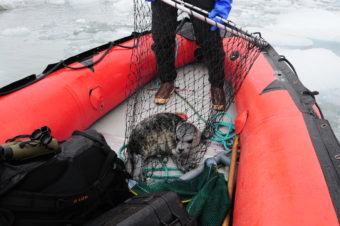
A netted pup: a harbor seal pup just captured in Disenchantment Bay, Alaska. The pup will provide hair, skin, and whisker samples just before having a satellite tag glued to the hair on its back. Pups were reunited with their moms in 20-30 minutes. Photo collected under the authority of MMPA permit No. 19309. Photo credit: John Jansen (NOAA)
A netted pup: a harbor seal pup just captured in Disenchantment Bay near Yakutat. (Photo by John Jansen/NOAA)

“There is a really critical function of hauling out, and if that period of hauling out is disturbed by humans, it has a consequence,” Jansen said.

As many as four cruise ships can be in Disenchantment Bay a day. It’s popular spot to see massive hunks of the Hubbard Glacier fall into the water. Seals are rest on icebergs nearby.

But the ships sometimes scare seals into the water.

“In Yakutat, we harvest seals so the seal population has to stay healthy,” said Victoria Demmert, the president of the Yakutat tribe.

She said local hunters became concerned in the late ’90s when they noticed fewer seals in Disenchantment Bay. And they wondered if an increase in tourism was affecting the population. So NOAA started monitoring the seals. Over the years, the federal agency has observed large vessels are causing the seals to spend less time on the ice.

Demmert said that’s a growing concern for the tribe.

“We understand they want to show off the area for their passengers but we need them to be considerate,” Demmert said.

The old marine viewing guidelines advised vessels to stay 100 yards away from seals. They were created before the boom of tourism. Aleria Jensen, a NOAA stranding coordinator, said that’s no longer adequate in glacial fjords. So the agency came up with new guidelines and public comment was taken.

NOAA had two options: Make it voluntary or require it through regulation.

“The agency decided to go with a voluntary approach. So there are some measures that are meant to apply to glacial fjords across Alaska,” Jensen said.

Vessels are now being asked to stay 500 yards away from seals. Jensen said NOAA realizes the tour industry offers the state a significant economic boost.

“And the goal here is to protect seals without compromising opportunities for high quality glacial viewing and wildlife viewing experiences but finding the balance,” Jensen said.

Satellite technology: A closeup view of a satellite tag attached to a harbor seal pup. The tag will transmit information about haulout and diving behavior of pups during the period they are dependent on mom for nutrition, and during their first year of independence. Photo collected under the authority of MMPA permit No. 19309. Photo credit: Jamie Womble (NPS)
A closeup view of a satellite tag attached to a harbor seal pup. (Photo by Jamie Womble/National Park Service)

Soon, NOAA and the National Park Service will be closer to figuring out what that balance is. They’ll use this summer’s research to determine exactly how the vessels impact the growing seals. For example, how much time are they really spending on the ice?

Back in Disenchantment Bay, John Jansen and his team are giving a seal pup a haircut. Actually, they’re taking hair and whisker samples to bring back to the lab. Then they glue on the tracking device.

“We just want to make sure that the rise and presence of humans is not putting those populations at risk,” Jansen said. “We want to make sure they’re there for everyone to enjoy in the long term.”

After awhile, the seal mom swims around to check on her baby.

“That’s frickin’ awesome!” Jansen said.

When the biologists are finished, they’ll dip the pup back into the water — with new haircut and new hardware.

Study participant: A study animal resting on ice in a group near Hubbard Glacier in Disenchantment Bay some days after having a satellite tag attached (see tag on pup’s back). Photo collected under the authority of MMPA permit No. 19309. Photo credit: John Jansen (NOAA)
A study animal resting on ice in a group near Hubbard Glacier in Disenchantment Bay. (Photo by John Jansen/NOAA)

Correction: An earlier version of this story overstated how many cruise ships are in Disenchantment Bay at once. This summer, as many as four cruise ships are scheduled to pass through the bay in a single day, but not at the same time. 

Yukon subsistence fisherman get first targeted opening for Yukon salmon in 5 years

Chinook salmon, otherwise known as a king. (Photo courtesy U.S. Fish and Wildlife Service)

Subsistence fishermen on the Yukon are getting some rare gillnet openings during the middle of the summer season, and will be allowed to keep any king salmon they catch.
Targeted openings for Yukon king salmon have not occurred in more than 5 years, though occasionally subsistence users are allowed to keep kings taken as bycatch in the summer chum fishery.

Fish and Game Yukon River Summer Season Manager Holly Carroll said the idea of allowing gillnets during the heart of the summer run has been developing since the end of the 2015 fishing season when subsistence users up and down the Yukon repeatedly criticized managers for not enabling people to meet their subsistence needs.

When it came time to discuss the 2016 management plans last winter, Carroll said that subsistence users and fishery managers came to a consensus.

“We told them that we would rather, if the run looks strong enough, provide a little bit more subsistence harvest than last year,” Carroll said. “And most people gave us feedback on how they would want that. They want it soon enough to be able to dry their fish. They want it before all of the kings are old or unusable upriver. They also wanted chums when they were fresher, for the people that harvest chums. Basically at those meetings, we present our management strategy, and then we take all of the feedback we are given and try to incorporate what say they actually want.”

The openings are being timed to fall after a large second pulse of kings moves upriver, in order to minimize the impact that the more efficient gillnet gear could have on the struggling king salmon stock.

The 2016 king run appears to be similar in size to last year’s run, when over 85 thousand kings crossed into Canada – almost twice as much as required by a treaty between the U.S and Canada.

Fish and Wildlife Service Yukon River In-Season Manager Fred Bue acknowledges that managers achieved that high level of escapement, in part, by virtually eliminating subsistence fishing time. But this year, Bue said, managers want to provide better subsistence opportunities on the river.

“There’s no way we are going to meet people’s needs,” Bue said. “But we do hope to get a little bit of fish for people to use, and we hope to have it not right on the back end of the run when the quality of fish kind of deteriorates. It’s not as good as those first, fresh fish. If you are going to harvest a fish, we would like you to get the maximum benefit out of it.”

A series of 18-hour openings utilizing gillnets with a maximum mesh size of 6 inches have occurred in lower river districts 1 and 2, and similar opportunities will be afforded to middle and upper river districts over the next few weeks.

A 6-inch mesh restriction for gillnets is intended to select the smaller males, while allowing spawning females to escape.

Middle and upper river fishermen are more likely to harvest kings as the runs separate, and chum turn off into tributaries to spawn.

The Pilot Station sonar estimate for kings on Tuesday was just over 91 thousand fish – about 18 thousand fish above the 10-year average for that date. Managers attribute some of that high number to the early run timing this year.

Feds lift caribou hunting ban on Nushagak Peninsula

The Federal Subsistence Board approved more hunting opportunities on the Nushagak Peninsula Thursday. (Photo courtesy of KDLG)

Federal lands on the Nushagak Peninsula will be open to more Alaska residents for caribou hunting this year. The Federal Subsistence Board made the announcement Thursday.

Andy Aderman is a wildlife biologist at the Togiak National Wildlife Refuge and says the change should hopefully see more of the oversized herd taken in the year ahead.

“The people in the local communities here who have hunted that herd in the past will continue to be able to hunt that herd. The season’s been extended to include October and November,” Aderman said.

The population has grown to more than 1,700. But the federal closure could be reinstated if that number dips below 900 animals. Aderman says 750 would be the ideal number.

“If we could keep it at that number, we think we could sustain that for long, long time. But that’s the trick; trying to keep it there. And things like weather and access are huge in what happens as far as how many caribou are killed.”

The state will likely open its own hunting period on non-federal lands in the same area to try and maintain the herd size.

Site notifications
Update notification options
Subscribe to notifications