Subsistence

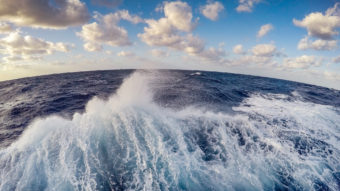
Ocean sustainability tops agenda of this week’s global conference

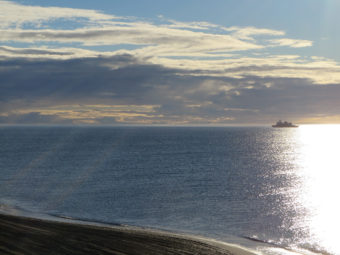
The U.S. Coast Guard icebreaker, Healy, sits just offshore of Barrow, shortly before setting sail on Arctic Shield 2013.
The U.S. Coast Guard icebreaker, Healy, sits just offshore of Barrow, shortly before setting sail on Arctic Shield 2013. (Photo courtesy of NOAA Office of Response and Restoration)

Over 450 representatives from 90 countries are expected to attend a two-day conference in Washington D.C. on the health and sustainability of the world’s oceans.

U.S. Secretary of State John Kerry is hosting the Our Ocean 2016 conference on Thursday and Friday.

President Barack Obama and Kathryn Sullivan, Under Secretary of Commerce for Oceans and Atmosphere, are expected to attend along with more than 40 foreign ministers and heads of state, plus explorers and scientists, members of the private sector and environmental activists from around the globe.

“Clearly, the challenges facing our ocean respect no boundaries,” Kerry said in a video posted on a U.S. State Department website.

Kerry said that’s why there’s a need to come up with global solutions.

He said government leaders, civil society, and business leaders have already pledged $4 billion in maritime sustainability initiatives, and promised to set aside an area nearly the twice the size of India in marine protected areas.

“Today, our ocean is suffering from massive quantities of plastic waste and pollution that run off from streets and farmlands around the world,” Kerry said. “The richness and diversity of our marine resources are being decimated by reckless and illicit fishing practices. Climate change and the excess carbon dioxide that helps cause it is making our ocean warmer and more acidic, hurting our fisheries. Climate change is also increasing the intensity of coastal storms, damaging the environment and putting at risk the billions of people who live in coastal communities, many of whom are economically dependent on the ocean and its resources.”

This year’s conference is a follow up to Our Ocean 2014 and will focus on protecting marine areas, mitigating the impacts of climate change, promoting sustainable fisheries and combating illegal fishing, and reducing marine pollution.

During a briefing with stakeholders Tuesday, U.S. State Department officials said this week’s events also will a feature a youth conference at Georgetown University that will be attended by 150 youth leaders from 50 countries.

Western Arctic caribou herd smaller than original estimates

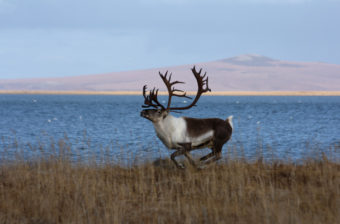
The Western Arctic Caribou herd is smaller than previous estimates of 206,000. (Photo courtesy of Alaska Department of Fish and Game)
The Western Arctic caribou herd is smaller than previous estimates of 206,000. (Photo courtesy of Alaska Department of Fish and Game)

Originally thought to total 206,000, the Western Arctic caribou herd is smaller than first estimated.
A new photo survey done by the Department of Fish and Game indicates the Western Arctic caribou herd totals 201,000.

The herd is Alaska’s largest that many use for subsistence and sport hunting.

Photo surveys of the herd are done every two to three years.

Officials on the Baldwin Peninsula have been carefully monitoring the herd, wary of the population nearing numbers appropriate for reduced harvest recommendations.

“One of the concerns brought up was that they weren’t able to do a survey in 2015,” Wildlife Division chief Chris McKee said. “The conditions for taking pictures, the light conditions, were not good so it didn’t allow them to really get good pictures in order to count the herd.”

Without an accurate count, and a history of user conflict in the area, the Federal Subsistence Board passed a special action to keep non-resident hunters out starting July 1 of this year in hunting Unit 23.

Now, the survey will be used in the latest information to repeal the special action.

“Our office is all of a sudden responsible for providing the analysis and then it goes through several levels of review before finish analysis is given to the board,” McKee said. “The board sees that analysis, deliberates, and has a vote to determine how they’re gonna come down on the issue”

The information to repeal the action is currently in the last stage of review. After review, the analysis will go to one more committee. That committee will make a policy recommendation to the Federal Subsistence Board. And after everything is said and done, the board will vote to overturn the special action, or continue to keep non-resident hunters out of Unit 23.

Science and cooking collide to fight botulism

A bearded seal, or ugruk, on the sea ice.
A bearded seal, or ugruk, on sea ice. (Courtesy of Kawerak Subsistence Program)

Food scientists with the help of a botulism expert are trying to combine science and traditional Alaska Native methods to make one prohibited food safe to eat.

Regulated programs under the State of Alaska Food Safety and Sanitation Program are not allowed to accept or distribute seal oil due to the danger of botulism, a potentially fatal disease which is caused by bacteria in contaminated food.

But how or when the neurotoxins enter the rendering process is still a mystery. That’s what researchers want to find out.

Val Kreil describes seal oil as “a little bit like a heavy olive oil.” He’s the administrator of Utuqqanaat Inaat, a long-term care facility in Kotzebue that falls under the Maniilaq Association.

He says elders at the facility identified seal oil as a priority food.

“For them it’s like eating butter. This is just part of their daily diet. This is what they’ve always been eating and, in terms of health, it’s actually healthier than fish oil. So, there’s a lot of benefit to eating seal oil.”

But because the bacteria that causes botulism grows in anaerobic environment – or one without exposure to oxygen – traditional methods using containers like bottles or barrels to render the seal oil can lead to contamination. The challenge is how to prevent the risk of poisoning while working with the traditional techniques.

Kreil says beginning last year; Maniilaq started looking for ways to get a variance approved to distribute seal oil. He says he’s one of a number of Alaskans interested in getting prohibited traditional foods safe and approved for consumption, and he hopes to clear the way for other programs.

The first step in the mission was to turn to regulators.

Lorinda Lhotka, a section manager with the State of Alaska Food Safety and Sanitation Program, says the state was willing to allow organizations to serve the seal oil if they could demonstrate a safe process.

However, she explains Lorinda Lhotka needed to reach out to resources other than the state.

“We do testing, but it’s usually in result of outbreaks of illness, and we don’t do a lot of preventative testing to help evaluate the safety of the product. So, it’s usually just in response to illnesses, and our labs don’t have that capacity.”

So, along the way, Maniilaq got in touch with UAF’s Kodiak Seafood and Marine Science Center, and Dr. Eric Johnson, a botulism specialist and professor of bacteriology at the University of Wisconsin – Madison.

He has a long history in researching botulism and his lab is registered for toxin analysis.

Johnson says he’ll watch the traditional process in action in the community of Kotzebue and, once he understands the preparation, examine samples in his lab.

“My interest is in helping validate the process from a safety perspective – for example, what aspects in this process may contribute to the growth of clostridium botulinum and its formation of toxins and to implement minor changes in the process that will enhance its safety.”

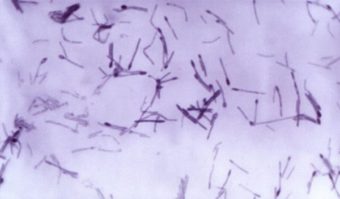
Bacteria that causes botulism.
Bacteria that causes botulism. (Public domain image)

While the Seafood and Marine Science Center is not registered to work with toxins, it does focus on the research of seafood. Associate Professor of Seafood Microbiology Brian Himelbloom explains they can study the other aspects of a seal oil sample, like what it’s composed of and how much water is left in the extract.

“Because that will give us an idea when things go bad maybe that’s because some of that seal oil has some residual water available and that’s where we theorize clostridium botulinum is actually going to operate.”

Himelbloom says, in theory, the preparers of the seal oil can avoid a botulism incident if they pour off 100% oil.

“But in their mixing, if there’s splash over from water or they’re not careful how they’re pouring it off, maybe that’s the situation – because under what we call ambient temperatures, room temperature or outside temperature, that’s probably in the range where this organism can proliferate.”

So far, it’s all speculation. The trick according to Himelbloom and the other researchers is to find the solution while keeping scientific intervention to a minimum.

“We know something about clostridium botulinum and how it acts and how it behaves and where it can be found and how you test for it and how do you assay for the toxin, and so if we can combine those two worlds of traditional knowledge and Western science, we might actually come to the point of oh, now we know how we can most likely guarantee, hopefully, that there won’t be a botulism incident if they follow these particular steps.”

Next, researchers will observe the traditional process, and then, through collaboration with each other, Maniilaq, and other community partners in Kotzebue, they’ll decide on what they should test and how much of it.

Johnson will visit Kotzebue today and Friday to watch how local processors render seal oil.


Protected Marine Area Near Hawaii Is Now Twice The Size Of Texas

Rough seas prevented the NOAA's Okeanos Explorer from collecting data in the the Papahānaumokuākea Marine National Monument in February. NOAA Office of Ocean Exploration
Rough seas prevented the NOAA’s Okeanos Explorer from collecting data in the the Papahānaumokuākea Marine National Monument in February.
NOAA Office of Ocean Exploration

President Obama is expanding a national monument off the coast of Hawaii, more than quadrupling it in size and making it the world’s largest protected marine area.

The Papahānaumokuākea Marine National Monument was created by President George W. Bush in 2006. At the time, it was seven times larger than all the other U.S. marine sanctuaries combined and the biggest marine reserve in the world.

On Friday, Obama signed a proclamation expanding the monument to more than 580,000 square miles — twice the size of Texas, and once again the world’s largest.

“The monument designation bans commercial fishing and any new mining, as is the case within the existing monument,” The Associated Press notes. “Recreational fishing will be allowed through a permit, as will be scientific research and the removal of fish and other resources for Native Hawaiian cultural practices.”

It’s not the first time Obama has expanded a Bush-era marine monument; in 2014, he expanded the Pacific Remote Islands Marine National Monument to 490,000 square miles, making it the largest in the world at the time.

Now that title has returned to Papahānaumokuākea. And we’ll pause here to say, if you’re wondering how to pronounce that name, take a listen to newscaster Korva Coleman rattling it off on NPR on Friday morning:

The Pew Charitable Trusts, which pushed for the expansion of the monument, celebrated Friday’s announcement and highlighted the region’s biodiversity:

“Although much of the region remains to be fully explored, Papahānaumokuākea is home to more than 7,000 species, a quarter of which are endemic, or found nowhere else on Earth; some have only recently been discovered. The area provides habitat for rare species such as threatened green turtles, endangered Hawaiian monk seals, and false killer whales, as well as 14 million seabirds representing 22 species. This year, scientists exploring these waters discovered a new type of ghostlike octopus they nicknamed Casper, as well as three new species of fish.”

But the Western Pacific Regional Fishery Management Council was disappointed to see hundreds of thousands of square miles closed to fishing. In a statement, the group’s leaders said they believed the expansion was driven by politics rather than science, and criticized the Pew’s Ocean Legacy program as an “agenda-driven environmental organization.”

“Closing 60 percent of Hawaii’s waters to commercial fishing, when science is telling us that it will not lead to more productive local fisheries, makes no sense,” Council Chair Edwin Ebiusi Jr. said in the statement.

The monument was created and expanded under the Antiquities Act of 1906, a law signed by Teddy Roosevelt that established America’s first-ever program for protecting cultural or natural resources.

Under the law, the president can designate as national monuments any federal lands containing objects of “historic or scientific interest.” In this case, the waters are scientifically unique in their geological and biological resources, and also have cultural significance, the White House said in Friday’s announcement.

“Native Hawaiian culture considers the Monument and the adjacent area a sacred place. This place contains the boundary between Ao, the world of light and the living, and Pō, the world of the gods and spirits from which all life is born and to which ancestors return after death,” the statement read.

A purple crinoid "hangs out on a dead coral stalk," as NOAA scientists put it, in the Papahānaumokuākea Marine National Monument off the coast of Hawaii. NOAA Office of Ocean Exploration
A purple crinoid “hangs out on a dead coral stalk,” as NOAA scientists put it, in the Papahānaumokuākea Marine National Monument off the coast of Hawaii.
NOAA Office of Ocean Exploration

Shipwrecks from the Battle of Midway in World War II are also located in the waters, the administration notes.

Access to the monument is currently by permit only. But several of the islands in the original monument area can be seen on Google Street View, where you can take a scroll down Tern Island and East Island at French Frigate Shoals, Laysan Island, Lisianski Island, Pearl and Hermes Atoll and Midway Atoll.

Copyright 2016 NPR. To see more, visit http://www.npr.org/.

Kotzebue Caribou Meeting Reveals Tensions From Both Sides


A male caribou runs near Kiwalik, Alaska. Photo: Jim Dau.
A male caribou runs near Kiwalik, Alaska. (Photo by Jim Dau)

Kotzebue residents expressed concerns last week that data used by the Alaska Department of Fish and Game to overturn the sport hunter ban in Unit 23 may be incomplete and misleading. Unit 23, around 25 miles north of Kotzebue, is home to the Western Arctic Caribou Herd, which many use for subsistence and sport hunting. The Federal Subsistence Board held the meeting to collect opinions regarding the special action to overturn the exclusion of non-resident caribou hunters in Unit 23.

During the July 18th public comment session, tensions were palpable in the Northwest Arctic Borough (NWAB). Walter Sampson, a Kotzebue subsistence hunter, was the first to take the microphone for public comment.

“I apologize for taking time, but I am addressing my way of life,” he said. “Putting food on the table for my family is important. I’m not worried about bureaucracy.”

The main issues raised were challenges to the data and arguments surrounding potential increased user conflict, as well as concerns about the size and health of the herd.

Kotzebue resident Lance Kramer, with support of other subsistence hunters, questioned the new data’s significance and completeness. During their comment period at the meeting, Fish and Game stated that the newly gathered information was “sufficient” for passing the special action to allow sport hunting. Kramer thinks the term “sufficient” is too generous a description, however, and says he isn’t the only one to think so.

“I even talked to the biologist who put this together, and he said that that word (‘sufficient’) is subjective,” said Kramer.

As an NWAB subsistence mapper, Kramer is skeptical about the accuracy of the calf survival rate in particular. The 82% calf survival rate being cited to repeal the subsistence board’s decision comes from tracking 31 collared calves migrating from Onion Portage to their winter resting grounds.

The survival rate comes from how many calves survive that journey. Kramer argues that starting at Onion Portage skips a lot of the migration that caribou undergo.

Larry Bartlett of Fairbanks, wearing a dress shirt and hunting gear, makes his case for passing the special action to allow sport hunting in Unit 23. (Photo by Tyler Stup/KNOM)

“The problem is that’s not where the calves are declining. The calves are declining in their summer grounds through their migration route,” said Kramer.

His second contention is with Fish and Game’s caribou population count. Kramer emphasizes this number is just an estimate and notes the official population count won’t come until sometime this fall. The latest caribou count is estimated at 206,000.

The Western Arctic Caribou Herd Working Group, which Fish and Game is a part of, stipulates at 200,000 caribou non-subsistence hunters must be banned from Unit 23. As non-resident hunter Larry Bartlett put it, “Getting to the edge of the cliff can be scary, but it’s not the same as falling over the edge,” said Bartlett.

Kramer thinks that nearing the 200,000 edge is enough reason for concern. He says that if the herd is declining, even in a slower or more leveled-off way, the state should still be concerned about the herd.

The last issue raised at the meeting last week was the possibility of increased user conflict. Some people at the meeting believe if the special action goes through, then there will be more tension between sport and subsistence hunters. Kramer thinks both groups won’t share the same territories because caribou migrated to lands sport hunters couldn’t access if banned from Unit 23.  

The Federal Subsistence Board will make their decision on whether the exclusion of non-subsistence hunters is permanent sometime this fall.

Kotzebue caribou meeting reveals tensions from both sides

Male caribou running near Kiwalik, Alaska. (Photo by Jim Dau/ADF&G)

Kotzebue residents expressed concerns last week that data used by the Alaska Department of Fish and Game to overturn the sport hunter ban in Unit 23 may be incomplete and misleading.

The Federal Subsistence Board held the meeting July 18 to collect opinions regarding the special action to overturn the exclusion of non-resident caribou hunters in Unit 23.

Unit 23, about 25 miles north of Kotzebue, is home to the Western Arctic Caribou Herd, which many use for subsistence and sport hunting.

During the public comment session, tensions were high in the Northwest Arctic Borough, or NWAB.

“I apologize for taking time, but I am addressing my way of life,” said Walter Sampson, a Kotzebue subsistence hunter, who was the first to speak during public comment. “Putting food on the table for my family is important. I’m not worried about bureaucracy.”

Among the main issues raised were challenges to the data, which Lance Kramer of Kotzebue, who with support of other subsistence hunters, questioned the new data’s significance and completeness.

Fish and Game stated that the newly gathered information was “sufficient” for passing the special action to allow sport hunting, during its comment period at the meeting.

Kramer said the term “sufficient” is too generous a description, however, and said he isn’t the only one to think so.

“I even talked to the biologist who put this together, and he said that that word (‘sufficient’ is subjective,)” he said.

Kramer, a NWAB subsistence mapper, is skeptical about the accuracy of the cited 82 percent calf survival rate in particular.

That rate being cited to repeal the subsistence board’s decision was measured by tracking 31 collared calves migrating from Onion Portage to their winter resting grounds. The survival rate comes from how many calves survive that journey.

Starting at Onion Portage skips a lot of the migration that caribou undergo, Kramer argued.

“The problem is that that’s not where the calves are declining,” he said. “The calves are declining in their summer grounds through their migration route.”

Kramer’s second contention is with Fish and Game’s caribou population count, an estimated 206,000. He said this number is just an estimate.

The official population count won’t come until this fall.

The Western Arctic Caribou Herd Working Group, which includes Fish and Game, stipulates that at 200,000 caribou, non-subsistence hunters must be banned from Unit 23.

“Getting to the edge of the cliff can be scary, but it’s not the same as falling over the edge,” said Larry Bartlett, a non-resident hunter.

Nearing the 200,000 edge is enough reason for concern, Kramer said. He says that if the herd is declining, even in a slower or more leveled-off way, the state should still be concerned about the herd.

Some people at the meeting believe if the special action goes through, tension between sport and subsistence hunters will increase. Kramer thinks both groups won’t share the same territories because caribou have migrated to lands sport hunters couldn’t access if banned from Unit 23.

The Federal Subsistence Board will make their decision on whether the exclusion of non-subsistence hunters is permanent sometime this fall.


Site notifications
Update notification options
Subscribe to notifications