Subsistence

Interior Secretary Sally Jewell announces inclusion of Native communities in land management

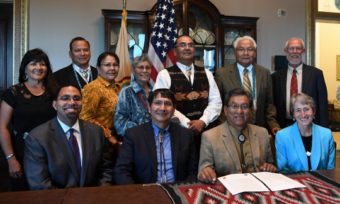
The White House Tribal Nations Conference convenes leaders from the 567 federally recognized tribes to interact directly with high-level federal government officials and members of the White House Council on Native American Affairs.
The White House Tribal Nations Conference convenes leaders from the 567 federally recognized tribes to interact directly with high-level federal government officials and members of the White House Council on Native American Affairs (Public Domain photo courtesy of the U.S. Department of the Interior)

Interior Secretary Sally Jewell addressed AFN Friday. Jewell announced a new secretarial order that requires the Department to include Native communities and traditional ecological knowledge in land management decisions.

Earlier in her talk, Jewell reviewed gains made in recent years which have brought federal managers and tribal leaders closer together in collaboration on resource issues, specifically pointing to working toward greater tribal engagement in subsistence issues.

“I’m announcing today a new secretarial order, which encourages collaborative agreements between Interior Department’s land managers and federally recognized tribes,” Jewell said.

“The purpose is to provide guidance to our nation’s public land and water managers to make sure that when we share resources with a special geographical, historical and or cultural connection with tribes, that Natives have a meaningful and substantive role in their management.”

She cited an example of federal managers working with tribes in the Ahtna region on solutions to hunting pressure on moose.

Jewell said her new secretarial order provides guidance to managers that native communities have a meaningful and substantive role in decisions.

Elders and Youth conference kicks off today in Fairbanks

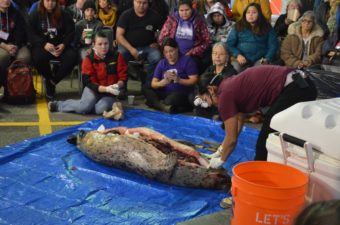
Marjorie Tahbone shows a crowd how to properly butcher a seal during a workshop at the 33rd annual Elders and Youth conference in Fairbanks. (Photo by Jennifer Canfield)

More than a thousand Alaska Natives, young and old, from across the state are met today at the 33rd annual Elders and Youth conference. The event, hosted by the First Alaskans Institute, is usually an opportunity for 13 to 18 year olds to learn about leadership, civic engagement and consensus building alongside their elders.

This year’s conference theme is Ancestral Imperative: Adapt. Unite. Achieve. and it runs through Wednesday morning.

Attendees are encouraged to talk seriously about issues facing their communities, and there are many afternoon workshops focused on language, culture, subsistence and policy. One of the first orders of business requires regional groups to elect new members to the Statewide Elders and Youth Council.

The day began with a welcome and blessing from the Rev. Luke Titus and the Rev. Anna Frank, both are Tanana Athabascan from Interior Alaska. The custom is typical of Alaska Native gatherings in which many of the attendees are not from the surrounding area. When the conference is held in Anchorage, for example, the group is welcomed by representatives from the Dena’ina Athabascan community.

Liz Medicine Crow, president and CEO of First Alaskans Institute, and board chair Willie Hensley give opening remarks at the 33rd annual Elders and Youth conference in Fairbanks. (Photo by Jennifer Canfield)

Liz Medicine Crow, the institute’s president and CEO, addressed the crowd along with former state lawmaker Willie Hensley, who serves as the organization’s board chair.

Hensley talked about how the Elders and Youth conference first started as an opportunity for Alaska Native youth who spent most of the year at boarding school, away from their home communities.

“We didn’t have the opportunity to interface with our parents, aunts and uncles, our communities, we were away from our language, we were away from our stories. There were a lot things about the culture that we missed out on because we were gone for years at a time,” Hensley said.

The conference took on a more solemn tone briefly when Medicine Crow advised the gathering about an ongoing manhunt in Fairbanks. Just after midnight on Sunday, a Fairbanks police officer was shot and seriously injured. The suspect in that shooting is yet to be apprehended. Fairbanks police say they’re looking for an Alaska Native man in his 20s.

Medicine Crow said the organization has talked to Fairbanks police.

“They are aware of all of our visitors coming in and they want to make sure that you have a good experience as well, but it just requires a little more awareness of what’s happening around you when you go out and about,” Medicine Crow said. “Remind our men, remind our brothers to keep their heads up and to be safe.”

Lt. Gov. Byron Mallott is scheduled to address the conference Tuesday afternoon.

Joan Inga Barnowski, 11, gives the youth keynote speech at the 33rd annual Elders and Youth conference in Fairbanks. (Photo by Jennifer Canfield)

This year’s youth keynote address was given by Joan Inga Barnowski, 11, who is Sugpiaq (Alutiiq) from Old Harbor, a city in the Kodiak Island Borough. As part of a science project she worked on earlier this year, the 6th grader tested homes in her community for radon, a known carcinogen. Based on her initial work, potential issues were identified in several homes. In her speech, Barnowski advocated for youth to be aware of the environment and to be good stewards.

Raphael and Vivian Jimmy, both Yup’ik from Mountain Village, will give the elder keynote address Tuesday. The couple now lives in Anchorage where they lead the Kuigpagmiut Dance Group. Raphael is 91 and Vivian is 87.

Some of the workshops listed on the conference agenda include Food Sovereignty: Working on Seal, The Return from Carlisle, Social Justice Issues: An Alaska Native Perspective and Spoken Roots: Writing Ourselves, Our Communities and Our Histories.

This year’s conference theme is Ancestral Imperative: Adapt. Unite. Achieve. The conference is open to people of all ages and backgrounds.

The conference runs through Wednesday morning and will be broadcast live on 360 North.

Chicken ordinance draws children to Kodiak assembly meeting

It’s not often that a child gives public comment at a Kodiak Island Borough Assembly regular meeting, but last week, a 10-year-old stood up for the right to keep chickens and roosters.

On Thursday the assembly held a public hearing on an ordinance that would put a temporary hold on poultry restrictions in certain areas of the borough until the Planning and Zoning Commission can review that code.
No one stepped up during the actual public hearing, but Thor Berestoff made his statement during general public comment at the beginning of the meeting.

“When you were a kid did you want pets and you got it and you had to get rid of it because it bit you? Farm animals won’t make you bleed. Well, when I was younger a dog bit me in the face. Now people ask me what happened to your face. I felt mad. It’s weird to ask you (about your) imperfection. Like, do you have an extra toe? Chickens are helpful a lot. They give you eggs. And also roosters wake you up. That meant I was never late to wake up to make my lunch.”

Soon after, Oni Thomas took her turn at the mic and talked about the chicken wrangler in her family, her 13-year-old daughter, who sat in the audience.

“She’s had chickens for the last 10 years. Her favorite chicken is eight years old. She’s had her organic egg business for five years now. She’s got dozens of customers. We can’t supply all of her customers. If the moratorium does not pass, then my daughter and I will be in violation and we are supposed to give up our chickens that we’ve had for years.”

Assemblyman Larry LeDoux was pleased about the number of kids who got involved in the code change process.

“If there’s one really good thing that comes from it are the number of young people that had a chance to come and testify and find out hopefully that speaking before the assembly or being a part of government does make a difference, ’cause I certainly heard their voice and I think they were a good part of it.”

The assembly passed the moratorium, which will put a stop to restrictions until the Planning and Zoning Commission can review the livestock limitations in title 17 of the borough code. The process may take months, so the moratorium means people will not be fined for violations during that period.

Hydaburg mayor named temporary head of Federal Subsistence Board

Hydaburg Mayor Tony Christianson accepts an award from the U.S. Forest Service in May, 2013.
Hydaburg Mayor Tony Christianson accepts an award from the U.S. Forest Service in May 2013. (Public Domain photo courtesy of the U.S. Forest Service)

Anthony “Tony” Christianson of Hydaburg has been named interim chair of the Federal Subsistence Board.  The announcement was made by Secretary of the Interior Sally Jewell on Tuesday. Secretary of Agriculture Tom Vilsack concurred with the appointment.  Christianson says he is pleased to have been selected.

“Through a couple of years of learning, I really liked being involved. When that opportunity came up, I thought I would take a stab at it.”

Christianson was appointed to the Federal Subsistence Board in 2012 as one of the first public members representing rural Alaskans.  He says serving on the board is rewarding.

“I’ve really enjoyed being able to help rural members find the food they need, basically. That’s been my interest all the time. To make sure rural people are considered the priority and can access the resource to meet the demands of their needs.”

Christianson says he is impressed with the other people who serve on the board.

“A really good, professional group of people that really looks out for the best interest of the subsistence and federal needs across the state. Not just the subsistence users, but all of the user groups across the state, to regulate the wildlife and fisheries.”  

Christianson is the mayor of the City of Hydaburg and works as the natural resource director for the Hydaburg Cooperative Association, a federally recognized tribe. He is also a commercial fisherman.

The Federal Subsistence Board was created in the early 1990s and is the decision-making body that oversees management of fish and wildlife resources for subsistence uses on federal public lands and waters in Alaska.

Christianson will take the place of Chairman Tim Towarak, who retired. A permanent chair is expected to be appointed in the next several months. Christianson says he has put his name in for consideration.

Mushroom hunting brings risks and rewards

In Alaska, passion for hunting runs deep. For many, the thrill of hunting big game is second to none. But there’s another group of hunters in Alaska tracking a different kind of prey: mushrooms.

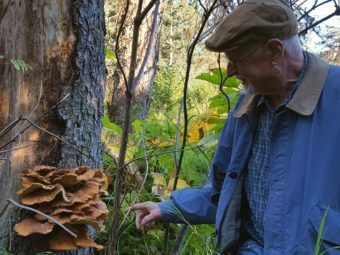
Neil McArthur has one rule when he’s mushroom hunting.

“When in doubt, move on,” he said.

McArthur would know. He’s been hunting mushrooms in Homer for 25 years.

This year, he published “Alaska’s Mushrooms: A Wide-Ranging Guide,” along with University of Fairbanks Professor Gary Laursen.

Mushroom hunting can be a dangerous business, McArthur said.

Some mushrooms, like the infamous Amanitas, are lethal to humans.

“Some of the amanitas are extremely toxic. They’re reputed to taste wonderful,” he said. “The only thing is that three days later you need a liver transplant.”

One of the challenges with identifying mushrooms is that their appearance changes dramatically as they age.

When it first pops out of the ground, an immature mushroom often looks like something you might find in a grocery store: a little button.

At this stage, it’s easy to confuse an edible species with a poisonous one.

“The gill structure isn’t really visible, the gill color isn’t really visible. They tend to be white and small and rolled up in a button,” McArthur said.

The sheer number of mushroom species can also make identification difficult. There are about 70,000 species of fungi worldwide.

In Alaska alone, there are thousands of mushroom species.

A mushroom hunter’s first question is usually “Can I eat it?”

Unfortunately, many of the species in Alaska are inedible.

With names like dung dome and belted slimy cort, it’s not hard to imagine why.

On a crisp fall day in September, McArthur leads a small group of amateur mushroom hunters on a collecting trip near the Homer Airport.

The group fans out across the forest, eyes glued to the ground.

A thick layer of cushy sphagnum moss carpets the forest floor.

One hunter spots a mushroom peeking out from behind a log.

McArthur tells her not to bother picking it.

“Is this fungus poisonous? No, but it has the texture of a hardwood plank, I don’t think you want to eat it!”

But mushroom collector Pat Esperanto isn’t deterred.

He’s holding out hope that he might find his favorite mushroom, the King Bolete, also known as the porcini.

“They’re wonderful. They taste delicious, they taste like steaks. They’re just phenomenal,” Esperanto said.

McArthur spots a patch of mushrooms that looks promising.

He sloshes through a puddle and crawls under the low hanging branches of a spruce tree to take a closer look.

“This is a relation of the grocery store mushroom. It’s usually edible,” McArthur said.

“Okay, you go first,” quips one mushroom collector.

“Well, I made an omelet out of a couple of ‘em that I found in my driveway last week,” said McArthur, laughing.

It’s a patch of horse mushrooms, Agaricus arvensis.

None of them are poisonous, but only one of the mushrooms in the patch is edible.

McArthur cuts open the other two to show why you probably wouldn’t want to eat them.

“See the little tiny holes? They’ve probably gone clear up through and into the cap. I’m sure the maggots are edible, but they’re not really appealing,” McArthur said.

The hunters find dozens of mushrooms in the forest, but not many of them are edible.

Most leave empty-handed.

But McArthur isn’t disappointed.

For him, mushroom hunting is really just an excuse to spend time enjoying the great outdoors.

“Even when you’re finding no mushrooms you get a nice walk in the woods,” McArthur said.

The mushroom hunting season is nearly over for the year, but McArthur says there’s still a chance to find edible mushrooms before the first hard frost.

Four men charged regarding wasteful subsistence taking of Walrus

Walrus found dead and decapitated near Cape Lisburne. (Photo by U.S. Fish and Wildlife Service.)

Four men from Point Hope have been charged with wasteful subsistence taking and wasteful taking through harassment of marine mammals.

Federal prosecutors filed the charges based on an incident that occurred last year when the four Native hunters allegedly removed the animals’ ivory tusks and left the meat to waste.

The four men charged are Adam Thomas Sage, Michael Ricky Tuzroyluk Jr., Guy Stephen Tuzroyluk, and Jacob John Peel Lane.

Stephen Cooper is an assistant U.S. attorney from Fairbanks working on this case. He explained the difference between the three counts of wasteful subsistence taking and the two counts of wasteful taking through harassment.

“The difference being that the first three counts mentioned a charge or crime of actually killing a walrus, that is, shooting them and taking the tusks and leaving the rest,” Cooper said. “And then the other two counts are wasteful taking through disturbing a herd in a manner that causes the herd to stampede and then that results in the death by trampling of some of them, individual walrus in the herd.”

All five charges were believed to have occurred on Sept.  2 and Sept. 4 of 2015 at the walrus haulout beach on Cape Lisburne, during which the four accused men were hunting with guns.

If these men are found guilty, then the penalty could include jail time and a sizable fine.

“The maximum isn’t what’s going to be necessarily imposed in any particular case, it’s what the maximum could be imposed and that maximum is the same one for all five of these counts,” Cooper said. “Each count has a maximum penalty of one-year imprisonment, a one-hundred-thousand dollar fine, and a $25 special assessment, which is a mandatory payment per count.”

Cooper has dealt with wasteful subsistence take cases before and says they happen every so often within the State court system.

A court date has not yet been given to determine when their case will go to trial.

Site notifications
Update notification options
Subscribe to notifications