Subsistence

Ketchikan Indian Community checking Ketchikan beaches and shellfish for toxins

Esther Kennedy of the Resource Protection Department collects water samples every week from Starrigavan.
Esther Kennedy of the Resource Protection Department collects water samples every week from Starrigavan. Along with six other tribes in Southeast, the group is working to create an early warning system to protect shellfish diggers from PSP. (Photo by Emily Kwong/KCAW)

Last summer, Ketchikan Indian Community began a phytoplankton and shellfish monitoring program in Ketchikan as part of the Southeast Alaska Tribal Toxins Program. KIC tests samples, and informs the public if dangerous levels of the toxin that causes paralytic shellfish poisoning are found in local clams and mussels.

Nicole Forbes is the environmental specialist at KIC in charge of collecting samples. She says it’s important for people to understand what paralytic shellfish poisoning is and how it is transmitted.

“Basically there are tiny, microscopic plants in the ocean called phytoplankton. Most of them are not harmful. In fact, they produce 50 percent of our oxygen. But there are a few harmful species and one of those is Alexandrium and it produces something called saxitoxin. When the shellfish filter-feed, it gets collected in the shellfish, and when people eat it, that’s what causes paralytic shellfish poisoning.”

PSP toxins cannot be cooked or cleaned out of shellfish, and freezing does not destroy the toxin. Consumption of the toxin can cause paralysis and death. Commercial shellfish is tested and considered safe. The Tribal Toxins Program targets recreational beaches.

Forbes says KIC is testing samples at popular beaches in the Ketchikan area so people will know if clams, mussels, and cockles are safe to harvest. Currently, testing is being done at Settlers Cove and Whipple Creek. Forbes says they plan to add Seaport Beach in Saxman soon. She says the program is in the beginning stages and they are working to identify other sample sites.

“We’re trying to figure out where most people harvest, so that we can get those results. The thing is you have to get results for each beach. Because you could go two or three miles down and it’s going to be completely different down there.”

Forbes says there are three steps to the collection process, which starts with weekly phytoplankton samples.

“Which involves me going out there with a phytoplankton net and wading in the water, and grabbing a sample. I bring that back to our local lab, and I put it under the microscope and look for those harmful phytoplankton species that I was talking about. If I see one, that’s the first warning sign that we need to get a shellfish sample out as soon as possible, because it’s possible that saxitoxin is in the shellfish.”

Forbes says suspect samples are sent to the Sitka Tribe of Alaska’s lab in Sitka. She says the turnaround time for testing is fairly quick.

“I send it out on Tuesday, gets there Wednesday, I get results Thursday or Friday.”

She says the third step of the process is filtration, which involves taking a water sample, filtering it, and then sending the filter to the lab, where phytoplankton species and quantities are identified, along with concentration of toxins.

Tony Gallegos, the cultural and natural resources director for KIC, says Alexandrium may be present, but not necessarily producing toxins.

“The scientific literature hasn’t come to clear conclusion on how you know whether they’re going to produce the toxins or not, what triggers that. That’s still unclear. We can see the algae, but we need to actually do an analysis of those algae to see if they actually have toxins in them.”

Forbes says phytoplankton aren’t as active in the winter because it is cold and dark, but she says no time of the year is safe to harvest without testing. She says they found high levels of toxins in butter clams at Whipple Creek this winter.

“Actually butter clams hold onto the toxins longer, and then during the winter the shellfish slow down their filter feeding, so they can actually hold on to those toxins for the whole winter.”

Forbes says she collects samples every two weeks, weather permitting, and if samples test positive, they are retested weekly. Results for all Southeast beaches being tested are posted in the data section of the Southeast Alaska Tribal Association Research website – www.seator.org. Information is also sent to local media.

KIC is interested in identifying other local sites for sampling.

If you have suggestions, you can contact Nicole Forbes at KIC. Forbes email is nforbes@kictribe.org.  The phone number is 228-9365.

No lichen, no problem: St. Paul’s reindeer thrive without essential food

With no lichen left on St. Paul Island, reindeer are grazing on grass and digging up roots. (Courtesy Paul Melovidov)

For a long time, scientists thought reindeer would be big losers in climate change, but the reindeer on St. Paul Island are challenging that theory.

As their main winter food source has disappeared, the St. Paul herd has changed its diet so they can survive on the remote island. This adaptation could have global implications for reindeer facing a warming climate.

If there’s one fact everyone agrees on about reindeer, it’s this:

“No lichen. No reindeer,” said Lauren Divine, co-director of the Aleut Community of St. Paul’s Ecosystem Conservation Office (ECO). “Reindeer all over the world depend on lichen. They’re very high in sugars and starch. They’re considered like a Snickers bar for reindeer in the winter”

Reindeer aren’t native to Alaska. They were brought to rural villages – including those in the Pribilof Islands – in the early 1900s. The St. Paul herd roams free, but like all reindeer, they are domesticated.

When reindeer first came to the small island, there was a lot of lichen, but the reindeer ate it faster than it could regrow and now it’s gone. The reindeer, however, are still there: about 400 of them.

Divine was interested in managing the herd more formally, so in March of 2016 she connected with Greg Finstad, program manager of the University of Alaska Fairbanks Reindeer Research Program, and invited him to visit.

When Finstad got there, he saw something he’d never witnessed before.

“The reindeer are doing something really very interesting,” Finstad said. “They have managed to find other things to eat. They’ve gone underground.”

Greg Finstad (R) examines a reindeer on St. Paul. (Courtesy Lauren Divine/ECO)

When examining the animals, Finstad discovered instead of lichen, reindeer on St. Paul are grazing on grass and digging up roots.

Grass is rich in fiber and their teeth are wearing down faster because they’re eating more of it than typical reindeer. Based on the size of the animals — they’re gigantic — Finstad can tell the herd is consuming a lot of protein.

On St. Paul, the reindeer are responsible for decimating the lichen; they’ve literally eaten it all. Lichen is also disappearing around the world, but there’s a different culprit: climate change.

Finstad thinks what’s happening on St. Paul could be a preview of how more northern herds may adapt to a warmer planet.

“There’s a lot of scientists, researchers, reindeer producers waving their arms in the world, ‘oh climate change, it’s the death of reindeer and caribou,'” Finstad said. “But you know what, we’ve forgotten to tell the reindeer and caribou: things change and they change with it.”

Finstad used to worry about the future of reindeer, but what he’s seen on St. Paul makes him optimistic that reindeer could deal with climate change just fine.

Mark Boyce, an ecology professor who studies caribou at the University of Alberta, isn’t ready to make that leap.

“I would say no,” Boyce said. “It’s an island population and a very small sample of our global populations of reindeer and caribou. The general pattern has been one of decline. So I guess I’m not very optimistic.”

Boyce says he’s happy to hear some herds — like the one on St. Paul — might do better than expected. But he says overall, the picture for reindeer is bleak.

Finstad thinks skeptics like Boyce can be convinced if they visit the island and see the herd with their own eyes. Finstad has seen reindeer around the world and he says the St. Paul herd is exceptional.

“These are beautiful, magnificent animals: Large healthy females, large antlers,” Finstad said. “The antlers are as large as the males. The calves, they are large. Very healthy good looking population.”

Residents of St. Paul are taking full advantage of the herd. The community has mostly subsistence hunted fur seal and seabirds, but Lauren Divine says there are now more reindeer hunters than anything on the island. The thriving reindeer herd is an especially important source of meat in a place where grocery prices are astronomical.

Working group supports Fish and Game proposal for caribou hunt changes

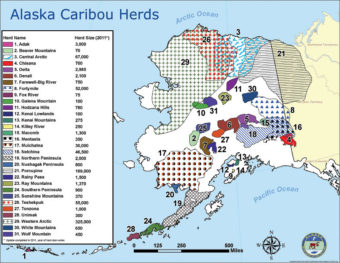
The working group voted to support a proposed change to a registration permit hunt in units 21, 23, 24, and 26. (Map by Alaska Department of Fish and Game)

In a meeting last month, the Western Arctic Caribou Herd Working Group voted to give its official support of the Department of Fish and Game’s proposal to modify the caribou hunt structure in five northern hunting units.
The working group’s Dec. 19 votes support changes to four different proposals that outline current hunting regulations: most notably, the establishment of registration permit hunts within hunting units 21, 23, 24 and 26.

Those units stretch from Bethel up to Utgiavik, encompassing thousands of acres. Unit 23 is most famously known as home to the Western Arctic Caribou Herd, and, as of last April, is off limits to non-resident hunters.

The proposed change to the structure would not affect the ban of non-residents put in place by the federal subsistence board.

The units in question currently use a harvest registration system.

Supporting a registration permit hunt would give the Fish and Game board power to require mandatory reporting from people who buy the licenses.

The current harvest registration system does not require people to accurately track what they kill.

The ability to require reporting can lead to stronger data surrounding herd conditions, allowing for more frequent herd evaluations.

If numbers were found to be worrisome, then the permits would increase the Department of Fish and Game’s ability to quickly close or open seasons.

The working group also voted to support hunt camp spacing and extending unit 23’s boundaries, while opposing a no-fly zone above hunting units on the North Slope.

With the Western Arctic Caribou Herd’s official support, the Department of Fish and Game will go on at a later time to either pass or reject the supported proposed changes.

Passed proposals will come into effect July 1, 2017.

New network of tribes expands toxic shellfish testing

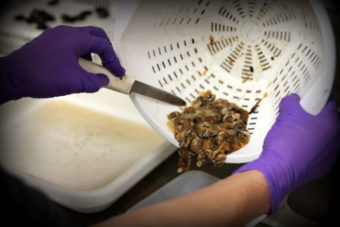
Sitka Tribe of Alaska fisheries biologish Jen Hamblen empties blue mussel meat into a blender. (Photo by Emily Russell/KCAW)

Shellfish is a staple in many homes throughout Southeast Alaska, but it also can be a hazard.

A new lab in Sitka tests regularly for shellfish toxins and now is teaching more than a dozen tribes in the region to do the same.

Global warming could increase the level of toxins, so tribes are working fast to take the mystery out of what’s blooming on their shores.
Jen Hamblen wears purple plastic gloves and a long black apron.

She’s shucking blue mussels, the kind you might find in a seafood restaurant.

“I love chowder,” said Hamblen, a fisheries biologist for the Sitka Tribe of Alaska. “I must say, my appetite for raw shellfish has decreased since I began this position.”

She’s scrapes the meat off the shells into a little white bowl.

When she has at least 100 grams worth of blue mussel meat, she empties the bowl into a blender.

She sets the timer for three minutes and turns the blender on high.

“The fancy word for that is ‘homogenization,’ but ‘shellfish smoothies’ is the other term we like to use,” Hamblen said, joking.

The tribe started blending up shellfish and testing them in the lab because of the growing concern over paralytic shellfish poisoning, or PSP.

Toxic algae blooms can contaminate shellfish, causing the sometimes fatal illness.

“People want to know, ‘Can we go out? Is it safe or is it not?’ Because it is an easy subsistence resource to harvest here,” she said. “There are shellfish everywhere.”

Michael Jamros directs the tribe’s research lab, which opened last year.

“When I showed up a year ago the lab was basically a bunch of boxes and I pretty much had to from there ordering the rest of supplies and getting the lab set up,” Jamros said.

It’s all set up and fully functioning now. That’s a good thing, since a study published last month reports that since 1997, the annual production of algae in the Arctic has risen by nearly 50 percent.

Chris Whitehead, the environmental program manager for the tribe, said warmer ocean temperatures make better breeding grounds for toxins.

“Just like your garden — if you water it and it’s warm and sunny out and you give it fertilizer — everything does really well,” Whitehead said. “It’s the same with these vegetative cells in the marine system.”

That’s why their weekly tests are so important, Whitehead said. And now more than a dozen other tribes in the region are also testing for toxins, including communities like Wrangell, Ketchikan, Juneau, Yakutat and Hoonah, Whitehead said.

“It’s a huge deal here,” said Ian Johnson, the environmental coordinator for the Hoonah Indian Association. “People are out digging all the time.”

“If I was just to guess, I would say over 50 percent of the community consumed clams, probably more. It might be 70 or 80 percent,” Johnson said.

Three people died in 2010 from paralytic shellfish poisoning, including one from Hoonah, and others have gotten sick since.

That’s why Johnson said people are eager for his weekly results, which he started releasing in October.

He soon ran into a problem.

People have different names for the same clams, like the Pacific littleneck clams — some people call them steamer clams.

Others, Johnson said, just differentiate between edible and inedible clams.

So he published an online survey about shellfish names.

“I was just trying to tap into this local base of knowledge and try to understand what people call these different species of clams so I can communicate the results better with them,” Johnson said.

Johnson released results from the survey online and continues testing the water for toxins each week.

If levels are unsafe, Johnson can send in shellfish samples to get blended up and tested in Sitka.

The batch of mussels in the blender right now is from Petersburg, a community 90 miles east of Sitka.

They were flown in just this morning.

After three minutes, the mixture is then run through a series of tests to determine if the mussels in Petersburg are safe to harvest.

Shellfish samples are flown in from other tribes almost every week, which helps Hamblen iron out the kinks in the lab.

Outside of the lab is a different story.

“A problem we encountered today is that there are frozen mussels on the beaches right now,” Hamblen said. “So, we’ll have to look at how to do sampling in Southeast Alaska when we have cold snaps like the one we’re experiencing now.”


From rotten ice to wildfires: hunting and fishing becomes complicated in a changing Alaska

Screenshot from the video Silavut Atlannuraqtuq, Our Changing Weather, about climate change in Northwest Alaska. (Image courtesy of the Maniilaq Association and ANTHC)

Alaskans have heard stories for years about how climate change is affecting subsistence hunting and fishing. Now researchers are trying to quantify that impact– and they’re finding the biggest problem is access.

This summer, Maija Lukin set out to document changes around her home community of Kotzebue.

For Lukin, the impacts of climate change are personal. She says her six-year-old niece is learning different rules for hunting and fishing than she did growing up.

“She’s going to grow up learning, oh, we (always) have to check the ice,” Lukin said. “I never had to check the ice, ever.”

Lukin heard similar stories all over the region, when she visited several villages this year with a videographer in tow.

Lukin was the tribal environmental manager for the Maniilaq Association, the regional nonprofit. (She’s now moved on to the National Park Service.) She didn’t tell people she was making a video about climate change. She just asked, how has the weather changed in your lifetime?

And, she says, people talked. And talked. And talked.

Iditarod musher John Baker told her, when he started running dogs 20 years ago, he could train year-round.

“This year, I started running first of September,” Baker said. “And I’m having to run them only early in the morning because it’s so warm.”

Carl Thomas of Deering said unreliable ice has made it difficult to hunt bearded seals, or oogruk.

“This year, me and my friend actually shot an oogruk, and we tried to walk to it, but we couldn’t get to it because the ice was so rotten,” Thomas said.

Their stories and more were captured in Lukin’s video, Silavut Atlannuraqtuq, or Our Changing Weather.

Above all, people talked about how unpredictable the weather is now, and how that makes it harder to get out on the land.

Those are exactly the kinds of issues University of Alaska Fairbanks biologist Todd Brinkman and his team found when they set out to assess the impact of climate change on subsistence use.

“Our take-home finding was relatively surprising, in that we found that climate effects on the environment are having the largest impact on people’s ability to travel across landscapes and access these resources,” Brinkman said.

In other words, the biggest effects right now aren’t on, say, the populations of caribou or seals. The biggest effects are on people’s ability to get to those animals.

Brinkman and his colleagues conducted interviews in four villages — Wainwright and Kaktovik on the Arctic coast; and Venetie and Fort Yukon in the Interior — for a paper published this fall.

Residents told them ice is thinner. Rivers are shallower. Permafrost is deteriorating. The biggest problem is just getting places.

Brinkman said that’s a surprise for wildlife biologists, who are used to focusing on a species’ population size.

“We make this assumption that if there’s an abundance of fish or game, hunting opportunities will follow suit, and they’ll be just fine,” he said. “But we found despite abundant resources, people were having trouble accessing them because of how the climate was changing the local environment.”

One example of this: Bowhead whales. The bowhead population is growing. But harvests have been uncertain because of thinner sea ice and unpredictable weather.

“Whalers have to be much more careful when they’re spring whaling, which occurs on sea ice — getting out to their whaling location, and finding a landing that’s stable enough to actually get the whale back onto after they harvest it,” Brinkman said. “So they may just be spending more time looking for ways to get out to their whaling area.”

The question is, how big a deal is all of this? Are these changes just inconveniences — or something more?

That’s what Brinkman’s newest research is focused on.

“Are people not able to meet their needs?” he said. “Are they forced to make serous sacrifices? Are they forced to abandon hunting areas altogether?”

To answer those questions, Brinkman and his colleagues have distributed GPS-equipped cameras in nine villages. As residents travel around the region, they’re asked to take photos of the kind of landscape changes that get in the way — from open water on rivers to fallen trees from recent wildfires.

Researchers will then cross-reference that data with satellite and aerial images from NASA dating back to the 1980s, to determine whether these kinds of disturbances are happening more frequently than in the past.

Another big question is how communities are adapting to these changes, whether through new technology or new approaches.

Maija Lukin has one answer: Facebook.

“Because it’s real time,” she said. “If you have enough friends who are hunters, berry pickers or fishers, then you know where the safe ice is, and so you can see them posting pictures, and you can say, hey, Onion Portage, tons of caribou, go right now!”

Study says climate change hinders some subsistence efforts in Alaska

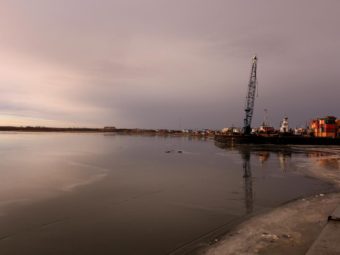
The Kuskokwim river from the seawall in Bethel. There was no snow and ice was barely visible in the warm November of 2014. (Photo by Dean Swope/KYUK)

Climate change has been the subject of many discussions, and scientists say that the Arctic is feeling the effects more significantly than the rest of the globe.

The results of a study gathered from University of Alaska Fairbanks-led interviews says climate change is having a significant effect on subsistence and travel activities in Alaska.

Assistant professor Todd Brinkman was the lead researcher on the article published in October in the science journal Climatic Change.

He says they were tipped off by villages in Alaska about how the changing weather patterns are hindering subsistence efforts.

“We started hearing from many rural communities in the Interior and Northern Alaska that the weather was changing, and it was forcing people to make different choices in regards to how they go out and hunt,” Brinkman said.

Brinkman points to an example from Wainwright, located on the northern coast of the state. Sea ice that whalers use to get out to the Chukchi Sea to look for bowhead whales has been declining and getting thinner over the years.

They started whaling with bigger boats in the fall.

Brinkman and his team spoke with over 70 hunters and collected data beginning in 2010.

One of their biggest findings was that out of 47 identified relationships between subsistence and climate change, well over half depended on getting to the hunting area or resource. He also adds that his team’s findings line up with their models for climate change, and that there is still more research to be done.

Though the Interior and northern coasts are far from the Yukon-Kuskokwim Delta, Mark Leary, who lives in Napaimute on the upper Kuskokwim, agrees that the weather has been changing over the years.

It has even been keeping him from one of his favorite seasonal hunts.

“The best hunting, in my experience, for birds has been when they first come and you could still go by snowmachine,” Leary said. “But it’s been so thawed out all over, that the birds are more spread out and we can’t go by snowmachine.”

Leary is referring to springtime goose and duck hunts, known in Yup’ik as nayuryaq or nutegyaq.

He says that the lack of snow, and the cycle of thawing and freezing in recent winters, has made it impossible for hunters to make it out onto the muddy tundra of spring with their snowmachines.

He said that the river breakup, which usually happens long after waterfowl have returned and settled in, has even beaten the geese.

“Like last year the ice went out and the birds weren’t even here. You know, it’s like ‘What do we do now?’” he said. “And we thought, ‘The ice went out early, maybe the fish will come early.’ But they didn’t really come early.”

Because of the fast warming last spring, Leary says the river broke up faster in April. He was still using his truck on the river less than a month before the ice washed out. He hopes that this year things will be different.

“Truck, snowmachine and boat in one month,” Leary said.

The lack of snow, Leary says, has caused low water breakups in recent years. In a normal spring season, the snow in the upper Kuskokwim area and in the mountains would melt and wash the ice out — so much water that it sometimes caused a flood when there was an ice jam.

Brinkman has heard many of the same concerns about traveling hazards in the communities he’s researched, and he said that the stories are the same across the whole state.

“What was striking was that all the communities were in agreement that these changes are having a significant impact on their ability to travel across the land,” Brinkman said. “So it wasn’t isolated to any one community, it wasn’t isolated to any one type of subsistence resource, it was affecting all of them.”

With the lack of snow due to melting or warm winters, many people are now using ATV’s or four-wheelers to get around since snowmachines have trouble in low-snow conditions. The riverbanks in parts of the state are eroding, especially in some coastal areas.

Brinkman and Leary both say that subsistence users have adapted to these new challenges, but it’s getting harder for some families.

Last year on the Kuskokwim, Akiak musher Mike Williams Sr. nearly lost some of his dog team when a large chunk of land which held his dog yard washed into the Kuskokwim. Leary adds that he’s also seen multiple breakups over the last five falls, which were unheard of before 10 years ago.

Brinkman’s article focuses on subsistence access.

In ecology, the availability of a subsistence resource depends on three factors: abundance of population, distribution of the resource in an area, and the accessibility of the resource for the hunter. Brinkman said that last factor is more important than he thought.

“We often make the assumption that if there’s plenty of fish and game in the area, that hunting opportunities are going to be good,” he said. “Our research demonstrated that even if local populations are healthy and plentiful, if people can’t get out there to them then the resource isn’t available to them.”

Brinkman and his team are in their first year of a new study with the National Aeronautics and Space Administration, or NASA. They are sending GPS-equipped cameras to nine communities. Hunters and travelers will use them to take pictures of the effects of climate change, whether it’s erosion, freaky seasonal weather patterns, or anything that could be attributed to a changing climate.

Teams will then visit some of these areas to investigate, or as they call it in the space program, to “ground truth” the data and match it up with imagery taken from space.

Site notifications
Update notification options
Subscribe to notifications