Subsistence

Keeping its promise, Interior Dept. gives Ahtna region more say in moose, caribou hunt

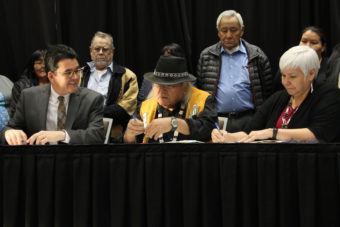
Deouty Interior Secretary Michael L. Connor joins Christopher Gene (center) and Karen Linnell of the Ahtna Intertribal Resource Commission to sign an agreement giving Alaska Native tribes in the Ahtna region more say over subsistence resources. (Photo by Rachel Waldholz/Alaska's Energy Desk)
Deputy Interior Secretary Michael L. Connor joins Christopher Gene (center) and Karen Linnell of the Ahtna Intertribal Resource Commission to sign an agreement giving Alaska Native tribes in the Ahtna region more say over subsistence resources. (Photo by Rachel Waldholz/Alaska’s Energy Desk)

In its final days, the Obama administration is forging ahead with a promise to include Alaska Native tribes in the management of fish and wildlife on federal land.

Deputy Interior Secretary Michael Connor was in Anchorage today to announce a pilot project giving Native communities in the Ahtna region greater say in managing the subsistence hunt for moose and caribou.

The Ahtna region includes eight villages from Cantwell to Gakona to Copper Center along the Parks and Richardson Highways in Southcentral Alaska. It’s one of the most accessible hunting areas in the state, attracting hunters from up and down the Railbelt.

That has put pressure on subsistence resources, Connor said. The goal of the agreement is to try to relieve some of that pressure.

“We think over time we will develop better strategies that will allow them better access to critical subsistence resources, which has been a big issue for those communities,” Connor said.

The announcement comes a month after Interior Secretary Sally Jewell spoke to the Alaska Federation of Natives convention in Fairbanks and issued an order aimed at expanding the tribal role in managing federal lands.

The announcement was met with emotion at the Bureau of Indian Affairs conference in downtown Anchorage.

Karen Linnell is the executive director of the Ahtna Intertribal Resource Commission (AITRC), which will represent the tribes in the partnership. She choked up as she described the agreement as the culmination of 45 years’ work to gain a greater say in the management of their traditional lands.

“I just want to thank the people back home for their support in getting this done. It’s a monumentous occasion!” Linnell said, to a standing ovation at the Dena’ina Center.

Speaking afterward, she said the agreement represents incremental progress in a long fight.

“This is just a little bit closer to being more in the driver’s seat. We’re almost there,” she said. “Not so much driver’s seat, but being able to sit at the table, and be on the bus, is important.”

The pilot project will allow the Ahtna Commission to manage the subsistence moose and caribou hunt on federal land for tribal members. It will also create a local advisory committee and formalize a bigger role for local communities in federal wildlife management decisions.

It’s the second such cooperative management agreement in Alaska. The first governs the harvest of king salmon on the Kuskokwim River.

Both Linnell and Connor stress the agreement will not affect access for non-Native rural subsistence and sport hunters. Gov. Bill Walker and Lieutenant Governor Byron Mallott released a statement applauding the agreement.

The push to increase collaboration with tribes has been a hallmark of the Interior Department under President Obama; it remains an open question whether the incoming Trump administration will continue the policy.

North Slope schools expand curricula to ‘reflect ideologies of the Inupiat’

North Slope government and history is now part of high school graduation requirements for all North Slope Borough schools.

The borough school board passed a new policy this month making the curriculum change mandatory for students, effectively beginning with freshmen who start in 2017.
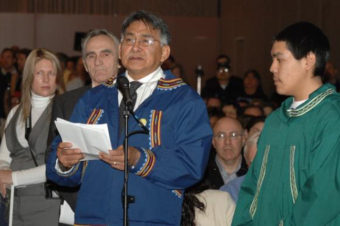
This change has been years in the making, said Pausauraq Jana Harcharek, the Inupiaq education director for the North Slope Borough school district.

“And it goes back probably to the formation of the North Slope Borough School District, when founding Mayor Eben Hopson, in a speech, said that our schools will reflect the ideologies of the Inupiat, that our schools will reflect who we are as people,” Harcharek said.

Now, thanks to the school board, borough district students will receive one credit toward social studies requirement through a North Slope government class and a North Slope history class.

The credit will be integrated into what’s already being taught instead of creating a separate class entirely, Harcharek said.

“So we’ve developed and implemented a series of what we call culture-based units,” Harcharek said. “So as a district we’ve been producing units for teachers to integrate into their teaching from kindergarten, or K-3, K-4, all the way up through grade 12, so this would just become part of that work.”

Harcharek does not foresee the curriculum changes incurring additional costs for the school district.

She said teaching students about their background, their Inupiaq history, is beneficial beyond helping students get a job post-graduation.

“They need to learn about how our people use Western tools through federal legislation in the formation, for example, of the North Slope Borough, our regional corporations, our village corporations, as tools to advance the Inupiaq agenda and to protect our subsistence life ways, to protect the rights that we have as people to land, to education,” Harcharek said.

As a person who identifies as Inupiaq, Harcharek recognizes the significance of incorporating North Slope local government and history into an Inupiaq student’s education.

“It means that we are able to fulfill the wishes of our elders and our people who have been expressing this idea of being inclusive of who we are in the classrooms,” Harcharek said. “It helps ground them in who they are from a historical perspective, because it is by knowing from where you came that you are able to maneuver more effectively in this day and age.”

The next step for expanding education related to local native history is to share these curriculum practices with international groups of people.

By 2018 the North Slope Borough school district’s goal, Harcharek said,  is to help schools in Chukotka, Canada, and Greenland incorporate their own local history and government classes.

Edward Itta remembered for balancing two worlds

Former North Slope Borough Mayor Edward Itta. (Photo courtesy of the Itta family)

Former North Slope Borough Mayor Edward Itta died Sunday in Utqiagvik, formerly known as Barrow. Family members said the cause was cancer. He was 71.
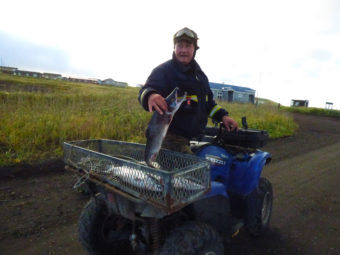
Itta was a powerful voice for North Slope communities. He was perhaps best known for first opposing, and then negotiating with Shell when the oil company wanted to drill in the Arctic Ocean. Above all, he insisted Inupiaq communities have a say in development in the region.

“After all the battles over the wilderness and the oil are done, we are the ones that have to live with the consequences,” he told an Arctic symposium in Seattle in January 2015. “We are the most directly impacted people. Decision makers, policy makers at all levels, need to understand that.”

As mayor, Itta became known for balancing the need for oil development and protecting subsistence.

He grew up as one of 11 children. In a phone interview Monday, his sister, Brenda Itta-Lee, recalled an older way of life, with little in the way of a cash economy, dependent on subsistence.

“Whaling, especially, was very important to Edward,” she said.

Then-North Slope Borough Mayor Edward Itta testifying before Department of Interior Secretary Ken Salazar, 2009. (Photo courtesy of the Department of the Interior)
Then-North Slope Borough Mayor Edward Itta testifying before Department of Interior Secretary Ken Salazar in 2009. (Photo courtesy Department of the Interior)

Itta-Lee said she and her siblings grew up with a foot in two worlds — traditional and modern, Inupiaq and English. Her brother became a whaling captain who negotiated with oil companies.

“He could speak just as powerfully in two languages,” Itta-Lee said. “We (had) a Western American schooling, where we were taught an American way of life. And Edward also mastered how to survive successfully in that setting. So he was very much admired for being bilingual and also bicultural.”

It was a crucial skill set when he became mayor of the North Slope Borough in 2005. Interest in the Arctic was on the rise, especially from oil companies. Shell developed big plans to drill in the Arctic Ocean.

But the company hadn’t consulted local communities, who worried about the impact on marine mammals, and especially on the whale migration.

Itta wasn’t having it. He insisted the Inupiat have a seat at the table, eventually suing the federal government to demand a more thorough environmental review.

Journalist Bob Reiss wrote about Itta’s long fight and eventual negotiation with Shell in his 2012 book “The Eskimo and The Oil Man.”

“It was too much, it was too fast, it was too soon, Edward said,” Reiss said Monday. “Here was this mayor that Shell had not even taken into account, who came up with the strategy of challenging them in court, and who brought the second largest oil company on Earth to its knees, in court. Just stopped them dead.”

Reiss said Itta agonized over his choices. North Slope communities depend on oil revenue to sustain their quality of life and public services, and on-shore oil production was in decline. Yet the ocean is central to both life and identity, and offshore drilling could threaten that.

“He said to me once, and this sort of epitomized everything, he said, ‘Well, what if it’s me?'” Reiss said. “And he meant more than, ‘What if it’s me?’ ‘What if it’s me, what if it’s my family?’ he said. ‘What if it’s me who stops the oil?’ Meaning, stops the money, stops the taxes, stops the building. ‘What if it’s me?’ But then a second later, he said, ‘Well, what if it’s me who allows the oil, and then something goes wrong, and then we lose the whales?'”

Reiss recalls sitting in on a meeting between Itta and Shell that encapsulated that struggle. Itta had come back from whaling camp to meet with oil industry executives.

“The whales only come twice a year,” Reiss said. “Edward was a whaling captain. He was responsible for the lives of his men. These are relatives, these are his best friends. Certainly the last thing that a whaling captain wants to do is leave the camp and go back to town. Which he did that day because — and this is the way the book starts, actually — Edward is on a snowmobile back to town, and a private jet is on the way up from Houston, with the top people at Shell. ”

The Shell executives wanted Itta to reassure people on the North Slope that drilling would be safe, Reiss said. Itta refused, saying Shell hadn’t done its homework, and hadn’t talked to the community.

“Well, I will say, Edward took their head off (that day),” Reiss said, laughing. “He really did! And it was great to watch as a journalist.”

The borough’s lawsuit helped force a more thorough environmental review, and over years of negotiations, Itta convinced Shell to build in measures to protect marine mammals, including a planned pause in work during the whale migration.

Department of Natural Resources Commissioner Andy Mack worked for Itta during those years, as the government affairs director for the North Slope Borough.

Asked how he liked working for Itta, Mack said, “Loved it. Loved every minute of it.”

“He’s a tremendously powerful example of a person who was really true to his principles, but practical,” Mack said. “He was also very committed to the people that he worked for.”

Above all, Reiss said, Itta had heart.

“Whether he was talking with an Inupiaq person, whether he was talking to a Yup’ik, whether he was talking with a Norwegian, or a senator, or an admiral, or an oil person, Edward could really feel your heart, and respond to it, as one human does to another. And I think that’s why he is as beloved as he is,” Reiss said. “Yeah, he was a leader. Yeah, he had brains. Yeah, he knew how to get through Washington. But when you were in a room with Edward, you were two people talking, and you were talking from the heart.”

Salmon fishing in St. Paul: Building a new subsistence resource

Diodor Stepetin shows off the salmon he caught in St. Paul's lagoon. (Courtesy Lauren Divine)
Diodor Stepetin shows off the salmon he caught in St. Paul’s salt lagoon. (Courtesy Lauren Divine)

Gregory Fratis Sr. isn’t a fan of salmon.

“Fresh cooked salmon, uh, uh. I don’t like it,” said Fratis. “I can taste that fishy taste.”

The 76-year-old says salmon aren’t worth the trouble. It takes too more time to catch and process each individual fish. To fill his freezer for the year, he’d rather catch seal, one of the Pribilof Islands’ traditional foods.

“We are the people of the seal,” he said. “That’s part of our diet. We are recognized through the fur seal. It’s our culture, too. The seal has everything to do with us Aleuts as food, as arts and crafts, as everything.”

But Fratis was also one of the first people on the island to go looking for salmon. Back in the early 1980s, someone told him about a salmon he discovered washed up on the beach. Fratis found a net and set out to see if he could catch some. After a bit of trial and error, he caught his first salmon.

“I took it home, excited,” he said. “Looked at it. Cooked it.”

All five salmon species have been found in the island’s salt lagoon. Now, the Aleut Community of St. Paul’s tribal council is hoping to get more residents interested in salmon fishing for two main reasons. First, salmon is a healthy food. Second, fishing is a great form of exercise.

Tribal council president Amos Philemonoff is onboard with the idea.

“Who can deny catching a salmon isn’t fun?” said Philemonoff. “The reward of going home and baking a whole salmon, it’s wonderful.”

Currently, there are no regulations on salmon fishing in St. Paul. The community doesn’t keep a count on how many fish there are, but Philemonoff estimates there are several hundred in the lagoon. That’s not much for a community of 500.

For the most part, residents get their salmon fix by trading with people off the island.

Philemonoff says the community is looking into enhancing the run to increase the amount of healthy food available on the island.

“All of the junk food they’ve got down at the store is pretty cheap,” he said. “You can buy five or six pizzas for a box of ammunition to go get these sea ducks or reindeer. What are you going to do? Are you going to get five pizzas and feed your family or are you going to buy a box of shells?”

Fratis isn’t ready to add salmon to his diet, but he fishes to stay active. It gets him out of the house. In the summers, he’ll spend eight or nine hours in the lagoon walking and catching up with other community members.

Even though he doesn’t enjoy the taste of salmon, he’s looking forward to developing the salmon resource, too.

“Imagine derbys and everything,” said Fratis. “Recreation starts. That gets you out of the house. Who knows? I may start eating salmon.”

Before that can happen, the community needs to establish if it’s even possible to enhance the resource and settle on the simplest way to increase the salmon in St. Paul.

Native artisans worry ivory bans in other states could reverberate in Alaska

Walrus ivory carvings and masks, like these on display at Maruskiya’s in Nome, may be threatened by other states’ bans on the sale, purchase, and trade of various types of ivory. (Photo by Emily Russell/KNOM)

In June, the federal government instituted a near-total ban on the domestic commercial trade of African elephant ivory.

Many Alaskans are concerned the backlash from this ban is affecting other ivories.

St. Lawrence Islander Susie Silook is the author of a petition to protect walrus ivory and other marine mammal byproducts from various states’ legislation that would see it banned as a response to the federal ban.

With close to 1,000 signatures, Silook sent the petition and a letter to President Barack Obama, which she read from the main stage at the Alaska Federation of Natives convention in Fairbanks last week.

“Dear Mr. President,” she said, “I write as a sculptor of walrus ivory and bowhead whale bone from the food sources. I was raised on and as founding member of Sikuliiq, Alaska Native artists’ advocacy group.”

At the AFN convention, during a field hearing focused on protecting walrus ivory, Sen. Dan Sullivan recognized that this federal ban does not affect Alaska Natives and their ivory work.

However, the Senator spoke about how individual states have proposed or passed their own ivory bans that extend beyond the federal one.

“By including walrus, mammoth and whale among the species subject to the ban, states like California and, now, New Jersey, and others are starting to get in line, have gone well beyond the federal standard and created an environment that’s having a chilling effect on the Alaska Native handicraft market that we see is so vibrant just outside the halls of this hearing,” Sullivan said.

Silook also spoke at the hearing about the differences in markings between walrus and other types of ivory.

“They’re saying that a lot of the illegal elephant ivory is coming in disguised as mammoth ivory, and there might be something to that, because I’ve never seen elephant ivory,” Silook said. “You have to remove walrus ivory from those descriptions, because it is visually distinguishable, it doesn’t have a cross hatching, it’s got the cracks on it. When you open it up, there’s a core inside that’s different from other ivories.”

One of the other speakers during the hearing was president of Sealaska Heritage Institute Rosita Worl.

She says even though she doesn’t have data to support it, Native artists’ ivory work is valuable to the art world.

“We know that ivory plays a significant role in Alaska small scale subsistence economies and the annual arts and crafts tourist market that is well over $32 million,” she said. “We know that village artisans can make up to 35,000 to 50,000 dollars annually.”

Vera Metcalf, director of Kawerak’s Eskimo Walrus Commission, said the impacts of states banning walrus ivory could affect more than just the ivory handicraft business.

“If walrus is listed on ESA (Endangered Species Act), it will make it much harder to make the case for walrus ivory based on only the artists’ viewpoint. … But it includes food security concerns that we have because we are so reliant on marine mammals for our subsistence resource.”

Hawaii is the latest state to enact legislation banning the sale, purchase and trade of walrus ivory, whale ivory and mammoth ivory, along with other types as well.

Their state’s ban will take effect Jan. 1, 2017.

Advisory committee looks at new subsistence regulation in Bethel

The Central Bering Sea Advisory Committee will hold public meetings in Bethel Tuesday and Wednesday to discuss a range of fisheries related topics.

One of those topics is Tier 2 Fisheries Management, which seeks to define subsistence users based on need.

The meetings will take place at the Bethel Fish and Game office this week.

For more information on other topics and specific times, visit the Alaska Department of Fish and Game’s website.

Site notifications
Update notification options
Subscribe to notifications