Subsistence

McLean, Barr take home 1st place in subsistence foods contests

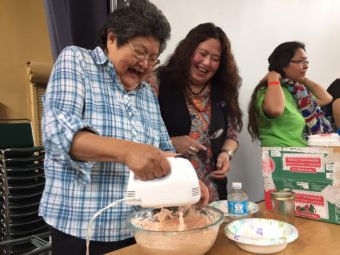
Doris McLean of Whitehorse whips up a jar of soapberries, which took first prize at Sealaska Heritage's contest. Next to her is Leonilei Abbott, daughter of Helen Watkins, who was widely known for teaching about native foods. (Photo by Emily Kwong/KCAW)
Doris McLean of Whitehorse whips up a jar of soapberries, which took first prize at Sealaska Heritage’s contest. Next to her is Leonilei Abbott, daughter of Helen Watkins, who was widely known for teaching about native foods. (Photo by Emily Kwong/KCAW)

Celebration brings together tribal citizens from across Southeast every other year. It’s a sensory experience and two contests in particular were made for the tastebuds.

Doris McLean stands before a bowl of soap berries, ripe and gleaming red.

But pretty soon, with the help of a hand mixer, they turn pink and frothy, the consistency of whipped cream. McLean is something of a soapberry alchemist.

The soapberry contest was dedicated to Helen Watkins, a longtime soapberry contest contestant who "walked into the forest" earlier this year. Competitors this year included Charlene Baker and Fran Neumann. (Photo by Emily Kwong/KCAW)
The soapberry contest was dedicated to Helen Watkins, a longtime soapberry contest contestant who “walked into the forest” earlier this year. Competitors this year included Charlene Baker and Fran Neumann. (Photo courtesy of Sealaska Heritage Institute)

“These soap berries are a healer,” McLean says. “Just tons of vitamin C in it, you know. Our people have to know the healing foods.”

McLean lives in Whitehorse, but picked her berries in Carcross in the Yukon. All she needed was an 8 oz. jar to feed the crowd.

The crown lets out a cheer as she flipps the bowl over — the whipped berries stay inside.

Her secret? Whipping the berries into a stiff, smooth formation, without any sugar granules. In fact, McLean prides herself on not adding much sugar at all.

“My soap berries don’t need any doctoring. Like god made it!” she says.

A man in the crowd yells out, “I wish you were my grandma.”

Like a lot of subsistence foods, methods for preparation and tricks of the trade are passed between the generations. McLean learned from her mom, who used to give her kids a mason jar and say, “Go pick some berries.”

“Get rid of us, hey? So we’d run out and pick enough berries in our mason jar. And she used to give a stick so we’d have to … whip it up and use the sugar and made our own dessert.”

Shifting over to the salty side of things, Celebration’s also included a black seaweed contest. Much like the soap berries, the friendly competition brings out differences in preparation.

At the black seaweed contest, some entries were dried outdoors while others were dried in the oven. "It all depends on where you grew up," says judge Paul Johnson, who was raised in Angoon. (Photo by Rashah McChesney/KTOO)
At the black seaweed contest, some entries were dried outdoors while others were dried in the oven. “It all depends on where you grew up,” says judge Paul Johnson, who was raised in Angoon. (Photo by Rashah McChesney/KTOO)

Paul Johnson prefers seaweed when it’s not too salty and not too dry, aired naturally in the sun instead of in the oven. When I ask what he means, he hands me a dark, green kernel.

Paul Johnson and Ashley Colon were two of three judges for the black seaweed contest, hosted by the Sealaska Heritage Institute at Celebration 2016. (Photo by Rashah McChesney/KTOO)

KCAW: (Crunches) Oh. I see what you mean now.
Johnson: This one’s got a lot of salt water. Depends on how you grew up. Where you grew up. Depends on the kind of seaweed you get.
Howard: We had to hand grind it! (Laughs) The grinders were only that big around.

Johnson’s daughter Catherine passes by. Johnson says, “You know, when I was pregnant with her. I was anemic.”

“I was allergic to the iron pills and my father was still alive and he went out and shot a seal. My dad was cooking seal meat, seal liver and it brought up my blood count. Our own natural food is good for us.”

Hosted by the Sealaska Heritage Institute, these contests are not only popular, but shine a spotlight on the health benefits of subsistence foods. The soapberry contest was dedicated to Tlingit elder Helen Watkins, who spent decades passing on her knowledge of traditional food and medicines. Watkins “walked into the forest” this year in February.

Doris McLean was the winner of the soapberry whipping contest, while the winner of the black seaweed contest was Dora Barr. They were each awarded a cash prize of $500.

New walrus haul out could interrupt Bristol Bay fishing

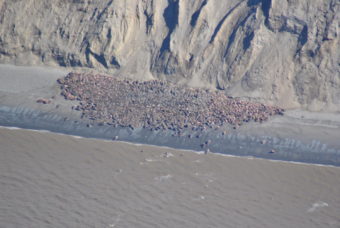
Photo taken by US Fish and Wildlife Service of walrus hauled out at Cape Grieg, just north of the Ugashik fishing district line, earlier this spring.
Photo of walrus hauled out at Cape Grieg, just north of the Ugashik fishing district line, earlier this spring. (Public domain photo courtesy of U.S. Fish and Wildlife Service)

The Alaska Department of Fish and Game says it will be up to fishermen to avoid problems with the walrus hauling out near Ugashik north line this summer.
The new walrus haul out at Cape Greig in Bristol Bay could create some problems for the Ugashik and Egegik salmon fishing districts. But right now the Department of Fish and Game says they’ll start the fishery business-as-usual.

The new haul out was spotted this spring, first by residents flying over the north coast of the Alaska Peninsula. It was confirmed by the US Fish and Wildlife Service. No one is sure yet why the walrus are there, but hope that they might go elsewhere is running thin.

“I’ve seen them anywhere from 300 to 2000 on the beach at Cape Grieg,” said Daniel Peppin, a wildlife biologist and pilot with the Alaska Peninsula/Becharof NWR. Peppin has been keeping an eye on them by air this spring. “I mean, it’s anybody’s guess how long they’re going to be there.”

On a flight last week he counted 1500.

While a new, more accessible walrus haul out might be welcome by some, that spot is awfully close to the boundaries of the Ugashik commercial fishing district. The Dept. of Fish and Game area management biologist for Ugashik and Egegik is Paul Salomone has been looking at pictures of the haul out over the past month or so.

“There’s a bluff right on the north line of Ugashik, and it seems to be towards the north end of it,” said Salmone. “My best estimate of it, at this point, there about a half mile north of the north line.”

That could be a problem in one of the busiest, most crowded fisheries in the state. Last July, when the fishing in Ugashik got hot, there were over 300 Bristol Bay drift permits registered to fish there. Just north of that district, even more fishermen keep their nets wet in the Egegik district. With tenders and other transiting vessels, the amount of traffic near the haul out increases the concern for the safety of those walrus hauling out near the line and feeding wherever it is they feed. Walrus are protected from disturbance by the Marine Mammal Protection Act.

There are guidelines published by the US Fish and Wildlife Service concerning how close vessels can come to haul outs, what operations are not allowed nearby, and how much sound can be generated. If the fleet familiarizes and follows those rules, Salmone believes the fishing should not be interrupted.

“As of right now, we’re still planning on business-as-usual. We’re not planning on making any changes to the way we approach the season at this point,” he said, adding a big caveat concerning enforcement of those federal rules. “We are putting a lot of the onus on the fishermen.”

The consequences of fishing boats triggering a stampede or walrus showing up dead from obvious fishing related causes could be severe, Salomone warned. He said he’s hoping it’s a non-issue.

The federal government has jurisdiction over enforcement to protect the mammals. Commercial fishing in the district opened Wednesday.

Young ‘Bio Blitzers explore and examine the Arctic environment

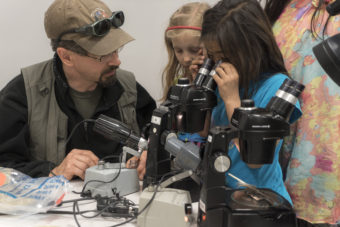
Seven-year-old Anna Nukapigak looks through a microscope at samples. Jeff Rasic and the rest of the students look on.
Seven-year-old Anna Nukapigak looks through a microscope at samples. Jeff Rasic and the rest of the students look on. (Photo courtesy of the National Park Service)

Last week a group of scientists traveled to a small village in the Arctic to find as many different species as they could. It was happening all over the country in celebration of the 100th anniversary of the National Park Service. But it had special meaning in Anaktuvuk Pass, where the local Inupiaq people live a subsistence lifestyle inside of a national park.
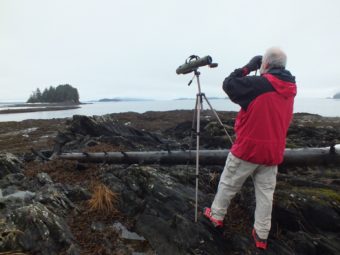
It was warm and sunny when we left Anaktuvuk Pass early in the morning. We headed toward Blueberry Hill, walking through soggy tundra and patches of snow.

Soon the village disappeared and we were surrounded by an amphitheater of mountains.

Suddenly there was something fluttering around our feet. Kyndall Hildebrandt lunged after a small flying creature. She cupped her hands over a patch of tundra and peeked underneath.

It was a brown butterfly, an exciting catch even though she was actually looking for voles. She had set over a hundred mouse traps in two days, smearing them with peanut butter and setting them near the openings of small holes in the tundra.

“It’s the Snicker(s) bars of the animal kingdom so everybody eats them,” Hildebrandt said. “So if there’s a lot of voles then you know there’s gonna be a lot of happy eagles and a lot of happy foxes.”

Hildebrandt is a small mammal researcher at the University of Alaska Fairbanks Museum. She’s one of 25 scientists and volunteers trying to find as many living things as they can in the dirt, mountains, and ponds around town.

Jeff Rasic works for Gates of the Arctic National Park.

“Wilson’s warbler, raven, Savannah sparrow, glaucous gull, American tree sparrow, orange crowned warbler, fox sparrow, white crowned sparrow,” Rasic said as he read off some of the species in the park.

Rasic organized the event to get a snapshot of what’s happening in the Arctic and to get the community involved in science. It’s called a Bio Blitz.

“It’s a scavenger hunt,” Rasic said. “Let’s tally up as many things as we can in a short amount of time: birds, plants, small mammals, large mammals (and) if we happen to see them, fish.”

While spring is well underway in most of the country, it’s a little early in the Arctic. So the species tended to be pretty small.

Among the species were slimy sculpin, wolf spiders, glacier avens, flower, snowshoe hair, singing vole, arctic ground squirrel, etc.

A louswort, one of the plants being examined.
A louswort, one of the plants being examined. (Photo by Molly Rettig, KUAC – Fairbanks)

After tramping through the park with nets, Ziploc bags, and binoculars, scientists returned to the Nunamiut school with backpacks full of samples. They set up tables in the gym and covered them with fox skulls, bird wings, and various types of scat.

The brown butterfly we had found on the hillside was now flattened onto a square of wax paper. Kathryn Daly studies insects at the UAF museum. She was straightening the wings, which had orange spots along the outer edges.

“The genus Erebia was documented here in the 70s,” Daly said. “It’s great to know it’s still here.”

The local people have a different name for it.

“I was talking to an elder last night who said ‘Oh, the chocolate butterflies,” Daly said. “That’s what you call it. And I said yes, chocolate butterflies.”

There were little scientists helping out too. Kids ran around the yard with nets searching for bugs and took turns looking through the microscope.

Seven-year-old Anna Nukapigak has long dark hair and was wearing a blue T-shirt with a butterfly on it. She said bugs are her favorite part of the BioBlitz.

She learns a lot about nature from her elders, especially when her family goes camping in the summer.

Kids searching for beetles and bugs outside the school.
Kids searching for beetles and bugs outside the school. (Photo courtesy of the National Park Service)

“They like teach us how bugs live and they teach us a lot of stuff in Inupiaq about cutting squirrels,” Nukapigak said. “Don’t eat that don’t eat them because we only use the skin to make atiqluq. I mean parkas.”

Animals are the basis of life in Anaktuvuk Pass. Far away from roads or supermarkets, most of the people living here hunt their food. One animal in particular: the caribou.

Vera Woods is curator at the Anaktuvuk Pass museum, and a hunter.

“We live with it every day,” Woods said. “I don’t care if it was for breakfast. I like it frozen raw, and it warms you up in the body because it’s cooking in your stomach and keeps you warm all day.”

The Western Arctic caribou have traditionally come right through the village on their way to the coast. But the past few years, the herd has been shrinking and moving farther away. It’s been hard for hunters, but they’re finding ways to adapt. Woods said the local people can learn from scientists about things like animal population and water quality. And they’re sharing their knowledge as well.

“We’re teaching them how we live here and they’re valuing us our ways of life, how we survive and live here in the mountains, in the park,” Woods said.

By Sunday, the bio blitzers had found over 100 species and counting. As locals headed up the valley looking for caribou, three scientists hunted for plants north of town. Down on the tundra, you could tell summer was near.

Historic agreement gives Kuskokwim tribes say in fish management

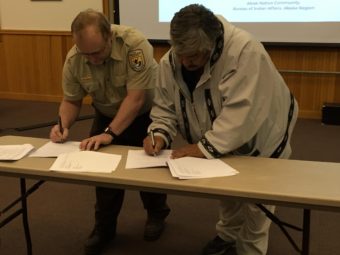
Chair Mike Williams Sr. signs the MOU with USFWS Yukon Delta Refuge Manager Ray Borne. (Photo by Charles Enoch/KYUK)

The Kuskokwim River Inter-Tribal Fish Commission signed a historic memorandum of understanding, or MOU, with the U.S. Fish and Wildlife Service. The agreement is the first formalization of co-management between the Alaska tribes along the Kuskokwim River and the federal government.
The full Kuskokwim River Intertribal Fish Commission, made up of representatives from village tribes all along the Kuskokwim, gathered at the Cultural Center in Bethel to take part in the Commission’s annual meeting, including the signing of the memorandum of understanding. Mike Williams Sr. of Akiak is the Chair of the commission.

“I’m really excited about the MOU, to work formally with the USFWS and the KRITFC, to make sure that our people have enough to eat and that we have enough escapement of our king salmon and salmon upriver,” Williams said.

Partners in the MOU include the U.S. Fish and Wildlife Service, the Alaska Department of Fish and Game, the Association of Village Council Presidents, and the Tanana Chiefs Conference.

The Commission was formed in May 2015 following an initiative presented by Deputy Secretary of the Department of Interior Mike Connor at the 2014 Alaska Federation of Natives Convention. Conner’s initiative calls for federal managers to integrate tribes into the management of Kuskokwim salmon fisheries in federal waters. The MOU is the first part of a two-part project called the “Partnership Project.”

The second part of the project is the creation of a detailed management framework. The Commission has brought forward a proposal to be discussed by the Commission, the Kuskokwim River Salmon Management Working Group, the Alaska State Office of Subsistence Management, and the U.S. Fish and Wildlife Service.

Since managers forecast a better king run this year, the management framework includes a proposal by the Intertribal Fish Commission for a subsistence harvest of 40 thousand king salmon, over 20 thousand more than last year.

According to the MOU the Yukon Delta Wildlife Refuge manager, based at the Refuge headquarters in Bethel, will consult with the Commission before making management decisions for the Kuskokwim salmon fishery in federally managed waters. Commission member Greg Roczicka said they will try to integrate state managers into the plan.

“And they have not developed the management plan yet, they have said they wanted to have a ‘blended management,’ and they came out with the idea that their blended management would say that they’ll limit it to federally qualified users and let the state manage all the openings and closings. The state does not have the options for calling what some might say is an allocation or to the harvest shares that we’re trying to get equitably, federal does.”

The commission expects to hear back from federal managers on the proposal by Wednesday this week.

PSP warning issued for Douglas Island beach

Outer Point
Grey Pendleton scans the shoreline along the Outer Point Trail during the Juneau Audubon Society’s 2013 Christmas Bird Count. (File photo by Casey Kelly/KTOO)

Juneau and Douglas residents are being warned to refrain from harvesting butter clams because of possible paralytic shellfish poisoning.

According to a community advisory issued by the Southeast Alaska Tribal Toxins or SEATT network and the University of Alaska Fairbanks School of Fisheries and Ocean Sciences, butter clam samples collected earlier this week from Outer Point on Douglas Island showed levels of biotoxin that were above the Food and Drug Administration’s regulatory limit.

Those results are from the new Sitka Tribe of Alaska Environmental Research Lab or STAERL that was created to test subsistence shellfish.

Elizabeth Tobin is post-doctoral researcher at UAF who is collaborating with STAERL to train tribes to monitor and also share information about any Juneau area observations through SEATT.

“At the moment, we don’t have a rigid monitoring program for the shellfish themselves,” Tobin said. “We’re doing weekly monitoring throughout Juneau for the algae that cause the toxins. So, if there’s any blooms of this toxic algae, we’re constantly monitoring for that. In terms of looking at the toxins within the shellfish, we’ll likely go out during the next low tide cycle when we can, access those shellfish and we’ll do another round of testing.”

Tobin said cockles and pinkneck or surf clams collected from Outer Point did not show elevated levels of biotoxin. But she still warns harvesters to be careful.

“Whether they are positive for the biotoxin or negative for the biotoxin at one beach, that isn’t exactly clear what the meaning is for even an adjacent beach next to it,” Tobin said. “So, really it is go at your own risk in terms of harvesting anywhere.”

You can find more information about shellfish monitoring throughout Southeast by going to Southeast Alaska Tribal Ocean Research website.

Art of an avant-garde Arctic in downtown Anchorage

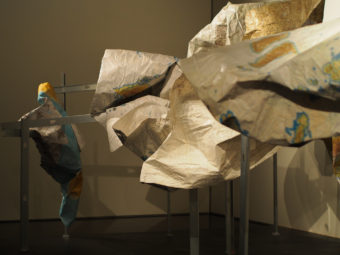
“Subsistence,” a sculpture by Marek Ranis from old military maps suspended on metal fish racks, part of the Anchorage Museum’s “The View From Up Here” exhibit. (Photo Zachariah Hughes/Alaska Public Media)

When people imagine Alaska’s Arctic, experimental art isn’t typically the first thing that comes to mind.

But a new exhibit at the Anchorage Museum is getting visitors, urbanites, and art-lovers to connect to the Arctic in different ways. And the works expand well beyond the gallery walls.

Standing outside the Anchorage museum during busy mid-day traffic, two radio producers from Brooklyn plug earbuds into an iPhone as they get ready to test a sound walk.

“A sound walk is like a museum audio tour, but it’s outside,” explained Isaac Kestenbaum, who has spent the last few months in Alaska as part of a project called “Frontier of Change,” a partnership with public radio station KNBA in Anchorage.

Kestenbaum, along with his collaborator and wife Josie Holtzman, is about to try their mile-long sound walk for the first time together, taking notes about how they can improve it for visitors in the days ahead.

“There’s just a lot of imagining that you have to do,” Holtzman explained of the challenges for synchronizing audio and the surrounding environment.

Sculpture’s by John Grade as part of his “Floats” exhibit within “The View From Up Here.” (Photo Zachariah Hughes/Alaska Public Media)

The two set out on the same route groups of guided guests will travel starting Friday. They slipped pairs of headphones into their ears, the dangling cords connecting to a smartphone loaded with a 31-minute podcast.

“I’d like to welcome you aboard Frontier of Change Airlines,” begins a flight attendant (voiced by Holtzman) in the audio file. “Non-stop service to Shaktoolik, by way of downtown Anchorage.”

The experimental piece isn’t actually about Anchorage, but instead Shaktoolik, a community of around 300 people hundreds of miles off the road system.

“You’ll be traveling in two places at once,” chimes the recording.

It’s a little discombobulating: my eyes are looking at traffic lights and JC Penny’s, but in my ears are the wind and waves you hear walking down the man-made berm separating Shaktoolik’s 61 homes from the Bering Sea.

“Shaktoolik is one mile long, and a little bit wider than this city block,” the flight attendant voice pipes in.

Across the street from the museum, we begin meeting people from around town.”

“Welcome to Shaktoolik,” says Mayor Eugene Asicksick. “Stormy Shaktoolik, I should say.”

A lot of what Asicksick and others talk about is the shifting climate: What warming winters, worsening storms, and a growing day-to-day fear over the weather feel like in the small town.

“It’s changing,” Asicksick says in the recording. “But to me, that’s home.”

Rounding the corner, a 15-story luxury hotel comes into view just as Shaktoolik teacher Lynda Bekoalok describes how her 11-year-old students talk about evacuating in a flood.

“They said, ‘I’d take water, and I would take food, and I’d take Band-Aids and I’d grab my VHF.’ Where before they’d grab toys, their phones, their video games,” says Bekoalok in a concerned by considered tone. “Their whole way of thinking is different.”

As the sound walk continued, the urban surroundings that can feel insulated from climate change began feeling closer to it. At times, was hard to tell if the airplanes I was hearing were from the earbuds or the actual Cessna’s overhead on their way to Merrill Field. Same with the buzzing hum of trucks, the wind, and seagulls.

As Holtzman scribbled notes after the tour, I asked if the Shaktoolik sound walk downtown is supposed to be a complement, a contradiction, or both.

Mary Mattingly’s “Arctic Food Forest,” a living sculpture that functions similar to a small-scale ecosystem, exhibited in front of the Anchorage Museum as part of “The View From Up Here.” (Photo Zachariah Hughes/Alaska Public Media)

This is just one of the experimental pieces in “The View From Up Here” exhibit. Most of the installations are inside the museum–although the lawn is playing host to an “arctic food forest.”

Derek Cote grew up in rural Canada and now teaches in Detroit. His video piece “Legends Are Made Here” (with an accompanying score by Paul Haas, played the Anchorage Symphony Orchestra) started years ago when the museum invited him to experiment with a new format during his time as an artist-in-residence.

A sculpture by Christoph Kapeller, part of his “Yedoma: Mounds of Life” exhibit within “The View From Up Here.” (Photo Zachariah Hughes/Alaska Public Media)

At one point in Cote’s film the burning pink globe of a shallow sunrise outside Shishmaref is shown alongside the lush red curtain rising at Anchorage’s Performing Arts Center. The movements and music harmonize on the screen, which is no accident.

“I think there’s a lot of dichotomy here that I’ve experienced, sort of the urban and the rural and remote, and I’m trying to find ways to reconcile those two,” Cote said.

The show’s theme is loose, and most of the works look nothing alike. There are sculptures of glass and wood suspended from the ceiling like ornamental cocoons, a multimedia display of prehistoric permafrost patterns, even a vinyl record made from wood burned during a bonfire in Kotzebue that you can listen to through headphones.

Museum director Julie Decker says the idea was to give support to several artists with long-standing ties to northern regions as they explore this particular point in time for Alaska’s Arctic.

“There’s always been a fascination with the Arctic, and with the North, and so artists have come to these places for centuries,” Decker said.

“But there’s an urgency to the story now, and there’s an increased curiosity because of the rapid pace of change,” she added.
The View From Up Here opens Friday and runs through October 6th.

The “Frontier of Change” sound walk will be available online at KNBA through the end of the summer.

Site notifications
Update notification options
Subscribe to notifications