Subsistence

Experts: Nomadic tradition waning, but Natives’ connection to land persists

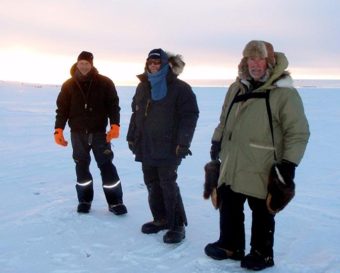
Members of the In Amundsen's Footsteps expedition team, from left: Graham Burke, of New Zealand; Wayne Hall, of Eagle, Alaska; and Tim Oakley, of the United Kingdom. (Photo courtesy of InAdmundsensFootsteps.com)
Members of the In Amundsen’s Footsteps expedition team, from left: Graham Burke, of New Zealand; Wayne Hall, of Eagle, Alaska; and Tim Oakley, of the United Kingdom. (Photo courtesy of InAdmundsensFootsteps.com)

Tim Oakley may by now finally have caught up on sleep lost during a monthlong expedition through northern Yukon Territory and Alaska, when he retraced the route taken more than a century ago by legendary Norwegian explorer Roald Amundsen.

He’s now working on a report of his journey for the Royal Geographical Society.

“We’ve been asked to write a paper showing comparative data on how it was for Roald Amundsen, in 1905 and what we experienced,” he said.

Oakley is a geographical society fellow, and he says his report will outline observations of many changes that’s occurred since Amundsen’s journey through the same stretch of wilderness Oakley’s three-man team traveled through on their grueling journey by dogsled from Herschel Island to Eagle, Alaska. Those changes include the disappearance of trails along the route – and the Native people who used them.

“Back in 1905,” he said, “all the Inuit and the Athabaskans were nomadic – trading and moving about and leading their traditional ways of life. Whereas today, now they all live in villages.”

Oakley says he thinks that reflects a change in the relationship between the Inuvialuit people and the land on which they’ve lived for thousands of years.

But Mike Koskey, an assistant indigenous-studies professor with UAF’s Center for Cross-Cultural Studies, says he think that’s a bit of an overstatement.

“The culture is not lost; the culture has changed,” he said. “Just as ours isn’t the same culture that our forefathers lived in, let’s say, the 17th century.”

Koskey’s spent years studying the indigenous peoples of Northern Alaska and Canada. And he agrees with Oakley’s view that Native people in the region have become less nomadic over the past couple of centuries. But Koskey says Arctic Native peoples’ relationship to the land remains strong, as shown by their continued harvest of food from the land and Arctic Ocean.

“Whether we’re talking about Inuit peoples or Athabaskan Dene peoples, their culture is still very much tied to the land,” he said.

Oakley says he’ll complete his report by September. And meanwhile, he plans to talk with students in the U.K., Norway and elsewhere about his journey.

State defends subsistence users in Haines land use case

Reuben Loewen testifying Monday. (Photo by Jillian Rogers/KHNS)

The trial of Reuben and Rosalie Loewen versus the State of Alaska Department of Natural Resources began proceedings Monday in Haines court. The case stems from a dispute between the Loewens, private landowners, who live on the Chilkoot River and locals who use the river for subsistence hooligan fishing.
Tlingit people have been hooligan fishing at the disputed location for centuries, says Kristen Miller, an attorney representing some of the state’s co-defendants. She says they will argue over the next several days that the fishermen should be able to have unhindered access to the spot. Hooligan season typically lasts for about a week in late April and early May.

The Loewens say they are stewards of the river and are trying to preserve the waterway by restricting vehicle access to the spot, which is just south of the Chilkoot River bridge. The Loewens say they don’t mind people fishing if they walk down to the spot instead of driving.

The conflict started a few years ago. It came to a head last year when the Loewens tried to block vehicles by placing a boulder in the middle of the path leading to the fishing spot. A group of subsistence users removed the boulder, and a verbal altercation ensued.

The boundaries and state right of way in the area are not clearly designated, so it’s unknown who exactly owns or has the right to access the land. The Loewens filed the accretion lawsuit against the state to clarify ownership. The state’s co-defendants include Sealaska Corp., the Alaska Native Brotherhood Haines Camp 5, and the Chilkoot Indian Association

Attorney Daniel Bruce is representing the Loewens. He called eight witnesses Monday, including Rosalie and Reuben, along with Lutak residents.

Miller had a list of more than a dozen witnesses representing various Native groups, including the Chilkoot Indian Association and the Alaska Native Brotherhood.

The trial is expected to last three days. Judge Phillip Pallenberg is residing.

Editor’s note: This story’s been updated to correct who attorney Kristen Miller is representing. She’s not an attorney for the state, but for some of the state’s co-defendants: Sealaska Corp., the Alaska Native Brotherhood Haines Camp 5 and the Chilkoot Indian Association.

Savoonga harvests second whale of the season

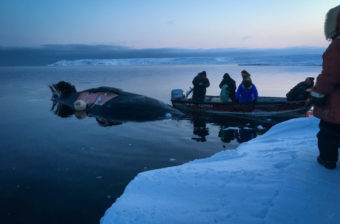
Savoonga’s second whale of the season, harpooned by whaling captain Carl Pelowook Jr. (Photo courtesy of Brianne Gologergen)

A whaling crew from Savoonga landed its second bowhead of the season recently. The St. Lawrence Island community has been working nonstop to haul the whale out of the icy waters, harvest its meat, and distribute it around the village.

For the past few weeks, whaling crews have been camped out on the southwest side of St. Lawrence Island. Elvin Noongwook was on the crew that landed Savoonga’s first whale in 1972.

Sitting around his kitchen table, the elder said they’ve been going to the same spot ever since.

“We call the whaling camp ‘Powooliak.’” Noongwook explained. “That’s where we’re doing whaling now in (the) springtime.”

Whale being separated out to distribute throughout the community of Savoonga. (Photo courtesy of Brianne Gologergen)

On March 27 of this year, Carl Pelowook, Jr., landed the first whale of the season and the earliest in Savoonga’s whaling history. Warmer ocean temperatures and stronger winds from the north make it easier for whalers to start their hunts earlier.

On April 5, Pelowook and his crew, which includes Michael Kralik and Nathaniel O’Connor, harpooned their second bowhead. With the help of eight other boats, they hauled the whale up to shore and got to work.

Elvin Noongwook says nothing goes to waste.

“We take everything from the head to the flukes, baleen and the meat.”

The work is nonstop. A steady stream of snowmachiners travel back and forth between camp for days, delivering processed whale and swapping out tired workers with well-rested ones.

Brianne Gologergen is a health aide at Savoonga’s clinic. She made the trip out to camp to watch it all unfold.

Gologergen said along with the days it takes to harvest a whale, it’s also pretty costly for the community to travel the 38 miles to camp.

“There’s the fuel for the boat, grub for camp for a couple of weeks, (and) fuel for your snow machine,” Gologergen explained.

But, she said, the taste of the fresh whale makes it all worth it.

“It was so yummy,” Gologergen said.

Even after the meat makes it into people’s mouths, the work doesn’t let up. George Noongwook is Elvin Noongwook’s cousin. He was also on Savoonga’s first whaling crew and now acts as the community’s commissioner on the Alaska Eskimo Whaling Commission.

He says prep for the whaling season starts thousands of miles from home.

“In order for us to go whaling, we first need to go to Washington, D.C.,” Noongwook explained.

Noongwook said there’s a lot of politicking needed to make sure Alaska’s 11 whaling communities can feed themselves throughout the year.

People pulling the whale out of the icy waters on the south side of St. Lawrence Island. (Photo courtesy of Brianne Gologergen)

“It takes a lot of coordination,” he said, adding “it takes a lot of people to work together to achieve that goal… it’s a lot of work, a lot of legwork.”

The Alaska Eskimo Whaling Commission meets four times each year. Their work helps inform the International Whaling Commission, or IWC, which meets every six years to set worldwide whaling quotas.

Noongwook said it’s a complicated process and not without its problems.

“Oftentimes, our quota is used as a political football for whaling nations and non-whaling nations,” Noongwook explained.

That’s exactly what happened in 1978 when the IWC failed to pass a whaling quota. Noongwook says those were dark days for Savoonga.

So after the IWC re-established the quota, he said he makes sure the community follows all IWC protocols and fills out all the right paperwork.

“We just have to keep plugging away if we want to survive,” Noongwook said.

Like the whale harvest itself, Noongwook said his work as a commissioner it’s tiring and time-consuming, but he said he’ll keep at it to keep the tradition alive.

Alaska nursing home asks to serve seal oil to Native clients

State regulators in Alaska are working with a Native organization that wants to serve its nursing home residents seal oil, a traditional staple that’s banned in public settings because of its high risk for botulism.

The Alaska Department of Environmental Conservation says it would grant an exemption to the Kotzebue-based Maniilaq Association if it can demonstrate a safe method for rendering the oil.

Alaska consistently has among the highest rates of foodborne botulism, which can lead to temporary paralysis.

Maniilaq hopes it can add seal oil to the list of traditional foods that can legally be donated to facilities such as its Kotzebue nursing home, which serves elderly Inupiat Eskimos. The organization, a regional tribal health care nonprofit, has also recently begun to incorporate other traditional foods on the menu.

Supreme Court sides with Sturgeon in case challenging NPS authority

John Sturgeon
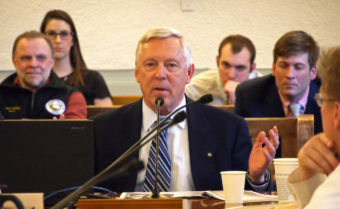
John Sturgeon discusses his U.S. Supreme Court case with the Alaska Senate Resources Committee, Feb. 17, 2016. Sturgeon is the plaintiff in in Sturgeon v. Frost, a case involving a dispute over federal control over navigable waters. (Photo by Skip Gray/360 North)

The U.S. Supreme Court issued a partial victory Tuesday to Alaska moose hunter John Sturgeon in his case against the National Park Service. The high court voted 8-0 to reject a 9th Circuit Court of Appeals decision against Sturgeon.
The case stems from a 2007 incident when rangers in the Yukon-Charley Rivers National Preserve told Sturgeon he couldn’t operate his hovercraft there.

The Supreme Court decision, written by Chief Justice John Roberts, says the Ninth Circuit’s interpretation of a section of the Alaska National Interests Lands Conservation Act is inconsistent with both the text and context of ANILCA. The section, 103-C, concerns which federal laws apply on non-federal inholdings within park boundaries.

The justices, though, did not rule for Sturgeon outright. Instead, they sent the case back down to the ninth Circuit for another decision.

The court heard arguments in the case in January.

Y-K region residents face tough decisions on jobs, environment with Donlin gold mine

The USACE presenting the Donlin Gold EIS in Nunapitchuk. (Photo courtesy of KYUK)

The US Army Corps of Engineers has completed a week of back-to-back meetings collecting public comment on the Donlin Gold draft environmental impact statement, or EIS, with a visit to Nunapitchuk.

The Army Corps is the lead federal agency on the document and has contracted the international environmental and engineering firm AECOM to create the draft.

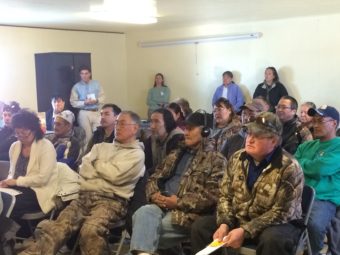
About 25 people from Nunapitchuk, Kasigluk, and Atmautluak attended the gathering on Thursday to testify on the proposed open pit gold mine located about 10 miles north of the village of Crooked Creek and the Kuskokwim River.

The comments at the meeting remained consistent with concerns expressed in other villages throughout the Yukon-Kuskokwim region on the project; mainly residents want the economic benefits of jobs without assuming the environmental impacts mining could have on subsistence.

But Bobby Hoffman, a Calista Corporation board member, says subsistence users can’t have one without the other.

“If we don’t have money we can’t get subsistence. Since our subsistence is away from our villages and our towns, we have to go get them. Without gas, without equipment— snow machines, shells, food— we can’t get them,” Hoffman said.

Calista owns the mineral rights to the mine site and plans to increase shareholder dividends with revenue generated from its operations—an estimated $1.5 billion over the life of the project and an additional quarter million dollars in right-of-way lease payments from a proposed pipeline, according to the draft EIS.

Nunapitchuk resident Barbara Evan says she’s torn about the mine.

“I know there (are) a lot of unemployed people all over these small rural communities. It’s a good opportunity for them, but then there’s that side where the elders are concerned about our subsistence,” Evan said.

Her son is one of those unemployed people. He’s 21 years old and living at home. She says he dropped out of high school, and she’s encouraging him to get his GED so he can work.

Evan says even though she’s concerned about environmental hazards if the mine offered her son a job, she’d encourage him to take it. And if the mine were operating, she says maybe he wouldn’t be in his situation, because more employment opportunities would motivate young people to finish school.

But Morris Alexie, a subsistence hunter from Nunapitchuk disagrees.

“It’s been 20 years since these guys showed up,” Alexie said. “I haven’t seen any improvements in our graduation rates.”

According to the draft EIS, in 1995 Placer Dome US began exploring the mine site, setting up camps and support facilities like an airstrip and roads to advance their assessments.

In 2007 Barrick Gold North America and NOVAGOLD Resources Alaska, Inc. formed Donlin Creek LLC in a 50/50 partnership. They changed the company’s name to Donlin Gold LLC in 2011.

Since then Donlin has committed to a Calista shareholder hiring preference, and the draft EIS estimates the mine would employ 1,600 to 1,900 YK residents during construction and 500 to 600 residents during operations.

Alexie says those numbers don’t substantially benefit the region.

“They say jobs. But there (are) 13,000 shareholders right now, and if we add the descendants, it’ll be 40,000 shareholders,” he said. “It outweighs the shareholders for the number of jobs available.”

Alexie says the possibilities for environmental impacts override the possibilities for employment. Jobs, he says, would benefit a few while subsistence consequences would affect everyone.

No matter what happens, Henry Tikiun Sr., an elder from Atmautluak, wants the region to hold the mine’s estimated 27-year lifespan in perspective.

“Subsistence outweighs jobs. You can have a job for so long. The gold mine can be open for so long and then close. Subsistence,” Tikiun said, “will last forever.”

The Army Corps will return to the YK region the final week of March to collect public comment on the draft EIS in Chuathbaluk, Holy Cross, and Lower Kalskag.

Lillian Michael provided Yup’ik translation for this story.

Site notifications
Update notification options
Subscribe to notifications