Anna Canny

Local News Reporter

New film documents local play reimagining Macbeth through Lingít lens

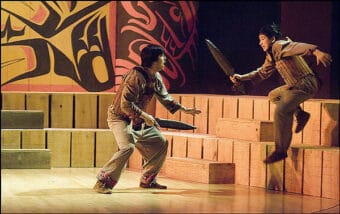
Jake Waid as Macbeth and Richard Atoruk as Soldier in Perseverance Theatre’s “Macbeth.” (Photo by Katherine Fogden/Smithsonian National Museum of the American Indian)

Last Thursday’s show at Juneau’s Goldtown Nickelodeon began with a blood-splattered formline title card on the screen. It read: “Macbeth through Alaskan eyes.” 

Beating drums marked the entrance of the three witches. They danced and slinked across the screen wearing masks that showed the barred teeth of a shape-shifting otter from Lingít folklore. 

As flashing stage lights evoked the stormy night that sets the play’s murderous plot in motion, actress Lily Hope delivered the familiar first line — when shall we three meet again? 

“Xeitl tóox’, séew kaa ch’u k’eeljáa gé,” Hope said — in thunder, lightning, or in rain? 

That line opens every performance of Macbeth. But the translation, and the elements of Lingít culture throughout, put a twist on Shakespeare’s tragedy. 

The production first ran at Juneau’s Perseverance Theater in the early 2000s. It even had a 2007 run at the Smithsonian Museum of the American Indian in Washington, D.C. 

“I remember going in the subways in D.C. speaking our lines together, in packed subways,” said Juneau actor Jake Waid, who played Macbeth. “And it was just like — to be in the nation’s capital, speaking our lines around the city — it was just a powerful experience to just feel like we were claiming the play.”

Recordings of the play were originally captured during those performances, but for years the footage was stored away in the Sealaska Heritage Institute archives. Now, it’s finally been adapted for the big screen as a film presented for 2024’s Celebration.

Actor Jake Waid during Macbeth’s coronation in a performance at the National Museum of the American Indian in 2007. (Photo courtesy of the Sealaska Heritage Institute archives)

Director Anita Maynard-Losh came up with the idea for the play after spending more than a decade living in Hoonah. She’s not Alaska Native herself, but the Shakespeare expert said she saw similarities between Lingít culture and the Scottish values portrayed in the play.

“The Scots and the Lingít were extremely feared for their fierceness and their warfare” Maynard-Losh said. “And they had a deep connection with the supernatural. And they had a cultural value of putting the good of the group ahead of any one individual.”

Maynard-Losh says valuing community is a virtue that prevails in Macbeth, and one that’s infused into the Lingít translation, which was originally done by the late elder Johnny Marks Kooteix’téek. While most of the characters deliver their lines in Lingít, some of the play, including most of the soliloquies and clandestine meetings between Macbeth and his sinister wife Lady Macbeth, are in English.

“We decided that we were going to lean into the metaphor by having the people who were adhering to that cultural value speak in Lingít,” she said. “And when the people were not adhering to that value, and going for personal ambition, they spoke in English.”

But delivering the rest of the lines in Lingít was a challenge. Though all of the actors are Alaska Native, and many are Lingít, none were fluent speakers. 

Waid said watching his performance brought back memories of rehearsing the difficult stanzas over and over with his castmates.

“It feels like a miracle that we got up on stage and we got the words out,” he said.

The play also incorporates cultural elements beyond language. The costumes and set feature formline designs. When Macbeth is crowned king, he dons a Ravenstail robe and a headdress adorned with ermine skins. When Banquo’s ghost haunts his killer Macbeth, he wears a raven costume. 

And when the righteous Macduff finally vanquishes Macbeth, they face off with shields that are drums and swords that are drum sticks, punctuating each blow. 

But in a lot of other ways, it’s just like any other Macbeth production, right down to superstition. Macbeth, in the world of theater, is often considered a cursed play. Hope recalls how, when they were putting the original production together, stage lights that fell from the ceiling and stage pieces that broke constantly felt like bad luck. 

“I think it was four-fold with the Lingít language being 10,000 years old, where we were like ‘Oh, let’s pull out some really dark energy in here,’” Hope said.

For Waid, all the Lingít elements enhance the play for new audiences and actors without changing Macbeth’s core meaning. 

“It’s one of the great plays in the English language. This is part of our history too, as English speakers, and also as people who want to dig deeper into our own culture and find meaning,” Waid said. “We’re not relegated to just what people might think of as Lingít things.”

Sealaska Heritage Institute staff said they’re hoping to screen the film again later this summer.

Disclaimer: KTOO 360TV was contracted to produce television and online video coverage of Celebration. 

In Juneau, years can pass without a thunderstorm. Why are they so rare?

Juneau lightning
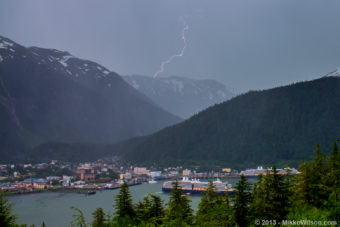
Lightning strikes over Juneau, June 17, 2013. (Photo by Mikko Wilson)

On Tuesday afternoon, Juneau climatologist Rick Fritsch was getting ready for his afternoon shift when the sky darkened suddenly, and the wind picked up. 

“It was rocking the trees, something furious. And my birdhouses were flying, you know, seven ways till Sunday,” Fritsch said. “So I kind of knew that something was up.”

A few minutes later, when he got to the National Weather Service office, a thunderstorm was already in full force. 

“And the office was just buzzing alive with activity,” he said. 

It was an exciting day for Juneau’s meteorologists because thunderstorms rarely happen here. On average, they only happen once about every 2 years. But on Tuesday, all the right ingredients came together. 

Earlier that day, Fritsch’s colleagues had been tracking an unseasonable cold front that was hovering high in the atmosphere just south of Juneau. Meanwhile, on the ground, unsuspecting Juneauites were enjoying a brief moment of sunshine and warmth. 

Now, imagine boiling a pot of water. Cooking up a thunderstorm works much the same way. 

“When it’s a sunny day, and the ground heats up, that’s the element on the stove that’s heating the pot of water from below,” Fritsch said. 

As the water heats up, bubbles of water rise to the top of the pot, while cooler water sinks from the surface. It’s a process called convection. Air does the same thing. 

On warm, sunny days, bubbles of hot air form near the ground and start rising. As they climb higher in the atmosphere, temperatures cool. Especially when there’s a cold front like the one we had on Tuesday.

When the air bubbles cool off, water particles inside them condense and form clouds. This process happens over and over again. Each newly formed cloud pushes the one that came before higher and higher into the atmosphere. 

“And they keep going and going and going,” Fritsch said. “That’s how you build a thunderstorm.”

The clouds stack and combine until, eventually, they form towering, dark gray cumulonimbus clouds. 

These storm clouds are powerful. When they burst, they release a deluge of rain, gusty wind, occasional hail storms — and of course, thunder and lightning.

But the chaos is usually brief. On Tuesday, it lasted just about 30 minutes. That’s because a thunderstorm is its own worst enemy. 

“Basically it kills itself because then it rains out, and it cools the ground underneath it,” Fritsch said. “You take away the heat source. You take away the fuel, if you will, for the thunderstorm.”

And in Juneau, thunderstorms have a couple of other adversaries. 

The first is the ice field. It stands between Juneau and British Columbia to the east, where hot stretches in the summer create massive thunderstorms. Lightning from these storms has sparked some of the Canadian wildfires that have become so prevalent.

But these powerful storms usually can’t make it to Juneau. 

“These thunderstorms grow and grow and grow and they get really exciting. And meteorologists get all tripped out about it, like, ‘Oh, this is really cool,’” Fritsch said. “And then it hits the icefield, you take away the heat, the fuel source, and it just peters out.” 

The storm deflates. 

“All of a sudden it just turns into a rainstorm, a rain shower,” Fritsch said. 

The other adversary, Fritsch said, is Juneau’s northern latitude. 

“We live at 58 north,” he said. “And physically, the atmosphere is thinner the closer you go to the pole.”

At lower latitudes, there is a thicker layer of atmosphere separating the surface of the Earth from space. Which means thunder clouds have plenty of room to grow. Near the equator, they can get up to 50,000 feet, or nearly ten miles, tall. 

In Southeast Alaska, the troposphere — that’s the part of the atmosphere where most weather forms — is only 15,000 to 20,000 feet thick.

“There’s not as much potential or ability for the thunderstorms to really grow to the point where they can manifest, like something in Kansas or Iowa,” Fritsch said. 

So even when thunderstorms do form, they’re typically milder than they might be in the lower 48. In fact, Southeast Alaska has only had one severe thunderstorm warning in Fritsch’s 18 years forecasting here — in Misty Fjords, back in 2019.

“The only time I’ve ever seen it. As a matter of fact, the only time since our weather station has been in existence,” Fritsch. “And that goes back to the 1890s.”

So if you missed Tuesday’s lightshow, you might have to wait a while for the next one.

Last year’s record outburst flood took Juneau by surprise. As Suicide Basin refills, scientists are working to improve their forecasts.

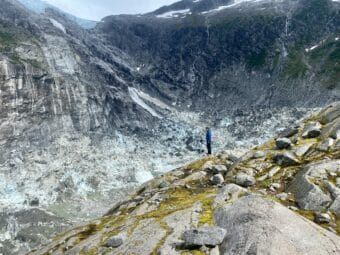
Researcher Eran Hood stands on the lip of an empty Suicide Basin just a few days after it drained to create a record-breaking glacial outburst flood in August 2023 (Photo by Anna Canny/KTOO)

Last summer’s record-breaking glacial outburst flood took everyone in Juneau by surprise. 

So this year, a team of local scientists and emergency managers are trying to improve flood forecasts. They talked about it during a Monday-night presentation at the University of Alaska Southeast.

Researcher Jamie Pierce with the U.S. Geological Survey says his agency is keeping a close eye on Suicide Basin, which has already started to fill again.

“We all know the anxiety when the basin is filling and not released yet. And we want to know the second it starts [releasing]” Pierce said. “We feel like we have enough in our favor now to be able to very confidently do that well.”

Each year, the basin — which is dammed by the Mendenhall Glacier — collects rain and meltwater. Eventually that water releases, draining first into Mendenhall Lake and then the river in what’s known as a glacial outburst flood, or a jökulhlaup.

Last year, 13 billion gallons of water burst out in a flood that was bigger and more damaging than ever before. So this year, scientists are using new technology to monitor the basin more closely. There’s also an improved warning system and a new set of flood maps to help homeowners figure out what to do when the water starts rising. 

Just last month, Pierce’s team installed new technology to understand how the basin fills and drains. There are sensors that measure water levels and a weather station to keep track of the rainstorms or hot-weather ice melt that add water. 

There are also two cameras that will take pictures of the basin four times a day. 

Meanwhile, researchers like Eran Hood at the University of Alaska Southeast are studying the shape of the basin, which is ever-evolving. 

Ice-dammed basins like Suicide Basin typically exist for a few decades, until a glacier retreats far enough that the dam no longer exists. That could take between 30 and 50 years. 

As the Mendenhall melts, the height of the ice dam gets lower. But at the same time, the face of the glacier is calving, which could make the basin wider. That means flood risk will continue to evolve too.  

“People always ask ‘Well is it gonna get bigger over time or smaller over time?,’” Hood said. “To answer that question accurately we need to be able to quantify how these competing processes are interacting with each other.”

They’ll do that by using frequent drone surveys to estimate the volume of the basin. There’s a brand new post-doc at the University who will do those surveys at least a half dozen times this summer.

Thanks to that technology, hydrologist Aaron Jacobs with the National Weather Service can get an idea of how much water is in the basin at any given time. 

“Currently, we are really, really low from where we were last year,” Jacobs said. “This time last year, we were 30 meters higher in ice elevation, water elevation than we are right now.”

But he says the challenge is forecasting how fast the water will drain. When it drains quickly, that creates a bigger flood peak. Last year, it basically all came out at once.

“Unfortunately there’s not really a confident way to say the size of this release. Is it going to be a full release? A half? A quarter? Or a certain percentage?,” Jacobs said. “That’s what we’re trying to get at.”

So going forward, flood forecasts will include that full release as the worst case scenario. From there, residents can consult an updated set of flood maps. 

City emergency manager Tom Mattice says the maps show what parts of town could flood under minor, moderate or severe flood scenarios.

“Everybody needs to have a personal plan,” Mattice said. “Where are you going to go? What are you going to do? Do you have a go-bag at your house?” 

The city also plans to introduce a new federal system called the Integrated Public Alert and Warning System, or IPAWS, which will allow them to send information about flooding or other emergencies directly to cell phones. 

Celebration returns this week to uplift Indigenous culture in Juneau

Hundreds gather to march during a processional and grand entrance on Wednesday, June 8, 2016, near Juneau, Alaska. Celebration is a biennial festival of Tlingit, Haida and Tsimshian tribal members put on by the Sealaska Heritage Institute. (Photo by Rashah McChesney/KTOO)
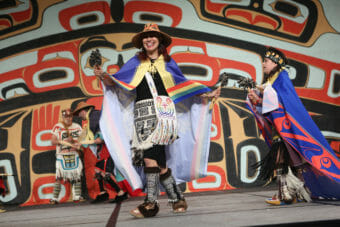
A dancer performs at the Celebration grand entrance in June, 2016. (Rashah McChesney/KTOO)

The beloved festival known as Celebration returns to Juneau this week. 

Since its inception in 1982, the biennial gathering has brought Lingít, Haida and Tsimshian people together in the capital city to celebrate their cultural survival and share it with the general public. 

It’s hosted by the Sealaska Heritage Institute. This year, it will happen from Wednesday, June 5 through Saturday, June 8. But the unofficial kickoff happens Tuesday, when traditional canoes — or yaakw — will land at 11:30 a.m. both downtown across from the Ramada and at Auke Recreation Area. 

The heart of the four day event is dancing. Performances will basically be going on all day, every day.

This year’s event promises almost 1,600 dancers from 36 dance groups, including the lead dance group Dakhká Khwáan Dancers or “People of the Inland,” a Lingít group from Whitehorse, Canada.

They’ll head up Wednesday evening’s grand entrance parade with drumming and singing

In addition to dance, the festival features a Native food contest, a daily Native art market, an Indigenous fashion show, a regalia review and brand-new Chilkat robes on display. 

There will also be an art exhibit at the Walter Soboleff Building and evening film screenings at Gold Town Theater. 

Events are happening across town at Centennial Hall, Elizabeth Peratrovich Hall, the Sealaska Heritage Institute Arts Campus and the Alaska State Library.

Áak’w Rock will also host Indigenous music events on Friday and Saturday and a multi-generational art show opens Wednesday at Alaska Robotics Gallery. 

The full schedule of official Celebration events can be found on Sealaska Heritage Institute’s website. 

Disclaimer: KTOO 360TV is contracted to produce television and online video coverage of Celebration. 

Correction: A previous version of this story mistakenly said canoes will be landing at Douglas Boat Harbor. They will land downtown across from the Ramada instead. 

New University of Alaska Southeast natural sciences building ‘opens to the environment’

The new “Áakʼw Tá Hít” natural science building in Juneau (Photo by Anna Canny/KTOO)

There are still some power tools and a clear plastic tarp scattered in the entryway of the newly constructed science building at the University of Southeast Alaska. Inside, there are shiny floors and a new building smell.

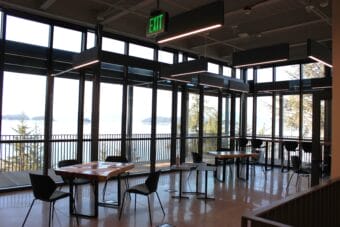
The first room you see after you walk through the main entrance, is a lounge with a few sets of tables and chairs and a giant picture window.

“This is the student lounge, which has a pretty stunning view out over Auke Bay and looking at Admiralty [Island]” said longtime professor of environmental science Eran Hood.

The brand new building is called Áakʼw Tá Hít, which translates to House at the Head of the Bay in Lingít.

A view of Auke Bay from the deck of the student lounge (Photo by Anna Canny/KTOO)

In the 20 years since Hood joined the faculty, the department has always been a bit scattered, with offices and classrooms spread across campus. But starting next fall, faculty, researchers, and students in ecology, glaciology, geophysics and more will come together here.

“After many years of waiting, we have our own program space, which will be really fantastic,” Hood said.

The 16.1 million dollar construction project was funded with money from the university’s existing budget, along with reserves for building renewal and profits from the sale of the University bookstore building.

The project has been in the works since 2016, though COVID-19 pandemic delayed construction. But now, the two-story with modern gray wood paneling is nearly ready for people to move in.

It’s right next door to the Anderson Building, which houses the biology department. So the many students who study across disciplines will have an easy walk back and forth. Both buildings are just up the road from the university’s main campus on Auke Lake.

The lounge, with its high ceilings and a big wrap-around deck, will be the main gathering place for studying and group projects.

The student lounge is the main gathering space at UAS’ new natural science building (Photo by Anna Canny/KTOO)

Faculty, including Hood, are just a few feet away.

“When I come out to have lunch there, I’ll be sitting with the students,” Hood said.

His office is just up the hall, in a row of offices that line one side, and his lab, which will be used for hydrology research, is right across the hall.

It will replace the old environmental research lab, which is a mile and a half away, in the Mendenhall Valley. Hood said that distance has been a challenge in the past.

“If I wanted to go from my office to my lab, I had to get in my car and drive. And if I wanted to have a student working with me, they had to have a way to get out there,” Hood said. “Now what you’ll see is, I can walk out of my office, across the hall and into the lab.”

New laboratories will support research in hydrology and glaciology (Photo by Anna Canny/KTOO)

A lab next door holds the university’s research on glaciology and drones. Each lab is equipped with all the basics — benches, fume hoods, and plenty of storage space.

“Both of the lab spaces are very flexible, so as we get new and different faculty in the future, you could use this space for a lot of different kinds of research,” Hood said.

On opposite ends of the building, there’s a wing with offices for administrators and visiting faculty, and another wing with desks for graduate students.

There are also classrooms. On the top floor, there’s a smaller one that holds about 20 students. Downstairs, a 40-person seminar room will hold introductory classes.

The downstairs also holds a lot of extra storage space and a dive locker for students studying marine biology and oceanography.

Eran Hood in a brand new 40-student seminar room (Photo by Anna Canny/KTOO)

Almost all of the rooms have huge glass windows and doors, which let in sunlight and views of spruce trees and the beach.

“It really kind of opens to the environment,” Hood said. “Which is just what we were hoping for when developing the space.”

Hood said it will be a great place to study the natural world once students, faculty and researchers move in this fall.

Site notifications
Update notification options
Subscribe to notifications