Anna Canny

Local News Reporter

Marie Gutgesell on seeing the forests for the food through her research

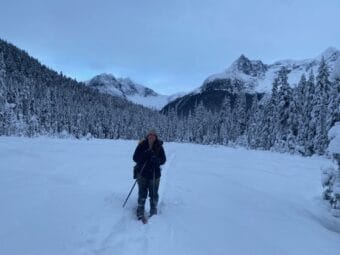
Marie Gutgesell in the Héen Latinee Experimental Forest by Davies Creek (Photo courtesy of Marie Gutgesell)

For many of Southeast Alaska’s rural communities, forests and oceans are like a pantry, stocked with foods like fish, berries and shellfish that support nutrition and cultural well-being. 

All those foods, and the people that eat them, are intimately connected to each other. Marie Gutgesell, a post-doc with the Pacific Northwest Research Station, is recording those connections using food webs for a new project with the U.S. Forest Service.

She joined KTOO’s Anna Canny to talk about it. 

This interview has been edited for length and clarity.

Anna Canny: So, I definitely remember drawing a food web in like elementary school. Maybe that’s a universal experience. But it’s been awhile, so maybe you could start by telling me what a food web is? 

Marie Gutgesell: So food webs in a really general context are just the interactions that species have with each other in sort of like a predator-prey sense. So it really describes, you know, who’s eating who on the landscape and how much are they eating of each other.

Anna Canny: Okay. I think a lot of people here are probably at least a bit familiar with the food webs that exist here, given how many people are doing subsistence harvesting or even just sport hunting and fishing.

Marie Gutgesell: Yeah, absolutely. In Alaska, and I’m specifically focused in Southeast Alaska, wild foods are an integral part of communities’ ways of life. And those who are actually participating in wild food foraging, obviously know the importance of these forests in  providing these wild foods. I mean, in communities across Southeast, they’re harvesting over like 150 different types of species. So it’s a pretty amazing diversity of resources. But I don’t think it’s always recognized from that sort of higher management level, and so how can we re-envision how we’re thinking about public land management to promote the productivity and availability of these wild foods? 

Anna Canny: So it sounds like the food web approach has kind of been left out of traditional forest management?

Marie Gutgesell: I think it’s historically not very common at all. We tend to often focus management from sort of single species perspectives. We are starting to see shifts — like one example I can think of is when I mean, these forests are salmon forests, right? And so we’re starting to, you know, develop sort of food web models and food web thinking about restoration processes or sort of different areas for management to maintain sort of food web linkages that support the salmon.

Anna Canny: You’re basically saying that managing a forest for salmon is  a good start. But it’s not good enough. We’ve got to consider the whole food web that salmon is a part of. So how do you go about constructing that web?   

Marie Gutgesell: Really good question. So, there’s a really impressive, comprehensive dataset that the Alaska Department of Fish and Game has, since the 1980s, gathered data on subsistence harvest from communities across Southeast and also the rest of Alaska. So through that data, we can start to, from at least from the human perspective, sort of, like understand what are all of those linkages? And that’s sort of our first step is thinking how do humans fit into this? What are they eating? And how much are they eating? But then, you know, the sort of next step, which is definitely a more challenging endeavor, is then trying to understand what are the interactions between those species that they’re foraging on? So, you know, bears interact with salmon and berries, which might influence their accessibility to humans and things like that.

Anna Canny: Obviously the environment is not constant.  I can’t just draw my food web on a worksheet and have it stay that way, like I did in school. And so your research also considers how the food web can be rewired. Can you explain what that looks like?  

Marie Gutgesell: So rewiring is just the  changing of those interactions within a food web. So that can be through what we call topological rewiring. So essentially, you know, if a new species — like an invasive species — enters an ecosystem, they’re creating new feeding links within that food web. And then there’s something called an interaction strength rewiring, so that’s changing the magnitude of energy flow between different species. So for example, if the availability of a particular resource is benefited by climate change or due to other reasons we’re seeing an increase in that resource, a consumer might shift their foraging to now more rely on that particular resource. 

Anna Canny: Oh so say you’re losing some Salmonberries or some Chinook salmon, but you’re getting more blueberries and pinks. And we want to know more precisely where those kinds of shifts are happening. I don’t know if that’s a good example but…

Marie Gutgesell: Yeah, but, exactly exactly. And it’s important for us to think about because that strength of that interaction, that amount of energy flow, is  really important for sort of understanding the stability of that system. But it’s a really, you know, sort of large area of research right now trying to understand how are these wild foods going to change under future climate conditions? Are they going to  become more available, less available? More productive, less productive? You know, are they going to be available at different times of the season?  But I think it’s exciting to see this start to develop into into a really big research program. So excited to see where it goes. 

Juneau is a windy city. So why don’t we have more wind turbines?

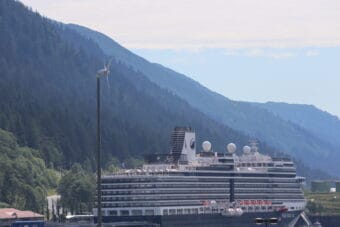
This wind turbine on Gastineau Channel generates just under 10% of the electricity needed to run Juneau’s Coast Guard station. (Photo by KTOO/Clarise Larson)

On a windy day in Juneau, you can see state flags fluttering along Egan Drive or a bald eagle coasting over Gastineau Channel. On the pier behind U.S. Coast Guard Station Juneau, you might catch the blur of a wind turbine’s blades. 

Do you have a Curious Juneau question? Submit it at the bottom of the page.

“It really spins in the wind and it makes a neat little whipping sound as it goes,” said energy educator Clay Good. He works for Renewable Energy Project Alaska. “So everybody notices it and wonders, ‘Hmm. Can we do more wind energy here?’”

For this Curious Juneau, a KTOO listener asked just that.

According to Lt. Kyle Hansen, the 60-foot miniature wind turbine at Coast Guard Station Juneau was installed back in 2010, following an executive order that called for more renewable energy at federal facilities. 

The turbine was also used as a teaching tool for high school students to learn about wind energy through a nationwide program called Wind for Schools. The same program brought a twin turbine to Sitka. 

Lt. Kyle Hansen stands in front Coast Guard Station Juneau with the wind turbine in the background in June 2024. (Photo by Anna Canny)

The educational component is defunct now, but the turbine on Juneau’s waterfront is still producing electricity — about 1,500 kilowatt hours per month. 

“Which turns into about 7% of Station Juneau’s needs,” Hansen said. 

A turbine this size could also easily power the average U.S. household, which needs about 900 kilowatt hours of electricity per month. And Hansen said it’s saved the Coast Guard some money, too. 

“It’s produced about $25,000 worth of electricity for the station,” he said. 

This is just a mini-turbine. The ones you might see on a wind farm can usually power almost 1,000 homes, and the cost of wind-generated electricity is dropping

So why not build more wind turbines in Juneau?

It turns out, our rugged landscape is not quite right.

“Wind turbines are often seen in areas of more open space around them, where there’s a smooth laminar wind,” Good said. 

Laminar winds are streamlined and consistent — Juneau’s winds are anything but that. When a breeze hits steep mountains and drops into Gastineau Channel, it often becomes turbulent, irregular and chaotic. And like airplanes, wind turbines don’t like turbulence.

The Coast Guard installed a Skystream 3.7 wind turbine on Oct. 11, 2010. (U.S. Coast Guard photo by Petty Officer 3rd Class Walter Shinn)

In 2005, the Alaska Energy Authority did a study on wind resources for dozens of communities across the state. They rated the feasibility of wind power on a scale of one to seven. At sea level, Juneau scored one — a poor rating. 

On the mountaintops, it might be a different story. 

“That’s a lovely place to capture the wind,” Good said. “But it’s not a lovely place to build a turbine. It’s not a lovely place to maintain one.”

Wind on the ridges is great for wind power on average, but at the extremes — especially in the winter — it’s too strong for a turbine to withstand.  

So Juneau’s wind, though powerful, is not really the right kind of wind. Perhaps more importantly, wind power faces a big renewable power competitor here. 

The same mountains that create turbulent winds also create rushing creeks and streams, making for really reliable hydropower. Deep mountain basins can store that water throughout the rainy season, and it can be used to create energy later on, during drier times. Wind and solar power, on the other hand, require expensive batteries to store energy. 

“We just had that extraordinary good fortune of having these hydro resources,” Good said. “It’s hard to even think about anything else.”

When a community wants to generate large-scale renewable power, there’s often a high start-up cost to build the infrastructure. That’s especially true for hydropower projects. 

But Juneau got a head start with hydro. Back in the late 1890s, water was the easiest way to power a bustling mining industry. 

“It’s not like 125 years ago, a bunch of conservationists and greenies moved to Juneau and said, ‘We’re gonna have green power here,” Good said. “It was just the power that was available.”

The first hydro powerhouse at Gold Creek later evolved into Juneau’s sole utility, Alaska Electric Light and Power. Today, they provide Juneau with 100% renewable electricity for relatively cheap. But that doesn’t mean Juneau is a renewable utopia.

Hydroelectricity only covers about 20% of the total energy used by the city. A lot of transportation and home heating still relies on fossil fuel like heating oil, diesel and gasoline. 

So eventaully, Juneau might need more renewable power to keep cutting down greenhouse gas emissions.  But there’s a lot more hydropower potential to tap into.

“Southeast Alaska was made for hydro,” Good said. “I think rain was invented here.”


Curious Juneau

Are you curious about Juneau, its history, places and people? Or if you just like to ask questions, then ask away!

Renewable energy summer camp teaches Juneau’s next generation about generation

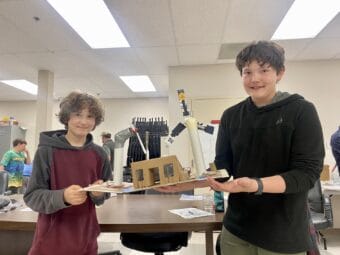
Akira Schaefer and his mom, Lyndsey Schaefer, show off his shoebox home with a working wind turbine and a lego “green roof.” (Photo by Anna Canny/KTOO)

In the Alaska Electric Light and Power office last Friday, a half dozen middle schoolers constructed a village of model homes. Felix Dean and his cousin Sterling Stark stood beside a small ranch-style house with cardboard walls and small plastic windows. 

“This house is supposed to be as energy efficient as possible,” Dean said. “It has two big windmills that can change to the direction of where the wind is coming from.” 

In this case, the wind came from a fan that turned the turbines’ cardboard blades. Inside the house, a little blue LED glowed.

“The lighting is controlled by the solar panels that we installed on the roof,” Dean said. 

The panels actually worked. Red and black cables carried real solar and wind power into the model. 

Dean and Stark spent the week building it while learning about renewable electricity during Discovery Southeast’s “Nature of Energy” summer camp. 

Sterling Stark (left) and Felix Dean (right) pose with the model home they built during Discovery Southeast’s “Nature of Energy” summer camp, in partnership with AEL&P and Renewable Energy Alaska Project (Photo by Anna Canny/KTOO)

The week-long camp was modeled after a similar camp that happened in Sitka last summer, led by Renewable Energy Alaska Project’s Energy Educator Clay Good. This year, Good brought it to Juneau. 

The camp featured classroom lessons on wind and solar power and field trips to hydropower sites like Salmon Creek Dam. Campers also took a tour of diesel generators with AEL&P’s staff, to see how electricity can be generated with fossil fuel. 
“So the students have seen the full range,” Good said. “Part of it got the kids outside in nature, and part of it was inside learning how we use energy in our society.”

To combat human-caused climate change, experts say technologies that burn fossil fuels — like internal combustion engines and gas-boilers — need to be replaced with things like electric vehicles and heat pumps, a transition that’s known as electrification.

“We’re obviously using more electricity these days as we use less fossil fuels,” Good said. “So where are we going to get our new electricity when we need more? And so having the next generation think about the new generation was sort of the idea.” 

Campers also learned about ways to conserve electricity with things like energy efficient appliances or rooftop gardens – known as green roofs — which can reduce flood risk, clean up air pollution and insulate buildings to reduce energy demand for heating and cooling.

Twelve-year-old Akira Schaefer’s shoebox home featured a Lego green roof with colorful plastic fruits and flowers. His mother, Lyndsey Schaefer, said the camp was perfect for her son. 

“Because he’s very interested in architecture and tiny homes and nature,” she said. “He got to learn about using what we have here — with the abundance of rain and sun and Taku winds — to power our homes. That’s the future — sustainability.” 

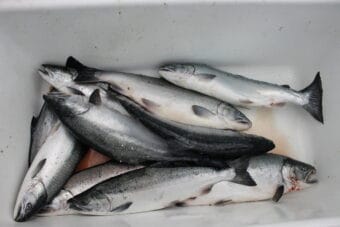
Much of Juneau’s king salmon fishery will close this summer, because of a 2020 landslide

Salmon fills a tote in Juneau in August 2022. (Clarise Larson/for the Juneau Empire)

Sport fishermen in Juneau may be disappointed come Monday, because king salmon will largely be off limits this summer. The Alaska Department of Fish and Game has announced an emergency closure for most near-shore fishing areas around Juneau.

The boundaries of the hatchery king salmon closure near Juneau. (Alaska Department of Fish and Game, Division of Sport Fish)

Douglas Island Pink and Chum, or DIPAC’s executive director Katie Harms said hatchery returns are expected to be quite low this year. That’s because most of the chinook that were supposed to come back were killed when a landslide severed the hatchery’s supply of freshwater from Salmon Creek during an atmospheric river in December 2020 that caused flooding and mudslides across the city.

“We had to prematurely release all those chinook salmon that were in raceways at the time,” Harms said. “They entered saltwater before they were biologically able to process saltwater and likely, mostly died.”

Most of the hatchery salmon come back when they are about five years old, so Harms said this summer’s low run was expected.

The closure includes Auke Bay, Fritz Cove, Gastineau Channel and areas around the Macaulay Salmon Hatchery. Starting Monday at midnight, any king salmon caught in those areas must be released immediately. That policy will extend through the end of August.

Closing the sport fishery will allow more mature chinook to gather in Fish Creek Pond, which is one of the local hatchery release sites. The pond will be missing most of those five-year-olds, but there should be some 6-year-olds returning.

“And what we plan to do this year, is use seine nets to seine up the pond in mid to late July, when the vast majority of the fish have made it back. And they should just be milling in that pond waiting to be ready to spawn,” Harms said. “And we bring them back to the hatchery. We’ve done this in the past, in other years, so we know it can be successful if there’s enough fish there.”

Most of Juneau’s summer king salmon come from hatcheries, while most of the wild kings make their way through the area to up to the Taku River, earlier in the spring.

DIPAC aims to use fish from the pond to replenish the hatchery’s broodstock, which will help them to sustain summer king production in the future.

“I’m not sure we’ll get our full broodstock even with this closure in effect, but it’ll put us a lot closer to our goal,” Harms said. “Which would in turn make better fishing opportunity for those that want to fish in five years time.”

Climate change is muddying the future of trail maintenance in Southeast Alaska

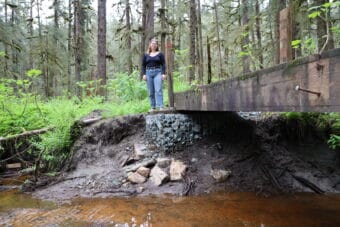
Meghan Tabacek, the executive director of Trail Mix Inc., stands over a “gabion basket” that was installed to prevent erosion under a bridge on Juneau’s Black Bear Trail. (Photo by Anna Canny/KTOO)

Meghan Tabacek stepped off the narrow path of the Black Bear Trail in Juneau and pointed to a U-shaped bend in Montana Creek where loose dirt and tree roots jut out over the water.

“If this all were to erode out and cut under the bank, then our whole trail could collapse,” she said. “At first glance, this looks pretty subtle and pretty far away from the trail. But give it like, three or four big storm cycles, and that could really get eaten away.”

Tabacek is the executive director of Trail Mix, Inc., a local non-profit that spends each summer clearing brush, downed trees and — occasionally — landslide debris, on trails managed by the City and Borough of Juneau, the state and the Forest Service.

But mostly, her crews work to strengthen trails against the rain that pummels Southeast Alaska. 

“We’re used to mud,” Tabacek said. “Mud is our bread and butter.” 

What they’re not used to is the intensity of the mud, the erosion and the wash-outs that are wreaking havoc on trails as human-caused climate change makes rainstorms more extreme. Typically, Tabacek says, trails have a lifespan of 10 to 20 years before they need major maintenance. But that’s changing now. 
“The time from when we build a trail or do a refurbishment of a trail to the time it needs touch-ups and fixings is shortening,” Tabacek said. “We’re having to do a lot of maintenance that isn’t technically planned.”

Erosion is eating away at the bank of lower Montana Creek, which borders the Black Bear Trail. Rapid stream erosion is one of the most common threats to Juneau’s trails. (Photo by Anna Canny/KTOO)

Warmer air holds more moisture. So as greenhouse gas pollution drives up global temperatures, rainy Southeast Alaska is becoming even rainier. According to Juneau’s Climate Change report, Juneau’s average annual precipitation has increased 20 inches in the last century. And a lot of that rain is coming down in atmospheric rivers — periods of heavy, prolonged rainfall that are often accompanied by high winds. 

An atmospheric river in December 2020 brought record-breaking rain that caused flooding and mudslides across Juneau. It also washed out local trails like the Blackerby Ridge Trail, which took weeks to clear and repair. 

Then another storm in 2021 blew down enormous trees that made some trails impassable, like the Herbert Glacier Trail. Tabacek recalls chainsawing and hauling out hundreds of downed trees. 

“Those trees would have dropped at some point anyway. But when we have these big storms and big wind events, then they’ll drop at once,” Tabacek said. “So we’ve been seeing some of these things that we have to react to more frequently.”

Tools used for trail maintenance and restoration. (Photo by Anna Canny/KTOO)

Storms may become more frequent over time, but Southeast Alaska’s trail system has always taken a beating. James King, who was the executive director when Trail Mix got started back in the 90s, says he remembers cleaning up frequent landslides on the city-owned Perseverance Trail. 

That trail was closed just this spring because of landslides.

Like a lot of trails in Alaska, Perseverance was created from an old mining road. Those routes were built to get to resources as fast as possible — not for longevity or climate resilience. 

“They go up narrow canyons. They’re going along creeks,” said King, referring to routes which make trails vulnerable to threats like landslides and erosion. “Some of these trails just aren’t in the right spot.”

Now King is the director of Recreations, Lands and Minerals for the Tongass and Chucagh National Forests. In the Tongass, the Forest Service manages nearly 1,000 miles of trails for nearly 3 million annual visitors.

Even without climate change, upkeep on some of these trails has been disrupted as federal funding fluctuated over the years. But right now the agency is relatively flush. And as they work on a new iteration of the Tongass forest plan, climate change and tourism are some of the most pressing priorities. 

Trail Mix crew remember Jessie Harlan prepares the bank for a new bridge abutment, which will support a crossing that collapses because of erosion. (Photo by Anna Canny/KTOO)

“So rerouting, rethinking how we get people through these places and how we build infrastructure that’s more resilient, that reduces that long term maintenance? That’s a big goal of ours,” King said. 

Building trails with climate resilience in mind might mean putting in larger bridges that can handle larger floods. It might also mean laying down gravel paths to weigh down the soil and stop water from pooling or rerouting trails so they’re less vulnerable to erosion.

Those improvements tend to make trails more accessible for hikers of all abilities too. 

Just down the Black Bear Trail, crews are building up a new fortified abutment for a lopsided wooden bridge. The bridge itself is in good condition, but it falls short of one bank and slumps into the mud. Erosion caused it to collapse. 

One of the bridges on Black Bear Trail falls short of the stream bank. Tabacek said damage like this drives up the cost of trail maintenance. (Photo by Anna Canny/KTOO)

“You see trail damage like this, and it’s just like a line of dollar signs floating down the water,” Tabacek said. 

On a sunny spring day, the creek below the bridge is running low and the forest undergrowth is full of fresh fans of Skunk Cabbage and Fiddlehead Ferns. 

“We get a couple weeks of rain and then it gets sunny for two days and everything goes ‘poof,’ she said.

Chemists, curators and Chilkat weavers present findings on historic dye techniques

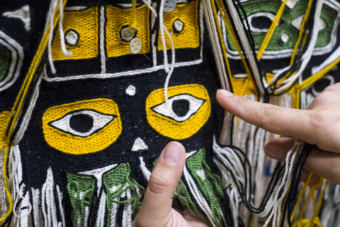
A detail of Lily Hope’s first full size Chilkat Robe. (Photo by Annie Bartholomew/KTOO)

The Chilkat robes in the Alaska State Museum collections feature formline faces woven with yarn. The historic ceremonial garments combines once-vibrant yellows that have softened with age with warm black-browns and striking blues and greens.

Museum conservator Ellen Carrlee and her collaborators wanted to figure out where those classic pigments came from. The color curiosity evolved into Chilkat Dye Working Group, a collaboration between staff from museums in Washington, Oregon and Juneau, chemists from Portland State University and Alaska Native weavers from across the region that set out to study historic and modern dye techniques. Carrlee presented their research results during 2024’s Celebration. 

With only three colors to identify, how hard could it be?

“Much harder than we anticipated,” Carrlee said. 

They spent five years and $1 million in funding from the Andrew W. Mellon Foundation to examine samples from historic Chilkat robes and concoct new dye formulas from scratch.

Dye-making experiments over the years have revealed an abundance of yellow.

“You might think that if you took say, like a Lupin, or an iris, and you’re like ‘Wow, I’m gonna get a purple dye. And you grind up, you put in a dye bath, you get yellow,'” Carrlee said. “Even out of weeds, out of plants are all over the place, getting yellow dyes is pretty easy.”

That’s because dye-making is not about the color of your material. It’s about the chemicals inside it. And a chemical compound called a flavonoid, present in many plants, makes yellow pigment. 

The blonde inner bark of the Western hemlock is packed with a chemical called tannins, which produces a deep, reddish brown dye when applied to yarn. Dip that dyed yarn in a solution of copper or iron and it transforms into a rich black. 

Chemists were able to find these chemicals on even the oldest Chilkat robes in the collection of the Alaska State Museum and the Sheldon Jackson Museum, which means a lot of the yarn was colored with natural dyes.

The chemical analysis on the historic robes also matched up with oral histories passed down from generations of Chilkat weavers. Traces of wolf moss were found in the yellow dye. The bright green lichen, which does not grow in the Tongass, was traded from drier regions, and it’s still used as a natural dye today. It’s well-liked because it is easy to dry and store and it acts as a natural pesticide. On robes dating back to the late 19th and early 20th century, moths that ate away at some sections of the robe tended to leave wolf-moss dyed portions in tact. 

Lily Hope dyes with Deb O’Gara (left) and Kay Field Parker (right) during a collaboration at the Alaska State Museum. (Photo courtesy of the Alaska State Museum)

Though plenty of natural dye is present in the historic weavings, most of the blue dye was synthetic. Modern weavers can extract shades of blue and green pigment from processing copper. 

“But the yarns that were visually minty green on our historic samples did not have copper in them, even though visually the color looks the same,” Carrlee said. “So it’s still a mystery.”

Blue has always been considered one of the hardest dye colors to make, but today’s weavers are exploring the possibility of making blue from chocolate lilies or a local mushroom called the bleeding tooth fungus, even as the formal dye research is wrapping up. 

Renowned Juneau weaver Lily Hope says this kind of experimentation, which blends science and art, has been one of the most inspiring things to come out of the research collaboration.

“Just because the results have been released into the world doesn’t mean the research ends,” Hope said. There’s always more to discover, and more to collaborate on. And, yeah, I hope it inspires more opportunities for collaborations like this.”

The blues were not the only synthetic dyes in the historic weavings. Many garments wove natural-dyed yarns and synthetic-dyed yarns together. Chemical analysis reveals that synthetic blues were sometimes overdyed with natural yellows to create unique blue-greens. And black borders were often woven with natural dyes, while the intricate formline centers were created with synthetic dyes.

The invention of many synthetic dyes in the late 1800s and early 1900s, when many of the museum’s weavings were created. 

“So this means that synthetic dyes were incorporated into Chilkat weaving all along, at least for the weavings in the Alaska State Museum and the Sheldon Jackson Museum,” Carrlee said. 

Today, store-bought materials and synthetic dyes are readily available. But Hope says making and using natural dye is a part of the artistry that goes into weaving. 

“I always ask my students, what is the story that you are telling with your art? What is the story of the work when it’s done, where you can say I gathered these handfuls of mountain goat, or I traded for this yellow cedar bark,” Hope said.  “When we use the historic materials and the historic ethnographic dyes, what is the story we’re telling with a piece of work made that way?”

The more weavers know about dye techniques past and present, the more stories they can tell. 

Site notifications
Update notification options
Subscribe to notifications