Claire Stremple

"I support KTOO reporters and guide coverage that informs our community and reflects its diverse perspectives."

When she's not editing stories or coaching reporters, you can find Claire outside with her dog Maya.
High hopes in Hoonah for safe, lucrative return of cruise ships as COVID-19 spikes elsewhere

The waterfront at Icy Strait Point. The Serenade of the Seas is the first large cruise ship to sail Alaska since 2019. Icy Strait Point in Hoonah is its second stop. (Claire Stremple/KTOO)

The first large cruise ship in nearly two years arrived in Alaska at the end of July. It marks the return of the region’s biggest source of tourism, once a multimillion-dollar industry that fueled tens of thousands of local jobs.

In the remote village of Hoonah, tourism at the Native corporation-owned Icy Strait Point destination fuels the economy. The community is vaccinated, masked, and ready to make up for a lost season — even as case counts rise dramatically statewide.

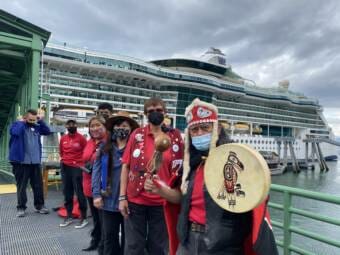
At 5:00, the sun is still high in the sky when the Serenade of the Seas sails into port at Icy Strait Point in Hoonah. Local dancers and singers wait at the top of the dock as a shore crew scurries to secure the thousand-foot vessel.

It’s a late start to the season, but one that marks an end to nearly two years of industry standstill for the state — a hiatus that cost an estimated $3 billion and more than 40,000 jobs in Alaska alone. Those losses are concentrated in Southeast Alaska, where cruising is about the easiest way to get large numbers of tourists to destinations off the road system.

Dancers, drummers, and singers prepare to welcome the Serenade of the Seas to Hoonah. It’s the first cruise ship in nearly two years. July 22, 2021. (Claire Stremple/KTOO)

George Dalton Jr. is one of the dancers. He wears his regalia, a white fur headpiece that shifts as the wind picks up and a felt cape lined with buttons and a moon beaded on his back.

“I’m telling you my heart is pounding right now, with watching this ship tie up,” he said.

Last year was supposed to be the biggest cruise season yet.

“I was really missing it big time,” Dalton said.

When the cruise season was canceled in 2020, he had to put plans to buy a new engine for his boat on hold. He’s one of about 100 employees hired back this season, only about a third of the full workforce.

This ship is carrying well under half of its usual passengers — fewer than 1,000 people — but that’s enough to nearly double the population of Hoonah for the hours it’s in port.

Drums pick up as passengers disgorge from the ship onto the dock. Some walk up the boardwalks towards food and souvenirs, others line up for sightseeing tours.

“It’s been just like a regular cruise other than you just have to wear a mask,” said Karen MacMillan from Clinton, Mississippi. She says there are perks to cruising in a pandemic; there are no lines for activities on the boat. Crew members outnumber the passengers.

She has been to Alaska before, but her grandkids — among the tiny minority of unvaccinated passengers on the ship — are seeing it for the first time.

Karen MacMillan (top, center) with her grandchildren and their other grandparents at the Icy Strait Point dock. July 22, 2021. (Claire Stremple/KTOO)

Her granddaughter Harper is almost 9 years old. She wears pink sparkles above her eyes and wears a green and white polka dot mask. It’s required indoors and out.

She deemed Alaska “awesome.” And the mask?

“It feels good when you’re standing outside, but when you’re standing inside you just want to take it off,” she said.

The kids won’t be able to go into the town of Hoonah, since only vaccinated people are allowed, but they do get to go on a whale watching tour.

Health precautions on the boat are dialed in tight. Anyone over 12 years old must be vaccinated. Icy Strait Point requires masks indoors regardless of vaccination status. And in Hoonah, a remote, largely Tlingit community of around 800 people, there are rules too. Unvaccinated visitors must quarantine or produce negative test results. That’s because there’s a local health clinic there, but no hospital. There have been only about 30 cases of COVID-19 since the beginning of the pandemic between Hoonah and its neighboring village of Angoon.

It’s a good track record, and officials hope to keep it that way, even as Alaska is among the states with the fastest rising case counts.

“Still happy to see ‘em, I just keep my distance from the ones that ain’t wearing the mask. Six feet away,” said Myrtle Brogdon Sharclane, as she walked against the tourist traffic towards the vessel with her brother.

They had to show their vaccination cards to come out to the docks from town. She’s from Hoonah, but visiting from Seattle. She scans the tourists walking up the dock.

“They just came from Sitka. There’s a hundred people there that have the COVID. I just heard on the news this morning. I don’t care if they don’t wear it, but we’ve got to protect ourselves,” she said.

Sharclane is a shareholder in the Native corporation that owns Icy Strait Point, so her pocketbook was hit when the cruise season was canceled last year.

She says she’s excited to see cruises back and she’s worried about COVID-19. Her mask is loose at one corner and her brother offers her a fresh one.

“I think personally that they moved too fast. And it’s all striking us hard again,” she said.

It’s taken a lot of effort to get to this moment. Congress passed a special waiver to allow cruise ships to bypass Canada’s closed port this summer. The cruise industry had to implement protocols and open up bookings in record time.

“It’s never easy, but it’s an honor to be the first ship and we’re happy to be the first ship,” said Mark Tamis, a senior vice president with Royal Caribbean.

His mask covers a smile as he surveys tourists shopping and eating crab legs in the sun.

The Centers for Disease Control and Prevention put the Serenade of the Seas on a yellow alert the morning the cruise arrived. Tamis says that alert is part of the new normal. It’s raised when a passenger exhibits any symptoms at all until a negative Covid test comes through. He says there are no COVID cases on the ship. The alert went down to green the next morning.

“We’re in great shape. It’s just part of the normal protocols that the CDC has when they’re just, you know, overall regulating and making sure that we come back in a very safe, a very moderated way,” he said.

Icy Strait Point was once a cannery and maintains its historical feel for tourists.  (Claire Stremple/KTOO)

Hoonah looks like what the brochures promise. Thick spruce trees cascade down the mountainside to blue water, where salmon jump. Bright pink fireweed blooms on the beach and the first thimbleberries are ripening on the sunny side of the boardwalks.

Even locals stop and turn when the sun catches on the slick black fin of an orca that pops up twice before it’s gone.

It happened: Someone on a large cruise ship in Juneau has tested positive for COVID-19

The Celebrity Millennium anchored near downtown Juneau on Monday, July 26, 2021. City officials confirmed that a passenger on board was infected with COVID-19 — the first case in Alaska on a large cruise ship since cruising resumed in 2021. (Photo by Rashah McChesney/KTOO)

A City and Borough of Juneau official confirmed on Monday that one vaccinated person from the cruise ship Celebrity Millennium was found to be infected with COVID-19 over the weekend. The ship is in port in Juneau and is scheduled to be in Skagway Tuesday morning.

Deputy city manager Robert Barr says the individual did not circulate in Juneau as a tourist, but will leave the capital city by air ambulance. The city is working with the cruise lines and the state’s health department to respond.
“I think that we were never expecting the cruise season to be entirely COVID free,” Barr said. “Because even though the cruise ships are highly vaccinated, we again know that vaccines are not perfect, and that they will rely on herd immunity.”

Barr says vaccines are nonetheless the most effective way to combat the spread of the virus. He said he’s heartened that nearly 80% of Juneau’s eligible population has now had a first shot.

There will be no immediate changes to the city’s health guidelines. Barr says there is no hard and fast threshold where Juneau would restrict ships into port, but does plan to examine that question on a case-by-case basis.

Barr says he is confident in the city’s partnership with the cruise industry and state health department to ensure a safe season despite occasional cases.

New maps show roughly half of downtown Juneau in hazard zone for moderate to severe landslides and avalanches

A view of Mt. Juneau from across the channel shows the Behrends avalanche path as a treeless swath on the side of the mountain. (Photo by David Purdy / KTOO)

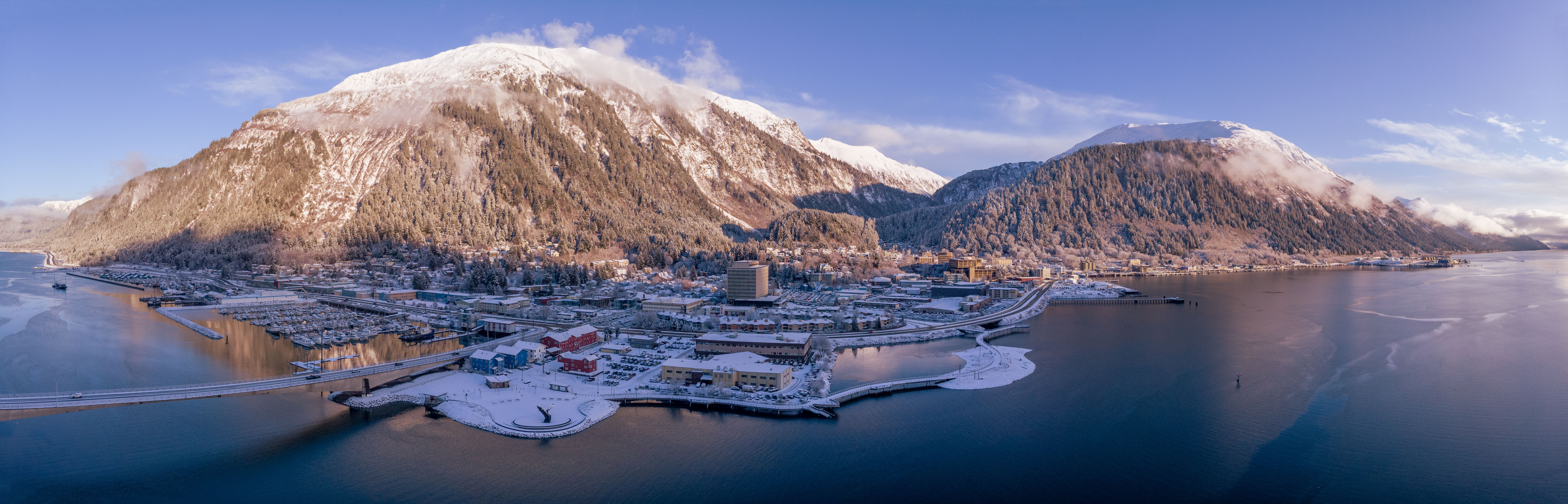
New maps put 200 more structures in Juneau’s hazard zones for landslides and avalanches.
They’re among the now roughly 550 structures in the capital city at moderate to severe risk of damage or destruction in a disaster — about half of the buildings and homes in the downtown area.

Juneau’s current hazard maps were made in the 1970s. Its new maps were finished this year, using advanced technology that paints the most accurate picture of risk in the city’s mountainous terrain.

“It’s a big change,” said Alexandra Pierce, Juneau’s planning manager. “The new maps are much, much easier for us to use and also much, much more accurate. It does mean some changes for people in the community and their properties.”

Juneau’s planning department has tried to upgrade its outdated maps before, back in the 1990s, but the assembly didn’t accept them. That’s because while the science is rock solid, the politics are where the maps start to crumble.

Insurance costs and resale value may change for homes in known hazard areas. Juneau’s code restricts construction and subdivision in those places too. That can generate push-back from the public.

Pierce says the city doesn’t have information on how insurance rates and values may change. All it’s doing is moving to adopt the maps.

The conversation about regulations and what’s allowed and what’s off limits in hazard areas will happen next year.

“We all recognize that people’s home is the biggest investment that most of us make in a lifetime. And that dealing with issues outside of your control that affects your property can be scary and can be difficult to digest. And our goal in this project was to give the public the most accurate and up-to-date information on the landslide and avalanche hazard areas in downtown Juneau,” said Pierce.

What the public wants to do with that information is up to the public and its elected officials.

The maps go to Juneau’s Planning Commission in mid-August and should be before the assembly by September.

The city’s planning department and the contractors who created the new maps will be available at a virtual neighborhood meeting on Wednesday evening. They’ll be taking questions and comments from the public.

Juneau requires masks in city facilities amid increase in COVID-19 cases

IGA Mask sign customer 2020 07 17
A customer wearing a mask heads into the Foodland IGA in Juneau on Friday, July 17, 2020. In July 2021, the City and Borough of Juneau started asking residents to mask up indoors again after relaxing requirements for several months. On July 20, the city required masks at city facilities. (Photo by Jeremy Hsieh/KTOO)

Update Tuesday, July 20, 12:11 p.m.

Masks are required in City and Borough of Juneau facilities effective immediately due to recent increases in COVID-19 cases.

Those facilities include City Hall, Augustus Brown Pool, Dimond Park Aquatic Center, Downtown Public Library, Mendenhall Valley Public Library, Douglas Public Library, Juneau-Douglas City Museum, and Zach Gordon Youth Center.
Masks continue to be required on Capital Transit/CAPITAK AKcess, in the Juneau International Airport, Juneau School District facilities, and Bartlett Regional Hospital.

Original story:

The City and Borough of Juneau is asking its residents to mask up indoors again — whether or not they’re vaccinated.

It’s not a mandate, but a request as local case counts rise.

Robert Barr from Juneau’s Emergency Operations Center says the borough wants to avoid a surge of cases like in Sitka, where the case count climbed over 150 this weekend.

“None of us want to see case activity grow. And none of us want to see requirements in place,” he said. “We really do need people to help out and help us get our current situation under control so that we don’t get there. I’m concerned that we might.”

The city cites increased travel and the advance of the easily-transmissible Delta variant as reasons for taking extra precautions. Barr says the goal is to keep businesses open and the school on track to resume in-person learning this fall.

He says the Juneau community has done well in keeping the virus under control so far, and he knows it’s especially tough to return to masks now.

“It’s just natural to want to sort of ease up and kind of get back to normal. And we actually enjoyed, I think, a month or so — I wish there was more than that — of being able to do so. But unfortunately, we are seeing that spread again,” said Barr.

The city recommends masks in any indoor spaces like grocery stores, libraries, restaurants and other places where people gather.

The borough continues to recommend that anyone with symptoms get tested. It also urges unvaccinated folks who have traveled —especially to Sitka, Anchorage or the Kenai Peninsula — to be tested as well.

City officials will provide detailed information and guidance during a COVID-19 community update on Tuesday, July 20, at 4 p.m. Participate online, call 1-253-215-8782 with webinar ID 985 6308 5159, or watch on Facebook Live.

Alaska’s getting millions this year to study landslides, but not for places recently impacted by deadly slides

A view of the landslide at Beach Road in Haines. June 14, 2021. (Photo by Claire Stremple/KTOO)

Congress recently passed legislation that will bring in millions of dollars for landslide research and mapping.  State scientists are excited about the new program’s potential for Alaska, which needs more hazard maps. But that money isn’t headed toward communities that have had deadly landslides recently.

In the small town of Haines, it’s been eight months since landslides killed two people, destroyed nine homes, pulverized roads, and cut the town off from its fuel and supply docks. The community is still rebuilding after its losses.

“I feel honestly frozen. It’s like a frozen in time feeling,” said Vanessa Wishstar.

Wishtar and her family lived in a home next to the major slide that ran through Beach Road. Their home is intact, but it isn’t safe.

“The problem for us it wasn’t just like, okay, we’re now past the slide … There’s a giant crack still hanging looming above our house,” she said.

Geophysicists spotted a fissure in the mountainside above their home. They say the rock could give way and trigger another slide. But they won’t know the full extent of the risk for another year. The family of four has been in a small apartment since the disaster and is seeking a permanent solution.

“There’s literally no difference from when it happened to now. For us, you know, our life situation. I mean, if you look at it … nothing has really changed.”

The small town’s administration has been overwhelmed with work related to the disaster. Haines Mayor Douglas Olerud has been wading through paperwork to get what’s essentially buyout money for families that can’t return to homes in the danger zone.

“The borough’s on the hook for one to one and a half million dollars,” Olerud said. “Where do we come up with those funds?”

He estimates that’s the match to unlock millions in relief money to re-house displaced residents. But sourcing an extra million bucks is a big ask in a town that brings in about $5 million in taxes in a good year.

And Olerud says the relief money won’t come overnight — the victims’ rental assistance will dry up long before they know whether they qualify for the buyout money at all.

“They won’t know on a lot of this for three years if we’re going to be able to do mitigation program on it. And that’s the really hard part. How do you have somebody in limbo for that long?” he said.

There is landslide money on the way for Alaska, but it isn’t for Vanessa Wishstar or for Haines. This year, there’s $4 million in additional federal funds for national landslide research nationwide. But all of it is headed to Prince William Sound, where a potential landslide threatens to unleash a tsunami that could devastate Whittier.

Congress passed the Landslide Protection Act just a month after the slides. Alaska Sen. Lisa Murkowski co-sponsored the bill. It’s aimed at better understanding landslide risks and protecting communities like Haines.

De Anne Stevens heads the engineering section of the state’s Division of Geological and Geophysical Surveys.

“Everything is just, you know, screeching out of the starting zone with our race cars to try and get things taken care of and get to work on this. So it’s really exciting times,” Stevens said.

Her department is partnering with the U.S. Geological Survey for a three-year project that aims to create a statewide database for landslide information. Stevens says it’s work her department has long sought to tackle.

“Alaska is huge. We have so much that really has not been looked at, you know. We kind of have a little, tiny snapshot of what we think is going on out there. But I think it’s going to be really eye-opening when we actually get out there and start really systematically eyeballing the landscape,” she said.

But that database isn’t covering a lot of ground this year. And the new federal investment isn’t currently enough to map every possible landslide in Alaska. It’s not even close.

“Just so we’re clear, the landslide hazards department in the USGS is tiny,” said Jonathan Godt, the department’s coordinator. “You’re talking about, oh, two dozen scientists and technicians that are in many ways the federal capability in landslide hazard. And there are other agencies that add people and expertise, of course, but the only program with a focus on landslide hazards is in the USGS and it’s that size. And we got a doubling in resources from $4 million to $8 [million]. And that work was directed towards Alaska.”

Even though this year it’s all directed at Prince William Sound, Godt and state geologists both envision a sustained effort to address needs in other parts of the state.

State program officials say it will take a lot of money and many more years to do the kind of landslide assessment work the state needs.
State to measure extent of toxic chemical spread in Gustavus

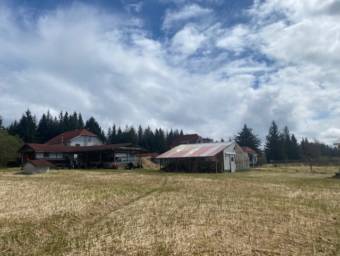
A property where PFAS have contaminated the well water in Gustavus. (Claire Stremple/ KTOO)

The state announced its latest plans to gauge the extent of contamination at and around the Gustavus Airport this week. It’s the transportation hub for the small Southeast community and an active contamination site due to the presence of PFAS — toxic “forever chemicals” that are used in firefighting foams and can linger in the ecosystem indefinitely.

Local advocates say the state should have started this work a year ago, before breaking ground on a $20 million runway upgrade project this April. They say construction risks spreading the chemicals even more. So far, the PFAS have contaminated more than a dozen wells in the town, which does not have a city water source. The state’s Department of Transportation has provided water to those homes since 2018.

Sammy Cummings manages PFAS for the agency. She says they’ve studied the extent of the PFAS in Gustavus before, in 2019. And this second round will be good for monitoring if the PFAS have spread.

“It’s really important for people to understand we are out there, we are sampling. We are following the data,” she said. “And we’re working with our technical experts … and taking their recommendations into consideration and moving forward and doing the best that we can with the little information that we have about PFAS.”

This project’s goal is to monitor what’s called a “plume” — the area where the chemicals have moved over time through soil and groundwater. The state plans to install 23 permanent monitoring wells. More than a dozen temporary wells will test for PFAS that may have spread due to flooding in the last year.

Because previous testing shows that the chemicals have moved beyond the airport, the contractor will take surface water, sediment and soil samples from drainage ditches on and near the airport as well as underground samples to see how deep the contamination goes.

The state will accept public comment on its plan through July 21st. Work is scheduled to begin in August and last 2-3 weeks.

Site notifications
Update notification options
Subscribe to notifications