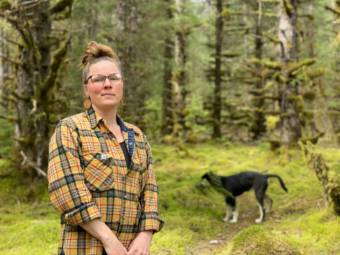
Claire Stremple

"I support KTOO reporters and guide coverage that informs our community and reflects its diverse perspectives."

When she's not editing stories or coaching reporters, you can find Claire outside with her dog Maya.

‘We’re gonna squeeze by’: Glacier Bay National Park and Preserve uses savings to dodge layoffs in cruise ship drought

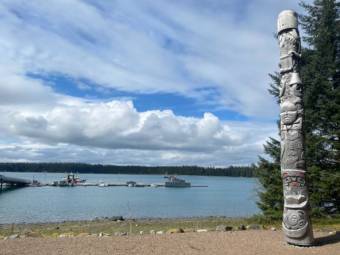
Glacier Bay National Park and Preserve (Claire Stremple/KTOO)

Usually, a couple of big cruise ships would be dwarfing charter boats in Bartlett Cove on a summer day. But not today.

Cruise ships aren’t scheduled to return until late July.

Most visitors to Glacier Bay National Park and Preserve in Gustavus visit by cruise ship. Last year, none of those tourists came. That erased more than half of the park’s operating budget since cruise visitors provide nearly 70% of the park’s revenue. After a year without them, Park Director Philip Hooge says there are moths flying out of his checkbook.

“We’re gonna squeeze by, you know, we’re gonna squish by without having anybody laid off or anything … so I can sleep at night,” Hooge said.

 As cruise ships announce significantly later start dates for the 2021 season, the park is poised for another lean year.

Luckily, Hooge was saving up money for some big projects and purchases. When the cruise ships stopped coming, he spent it all on employee salaries instead. Those savings will also offset this summer’s slim season.

“If we hadn’t had that reserve, you know, we would have, it would have been [a] financial disaster. If it were to continue for another year… God forbid, we would have to take dramatic and drastic steps here,” Hooge said.

Park director Philip Hooge (Claire Stremple/KTOO)

Spending the savings reserve means postponing two big expenditures: a series of projects to encourage long-stay tourism in Gustavus and a sea-going boat to patrol the park’s waters. Hooge says Glacier Bay is the only marine park of its kind that doesn’t have one.

He says it will take years to build back the park’s savings.

And while there were no layoffs due to COVID-19, there was a crucial group of park employees that didn’t get re-hired: seasonal rangers. They have a special job because cruise tourists don’t get off the boats when they sail into Glacier bay. The rangers get on instead.

“The Rangers come out in the morning, they get off onto the boat, they get on the intercom system and the casino closes down, the shops … and we talk about the national history for 12 hours as people are in here,” Hooge said.

It’s a job that requires special expertise, knowledge and storytelling skills. Some of those seasonal workers have been with the park for over 20 years. The job has a nearly 100% retention rate. Hooge says it will be really hard to replace some of the veteran rangers that have had to move on.

It’s hard to ever plan for something like what we seen here, which was 100% decline in the cruise industry. And then for it to go on to most of two years. And that has been a kind of a severe financial strain,” he said.

The shortfall is a reversal for the park, which usually has income that is recession-proof. That’s because Glacier Bay has a unique funding structure among national parks. Most parks’ revenue comes from congressional appropriations — federal money. Glacier Bay gets most of its money from cruise ship passenger fees.

In lean years, when Congress appropriates fewer dollars to national parks, the cruise industry buoys Glacier Bay’s earnings. 

When cruise ships arrive in June there will be rangers, but fewer of them. The park only anticipates being able to hire back a third of the seasonal workforce even though the end of the season is likely to be full.

“It’s going to be skeleton crews [and] at the same time it looks like it’s going to be a full house. So we’re kind of buckling our seatbelt. You know, it’s probably not going to be the level of service that we are wanting, but also I think the public is pent up demand and they’re going to be happy to just be outside, so I think it’ll all it will work out in a positive way,” Hooge said.

This season will be late and short, but Hooge says he’d be surprised if 2022 wasn’t robust. Even if it isn’t, he says  Glacier Bay National Park and Preserve only needs to make half of its usual income to make it.


CORRECTION: This story has been corrected to clarify language about Glacier Bay National Park and Preserve’s funding structure. Money that goes to the park comes from cruise ship passenger fees, not from the companies themselves.

Swollen creeks and soggy cookouts: Juneau sees double the usual May showers

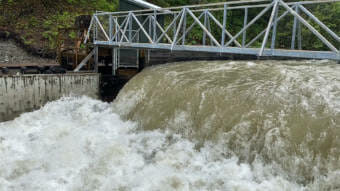
Water at Gold Creek near the Flume Trail in Juneau. (Claire Stremple/KTOO)

Local rivers ran high and rainfall drenched Memorial Day cookout plans in Juneau over the long weekend. Nearly 7 inches came down over the last month, making May 2021 the second wettest on record in the capital city.

“So, May is supposed to be one of our dry months,” said Greg Spann, a Juneau-based meteorologist for the National Weather Service. This May was actually twice as rainy as usual.

“You know, most Mays we see more sun, fewer clouds, where Juneau more closely resembles that postcard image that we love to show,” Spann said.

Meteorologists kept a close eye on local waterways over the weekend as lakes and creeks swelled with water. No major banks burst and the weather service did not issue flood warnings, but Montana Creek and Auke Lake reached high alert levels Monday night, before dropping again in the morning.
Spann says the storm system that’s been hammering the northern panhandle is moving south this week. And he says all this rain in May doesn’t necessarily mean we’re in for a soggy summer.

“We’re really hoping it’s not an omen for a rainy summer. It is still too soon to tell, though there aren’t any really good climate signals that would indicate whether or not we can say with confidence that it’s going to be more rainy or less rainy. I think I can say with confidence that we all do want some breaks in the clouds,” he said.

It’s likely to stay rainy for a few more days, but the Juneau weather office predicts sunny skies early next week.

‘This is already in my body’: Gustavus residents seek more protections as state construction continues at contaminated airport

Gustavus residents are asking the state to stop work on an upgrade to the city’s airport, where there are toxic chemicals. (Claire Stremple/KTOO)

Gustavus is getting a multi-million dollar airport upgrade, but city officials and some residents are calling on Alaska’s Department of Transportation to stop work on the project. That’s because toxic chemicals called PFAS are known to be present at the site.
So far, the state hasn’t stopped work, but it did hold a Zoom meeting last week to explain its plan to residents.

From her coffee shop and gallery on Gustavus’ main road, it’s just a short walk through the forest to owner Kelly McLaughlin’s place.

“So this is my house, my new muddy yard,” she said, stepping out of the trees.

McLaughlin grew up here. All her neighbors are relatives.

“This is sort of the back edge of the land that my grandparents bought when they moved here in the 60s.”

There’s a two-story house, a big chicken coop full of hens, a garden, and, now, an 8,000-gallon cistern that catches the rainwater her family drinks and bathes in.

They need the cistern because the state found toxic “forever chemicals” called PFAS in McLaughlin’s well. PFAS don’t break down in the environment and accumulate in the human body. They’ve been linked to serious health effects, like cancer and immune system problems.

The PFAS came from the state-run airport where contaminant-laden firefighting foams ran into the groundwater and spread. More than a dozen wells were affected, and the state has supplied bottled water to those households since 2018.

PFAS are in McLaughlin’s chickens, in her garden, and in her blood.

“I used to take the chicken eggs to the gallery and serve, you know, fresh local eggs. But I had to stop doing that because I didn’t want to, you know, poison people,” she said. “I didn’t eat anything from my property for a couple years. And then sort of started back just because I figured it’s, I’m, this is already in my body.”

Kelly McLaughlin organized the Gustavus PFAS Action Coalition advocating for people affected by the toxic chemicals from the state-run Gustavus airport. (Claire Stremple/KTOO)

McLaughlin says her blood has tested at 10,000 and 7,000 thousand parts per trillion — a number that makes PFAS experts squirm. She says her young son’s blood is double that. She hasn’t tested her daughter, who was an infant when the contaminants were found.

The experience pushed the cafe and gallery owner into another full-time job: advocacy. McLaughlin organized GPAC, Gustavus PFAS Action Coalition, to represent her family and neighbors affected by the chemicals.

“At least some of us have been through this now. So if the airport project does contaminate further, there’s recourse. There’s people to rely on, people to ask questions,” she said. “I had nobody.”

There was a close call this spring when the state began work on the airport. Its original plan was to move asphalt from the airport to a previously uncontaminated site near houses. Residents pushed to get the asphalt tested for PFAS, something the state isn’t required to do. The project managers listened. They tested the asphalt and they found contaminants. And they did change the plan.

But it didn’t feel exactly like a win for the community. It shook their trust in the state’s planning for the project.

And so GPAC asked the state to stop work at the site until the extent of PFAS contamination is fully understood. The city council, other concerned citizens, and EarthJustice joined them.

Kelly McLaughlin’s chicken coop. McLaughlin says she once gave other residents fresh eggs from her coup but stopped when she and her property had become affected by PFAS. (Claire Stremple/KTOO)

The Department of Transportation didn’t stop its work, but it did schedule a Zoom meeting.

Representatives from multiple state agencies and the Federal Aviation Authority joined the virtual meeting.

“I want you to know that Gustavus community members’ health and safety are of utmost importance to us while we deliver the needed airport improvement project,” said Christopher Goins, the construction engineer for DOT.

He pledged a full evaluation of PFAS contamination to the roughly 70 people who logged on, but was clear in his presentation that the scope of the project is to improve the runway, not to characterize or clean up contaminants.

Because the state doesn’t have a plan to clean up the chemicals at the airport yet. What it has is $20 million in federal funds to upgrade a runway that the community really needs.

“Due to FAA funding limitations, the airport reconstruction project cannot address ongoing PFAS site characterization, cleanup and replacement water efforts. Those efforts are covered in a separate project funded by state funds,” Goins said.

He also pledged to safely handle more than 7,000 cubic yards of PFAS contaminated materials. It will be stored in already contaminated areas or on thick plastic liners. And it plans to re-use some contaminated asphalt in the project. That didn’t sit well with residents on the call.

Kelly McLaughlin looks out toward her uncle’s property. PFAS came from the state-run airport where contaminated firefighting foams ran into the groundwater and spread, affecting McLaughlin’s well and dozens of other wells in the community. (Claire Stremple/KTOO)

In the end, the state gave a lot of information to residents during the meeting, but nothing in the state’s plan for the project changed.

John Buchheit is a city council member and a longtime resident of Gustavus. He’s at the airport the day after the Zoom call, under a dripping awning as a spring storm finishes up.

“We’re on the edge of a 3.3 million-acre world class wilderness park and there’s an expectation that this environment is fairly pristine,” he said, referring to Glacier Bay National Park and Preserve. Gustavus is basically the gateway to the park. 

“And then to discover that there is an industrial chemical that’s polluting the groundwater really shakes people’s faith and what they feel is special about this place.”

He said he’s grateful for the meeting and the agencies’ candor, but he’s disappointed that this conversation is happening now, at the 11th hour. He’s also concerned that the small town of Gustavus— a population of roughly 450 — has to be the watchdog for contaminated materials.

Buchheit says the city council’s role has been to support those residents and GPAC.

“It really took a handful of concerned citizens to pull the fire alarm and say, ‘hey, you’re gonna do what? And you’re starting it when? Hold on now,” he said.

He stands at the chain-link fence that separates the parking lot from the runways where more than a dozen yellow machines sit. On aerial view maps, this place is dotted with red, yellow and green markers that indicate levels of a contaminant whose full effects have yet to be seen.

Correction: An earlier version of this story said Christopher Goins was the project engineer for the Department of Transportation. Goins is the construction engineer. A photo caption has been corrected to state Kelly McLaughlin is looking out toward her uncle’s property.

‘This is creating havoc’: Juneau regional hospital’s mental health surge continues

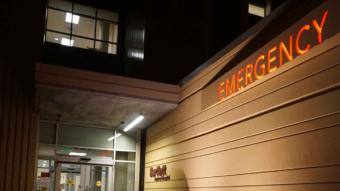
In 2020, Bartlett Regional Hospital braced for a surge of COVID-19 patients. It got a surge of mental health crises instead.

Bartlett behavioral health staff tie the surge in patients to spring break 2020. Students left the classroom for vacation and returned to a whole new reality. COVID-19 cases were increasing statewide and remote learning suddenly replaced their school day routines.

“We started to see kids and families and adults coming in struggling with the immediate changes that we as a community took on,” said Bradley Grigg, who leads the behavioral health arm of the regional hospital.

He says those social restrictions are causing spikes in anxiety, depression, substance use, and self-harm — for students, parents and just about everyone experiencing the disruption of the pandemic.
Bradley Grigg in his office on April 15, 2021. (Claire Stremple/KTOO)

Since last March, Grigg says patient visits have doubled to a thousand a month. And of those, he says more than 100 come to the emergency room. It works out to four people in crisis in Juneau per day.

“I hope that no one deals with what we’re seeing,” he said. “It’s a pandemic all within itself. And it’s creating more havoc — yes. COVID has created inconveniences for us. This is creating havoc.”

Juneau isn’t an outlier. Kristina Weltzin is a mental health clinician for the state’s health department.

“In all of our communities, the information that we’re getting is that absolutely, you know, behavioral health issues have increased dramatically,” Weltzin said.

In a state survey, most adults reported their mental health has worsened over the last year. More than half of parents reported that their child was more anxious or sad than usual.

Grigg says in the last year, he’s hired about 35 mental health staff to keep up with demand. He now manages a staff of 150. CARES money helps fund those new positions now, but Grigg says they will be permanent roles that reflect a new normal in Bartlett’s Behavioral Health program.

“When people are in crisis, whether it’s even if it’s just outpatient, we don’t want to waitlist them,” he said.

Even with increased staff, there’s still a waitlist for non-emergency patients.

The hospital started a Crisis Intervention Services team this spring. It provides follow-up support to patients after they are discharged from the emergency department. That team is available for in-home visits seven days a week and works with patients until they’re stable.

Grigg got emotional when he talked about how this affects kids. Prior to COVID-19, kids were only about a third of the patients in the behavioral health department. Now, children make up the majority of the hospital’s behavioral health patients and a quarter of the department’s emergency room traffic.

Hospital-recorded suicide attempts have quadrupled among teenagers. For children 13 and younger the hospital recorded one suicide attempt in 2019. In 2020, there were seven.

“The devastation that we’re seeing with kids, with families, when they can’t survive this because their anxiety or their depression or their substance use is so out of control … It’s an effect that, unless you’re seeing it every day, you don’t know how infiltrated it has been in our community,” Grigg said.

Restrictions have eased and more than 70% of Juneau’s eligible population has had its first dose of a COVID-19 vaccine. But Grigg said the patient load hasn’t decreased, it’s just leveled off. “It’s unrelenting,” he said. “It’s not stopping.”

If you or someone you know is struggling with thoughts of suicide or in need of care, help is available:

  • Alaska’s Careline: 1-877-266-4357 (HELP)
  • AK First Responders Relief Line: 844-985-8275 
  • JAMHI Health and Wellness: 907-463-3303
  • Bartlett Regional Hospital: 907-796-8900
  • 24/7 SEARHC Care Line: 1-877-294-0074


‘We want to get a handle on this’: Deadly fungus threatens Alaska amphibians

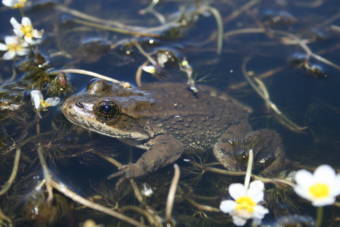
A spotted frog found in Alaska, British Columbia, Washington and portions of Wyoming, Nevada and Utah. (U.S. Fish and Wildlife Service)

An invasive fungus is threatening Alaska’s frogs, toads, newts and salamanders.
The fungus’ full Latin name — Batrachochytrium dendrobatidis — is such a mouthful that scientists refer to it as “Bd” or chytrid.

Reese Brand Phillips leads the threatened and endangered species program for the National Forest Service in Alaska. He says it’s a threat to all six of Alaska’s amphibian species. So he’s calling for a multi-agency working group to get ahead of the fungus before it’s too late.

“We know that it has had devastating impacts elsewhere. So we want to get a handle on this before we see impacts in Alaska,” Phillips said.

It’s not always lethal, but the fungus has decimated frog populations around the world and is thought to be responsible for up to 90 extinctions. Phillips says researchers aren’t sure how it got to Alaska, but it has been observed here since the year 2000.

Researchers have traced chytrid from the Kenai Peninsula to Prince of Wales Island. It’s not everywhere — there’s no evidence of the fungus on Douglas or Admiralty Islands near Juneau — but it’s turned up in Yakutat, Cordova, Haines and Skagway. And while scientists know the fungus is widespread, they don’t yet have a sense of its impact on frog populations in the state. Part of the reason for that is they don’t know how many amphibians there are.

“There’s some anecdotal evidence that frogs used to be more abundant than they are now, but we can’t definitively say that Bd did that. And so that’s one of the challenges that we have right now is trying to gather that baseline data to really try to ascertain where we’re at,” Phillips said.

Phillips says the fungus thrives in warm temperatures — about 60-70 degrees Fahrenheit. That means climate change could increase its prevalence in the state.

“If things warm in Alaska, like we anticipate, what that’s going to probably do is it’s going to expand the areas northward where Bd can survive. And so we can anticipate that we might have Bd in areas where we don’t have it now,” he said.

That could be hard on amphibians. Humans don’t get Bd, and predators don’t either. It only affects freshwater zones.

Phillips says fieldwork in Alaska this summer will give the agency a better sense of where the virus is, and point to how it might be contained.

Dozens of Alaska’s seismic stations are going offline, but earthquake monitoring is still on solid ground

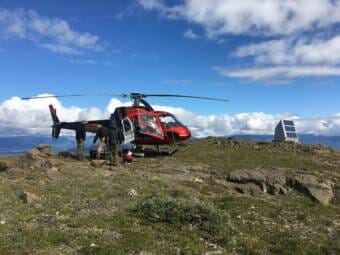
A seismometer station in 2018 (Photo by Kasey Aderhold/Incorporate Research Institutions for Seismology)

More than 80 seismic monitoring stations went dark in Alaska on Friday as a national project comes to an end. But the work leaves behind a more robust earthquake monitoring system than ever before.

If you ask Alaska Earthquake Center Director Michael West, he’ll tell you that what matters isn’t how many seismic stations the state is losing, but how many it gained.

“More than 100 of those are staying behind and they have already become part of our long-term earthquake and volcano and tsunami monitoring infrastructure,” he said.

The seismic stations are part of the U.S. Array, a multi-million dollar national research project. It spanned nearly two decades and the entire continent. The goal was to monitor seismic activity and better understand the ground under our feet. Transportable seismic stations started on the west coast and moved east, then doubled back to their last stop: Alaska.

“Think of it like a kids science fair project or something, you go out, you do an experiment, you collect some data, and then you pack up, go home and move on to something else,” West said.

“Somebody came along and did a really cool $50 million, you know, site short-term seismic experiment. But that plan always had in it, that at the end of the project, the lights would be turned off … and the project would be over.”

Except more than half of the equipment that should go home is staying in Alaska. That’s due to a big push from the scientific community and the state’s federal delegation. West says to think of it as the stations just getting thinned out a little bit.

He says the system brought earthquake monitoring and recording capabilities to huge swaths of the state where very little had existed before — filling in the details of what was once a sketchy understanding of certain regions.

“I can remember discussions a decade ago, where, you know, well-intentioned engineers thought, ‘oh, they’ll never be able to pull this off. This is too big and scale. This is too grandiose.'” West said.

But, they did. And now, it’s over.

Kasey Aderhold is a project associate for the Incorporated Research Institute for Seismology,  one of the national research groups responsible for the project. She says taking dozens of far-flung research stations in some of the most remote parts of the continent offline is actually pretty simple.

“It’s basically like calling up your cell phone provider and saying, I would like to cancel my line,” she said with a laugh.

They’ll just stop transmitting. Later this summer, scientists will visit the sites and pack up the equipment. That part is more complicated. Aderhold says because of the pandemic, they even got an extra year of data.

“It’s been an amazingly productive time, geophysically, in Alaska to have this network there. Alaska always has had a lot of earthquakes, a lot of volcanoes and other things, but the past years where this network has been in place have been extraordinarily busy,” she said.

The array captured data from Kaktovik earthquakes in 2018, a magnitude 6.4 rumbler on the North Slope, 2018’s Anchorage quake, and some magnitude 7 quakes in the Aleutians.

West says the end of the project is bittersweet for Alaska Earthquake Center.

“Kind of sad, it is. But there are just an unbelievable number of people who should be, you know, thanked and back slapped and all that stuff for their incredible vision and efforts to change — fundamentally and forever — change Alaska’s seismic monitoring environment,” he said.

The legacy of the U.S. Array in Alaska is a more robust earthquake monitoring system and years of data whose impacts have only begun to rumble through the scientific community.

Site notifications
Update notification options
Subscribe to notifications