Claire Stremple

"I support KTOO reporters and guide coverage that informs our community and reflects its diverse perspectives."

When she's not editing stories or coaching reporters, you can find Claire outside with her dog Maya.

Construction begins at Juneau’s Bartlett Hospital, $14 million behavioral health building to come by next winter


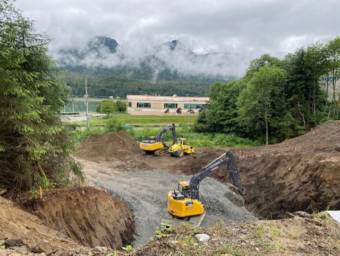
The remains of the Bartlett Outpatient Psychiatric Services building on July 8, in Juneau. (Claire Stremple/KTOO)

Contractors for Juneau’s Bartlett Regional Hospital broke ground on a multi-million dollar expansion project last month. The new building will hold the regional hub’s ballooning behavioral health program.

There’s a rubble strewn hole where Bartlett’s Outpatient Psychiatric Services used to be. Downhill, an excavator moves new rock into what will be the foundation for a $14 million dollar upgrade.

But when Bartlett’s Chief Behavioral Health Officer Bradley Grigg looks at the construction site, he sees a four story building that will house the hospital’s fastest growing department.

“So the patient rooms from crisis will be on the back of the facility facing the channel,” Grigg says, gesturing over Glacier Highway towards Gastineau Channel.

He’s not just excited about therapeutic views of Juneau’s waterfront. The behavioral health department has more than 10 times as many patients now as it did in September of 2019.

So, the building that will fill the space on the hillside below him will be nearly ten times the size of what was here before. It will house the 150-person behavioral health staff already working in the hospital and ideally have enough patient capacity to eliminate or reduce wait lists.

“This is really going to be a game changer in terms of access to treatment for people as they walk in. It’s on demand. It’s 24/7, it’s staffed 24/7. Psychiatry, therapist, behavioral health associates, nursing staff,” he said.

The hospital is taking on its biggest capital project in a decade because it doesn’t have enough room to house what Grigg calls an “unrelenting” influx of patients.

Right now, the behavioral health department has only one inpatient bed for youth—it has about 2 dozen for adults. The new facility will add 8 beds that can be used for adults or children. Currently, behavioral health patients who need to stay in a hospital must travel to Anchorage.
“We don’t want to be shipping them out north, doesn’t mean that it still won’t happen on occasion. But our ultimate goal is to serve any kid from Juneau and Southeast to come to our unit. In an effort to keep them as close to home community as possible. We know that if they’re closer, they’ll get better treatment,” said Grigg.

Even as hospital administration sat down with the final plans for the new building this year, they realized the hospital had already outgrown the unbuilt structure. They decided to add an entire floor. The cost of the additional floor was quickly accepted by the assembly and the hospital board. It will house 15 offices for therapists, nursing staff, and a case manager.

Jeanne Rynn is the city architect with the City and Borough of Juneau’s Engineering Department. Contractors broke ground on the project last month.

“The architectural team is working on the drawings right now to add the third floor. So you know, it’s very unusual to be designing the building while you’re building part of it, and they’re trying to stay ahead of the construction schedule,” she said.

Sky-high lumber prices precipitated another last minute change to the final plan. Architects finished designing the foundation footprint for what is now a steel structure in early July. Rynn says it’s been a little stressful, but the finished building will be worth the effort.

“I think the end result is going to serve the community well, so it’s a worthwhile cause for a good long term goal. And once the building is there, nobody’s going to care about what we went through to get it there. You know, that’s history. It takes on a life of its own at that point,” said Rynn.

The cost of the additional floor was quickly accepted by the assembly and the hospital board. It will house 15 offices for therapists, nursing staff, and a case management manager.

Grigg and his team secured about $5 million in outside funding for the project. The hospital will foot the bill for the remaining $9 million dollars, with approval from the Juneau assembly and its own board.

The goal is to have the exterior of the building up by the end of this season, so work can continue inside through the winter. Construction on the building is tentatively slated to be complete by winter of next year.


Clarification: This article has been updated to include the total bed count for the behavioral health department.

Alaska patients have reduced access to out-of-state telehealth appointments as emergency declarations end

It’s gotten a little harder for Alaska patients to get telehealth appointments with their doctors who are outside of the state. That’s because pandemic-era licensing waivers went away with the governor’s emergency order. It left some Seattle hospitals scrambling to reschedule Alaska patients.

There are a lot of reasons Alaska patients get referred to out-of-state doctors. Think specialty care, or just to get an appointment faster if all local doctors are booked. Over the course of the pandemic, Alaskans had thousands of telehealth appointments with out-of-state providers.

Doctors are usually required by the state to have a license to provide telehealth services to a patient located in Alaska. But when COVID-19 hit, the Alaska Legislature passed a bill that waived that requirement.
Now that’s over and the state has tightened its medical licensing requirements after more than a year of making exceptions during the pandemic. A representative from Virginia Mason Hospital in Washington said more than 100 providers there want Alaska licenses, but only about 20 have made it through the strenuous process.

Jared Kosin heads the Alaska State Hospital and Nursing Home Association. He says this is back to normal, but the pandemic revealed that normal needs work.

“We need to figure out how to take some of those flexibilities — not all of them because you do not want a pandemic model of care have made permanent, it doesn’t make sense in the everyday world — but can we take some of those flexibilities and the ones that make sense and reform telehealth in Alaska to incorporate them,” he said.

He says more than a year of pandemic telehealth waivers is enough time to know that it works for patients. He says the big concern is how to keep the service without sacrificing accountability.

The state requires an Alaska medical license so it has jurisdiction over medical providers who see Alaska patients. Otherwise, there’s no way for the state to stop unfit doctors from practicing.

Glen Hoskinson is a special assistant with the Department of Commerce, Community, and Economic Development, which handles licensing for the state.

“We need to make sure that these doctors don’t have any sort of major gaps in their education or experience or any disciplinary action that would be concerning,” she said.

“The last thing we want to do is have a doctor told they can’t practice in Washington anymore, because they did something atrocious. And then we didn’t check into that and we allow them to practice in Alaska. That would be a big public safety concern.”

Getting an Alaska license takes time and paperwork. And it costs over $800 bucks to get an initial two-year license. Hoskinson says the time, effort and cost don’t pencil out for Outside doctors with just a few Alaska patients.

So the state created Emergency Courtesy Licenses to get Lower 48 practitioners licensed and serving Alaskans more quickly. They’re only valid for six months, but they’re cheaper and faster. And Hoskinson says they’re a good interim solution while those doctors wait on a real license.


At home in an avalanche path: Why Juneauites buy and keep homes in a hazard zone

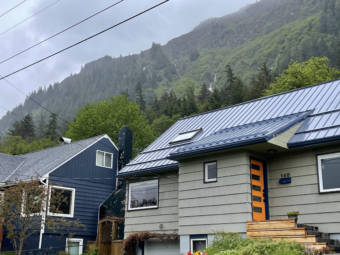
The Behrends avalanche path seen from the 100 block of Behrends Ave., south of where the neighborhood crosses the path. (Rashah McChesney/KTOO)

Dozens of sought-after Juneau homes are built in an avalanche path. And decades of studies have pointed to the very real possibility of a big, destructive slide in the neighborhood’s future. But researchers and residents gauge risks differently, and a mix of personal choices and policy decisions keeps people in at-risk areas.
Janice and “Butch” Holst have owned the yellow house in the middle of their block since the late 1970s. Janice sits in an armchair in her cozy, slightly nautical-themed living room.

“We’re a landmark,” she said. “The Holsts on Behrends Avenue.”

At the time of purchase, they didn’t know the house where they planned to raise their children was in a zone that National Geographic Magazine once called the nation’s worst risk for a major avalanche disaster. 

Janice’s husband found out about the risk at work, from a colleague.

“He was bragging about having found a nice house right here. With the schools and having four kids, it was perfect. And this friend said, ‘Really? I don’t know why. It’s a big avalanche area. You’re not going to be safe there,'” Holst said.

“And and we’ve lived here happily ever since. But we have had some scary times.”

Behind their house, the 3,000-foot avalanche chute is bright green with new spring foliage that stands out from the darker, older forest on either side.

When avalanche danger climbed into the extreme range in their neighborhood last winter, the Holsts went and stayed with their grown son for a night. But Janice doesn’t have any plans to leave her home for much longer than that. The city has toyed with the idea of a home buyout program, but she says there’s almost no way they’d take it.

“Unless it was like, a million, trillion, zillion, billion dollars and a free maid and cooked meals every day. And a mink coat to keep me warm,” she said, whacking the arm of her chair for emphasis.

She says they have great neighbors, and the avalanches everyone’s talking about haven’t hurt them.

Lisa Ibias in front of her home on Behrends Avenue. (Claire Stremple/KTOO)

Lisa Ibias lives down the street from the Holsts. She and her husband didn’t know they were buying into an avalanche zone either. The seller, the realtor and even their lender did not mention the home was in a known avalanche path. She found out from a neighbor, after the papers were signed.

She raised six kids in the house, and says when there was avalanche risk, they slept against the uphill side wall in the basement. She says she’d take a home buyout if it was offered.

“If the city’s wants to buy the house, come on, bring it,” Ibias said. “I don’t know where I’d move. But not where there’s another avalanche.”

In harm’s way

In 2011, the city of Juneau contracted Swiss researchers to assess the risk to the Behrends neighborhood. The report said a major avalanche could run all the way to Gastineau Channel with enough force to destroy wood frame houses in its path.

“When you look at town, and you see these huge snowfields looming over neighborhoods — I mean, the gentlemen I brought in from Switzerland and France and other places in Europe look at me and say, ‘we can’t believe you built here,'” Tom Mattice said.

He runs the city’s avalanche program, and he co-authored a study that describes the risk to 60 homes, a hotel and a boat harbor in the Behrends avalanche path.

City code reveals how seriously the municipality takes avalanche risk. In severe avalanche zones, like the Behrends path, the city of Juneau doesn’t allow new construction. No additions, no in-law units, no new bedrooms. Nothing that would increase the human density of the area.

But Mattice says right after he took on his job in 2008, he floated the idea of home buyouts. He says the assembly at the time balked at the cost share the city would have to take on and decided not to spend the money. Mattice says it’s a hard sell because people who have moved in more recently knew about the risk when they bought — sellers have to disclose it.

Mattice says he wanted to build a wall to protect the houses and do controlled detonation of landslides, but that idea didn’t gain traction either. Swiss experts said a wall wouldn’t work. And the city can’t force people to evacuate their homes while Mattice’s crew sets off avalanches.

Juneau’s Emergency Programs Manager Tom Mattice in his office in April 2021. (Andres Camacho/KTOO)

Mattice says one way to get the city and residents to consider a buyout might be after an avalanche causes damage in the neighborhood.

“Because as soon as you get the insurance company involved because you damaged your house, that actually could be used as the cost share,” he said.

“So we could get some FEMA money to come in and buy that property, use that insurance money instead of government money to be that local cost share, make that homeowner whole, move them out of that residence and turn that into open park space for perpetuity.”

It might sound reckless to wait for a predictable disaster to happen rather than take action to get people out of the way. But Matisse tried that. For a buyout to happen now, he says the homeowner would have to take their case to the assembly for approval. He remembers less than half of residents were even interested in a buyout. Some people on Behrends think the studies overestimate the risk. One accused Mattice of fear mongering.

Home buyouts aren’t simple

Sherri Brokopp Binder is a community psychologist and an independent researcher based on the East Coast.

“I’m a disaster researcher; I think about disasters all the time. But for residents, disasters are just one point among many that make up you know, the complex reality of their lives,” she said.

She studied home buyouts in the wake of major storms like Hurricane Sandy. And she found that while municipalities see buyouts as a tool for prevention, people see them as a tool for recovery. That is, most homeowners don’t want to leave a perfectly good home in a dangerous place. But they are more likely to consider leaving a damaged home.

“I can look at pictures of a community that’s in the path of an avalanche and think, ‘Yep, those houses shouldn’t be there,’ right? That’s not a great place to build a community. But it’s not my house, right? It’s not my community that we’re talking about dissolving. And it’s not my life that we’re talking about upending.”

A discarded warning sign leans against a railing in the woods behind Behrends Avenue. (Photo by Claire Stremple/KTOO)

She says there are social consequences to a move — think of the Holsts who love their neighbors — and financial consequences. There’s no guarantee about getting the market value for a home. Juneau’s housing market is tight. If more than 30 households wanted to move at once, it would be tough.

Current city policy offers residents an avalanche warning system — someone to literally knock on their doors and ask them to get out of harm’s way. But while the city won’t add people to the area, it hasn’t invested in a plan to reduce the number of people who live in the hazard zone yet. For those residents, the only path out of harm’s way is to sell their homes, passing the risk to someone else.

Alaska’s Avalanche Capital

This story is part of a KTOO series about Juneau’s urban avalanche risk.

A pandemic rule change could make it easier to get treatment for opioid addiction in Alaska

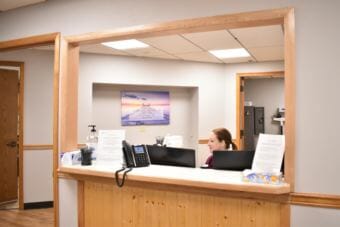
Medical assistant Sarah Martin sits at the reception desk of Ideal Option, a medication assisted addiction treatment clinic in Juneau. (Photo by Kavitha George/KTOO)

Alaska doctors have temporary permission from the state to use telehealth to prescribe a controlled, but life-saving drug used to treat opioid addiction. State officials say they’d like to make the change permanent.

Once a patient says they’re ready for treatment, physicians like Dr. Janice Sheufelt want to get them the medication that prevents withdrawal symptoms as soon as possible.

“Honestly, even a few days makes a difference because of how many people are dying from opioid overdoses in our state,” she said.

She got to sidestep a significant barrier to care for people with opioid addictions during the pandemic — the clinic visit. That is, until February when the state’s emergency order lapsed and the state tightened restrictions on telehealth.

That meant she and her patients had to schedule an in-person appointment with another doctor to prescribe the drug, buprenorphine. It’s also called by its brand name, Suboxone. An extra step, and extra time, when withdrawal symptoms can manifest within hours.

“Every patient I speak to, they tell me about their friends or family members who have died. So I really think time is of the essence, and even a few days can make a difference. I’ve had people overdose and die who were waiting to get into treatment,” said Dr. Sheufelt.

Last week, the state’s medical board approved an emergency order from the state health department to reinstate buprenorphine prescriptions by telehealth for 120 days. But there was a four-month period where providers had to set up in-person appointments to get prescriptions.

In that time, Dr. Sheufelt says more than 200 patients asked to start medicated treatment at her clinic alone.

The lapse came at a critical time: hospital visits for overdoses involving heroin have increased dramatically in the state since March. Overdose visits from March to May this year are more than double last year’s visits over the same period of time.

Officials from the state’s medical board declined recorded interviews but wrote in a statement that the board will work to make the change permanent and allow Alaska doctors to prescribe and renew prescriptions for buprenorphine without an in-person appointment.

“Medication is a key part of helping people who have opioid use disorder in stopping,” said Jeannie Monk, a senior Vice President at the Alaska State Hospital and Nursing Home Association, or ASHNAH.

She testified before the medical board on behalf of Alaska physicians who said the change is necessary to help their patients. She said the COVID-19 pandemic illuminated a real need.

“Because people couldn’t go in to see doctors and people in rural areas couldn’t travel, giving them access to really life-saving medication by telehealth has been essential,” she said.

Buprenorphine typically requires an in-person visit for a prescription because it is categorized as a controlled substance. It works to block withdrawal symptoms but doesn’t get users high like heroin or fentanyl do.
“It took quite a while to kind of get the State Medical Board to kind of understand the situation and take action,” Monk said.

Even though current state and federal law do not allow that type of drug to be prescribed without an in-person visit, the state’s medical board is working to keep the exemption in place. It cites high rates of opioid overuse, overdose and death in the state as reasons it will work towards the permanent change.

Tiny insects ate the needles off a half million acres of Tongass hemlocks. Most of the trees will be fine.

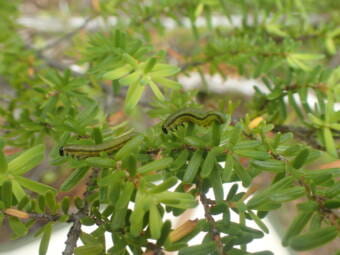
Hemlock sawfly larvae (Photo courtesy of Elizabeth Graham/National Forest Service)

Elizabeth Graham pulls off the road about 25 miles north of downtown Juneau to stand in the rain looking at partially dead trees.

“There’s probably you know, in this little stand right here, about 30 dead tops that I can see just on this little hillside,” she said.

Graham is an entomologist with the National Forest Service. She points out some peaked looking hemlocks.

“And that’s a good example of what we’re seeing in other places. Not every tree affected. But, you know, a small portion,” Graham said.

Dead crowns in the canopy and rusty-colored branches are woven in with the otherwise healthy, green temperate rainforest. About a third of the trees around here were hit by the voracious sawfly. The larvae get mistaken for caterpillars. Adults are a kind of non-stinging wasp, a little smaller than a pinky finger.

In 2018 and 2019, drought conditions allowed the hemlock sawfly to thrive in Southeast Alaska. Now they are mostly done eating the needles off of hemlock trees, but the damage from their 2-year feast is still apparent.

“When I was doing these stories two years ago, I told everyone, ‘Oh, none of the trees are gonna die. You know, it’s just a defoliator, it’s not gonna kill the trees,” Graham said.

Isaac Dell and Elizabeth Graham work for the National Forest Service’s Forest Health Program. (Claire Stremple/Alaska’s Energy Desk)

Some trees are gonna die. They lost a  lot more needles than she thought they would. But Graham says sawflies are nothing like spruce beetle, a really lethal pest if you’re a tree.

“It’s not going to be that bad, but it made me a liar. And we have a few that aren’t going to make it so I apologize for that,” Graham said.

Bare, sad looking hemlocks are going to stick out a bit in Juneau, Western Admiralty, Northern Prince of Wales and Mitkoff and Kupreanof islands. But the Forest Service isn’t taking any action beyond monitoring because the ecosystem is sorting things out on its own.

Sawfly isn’t an invasive species. Its larvae slowed down naturally because rain came back to the region after two years of drought conditions. The rain brought a fungus that infects the sawfly and controls the population.

But Graham says, it’s still a big deal. This is the biggest sawfly outbreak on record since the 1950s.

“When we saw this outbreak, and I saw it from the plane in 2019, the only way I can describe it is impressive,” she said.

When the Forest Service began to track the sawfly feeding frenzy they observed about 50,000 acres of the Tongass National Forest were affected. A year later, aerial surveys showed that the number had ballooned to half a million acres.

“The thing that I keep repeating to remember is, you know, that it is a natural part of our ecosystem. And, you know, we’re hoping that the impacts will be minimal,” Graham said.

Aerial view of the trees in the Tongass National Forest (Photo courtesy of Elizabeth Graham/National Forest Service)

Scientists are tracking the damage. They want to know the extent of the forest affected and how many trees don’t pull through. Scientists spent last year monitoring the outbreak via satellite since COVID-19 meant they couldn’t get in small planes together for aerial surveys.
There are drawbacks to monitoring a tiny insect from space, but the images did give scientists a sense of where to look when they’re back in the air this summer. They’re hoping there won’t be much new activity to see.


‘We need to be doing this work’: Tlingit and Haida takes on mental health and wellness with new division

Tlingit and Haida President Chalyee Éesh Richard Peterson in his office. (Claire Stremple/KTOO)

The Central Council of the Tlingit and Haida Indian Tribes already offers some social services, but it’s ready to expand. It launched the new Community and Behavioral Services Division this spring. The move marks a shift towards stronger tribal support for wellness.

Tlingit and Haida President Chalyee Éesh Richard Peterson says COVID-19 was the catalyst to creating a wellness division that’s been urged by the tribal delegation — that’s the legislative branch of the government — for years.

He said there’s been hesitancy to step into the wellness role because Southeast Regional Health Consortium and other medical providers already offer those services. But he says the demand is so great, that everyone needs to work together.

“For me, I’m not so worried about stepping on toes, step away, step on mine — we’ll figure it out. What we need to do is we need to jump in. We need to be doing this work,” he said.

Peterson says generational trauma — from colonization, residential schools and forced assimilation — underlies mental health and addiction challenges.

“That scar, that hurt, that trauma is passed down, you know, and you don’t even understand necessarily why. But it surfaces, and we want to take a more direct approach to working and providing the service to our citizens so that we can be the hand up, you know, we can be there,” Peterson said.

The new division will offer programs aimed at prevention, treatment and recovery, as well as providing regular mental health care to tribal citizens. The goal is to create a system of “wraparound services.”

Dr. Tina Woods (Photo courtesy of Central Council of Tlingit & Haida Indian Tribes of Alaska)

The tribe hired Dr. Tina Woods to lead the new division. She is a licensed clinical psychologist originally from St. Paul Island. She supported the administration with self care and mental wellness courses during the pandemic.

“I am a trained Western psychologist. However, I’ve also been trained by Alaska Native elders throughout the state. And to me, there’s nothing more powerful than blending two worlds together to provide the highest quality of services to our tribal citizens,” Woods said.

Woods earned her master’s degree and Ph.D. from the University of Alaska Anchorage and Fairbanks. The bulk of Woods’ career has been in the Alaska tribal health system, in both clinical practice and administration. Her studies and her work have a rural and Indigenous emphasis. She will lead the tribe’s existing programs but also expand the kind of care tribal members have been getting.

Woods says one of her main goals is to break down stigma around mental health issues and drug use so that people will seek help. And she says that while the pandemic caused a surge in cases of anxiety, depression and stress, it’s that same surge that has helped normalize the issues.

“As we all experienced this shared trauma of dealing with high stress of the unknown, unpredictable times, we can share that together and understand what anxiety really is. Grief is huge right now,” she said. “The pandemic has created a lot of grief in many ways. It has taken away our norm.”

Peterson says Dr. Woods’ clinical credentials speak for themselves, and he knows her focus on culture as a healer will keep the tribe moving in the right direction.


We updated to this story to include the name of the new division.

Site notifications
Update notification options
Subscribe to notifications