Claire Stremple

"I support KTOO reporters and guide coverage that informs our community and reflects its diverse perspectives."

When she's not editing stories or coaching reporters, you can find Claire outside with her dog Maya.

Glacier Bay whales bouncing back after marine heat wave

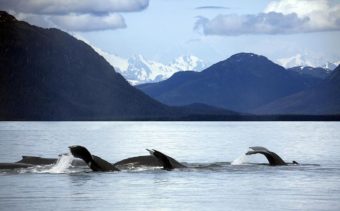
Whales in Glacier Bay
Whales in Glacier Bay (Wikimedia Commons)

Humpback whales were hit hard by “the blob”—a warm water event that killed off all kinds of sea life in the North Pacific. Researchers at Glacier Bay National Park and Preserve say the humpback population is rebounding.

The reflection of Mt.Wright ripples on the glassy water of Glacier Bay National Park and Preserve until a humpback breaks the surface for a huge mouthful of fish.

Chris Gabriele is a biologist with the park service. She has been observing whales here for over 30 years, but the sight of one of the mammals up so close still wows her. She snaps a few photos and checks them.

“So, that’s identifiable enough for us to tell what individual that is,” she said, looking at the image.

Whales are recognizable by their unique dorsal fins and flukes.

The photos and a log of the whale’s coordinates are the two newest entries in a data set that stretches back to 1973 — it may be the longest-running humpback study in the world. Some whales have returned here for more than 40 years. Some are older than Gabriele.

It’s long-term observational data like this that makes it possible to correlate changes in the ocean with their effects on the species that live there. Researchers could track the severity of a recent marine heat wave because the whale population sank by more than 70%, then stayed low. Lately, there’s a glimmer of hope in the data. The humpback whale population is growing.

“It’s been really encouraging last year, and this year to start to see the number of calves we’ve been seeing after the marine heat wave. And so, it really gives me hope that when the conditions are good, they’re really very resilient,” Gabriele said.

Remember “the blob?” From 2014 to 2016, consistent, record-high ocean temperatures in the northern Pacific decimated the humpback population that visits the preserve. The year before the blob, Gabriele counted an all-time high of more than 160 whales. The next year, only a quarter of them came back.

That two-year heat wave had a three-year hangover: the humpback population stayed low until 2020. This study reveals how deeply the marine ecosystem was affected.

“The whales were kind of a sentinel, that showed us what happened. Otherwise, we would not really have known. And I think it’s important to keep doing this work because we can come back in five years, 10 years, 20 years, and look at what the whales are telling us,” Gabriele said.

The numbers aren’t quite up to where they used to be, but Gabriele expects the population to stay healthy — as long as ocean conditions stay stable.

No guarantees

“It wouldn’t be surprising if there’s another blob event in the next 10 or 20 years,” said John Walsh, the Chief Scientist at the International Arctic Research Center at the University of Alaska Fairbanks.

He’s anticipating another oceanic heat wave because his lab has attributed events like “the blob” to human-caused climate change. He studies the blob through the lens of Arctic sea ice. And he found that, like whales, ice recovered somewhat a few years after the warming.

“We’ll have these modest recoveries after the big events. And then there’ll be another big extreme, somewhere down the road,” he said.

In other words, each time the ecosystem takes a hit, it bounces back. But each time a little less. He says we can count on that for the next few decades.

“The system has inertia in it. It’s like a freight train. You can put on the brakes, but it’s not going to stop on a dime, it might stop at half a mile,” Walsh said. “So I think we basically have to be ready for more of the consequences of what we’ve already done.”

Whales in Glacier Bay. Photographs taken under the authority of scientific research permit #21059 issued by the National Marine Fisheries Service. August 16, 2021. (National Marine Fisheries Service)

Signs of hope

Back on the preserve, a cow-calf pair comes up to breathe together. Their backs are slick, dark arches on the water.

There are eleven calves this year. During the heat wave, there were years without any calves at all.

The pair is a sign of the ecosystem righting itself, for now. Gabriele puts the boat in gear as she jots down the time of their breath; she knows she has 3-5 minutes until the whales surface again.

Correction: A previous version of this article contained a misspelling of Chris Gabriele’s name.


Mendenhall Glacier’s retreat is exposing new land. The Forest Service doesn’t want it to be mined.

Mendenhall Glacier
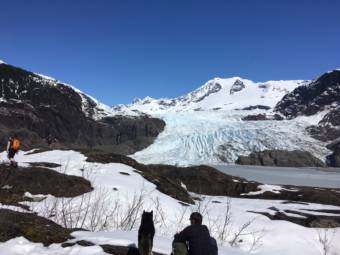
Mendenhall Glacier as seen from near the West Glacier Trail on April 18, 2021. (Photo by Matt Miller/KTOO)

The Mendenhall Glacier is one of the most visited sites in Alaska. As it retreats, it opens up new land, and that federal land is open to potential mining claims. But the U.S. Forest Service, which manages the glacier, is making moves to prevent that from happening to keep the area pristine for tourism and recreation.

“What we’re hearing and seeing from the public is this is an extremely valuable place to recreate, and the viewshed is very important,” said James King, the regional director of recreation, land and minerals for the Forest Service. “And so we’re working hard to protect that.”

That “viewshed” is everything you can see from the Mendenhall visitor center, where roughly half a million people a year gaze out at the blue ice.

In 1952, the Forest Service took the land around the Mendenhall Glacier off the table for mining. Now there’s a strip of land exposed by the shrinking glacier. King says his agency’s request is simply extending that decades-old prohibition to the new land — keeping up with the changing landscape.
But it’s not just procedural. There are actually mining interests that make claims below receding glaciers. A Canadian prospecting company did just that on the land exposed by the retreat of the nearby Herbert Glacier a few years ago. But King says he isn’t aware of a lot of that going on.

Since the acreage in question is public land, this isn’t going to happen overnight.

“The withdrawal process is a lengthy process,” King said. “And we hope to get through the environmental piece of that by the end of this year.”

This is the beginning of the environmental review. The first public comment period of the process is open now through September 7.

Cruise ships returned to Southeast Alaska, but don’t call it a comeback

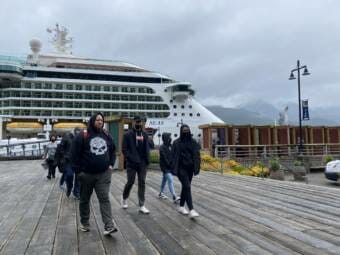
People walk on the dock in front of Royal Caribbean’s Serenade of the Seas. The ship docked in Juneau on July 23, 2021.
People walk on the dock in front of Royal Caribbean’s Serenade of the Seas. The ship docked in Juneau on July 23, 2021. (Photo by Bridget Dowd/ KTOO)

Cruise ships have returned to Southeast Alaska, but they aren’t full. Southeast businesses say they’re a hopeful sign, but this isn’t an easy year.

Cruise tourists usually pour off the docks into the heart of downtown Juneau. This summer, it’s more of a trickle.

But local businesses are still celebrating their return.

“I’d say there was like a sigh of relief, like, okay, we can do this,” said Scott Bergman, an owner of Alaska Fudge Company. Long bars of the candy sit behind him on marble slabs.

He’s stirring caramel in a copper pot. There’s a steady flow of customers on this day. Cruise tourists are the bulk of his clientele.

“We’re gonna get through to 2022. Yeah, I mean, that is what a lot of the businesses down here are looking for, you know, enough money in the bank to get through the winter,” he said.

The year before the pandemic, Alaska set record numbers for cruise ship tourism. On a busy summer day back then, Bergman made up to 300 pounds of fudge. This year, it’s more like 100 pounds.

Scott Bergman stirs caramel at the Alaska Fudge Company in downtown Juneau. (Claire Stremple/KTOO).

Wendy Andrews of Rancho Cucamonga, California cruises Alaska every year with her husband. They can’t remember if it has been six or eight times.

“Glad to be back,” Andrews said.

They always stop at Bergman’s fudge shop for local flavors like Glacier Chip and Motherlode Maple.

“Every time we come, we buy fudge … we buy the three-pack because we can’t make up our mind,” she said.

Like Andrews, almost all of Southeast Alaska’s tourists step off a cruise ship — 90%.

Meilani Schijvens runs an economic development firm in Juneau. She surveyed regional businesses and found that last year, revenue was down by more than half.

“And 50% are still struggling to pay their bills just to keep their head above water right now, and about a third still remain vulnerable to closure,” she added.

She says this year’s season is a really good sign, even though she estimates that Juneau will see about 10% of its usual cruise traffic this year.

The season is short — it started in July rather than May — but it’s also condensed. She says that makes it hard for tour operators to get fully staffed for just a few uncertain months.

“Southeast Alaskans are up for challenges. They’re, you know, very resilient and very innovative. And people are figuring it out. But it’s not for the faint of heart,” Schijvens said.

Serene Hutchinson is among those figuring it out. She operates a Juneau tour company that offers whale watching and bus excursions. She said psychologically, it’s good to be back in business.

“Financially, you know, financially, probably when all is said and done, hopefully, break-even?” Hutchinson said.

This year, just a fraction of her fleet is running. She says she’s booking at less than 10 percent of “usual.” She and most of her staff have second jobs. She can only offer a couple months of work at half the usual pay.

She says there’s been an uptick in independent travelers, but nothing that comes close to matching the loss of cruise volume.

“We’re living in the sort of between world of just being so grateful for anything because anything is better than zero and last year was devastating,” said Hutchinson.

On the day we spoke, she’d just sent a whale-watching boat out and had plans to jump in as a deckhand for one of her afternoon tours.

She could only afford to hire back a few key employees, so everyone has to help out where they can.

Proposed update to Juneau’s hazard maps heads to Planning Commission

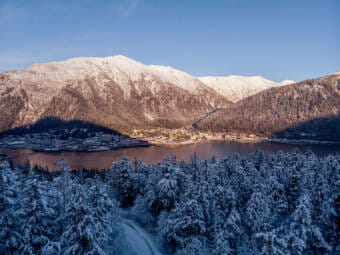
Downtown Juneau in December 2018. If adopted, new hazard maps would expand known hazard zones to include about half of the structures in the downtown area. (David Purdy/KTOO)

Juneau’s planning commission will consider updated landslide and avalanche maps at a Tuesday night meeting. The city’s current maps were created in the 1970s. If adopted, the new maps will expand known hazard zones to include about half of the structures in the downtown area.
The planning department tried to upgrade the maps in the 1990s, but the assembly did not vote to accept them.

Some residents support the new maps as vital public safety tools and urged their speedy adoption in letters to the committee. Others don’t agree with the new assessment.

“The city just increased our property taxes fairly significantly. And now, you know, this whole remapping for the landslide area inclusion area, in my view, is going to significantly lower our property value,” John Nemeth said.

Nemeth is a business owner who lives in the Highlands neighborhood. The new maps put his property in a severe hazard zone for landslides.

The city doesn’t have information about how insurance rates or property values may change as a result of the new maps if they are adopted.

The city’s planning commission is tasked with making a recommendation to the Juneau Assembly. It will be up to the assembly to approve the maps or not.

As Juneau’s COVID cases skyrocket, hospital staff are testing positive too

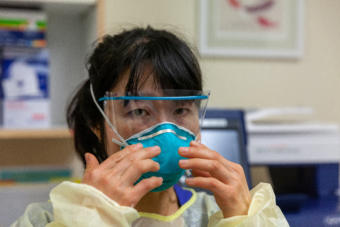
A healthcare provider, wearing several types of personal protective equipment that is being tracked by the State of Alaska, provides care on April 7, 2020, for a woman hospitalized in an isolation room in the critical care unit of Bartlett Hospital, in Juneau, Alaska. on (Photo by Rashah McChesney/KTOO)
A healthcare provider, wearing several types of personal protective equipment that is being tracked by the State of Alaska, provides care in 2020, for a woman hospitalized in an isolation room in the critical care unit of Bartlett Hospital, in Juneau. As of August 6, 2021, there are four people with COVID-19 being treated at the hospital, two are severely ill and require additional oxygen. (Photo by Rashah McChesney/KTOO)

Local COVID-19 case counts in Juneau skyrocketed in July, and the community’s risk level went to “high” last week. That’s meant more cases and more restrictions at Bartlett Regional Hospital.

Infection preventionist Charlee Gribbon said she has to manage a lot more risk in the hospital — for patients and staff.

“Our infection rate has increased at the hospital just like it has in the community. And we’ve seen that across the board,” she said. “The community level infection equals what’s happening in the hospital because we are community members.”

Charlee Gribbon, infectious disease preventionist from Bartlett Regional Hospital, left, and Adam Crum, Alaska Department of Health and Social Services commissioner, center, answer questions about coronavirus for a KTOO News special program on March 5, 2020, in Juneau. (Photo by Rashah McChesney/KTOO)

The hospital has a 90% vaccination rate. There are 75 unvaccinated employees spread across departments, from doctors and nurses to mental health clinicians and administrative staff.
Gribbon said eight healthcare workers at Bartlett tested positive for COVID-19 in July alone. So far this year, there have been 16. By contrast, in 2020 only 12 employees at the hospital tested positive.

Gribbon said the uptick is because the delta variant is so much more infectious and because both vaccinated and unvaccinated people can get it — and that people are mixing socially much more now than in 2020. People arrive on planes, cruise ships come into town and restaurants and summer camps are open.

“I’m monitoring symptoms and testing people on very low symptoms; our testing threshold is very low. So what that translates to the hospital’s amount of response, at least in the employee health part, is testing our employees a lot more often,” she said. “So that’s what I’m doing, is testing a lot.”

She estimates she tests about 10 employees a day.

The hospital is screening patients and visitors with the same questions it’s been using since the beginning of the pandemic. Masks are still required at all times.

The visitor policy has changed, though. Now patients are allowed only two visitors throughout their hospital stay — and they have to be the same two visitors. Before, patients were allowed two visitors at a time, but as many different visitors as they liked.

As of Friday, Aug. 6 there were four COVID-19 patients at Bartlett. Of those, two were severely ill and required high levels of additional oxygen. If they need to be intubated, they’ll be sent to Anchorage or Seattle for care.

Listen: How Alaska cruise towns are handling COVID-19 arriving on ships

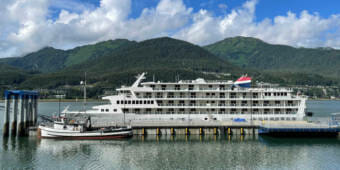
The American Constellation is docked near downtown on Thursday, July 15, 2021, in Juneau, Alaska. The American Cruise Lines ship has been in port and hosting quarantining crew since several tested positive for COVID-19. (Rashah McChesney/KTOO)

Cruise tourism’s restart after a nearly two-year hiatus is bringing hope for a revived economy in Southeast — but also safety concerns on ship and shore.

Nearly a dozen passengers have tested positive for COVID-19 in the first week of large cruise ships’ return to Alaska.

Still, fully-vaccinated cruise passengers have not shown symptoms beyond those of a mild cold, according to cruise companies. And port cities report climbing case counts come from residents, not tourists.

KTOO’s Claire Stremple spoke with Alaska Public Media’s Casey Grove about Southeast Alaska’s 2021 COVID-19 cruise season.

Listen here:

The following transcript has been lightly edited for length and clarity.

Claire Stremple: In the last week, there have only been about nine COVID-19 cases on cruise ships. Cruise ships are requiring vaccinations.

But the Celebrity Millennium reported a first breakthrough case — that’s a COVID-19 case in a vaccinated person — that was discovered over the weekend. That was the first case detected on a large cruise ship.

That was followed by seven cases on an UnCruise boat — that’s a small local cruise adventurer company. And those people were also fully vaccinated, per the company’s policy.

Yesterday, another case was reported on American Cruise Lines’ American Constellation, and that’s the small cruise boat that got hit with a cluster of over a dozen cases earlier this month.

So, cruises are finding these cases because they test anyone with symptoms.

Casey Grove: How bad have the symptoms been, and how are the patients being treated?

Claire Stremple: Cruise lines are reporting only mild, cold-like symptoms so far. Remember, these people are vaccinated, so they have some defense against the virus.

Casey Grove: What are the folks in cruise port communities saying about this?

Claire Stremple: Officials are saying they expected some cases to come with this season. For example, Skagway is one of the remote communities hardest hit by the last year and a half without cruising. They got their first big boat, the Celebrity Millennium, in there on Tuesday. That’s the ship that reported a positive case in Juneau on Monday. That passenger was medevaced out of town. They’re no longer on the ship. But Skagway Mayor Andrew Cremata says he’s encouraging folks to wear their masks.

Andrew Cremata: I think it’s perfectly normal to expect that there are going to be COVID cases. The question is: Have the proper precautions been taken to ensure the spread is minimalized — and the community, the passengers onboard the vessel, are protected? That has been the real work over the last year and a half.

Claire Stremple: Again, these cases are mostly ending up in Juneau. The infected passengers from UnCruise are isolating in a Juneau hotel. And the infected crew is isolating onboard the UnCruise vessel in Juneau’s port. Juneau officials maintain there’s minimal risk to the community. They say none of the passengers have circulated in Juneau as tourists.

Casey Grove: What does it say about the safety of either going on a cruise or the risk of exposure to Alaskans? Is this indicative of further spread?

Claire Stremple: It’s a little too soon to tell. Large cruise lines have been back for only a week. They’ve reported one case. Smaller lines have been on the water longer and have reported more cases. The cruise numbers still look good compared to statewide or nationwide averages.

In Juneau, the last two weeks have been the biggest COVID weeks since the beginning of the pandemic. But Juneau Deputy City Manager Robert Barr says those cases aren’t from cruises.

Robert Barr: The main risk is not from cruise ships, and not from tourists. The significant majority of cases that we’re seeing are among our residents. And as we’re able to contact trace those investigations, it’s clear that they’re not coming from tourism.

Casey Grove: Okay, Claire, are cruises to Alaska at risk because of all this?

Claire Stremple: There’s no sign of that so far. And so far, that seems to be a municipality-level decision. In Juneau, there’s no hard-and-fast threshold where the city will cancel cruises. Official say they’re taking things on a case-by-case basis.

Site notifications
Update notification options
Subscribe to notifications