Jacob Resneck is CoastAlaska's regional news director based in Juneau. CoastAlaska is our partner in Southeast Alaska. KTOO collaborates with partners across the state to cover important news and to share stories with our audiences.
The Holland America Line cruise ship Westerdam prepares to dock in Juneau, July 16, 2012. (Photo by Heather Bryant/KTOO)
Holland America Line will pay the state a $17,653 after one of its cruise ship’s holding tanks leaked graywater into Glacier Bay National Park and Preserve last year, according to the terms of a settlement released this week to CoastAlaska.
The cruise ship Westerdam was visiting the national park on Sept. 11, 2018, when a crew member mistakenly opened the wrong valve. That’s according to the state’s notice of violation issued late last year.
An estimated 22,560 gallons overflowed into national park waters. The discharge lasted about 25 minutes and was reported to state authorities.
The settlement — signed Aug. 1 by Holland America’s attorney Kelly W. Clark — says the cruise line “does not admit to any, and hereby denies all, of the factual allegations or legal claims set forth herein.”
A spokesperson for Holland America, a subsidiary of Carnival Corporation, said the company didn’t have any additional comment, “other than we remain committed to environmental excellence and compliance, and protecting the environment in which we live, work and sail.”
Graywater is untreated runoff, usually from cleaning and kitchen use. It’s less hazardous than wastewater containing human waste.
Cruise ships are prohibited from discharging anything within park boundaries. The National Park Service also fined the cruise line $250 over the incident.
Delta Western has settled with the Environmental Protection Agency over allegations it violated emission standards at its tank farm in Juneau about a mile south of downtown.
The Seattle-based company neither admitted nor denied any wrongdoing in the settlement. But had it been convicted and sentenced to the maximum penalties, it could have paid out more than $90 million.
The company settled for a fraction of that — $400,000 — and agreed to upgrade its emission control equipment by the end of next month.
EPA enforcement officer John Keenan said emission control equipment is required when a company offloads more than 20,000 gallons of gasoline in a day.
“The regulations are really designed to reduce emissions of hazardous air pollutants,” Keenan told CoastAlaska.
The company will upgrade its tanks to keep gasoline fumes from escaping by Oct. 31.
“Those hazardous air pollutants going into the community would be reduced when this facility completes the installation of all these emission controls,” Keenan said.
Company spokeswoman Piper Pettersen said in a statement that the company cares about the health and well-being of the people and environments in which it operates.
“The vapor recovery system in Juneau ensures we are in compliance with air regulations and also enables us to serve customers we were unable to accommodate in the past,” she wrote.
Delta Western — a subsidiary of NorthStar Energy, a part of the Saltchuk family of companies — also operates Southeast fuel facilities in Sitka, Haines and Yakutat.
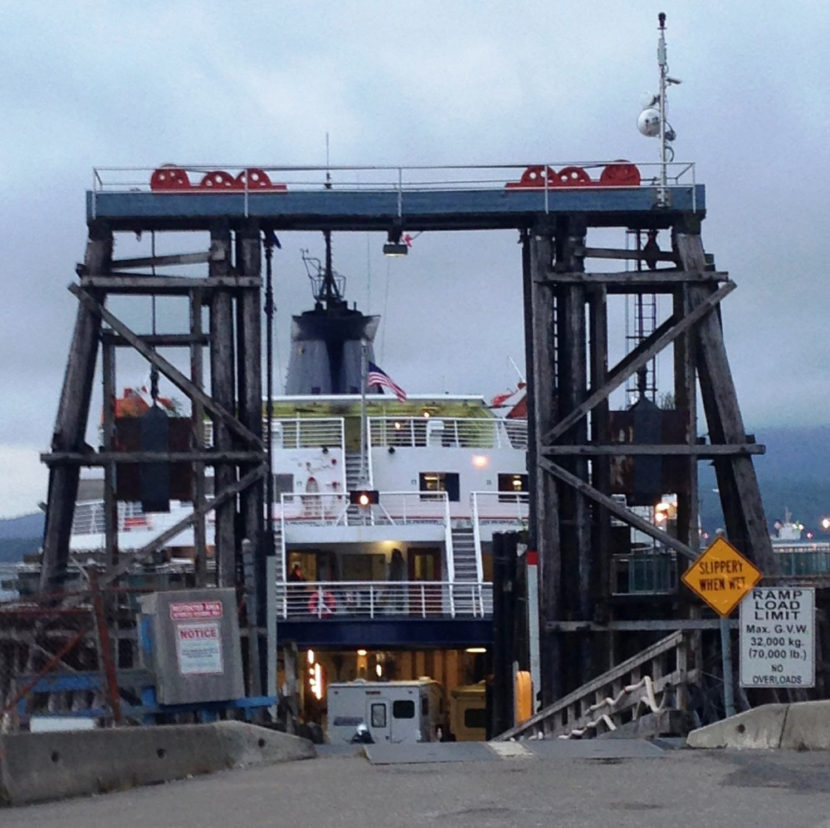
The ferry Taku loads up at the Prince Rupert, B.C., ferry terminal July 24, 2014. Rupert officials are in Juneau, lobbying for continued ferry service. (Ed Schoenfeld/CoastAlaska News)
The Alaska Marine Highway System is ending service to Prince Rupert, B.C. at the end of the month.
Alaska transportation spokeswoman Meadow Bailey said the decision to end service is unrelated to the ferry system’s budget woes.
A waiver from this requirement expires September 30 – the last day ferries are scheduled to call on the Canadian port city 120 miles from Ketchikan.
Customs spokesman Jerry McGee said the requirement is mandated across the U.S. He said it’s a safety issue, as it’s legal for the traveling public to carry hunting rifles and shotguns to and from Canada.
“So theoretically our staff are the only staff there that are unarmed. So again, this is for the safety of our traveling public as well as our officers,” he said.
In July, the state ferry system said it was exploring options to contract with armed Canadian law enforcement to provide backup for unarmed U.S. agents. But Bailey says the Royal Canadian Mounted Police aren’t available.
“The city of Prince Rupert does not have local law enforcement,” Bailey said. “So, they rely on the Canadian Mounted Police and the Canadian Mounted Police do not have personnel that they can divert away from their normal everyday tasks to be able to meet the vessels.”
Rep. Dan Ortiz , an independent state lawmaker from Ketchikan, says he and other lawmakers are still trying to solve the problem.
“Access to Prince Rupert is critical a piece of the Alaska Marine Highway System particularly to southern Southeast Alaska, but it has implications throughout all of Alaska. So I’m not considering this a done deal at all,” he said.
Prince Rupert is a significant transit hub that links Alaska with the Canadian road system. State ferries bring an average of 13,000 passengers and 6,000 vehicles through the Canadian port each year.
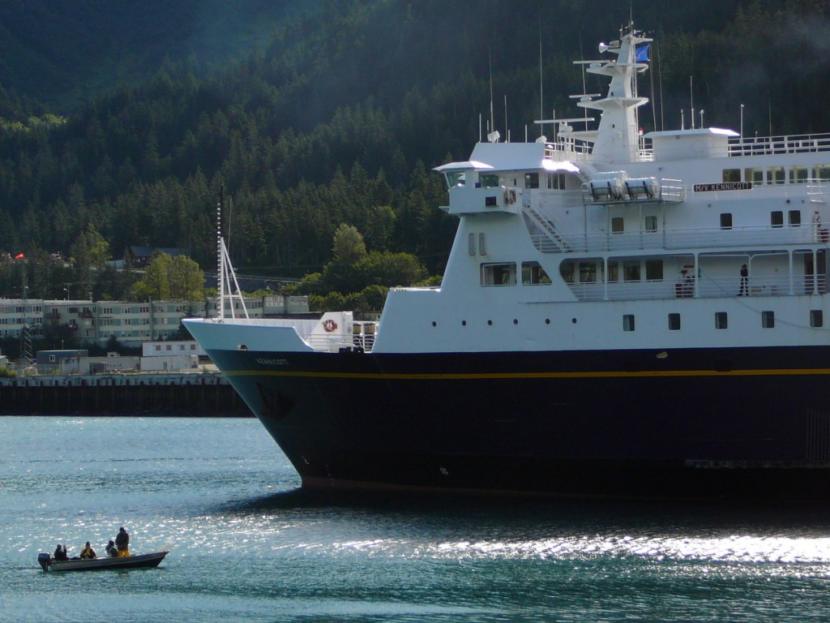
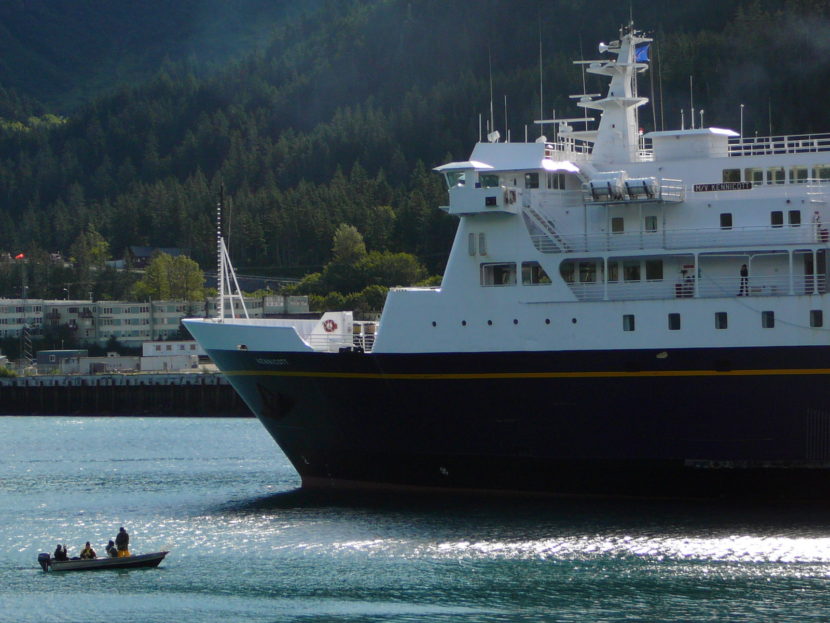
The 382-foot-long MV Kennicott pulls out of Whittier in 2011. (Photo by Ed Schoenfeld/CoastaAlaska)
An Alaska Marine Highway System ferry rescued five people after a small boat capsized Friday morning near Bella Bella, British Columbia, in the Inside Passage. A sixth passenger, the boat’s captain, was still missing.
The Bellingham-bound ferry Kennicott responded to a distress call that a 26-foot boat was sinking near Humchitt Island, about 200 miles south of Prince Rupert, British Columbia.
The ferry dispatched its fast rescue boat, ferry officials said.
“The crew and master of the Kennicott did a very professional job in quickly assisting with the rescue,” Alaska Department of Transportation and Public Facilities spokesperson Meadow Bailey wrote in a statement. “All vessels and crews in our fleet drill for these types of situations as part of the AMHS’s strong safety program and safety culture.”
The partially-submerged vessel’s captain was still missing as of Monday, Royal Canadian Mounted Police said.
“There were six people on board, and all but the captain made it safely to shore on Humchitt Island,” RCMP Cpl. Madonna Saunderson wrote in a statement Monday.
The rescue delayed the ferry by about four hours, Bailey said. She added the Kennicott cut its time in port short to get back on schedule.
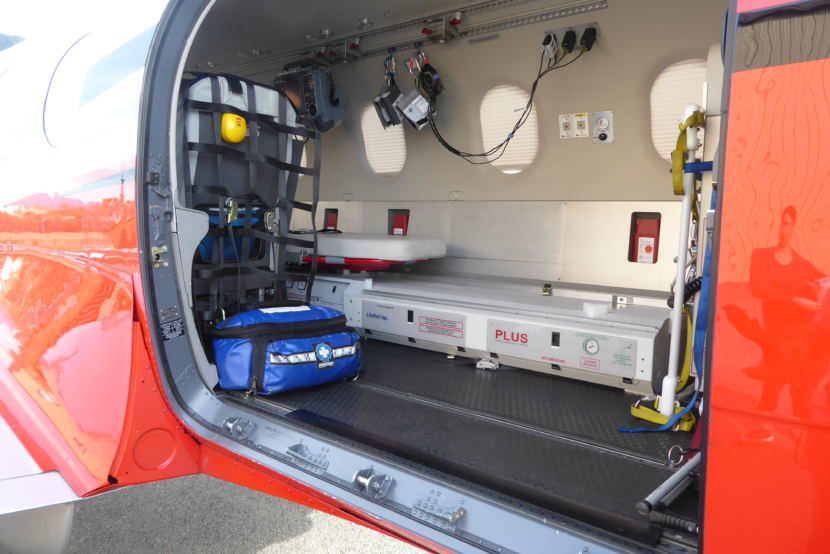
The interior of Airlift Northwest’s Pilatus aircraft. (Photo by Quinton Chandler/KTOO)
Alaska is taking a step back from regulating the membership plans marketed by air ambulance providers. State regulators say it’ll cut unnecessary red tape. But consumer advocates aren’t thrilled.
“I think it’s important for people to understand the cost of being transported,” Shelly Deering, the Juneau-based regional manager for Airlift Northwest, a nonprofit air ambulance service that flies in Southeast Alaska. “And that high cost can be over $100,000, depending where you’re coming from and where you’re going to.”
Health insurance plans often won’t cover the full cost of a flight. So to guard against sticker shock, air ambulance companies offer membership plans.
Households pay a flat fee — between $49 and $125 depending on the carrier — to ensure they don’t end up paying out-of-pocket.
Until this month, the state’s Division of Insurance used its authority under a 2014 law to look over the fine print of those membership plans to make sure they were legal.
But not anymore.
“We are no longer going to review those $49 membership or $100 membership agreements,” Alaska’s Division of Insurance Director Lori Wing-Heier told CoastAlaska.
She signed a recent regulatory order that says the state’s three air ambulance providers no longer need to file their membership plans with the state for pre-approval.
“They’re easily fully understood, they always have been, and we didn’t see the need to further stagnate the process of getting those agreements out to market,” she added.
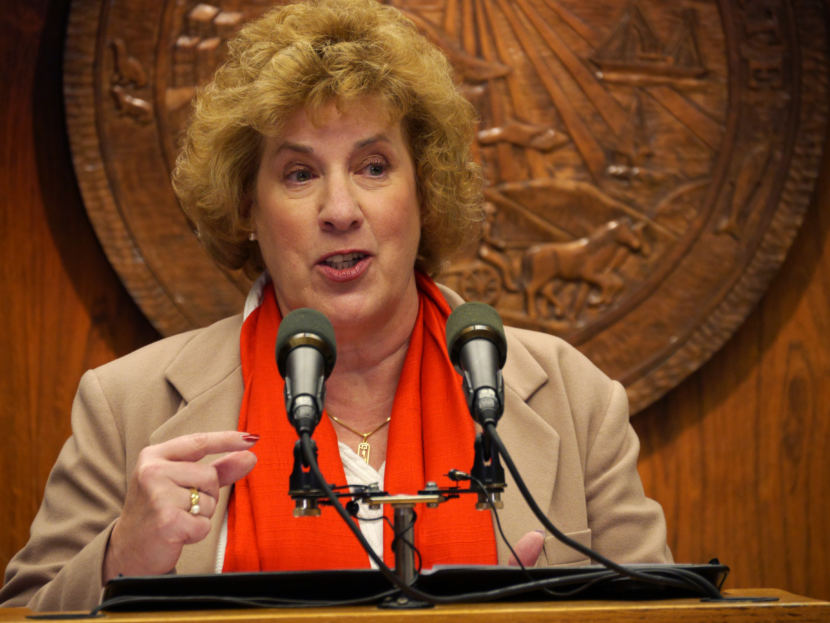
Lori Wing-Heier, the director of the Alaska Division of Insurance, testifying to the Legislature on Jan. 29, 2016. (File photo by Skip Gray/360 North)
The order says it “does not limit or in any way prevent the division from enforcing the insurance laws and regulations.”
The change was welcomed by carriers. All three air ambulance providers contacted told CoastAlaska they hadn’t asked for it, but are nonetheless pleased.
“This is a great example of the government working with companies to improve the process,” Deering said.
Guardian Flight Alaska Executive Director Jared Sherman says the arrangement makes sense. Under the old rules, any tweaks to membership plans — even minor ones — could take months for approval.
He says now his staff can just pick up the phone to the Division of Insurance.
“We (can) just reach out and ask them,” Sherman said. “Rather than us submitting formal documentation, and going through a formal process for that evaluation.”
And if a complaint or dispute does arise, Wing-Heier says the insurance division can step in at any time.
“We would still have authority to investigate that and seek resolution between the two parties,” Wing-Heier said.
But consumer advocates aren’t enthusiastic about shifting to a complaint-driven process.
“A regulator opting to waive oversight always raises red flags,” Dena Mendelsohn, senior policy counsel for Consumer Reports in San Francisco, told CoastAlaska.
“A consumer has gone through enough trauma to have to be in an air ambulance in the first place,” Mendelsohn said. “And now they’re going to have to follow up and, and reach out to the regulator to get the protections that they should have already had from the beginning? That doesn’t make sense.”
States like Alaska are limited in how they can regulate air ambulances. They can’t set the rates to control costs. That’s because the courts have held that Congress’ deregulation of airlines in the 1970s also extends to air ambulances.
But pending legislation could change that. The No Surprises Act would — among other things — allow states to regulate the cost of medevac flights.
Wing-Heier says the recent order can always be walked back — if her division sees a reason or need.
“We hold the right to repeal the order at some point,” Wing-Heier said. “If we get additional authority, that would have to come from the federal government back down to the states to regulate the actual cost of transportation.”
It’s unclear how many people could be affected by the recent rule change. Air ambulance providers wouldn’t disclose how many households they’ve enrolled in the membership plans.
But Alaska patients are flown every day. In Juneau, for example, Bartlett Regional Hospital’s records show around 1,000 people were medevaced over the past three years.
The mainline ferry Kennicott pulls out of Whittier as fishermen watch in 2011. (Photo by Ed Schoenfeld/CoastAlaska)
The Legislature’s attempt to add funding to the Alaska Marine Highway System has been blocked.
Gov. Mike Dunleavy used his line-item veto power to eliminate $5 million added by lawmakers in the wake of a $43 million cut that will mean long gaps in service.
“I don’t know how it could be premature. We could see that these areas were going to be without needed services,” said Rep. Dan Ortiz, a Ketchikan independent.
He says he’s heard from coastal residents who can’t get on a plane and are facing as long as seven months with no ferries.
“They’re cut off,” he said Monday. “They don’t have access to medical care if they’re not allowed to fly because now the marine highway is not there for them.”
A draft winter schedule released last month proposes no ships on Prince William Sound between October and May.
Cordova Mayor Clay Koplin predicted that’s going to hurt the state’s economy by cutting off commerce between communities.
“It’s pretty simple economics: we either do business in the state and have a ferry system and a (marine) highway we can use or we have to look for alternatives,” Koplin said Monday. “If we don’t have a ferry and a way to get in out of the community and conduct our business — it’s going to hurt.”
Just hours after the governor’s announcement, the Alaska Department of Transportation released a statement saying it was working to finalize its winter ferry schedule.
“As the winter schedule is finalized, please keep in mind that AMHS funding for the fiscal year 2020 has been reduced by $43 million and the winter schedule is fiscally constrained,” the statement said. “The 31% budget reduction from previous fiscal years will limit the adjustments that can be made to the schedule.”
The fiscal note accompanying the line-item veto notes that the ferry study is due in mid-October.
Close
Update notification options
Subscribe to notifications
Subscribe
Get notifications about news related to the topics you care about. You can unsubscribe anytime.