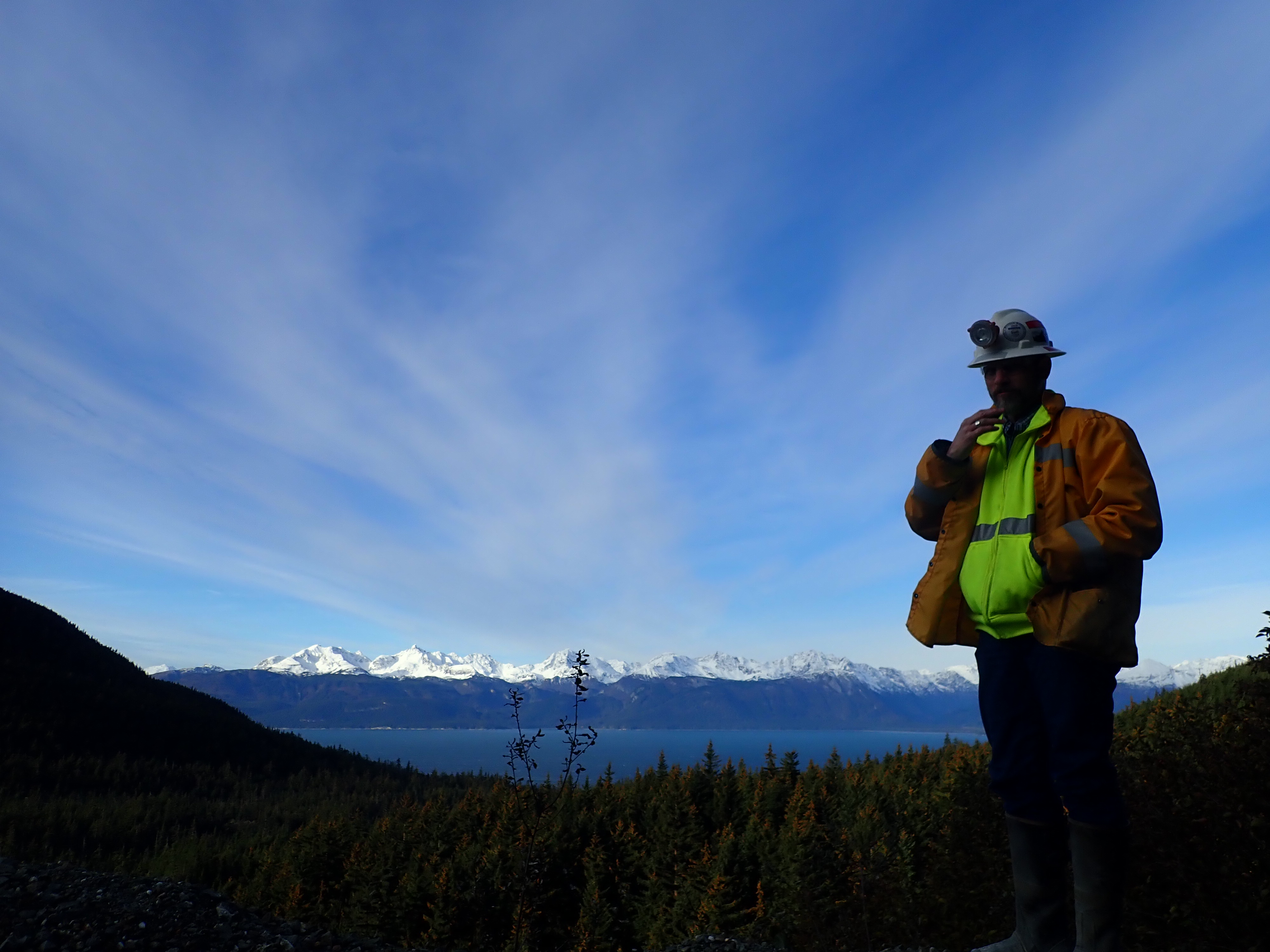
Jacob Resneck, CoastAlaska

Jacob Resneck is CoastAlaska's regional news director based in Juneau. CoastAlaska is our partner in Southeast Alaska. KTOO collaborates with partners across the state to cover important news and to share stories with our audiences.

LeConte repairs delayed, potentially dropping another Alaska ferry from the winter schedule

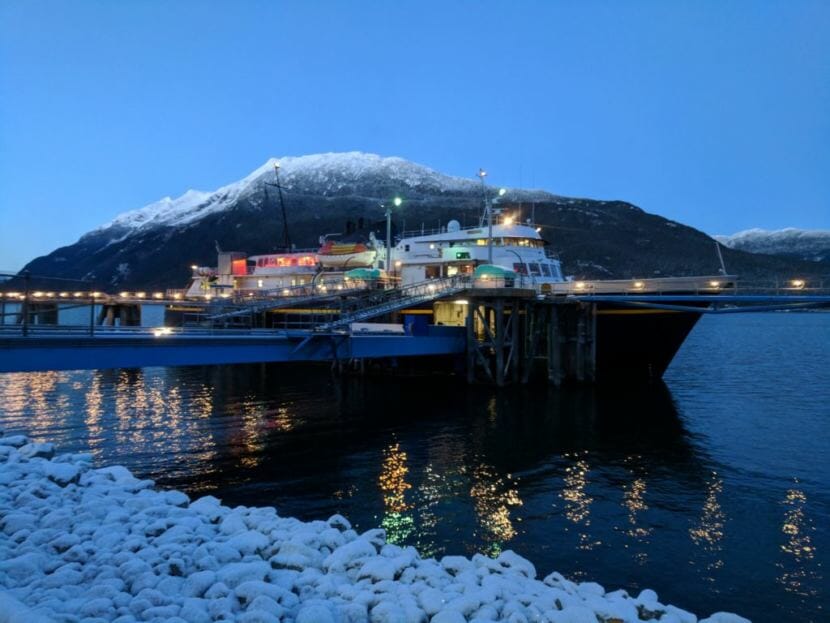
Ferry LeConte docks in Haines earlier this winter. (Photo by Berett Wilber/KHNS)
The MV LeConte ferry docks in Haines in 2018. (Photo by Berett Wilber/KHNS)

Update (Friday, 1:37 p.m.) — Henry Leasia, KHNS-Haines

On Thursday, the Alaska Marine Highway System removed most of its previously scheduled sailings to and from the Upper Lynn Canal until spring.

According to a press release from the state Department of Transportation and Public Facilities, starting Oct. 31, there will be one ferry a week to Haines and Skagway. There will be no AMHS service to Angoon, Tenakee Springs, Pelican and Gustavus. Hoonah will receive service twice per month. (Read more.)

Original story

Another Alaska ferry could be dropped from the winter schedule, leaving Southeast communities scrambling for alternatives.

“The MV LeConte is in need of more repairs than originally budgeted for,” wrote Alaska Department of Transportation and Public Facilities spokesperson Meadow Bailey in an email answering questions over the fate of the decades-old ferry that serves small communities like Tenakee Springs.

At the moment, state officials have delayed work on the LeConte until further notice.

There’s no regular barge service or a land airport to the Chichagof Island community, meaning the ferry is the primary way in and out. The community has a winter population of about 60 people.

“We have the ferry, and then we have seaplane service,” said Tenakee Springs Mayor Dan Kennedy.

“I’ve been here 30 years. I’ve seen some winters where we didn’t get a plane for almost three weeks,” he said.
The MV LeConte approaches the dock at the Southeast community of Tenakee Springs on March 28, 2019.
The MV LeConte approaches the dock at the Southeast community of Tenakee Springs on March 28, 2019. (Photo by Nat Herz/Alaska’s Energy Desk)

The Department of Transportation budgeted $1.2 million for the LeConte’s overhaul, but when it got to the shipyard this month, the ferry needed additional work costing around $4 million more.

Critics said the state should’ve planned ahead and applied for more federal funds for these overhauls.

“Nobody should be surprised that 46-year-old boats (that) spend their whole lives in saltwater need a lot of steel replaced,” said Sen. Jesse Kiehl, D-Juneau.

He said poor planning by successive administrations has gotten the Alaska Marine Highway System into this. But politics aside, he said people in his district depend on the ferry.

“We recently heard Alaskans in the Railbelt really upset that middle-of-the-night plowing might be delayed for daylight hours, because it reduces their access and their safety,” Kiehl said. “We have a ferry schedule that radically reduces our safe access from one community to another. … We can’t keep going like this. It’s going to hurt the economy and hurt our families and schools. It’s not OK.”

Ordinarily, this wouldn’t be such a big deal. But while repair work on the LeConte is delayed, the Aurora is also being overhauled this winter.
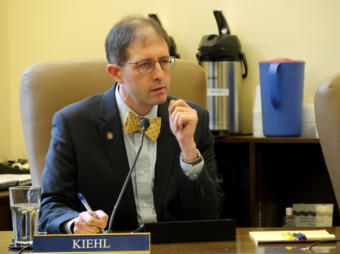
Sen. Jesse Kiehl, D-Juneau, listens during a Senate Judiciary Committee meeting in Juneau on March 22, 2019. Assistant Attorney General William Milks was laying out some details of Senate Bills 23 and 24, which would compensate Alaskans for past cuts to the Alaska Permanent Fund dividend.
Sen. Jesse Kiehl, D-Juneau, listens during a Senate Judiciary Committee meeting on March 22, 2019, in Juneau. (Photo by Skip Gray/360 North)

State officials haven’t said what service would look like in Southeast with both ships offline. Transportation officials said the plan is to bring both into dry dock for a side-by-side comparison next week to see which needs less work.

But both of those ships usually service the smaller communities in Southeast Alaska. In Tenakee Springs, Kennedy said the larger ferries can’t maneuver into his town’s dock.

“Our ferry dock is in in horrible shape. It’s supposed to be going out to bid to be replaced next summer. So I doubt whether they’d want to, you know, bring in a bigger ship to keep us going if the little ones were both down,” Kennedy said.

And it’s not just the smaller ships having issues. Earlier this month DOT announced the Malaspina would be in layup indefinitely starting in December.

State officials cited the $16 million cost of steel work as its reasoning for taking that ship out of service. Though, again, it was unclear how much of this could be covered with federal transportation dollars.

In Hoonah, a city of fewer than 800 people, Mayor Gerald Byers said local stores are already stockpiling dry goods as ferry service gets less frequent.

But for fresh produce and perishables, “it’s already expensive enough. If they have to fly that stuff over at 50 cents a pound, that’s eight pounds per gallon milk. So you’re going to have to add that $4 on the cost they’re already paying.”

The state does have two brand-new ferries: the Tazlina and the Hubbard. But neither are on the winter schedule. That’s because the state is adding side doors to allow them to load and unload more efficiently.

Correction: An earlier version of this story erroneously stated that DOT had estimated a total repair cost of $4 million for the LeConte. In fact, LeConte’s repairs will cost an additional $4 million on top of the $1.2 million already budgeted.
Coast Guard weighs dropping radio-based NAVTEX system to communicate with mariners

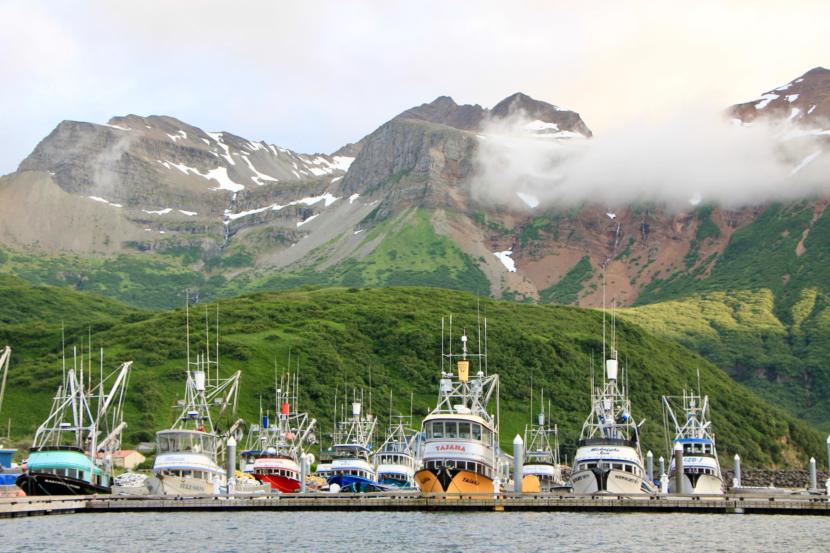
Fishing boats wait for an opener in the city harbor in Chignik. (Photo by Alex Hager/KDLG)

For decades, the Coast Guard’s NAVTEX towers have broadcast from Cape Cod to Kodiak Island. The global system broadcasts weather and safety information to boats large and small.

The International Maritime Organization developed the NAVTEX system decades ago as a means to get weather and urgent information to ships on the water. It’s low-tech. Receivers spit out basic telex-type messages onto paper or on a screen.

“The most common thing that you would see is a weather message, but you will also get public safety information messages,” said Derrick Croinex, the Coast Guard chief of spectrum management and telecommunications.

“We need to replace it because the infrastructure is old and it’s failing,” Croinex said.

But before the federal government commits to an expensive upgrade, Croinex said it wants to gauge how vital the service really is.

Right now, the International Maritime Organization is working on upgrading the text-only NAVTEX system to something called NAVDAT. The new system will include images and graphics. And when that system is ready, larger vessels will be required to upgrade to it.

But not if the Coast Guard phases out these radio-based systems completely.

“Our view is, it may be better and more reliable for people to actually switch to satellite,” Croinex said.

But some mariners are urging the Coast Guard to keep the free, low-tech service rather than switch over to subscription-based satellites.

In September, the Coast Guard made its case in a notice in the federal register. More than 50 people have commented so far, almost all in favor of keeping NAVTEX.

“It’s pretty deeply embedded across the fleet,” said Pete Devaris. “We find it on board, everything from ocean-going tugs to the commercial fishing fleet.”

Devaris was a Kodiak-based commercial fisherman for years. “It’s relatively cheap. We can buy used NAVTEX receivers on eBay for 100 bucks. And (International Maritime Organization) satellite services are a subscription service, so we’re talking about retrofitting, you know, an entire fleet with new technology, some that might not be available to the smaller vessels,” he said.

Piggybacking on commercial satellites would be much cheaper for the federal government. Croinex said feedback will help the Coast Guard justify investment in radio transmitters.

“We haven’t made a decision yet. We’re trying to get public opinion on this. Because we want to know, (does) the switch to satellite make more sense for people?” Croinex said.

Ed Page is the executive director of the Juneau-based Marine Exchange of Alaska. It provides real-time marine vessel tracking. Page said he’s concerned about a proposal that would migrate a free maritime service over to fee-based satellite platforms.

“I suspect some vessel operators will not pay for these added costs and go without accurate weather and safety information,” he wrote in an email.

The Coast Guard is accepting comments online through Nov. 12.

Editor’s Note: An earlier version of this article incorrectly reported that NAVTEX broadcasts were available via VHF radios and misidentified Pete Devaris.

Despite contamination, state will continue using PFAS-linked firefighting foam

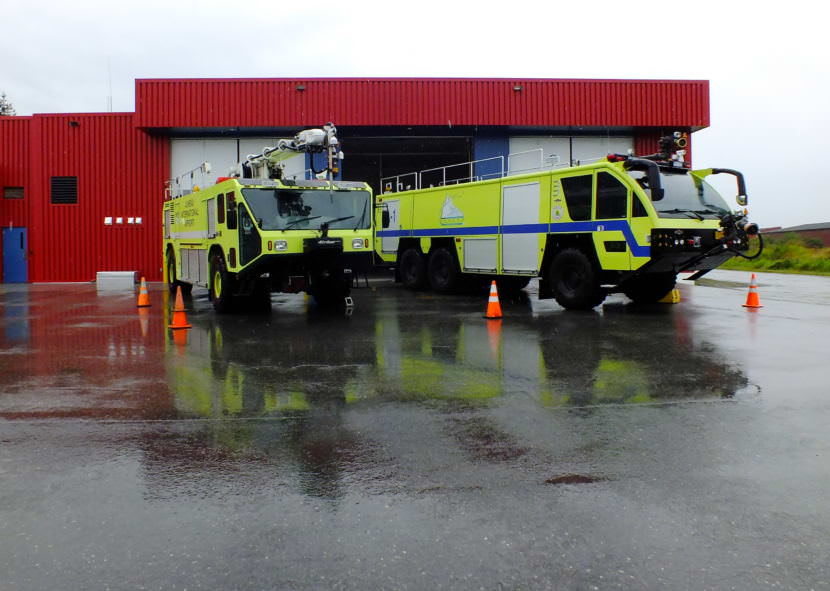
The 'first-outs', or the first ARFF vehicles dispatched to an incident at the Juneau International Airport, are parked outside the Glacier Valley Fire Station.
Two firefighting vehicles tailored for the Juneau International Airport are parked outside the Glacier Valley Fire Station in 2017. The results of tests for a contaminant known as PFAS — linked to firefighting foam used at airports — in the wetlands around the airport are pending. (Photo by Matt Miller/KTOO)

Burning fuel from a fiery plane crash can be tough to put out. That’s why firefighters at Alaska’s airports carry chemical agents for the job, and for decades the industry standard has been aqueous film-forming foams — known as AFFF — that smother the blaze.

“The whole goal of the foam is to essentially encapsulate the fuel that prevent oxygen from getting to it,” said John Binder, a deputy commissioner of Alaska’s Department of Transportation and Public Facilities overseeing state-owned airports.

But the same chemicals that make it effective for fighting fire are also linked to contamination in drinking water.

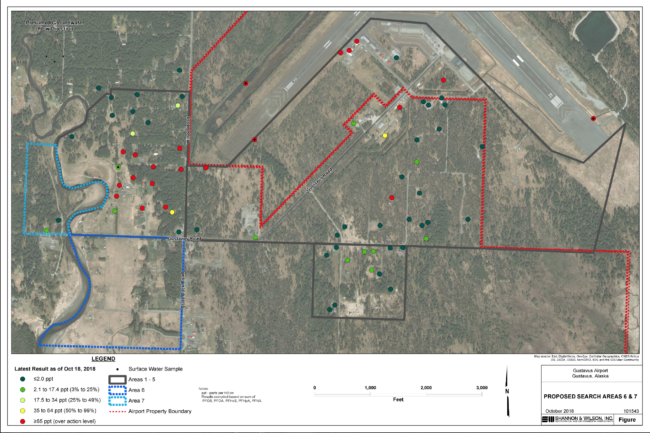
“It contains the (per- and polyfluoroalkyl substances, or PFAS) family of chemicals, and they have been used liberally in Gustavus and are in a lot of our groundwater,” said Kelly McLaughlin. She lives in the small Southeast community. State regulators said her household’s well is unsafe to drink from, so she’s been receiving state-supplied bottled water for more than a year.

Now she heads the grassroots Gustavus PFAS Action Coalition that has been asking for foams to be removed from her local airport.

“I just, I feel like it’s so toxic. It just needs to be gone,” she said.

But state officials said they’re not ready to do that, despite requests from Gustavus’ elected officials.

Gustavus Mayor Calvin Casipit said he understands where the state’s coming from, but Gustavus is in a unique situation — it is a low-lying area with a cluster of private wells around its airport.

PFAS levels in Gustavus. (Image courtesy of the Alaska Department of Transportation and Public Facilities)

I know they’ve used AFFF you know at other airports and stuff but do people drink the groundwater there?” Casipit said.

There are federal requirements for the types of firefighting agents kept at airports, but AFFF isn’t required at smaller ones — like Gustavus’s.

“The (Federal Aviation Administration) has an alternative that that meets the regulations. The community here doesn’t want to have this stuff around. I think that should be honored,” Casipit said.

But those in the know said the alternative just doesn’t work as well.

Juneau’s fire chief Rich Etheridge said he understands the environmental concerns, but when it comes to putting out burning aircraft, “there isn’t a product on the market that’s totally environmentally friendly that works like it’s supposed to.”

There’s contamination in Juneau too. Those PFAS chemicals linked to the firefighting foam have been measured in groundwater around the fire department’s training facility. The results of additional testing in the wetlands around Juneau’s airport are pending.

In the meantime, PFAS contamination from firefighting foams have officially tainted the drinking water in five communities. Because of the link to the foam, DOT is the legally responsible party and has been paying for bottled water supplied to households around Bristol Bay, Fairbanks, Yakutat and Gustavus.

DOT Deputy Commissioner John Binder said his agency is trying to balance the risk of contamination with its responsibility to keep airports safe. He said Alaska firefighters no longer train with the foam.

“The state and the various departments — primarily DOT and (the Alaska Department of Environmental Conservation) as well — are certainly well aware of the challenges associated with this subject. We’re working closely with the FAA on alternatives out there and doing our best to ensure that no contamination happens unintentionally here in the meantime, while we wait for a non-fluorinated foam to come available,” Binder said.

Meanwhile, the Pentagon is investing millions in research for alternatives. And last year, Washington became the first state in the nation to begin phasing out PFAS-laced firefighting foam.


Clarification: This article has been updated to clarify that while FAA regulations don’t require AFFF-type firefighting foam to be stored at small commercial airports like in Gustavus, it still requires it for larger facilities.

Kensington Gold Mine plans major expansion for operations past 2024

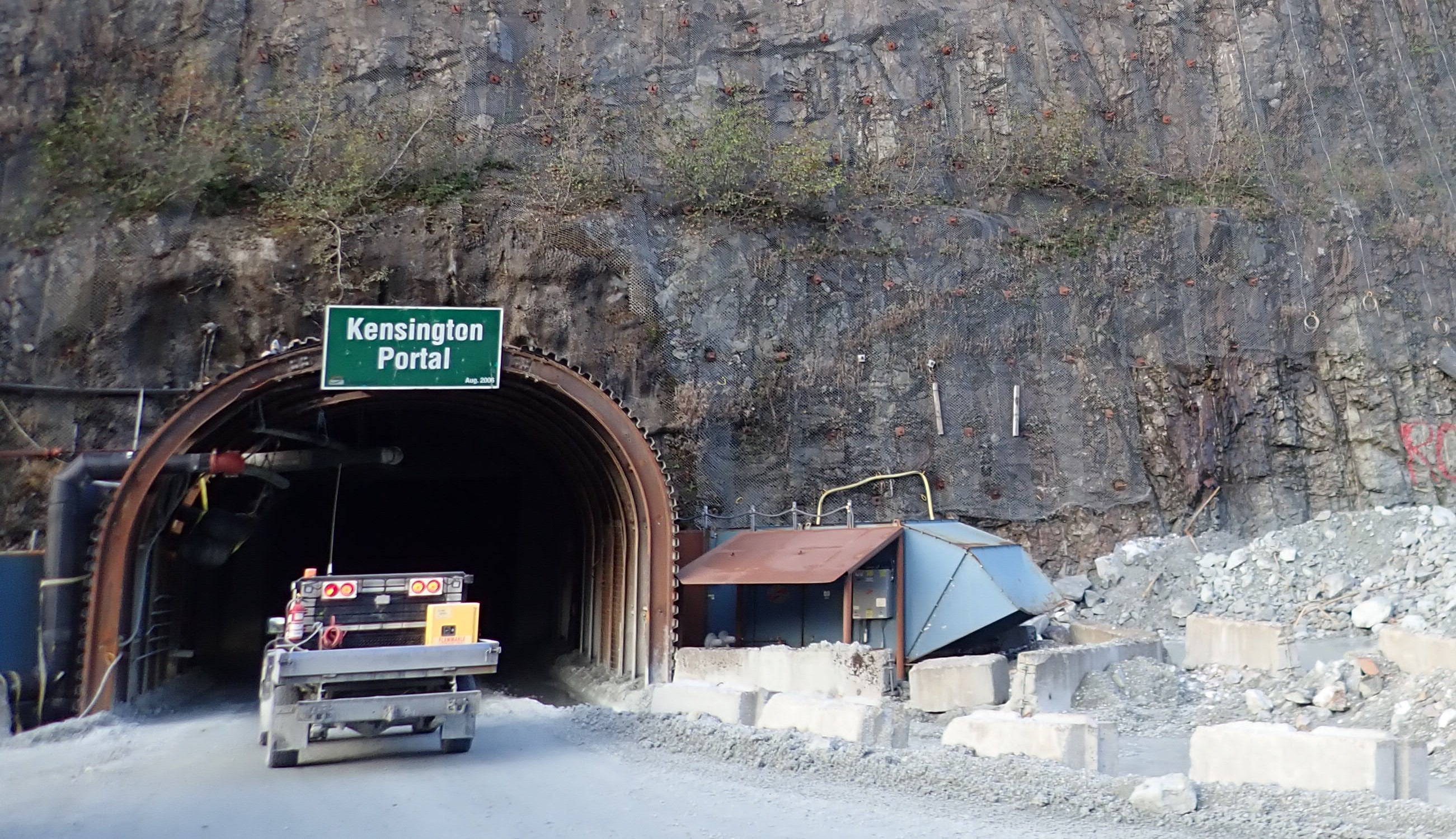
A mine vehicle enters the Kensington Portal on Oct. 15, 2019.
A mine vehicle enters the Kensington Portal on Oct. 15. It’s one of two accesses for a network of about 28 miles of underground tunnels. (Photo by Jacob Resneck/CoastAlaska)

Growth at the Kensington Gold Mine means the mine will need to expand its footprint considerably to keep operating for another decade.

The modern Kensington Gold Mine began operations in 2010. But its 28 miles of underground tunnels follow veins first explored and blasted more than a century ago.

Today, there are a number of sections underground that carry the names of 19th century and early 20th century operations in a remote area about 45 miles north of downtown Juneau.

“Kensington came from the historic Kensington mine, the Jualin came from the Jualin Mine,” Coeur Alaska’s General Manager Mark Kiessling told CoastAlaska during a recent site tour.

There’s heavy machinery loading ore to be milled into gold concentrate in the Elmira section. That follows the historic Elmira Mine though Coeur Alaska is only now expanding its blasting and drilling here.

A manager walks past Kensington Gold Mine’s Elmira deposit on Oct. 15, 2019.
A manager walks past Kensington Gold Mine’s Elmira deposit on Oct. 15. It’s one of the areas Coeur Alaska is currently exploring. (Photo by Jacob Resneck/CoastAlaska)

The point of showing all this is to demonstrate that 10 years into operations, there’s a lot of ore left to mine. But the mine company faces a challenge: it’s running out of room for the waste rock and tailings it’s generating as it mines ore and mills it into gold concentrate.

“We know that there’s additional veins out there,” Kiessling said.

The company projects it’ll be out of room for waste rock in 2022. And its tailings facility will be at capacity by 2024. Coeur Alaska — a subsidiary of Chicago-based Coeur Mining — has already started the permitting process to expand.

Filings with the U.S. Forest Service envision expanding three existing waste rock storage piles, adding a new one and to expand its footprint by 150 acres of the mine that’s on a patchwork of public and private land.

More controversially, the plan calls for expanding its tailings treatment facility. That’s a body of water that once appeared on maps as Lower Slate Lake.

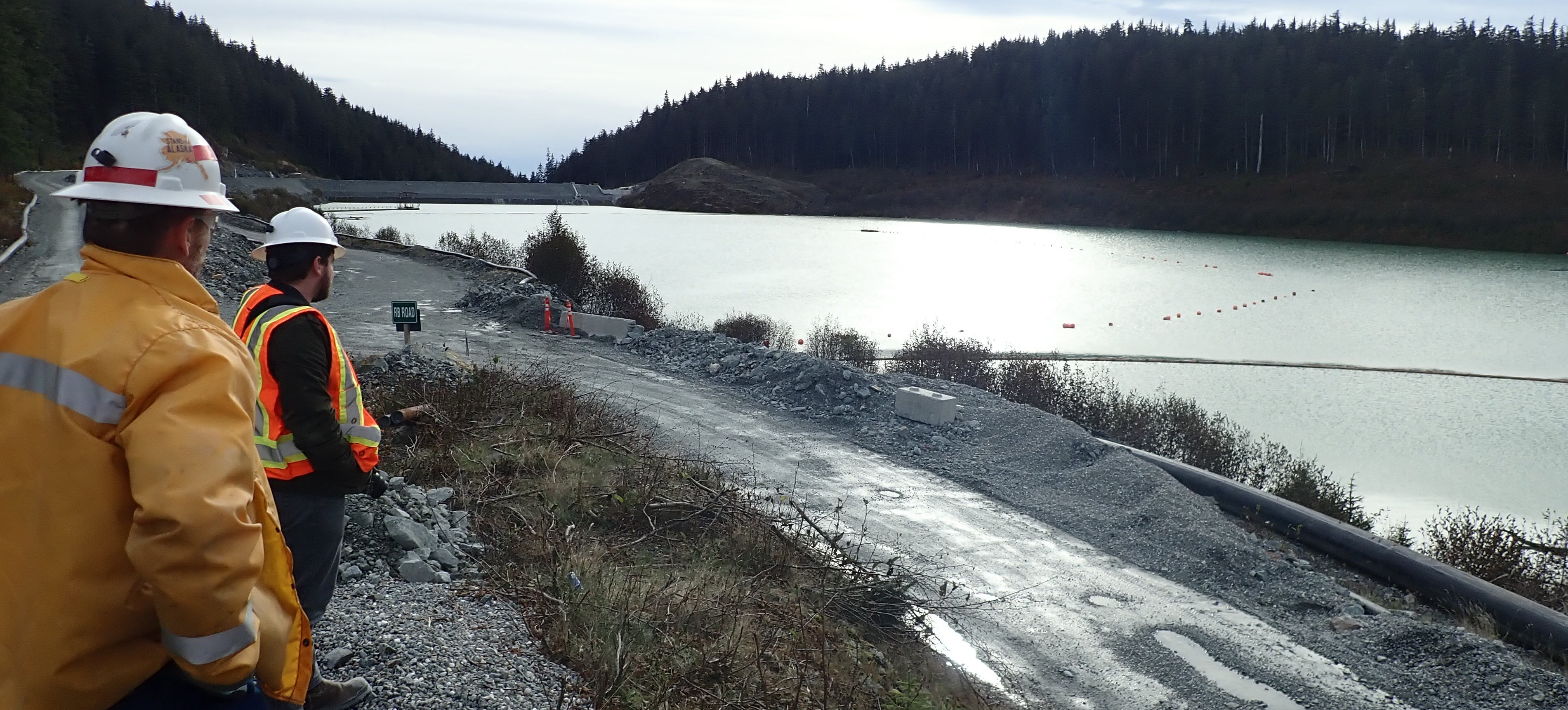
Lower Slate Lake, pictured here on Oct. 15, 2019, is now Kensington Mine’s tailings treatment facility.
Lower Slate Lake, pictured here on Oct. 15, is now Kensington Mine’s tailings treatment facility. But the mine company says its reclamation plan will treat the water body until it can sustain Dolly Varden and other fish species, and merge it with the neighboring Upper Slate Lake. (Photo by Jacob Resneck/CoastAlaska)

A U.S. Supreme Court decision in 2009 struck down environmentalists’ legal challenges. And for the first time in the United States, a mine operator was permitted to convert a natural lake into a holding pond for liquid mine waste.

To expand, the mine company wants to raise the lake’s artificial dam by 36 feet and buffer the opposite shoreline with rock.

“It would enable us to contain another 4 million tons of tailings,” Kevin Eppers, the mine’s environmental manager, told CoastAlaska.

And the company proposes a rock causeway to reinforce the lake’s shoreline to prevent the water line from spilling into the adjacent Upper Slate Lake.

Upper Slate Lake is a second natural lake that so far has been untouched by mine waste. Eventually, the company plans to flood Lower Slate Lake so that the two merge into one after the mine closes down for good.

Kiessling said the two lakes would merge only after the lower lake containing submerged mine waste is brought up to state water standards. That would be accomplished by filtering the water at its wastewater treatment plant.

“We would continue to treat until we reach those levels and if we weren’t able to reach those levels we continue to treat and treat and treat,” Kiessling said.

Coeur Alaska General Manager Mark Kiessling stands outside the Comet Portal of Kensington Mine on Oct. 15, 2019.
Coeur Alaska General Manager Mark Kiessling stands outside the Comet Portal of Kensington Mine on Oct. 15, 2019. Lynn Canal is in the background. (Photo by Jacob Resneck/CoastAlaska)

After which the mining company would allow the water to rise in the lower lake, spilling over the man-made causeway and leaving behind a single body of water capable of supporting fish habitat, including Dolly Varden.

“It’s going to be restored as a high quality lake,” he said.

So far a half dozen people have written to the U.S. Forest Service about the expansion. Two are in support, noting that Kensington Mine is one of the Southeast Alaska’s largest employers with nearly 400 people on its payroll.

Four letters were critical of the mine’s expansion. One in particular noted how in August the Environmental Protection Agency fined the mining company more than a half million dollars for permit violations.

Kensington’s proposed expansion has reigniting debate over the long-term safety of the mine on Lynn Canal and the surrounding watershed.

“Berners Bay is a natural resource that for all intents and purposes has existed forever,” staff scientist Guy Archibald of the Southeast Alaska Conservation Council said in a recent interview.

SEACC unsuccessfully sued to prevent Kensington from opening in the mid-2000s.

“We hope that it will continue to exist forever and not be completely destroyed by a mine that lasted 20 to 30 years,” Archibald said.

One of the EPA violations was for acidic runoff along the tailings dam. Mine engineers have been spraying concrete to try and contain the runoff with mixed results. The EPA has since modified the mine’s permit to allow acid rock runoff into the lake. But only after levying fines this summer.

Kiessling defends the mine’s environmental record and predicts raising the water levels in the tailings pond would address the acid runoff problem.

“By building the higher dam,” he said, “we feel that that’s going to give us an opportunity to kind of put that issue issue to rest.”

Kensington’s proposed expansion will go under a formal environmental review. But first the public has until Nov. 7 to weigh in on how much  or how little the mine should be allowed to expand its footprint in the Tongass National Forest.

Pacific tribes across borders declare ‘salmon emergency’

Taku River
The Taku River. (Photo courtesy Rivers Without Borders)

Tribal representatives from across Southeast Alaska, British Columbia and Washington state are sounding the alarm over threats posed to wild salmon across state and national borders.

“We will not surrender our responsibilities as stewards of the land and resources entrusted to us by our creator,” John Ward of the Taku River Tlingit in Atlin, British Columbia said in a statement.

Pacific tribes stretching from Yakutat, Alaska to Bellingham, Washington attended the three-day summit hosted by the Lummi Nation near Ferndale, Washington.

At the conclusion of the three-day summit, the tribal governments jointly pledged they are:

  • declaring a state of emergency regarding polluted waters and declining wild salmon stocks,
  • committing to understanding one another’s concerns, and
  • establishing a committee whereby individuals from Tribes and First Nations can come together and act on these shared concerns.

“We felt that the plight of the salmon is that emergency state at this time,” Tis Peterman, executive director the Southeast Alaska Indigenous Transboundary Commission, a consortium of 15 tribes in Southeast Alaska.

“It’s just death by a thousand cuts,” she said Thursday. “There’s so many things affecting our salmon, and this has been a focus of SEITC’s work for five years now.”

The tribes’ statement pointed to resource extraction industries, namely Canadian mines on transboundary watersheds that they say threaten fisheries that are primary food sources and the livelihoods of indigenous peoples.

In Alaska, the agency responsible for managing in-state fisheries is the Department of Fish and Game.

“I don’t think we’ve hit an emergency yet,” the agency’s Deputy Commissioner Ben Mulligan said Friday.

He said there are chinook runs that are stocks of concern on the Chilkat, Unuk and King Salmon rivers.

“We haven’t had an indication that we’re reaching that point where we would say overall in the whole of Southeast that those are stocks of concern,” he said.

But Peterman said at the tribal summit, the consensus was governments in both countries aren’t doing enough to protect wild salmon.

She said Canada’s First Nations, Alaska and Washington state tribes pledged to work closer in the future.

“Our message is we’re going to keep on working on this issue to try and come up with some solutions based on traditional ecological knowledge,” she said.

It was the second summit organized by SEITC.

Even more cruise ships are coming to Alaska in 2020

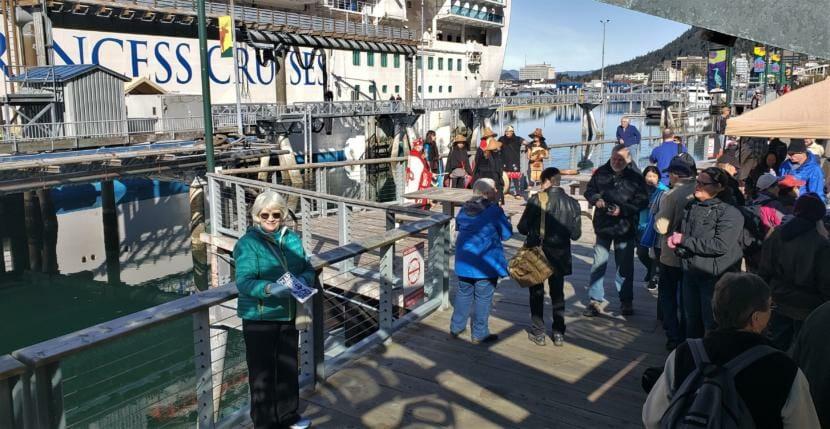
Vicki Logan of Travel Juneau greets and hands out walking maps to passengers of the Ruby Princess at the Franklin Dock on Sunday, April 28, 2019. (Photo by Jeremy Hsieh/KTOO)

Alaska cruise ship visitors are expected to break new records for the fifth straight year.

That’s according to an industry trade group whose projections for 2020 were announced Wednesday at Southeast Conference in Sitka.

Meilani Schijvens of Rain Coast Data said that at least 1.44 million passengers are expected next season.

“So that’s an increase of 6%,” she said. “So not a huge increase that we saw in 2019. But still a really healthy growth in terms of total number of passengers coming to the region.”

Between 2018 and 2019, cruise ship traffic increased by around 200,000 passengers across Southeast Alaska.

Next year, 10 new ships and 29 additional port calls are expected. The top destinations are Juneau, Ketchikan and Skagway. But the biggest leap will be for Hoonah, whose private Icy Strait Point entertainment complex is expected to more than double its visitors over two years.

The projections come from Cruise Lines International Association Alaska. The figures are for passengers and do not include crew.

Alaska cruise tourism accounts for 5% of global cruise ship passengers, according to the Rain Coast Data report.

The Southeast Conference is an organization of regional government and business leaders in Southeast Alaska. Its annual meeting runs through this Friday in Sitka.

Site notifications
Update notification options
Subscribe to notifications