Jacob Resneck, CoastAlaska

Jacob Resneck is CoastAlaska's regional news director based in Juneau. CoastAlaska is our partner in Southeast Alaska. KTOO collaborates with partners across the state to cover important news and to share stories with our audiences.

Researchers, marine pilots work to prevent vessel strikes from killing Alaska whales

Holland America Line cruise ship Noordam enters Glacier Bay National Park on July 16, 2019. (Photo by Jacob Resneck/CoastAlaska)
The Holland America Line cruise ship Noordam enters Glacier Bay National Park on July 16, 2019. (Photo by Jacob Resneck/CoastAlaska)

Over the past decade, federal officials have logged 77 incidents of vessels hitting whales in Alaska waters. About three-quarters of those, were endangered humpbacks. But, it’s not clear why those strikes keep happening. A group of federal researchers and marine pilots have teamed up to combine what scientists know about whale behavior with what marine pilots know about ships.

Most of the 3 million who visit Glacier Bay National Park every year never touch dry land. They view the majestic ice sheets from the deck of a cruise ship.

But for those that do make landfall, a visitors center in Bartlett Cove displays a towering skeleton of a humpback whale.

National Park Service scientist Scott Gende explains she didn’t die of natural causes.

“This is the whale that was struck in 2001 that by a cruise ship that was exiting Glacier Bay,” Gende said. “And it kind of served as a catalyst to a lot of the efforts to reduce the probability of collision between ships and whales in the park.”

The whale’s name was Snow. She was a pregnant humpback that park visitors had been photographing since 1975. Princess Cruise Lines ended up paying $750,000 to settle with the federal government.
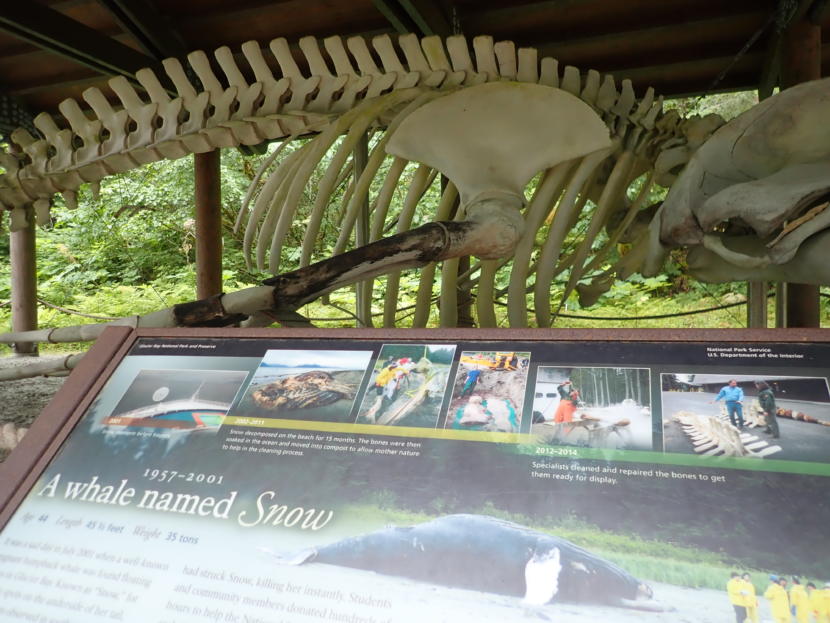
The reconstructed 45-foot long skeleton of Whale #68 has been on display at the national park’s visitor center at Bartlett Cove since 2014. The humpback had been well-known to park staff and visitors alike as “Snow” before being killed by a Princes Cruise Lines ship in 2001. (Photo by Jacob Resneck/Coast Alaska)

Vessel strikes are relatively rare — but they’re still a threat to endangered humpback whales.

Gende is riding as an observer on Holland America’s Noordam. He’s using a military-grade spotter scope and has a walkie-talkie to talk to the bridge.

“Two killer whales sighted, about 2,000 meters,” he informs the deck officers.

They acknowledge. Then he begins jotting down notes.

“We take a waypoint when we sight a whale and then we write down on the data sheet that has the distance the orientation, the behavior and the relative bearing to the ship,” he explained.

Gende designed this program that’s been logging observations since 2006 on how whales react as these hulking ships close in. But he didn’t realize how his data could translate into real-word advice — until a chance meeting with the people driving the ships.

In Alaska, foreign-flagged ships have to hire pilots to guide them through state waters.

“We do this all the time and it’s not just in Glacier Bay,” Gende recalled members of the Southeast Alaska Pilots Association telling him in 2013. “And, you know, we’d like to work with you and develop some of these ideas because you have a good grip on the science of whale behavior and, but we’re the ones out there operating the ships every day.”
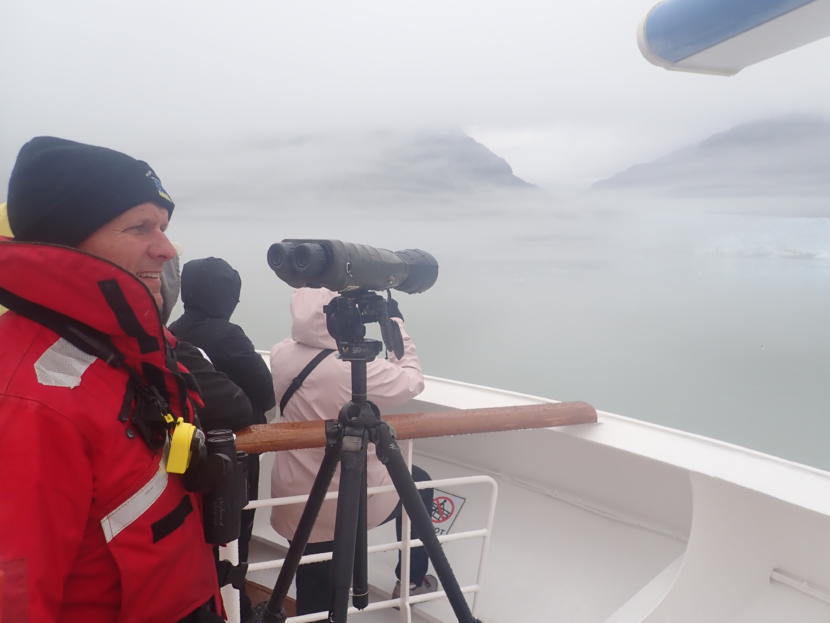
National Park Service scientist Scott Gende spots for whales and logs their behavior from the deck of the Noordam in Glacier Bay, Alaska. The cruise line has been providing space for federal whale observers in the national park since 2006. (Photo by Jacob Resneck/Coast Alaska)

The pilots had questions over federal regulations that require slowing down a ship when whales are sighted within a quarter mile in Glacier Bay. They say they want more flexibility in what course of action to take.

“Just like a deer running out in front of a car, you may or may not have time to react,” marine pilot Larry Vose told CoastAlaska. “And that action that you take has to factor in, do no further harm. Don’t drive head-on into a tree and don’t list a ship so much that you cause damage.”

Gende’s research coupled with the pilots experiences at the helm is getting results. Their research lays out what they’ve learned in Glacier Bay and some ways it could be applied in other places.

That’s important as NOAA has logged 182 whale strikes in U.S. waters over the last decade. But that’s an undercount: ships aren’t legally required to report when they hit whale.

And sometimes they don’t even know it’s happened. The dead whale can sink to the bottom or it decomposes on a remote beach.

Other times it isn’t discreet. Like in 2017 when a Princess Cruise Lines ship sailed into Ketchikan with a dead humpback across its bow.

“Quite frankly I have no idea when we picked the whale up,” Eric Chamberlin, a senior executive for Carnival Corporation’s subsidiaries Holland America and Princess Cruise Lines.

The collision reportedly happened at night. Nobody saw it and it wasn’t discovered until first light. He says, the crew had followed all of their procedures to avoid hitting whales. But he says the cruise industry is eager to improve in any way it can. For two reasons: it’s the right thing to do and it’s good business.

“It is of utmost importance that our use of the area, the resource of the area is sustainable,” Chamberlin said. “Because that’s really what brings the people to our ships.”
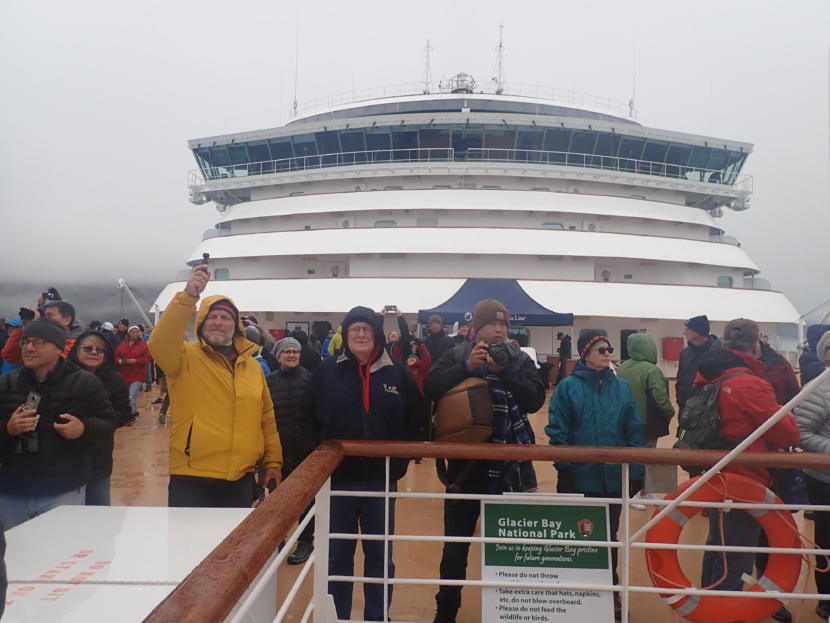
Cruise ship passengers on the forward observation deck of the Noordam vie for the best look at glaciers and whales. (Photo by Jacob Resneck/Coast Alaska)

Vose says he’s still learning even after decades driving ships in Southeast Alaska. He says he’s never hit a whale – but he’s had some close calls.

“There’s just times when for whatever reason with nothing else going on literally a whale surfaces close aboard,” he said.

This working group of federal researchers and independent marine pilots recently put their findings down on paper. Gende and Vose were among the co-authors of a peer-reviewed article published September 30 in the journal Frontiers in Marine Science.

Gende says eliminating vessel strikes is a long road ahead but he’s happy with what the group has contributed so far.

“If we can understand the nature of ship strikes without actually having ship strikes occur,” Gende said, “then you can formulate management actions, or we can understand avoidance maneuvers without having a bunch of dead whales on the beach.”

On the bow of the Holland America ship, passengers wrapped in parkas on a chilly summer day hoot and holler as a humpback whale sidles up to the ship. This is what they’ve come to Alaska to see.
LeConte ferry repairs to take 6 months; fate of sister ship Aurora unclear

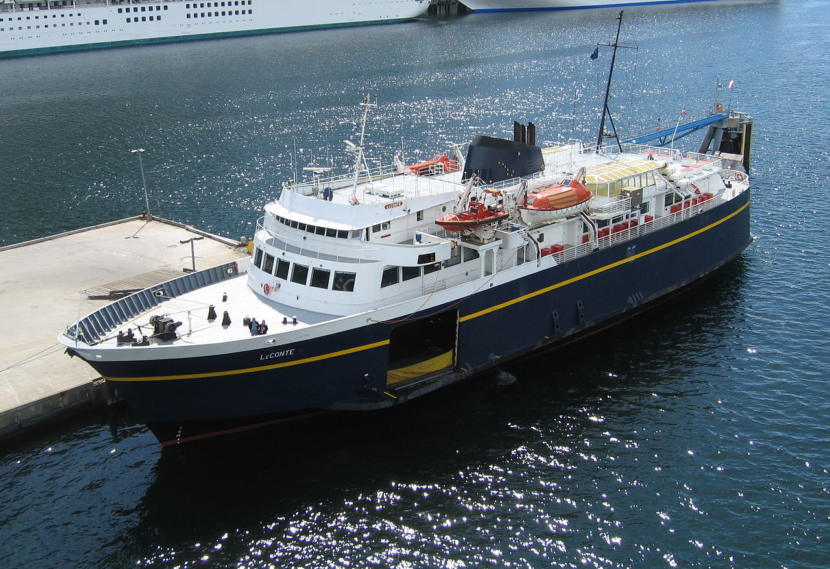
Alaska Marine Highway System ferry LeConte docked in Skagway in 2009. (Public domain photo by JWebber)

The ferry LeConte won’t return to service until May 15, according to representatives from the Alaska Marine Highway System. For at least two small Chichagof Island communities that translates into around seven months without a ferry.

The LeConte is one of two ships in the Alaska Marine Highway System fleet that can maneuver into communities with small docks. It went in for an overhaul in October. State officials said they discovered around $4 million in additional steel work would be needed to bring the 45-year-old vessel up to par.

Work has been at a standstill for at least three weeks.

Its sister ship, Aurora, was also due for its overhaul this month. Rather than repair both ships, state officials said they’d patch together the one needing the least amount of work.

On Thursday the state announced its decision: The LeConte will be repaired and should be back online May 15.

In the meantime, with both ships out of service, Southeast has been on a much-reduced schedule, with four communities getting no ferries at all.

“I mean, it’s just ridiculous,” Tenakee Springs Mayor Dan Kennedy said. “I feel like we should go up and close down the ALCAN for a week and see how they like it.”

Tenakee Springs has no airport or barge freight. The only other way in and out is by seaplane which mostly fly in fair weather.

“We got a couple guys with fishing boats who may be able to run back in and help keep the store stocked a bit,” Kennedy said. “But of course they’re more weather dependent than the ferry.”

That’s what the community of Pelican has been doing. It’s 40 miles west of Tenakee Springs on the opposite side of Chichagof, though there’s no road between them.

A salmon troller is preparing for its second run from Juneau with food and supplies to the small city.

But Pelican Mayor Walt Weller said it’s not a permanent solution.

“If the fishing picks up, or he goes winter king fishing, or the problem lasts until summer, then we’re not going to have that boat available at a decent rate,” Weller said.

The ferry Tazlina, one of a pair of $60 million Alaska-built vessels, has reentered service in Southeast after plans to add side-doors to allow it to load and unload efficiently were delayed.

It’ll be calling in Gustavus, which was among the communities whose ferry connection has been severed. It’ll also be attempting two runs into Angoon, where a broken ramp has plagued that community’s dock and prevented larger ferries from berthing.

But Alaska Marine Highway System spokesperson Sam Dapcevich said officials have found a workaround: A boom truck or crane will manually winch up Angoon’s broken ramp.

“We’re going to use heavy equipment to lift it up, and when the vessel backs in we’ll lower it with heavy equipment onto the deck,” Dapcevich said.

He said DOT is putting the repair project out to bid with the hope of getting it repaired in coming months.

In the meantime, efforts by Angoon’s city government to hire a private catamaran to ferry passengers to Juneau for supplies is having trouble finding a way for the voyage to pencil out.

On Wednesday, Nov. 20, the city announced it had signed up 18 people for a run the following Sunday, which would translate into $300 per person each way. The notice said the city and local tribe were considering a subsidy.

“Please understand that there is the potential that we may not have enough passengers for a November run and might not be able to pull it off,” the city wrote in a Facebook post signed by Angoon Mayor Joshua Bowen.

Tenakee Springs Mayor Dan Kennedy said the state never should’ve forced communities into this position.

“I don’t see it as the municipality’s responsibility,” Kennedy said, “when you know, people moved here, bought land and we’ve had the Alaska Marine Highway. And without it? We’re just left out in the wind.”

Transportation officials haven’t said what will be done with the LeConte’s sister ship Aurora. Its Thursday statement said it needs 20% more steel work than the LeConte.

In the meantime, the Aurora is being laid up in Ketchikan’s Ward Cove with no immediate plans for an overhaul. This comes as the state has also announced it’s laying up its mainliner Malaspina rather than invest the $16 million that is needed for steel work in that 56-year-old ship.

Future of Alaska ferry Malaspina in question as state consigns ship to ‘long-term layup’

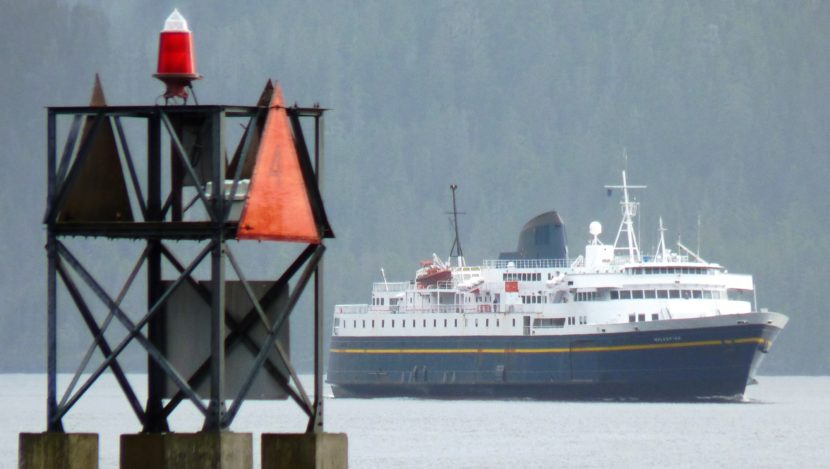
The ferry Malaspina makes a rare appearance near downtown Sitka in 2010. A new report suggests a public corporation be formed to manage ferry operations. (Photo by Ed Schoenfeld/CoastAlaska News)
The ferry Malaspina near downtown Sitka in 2010. Its last run could be as early as Dec. 2, 2019. (Photo by Ed Schoenfeld/CoastAlaska)

One of Alaska’s original ferries is being taken out of service next month. It’ll be tied up and its crew reassigned.

But marine engineers warn that, without a crew keeping things shipshape, things break down quickly. And there are questions whether the Malaspina’s trip south could be its last as an Alaska ferry.

Alaska Department of Transportation and Public Facilities officials announced that the Malaspina is being taken off the winter schedule for a simple reason: The 56-year-old ship needs an estimated $16 million in repairs. And the state says that’s not in the current budget.

By Jan. 10, the ferry will be uncrewed and tied up indefinitely. That means its systems are shut down, lines are drained and the equipment is secured.

There will be power on board. Transportation spokesperson Sam Dapcevich said that should help prevent damage.

“We keep the vessel heated, and we make sure that humidity is controlled to protect equipment from rust,” Dapcevich told CoastAlaska.

Retired ferry workers say it’s not the first time the ship has been taken out of service.

In the early 1990s, the state considered selling the Malaspina and tied it up in Auke Bay without power for a winter. But then it was needed the following the spring, so they had to restart the ship.

“When we got on board, the fuel system on the main engines was pretty much destroyed once we started running it again,” recalled former Alaska Marine Highway System engineer George Danner, who retired in 2007.

He was in charge of maintenance on the Malaspina for most of the 1990s. He said a few years later, the state decided to sideline the Malaspina again.

But engineers like Danner convinced management to assign a crew to service the Malaspina while she was tied up in Ketchikan.

“When we laid it up the second time, we knew what to do,” he said. “And therefore, we had the ability to maintain the engines. We would roll them over once a week. We’d start the generators.”

There’s no plan for that this time around. The layup will be completely “unmanned,” with no crew assigned to the ship which already needs a lot of work.

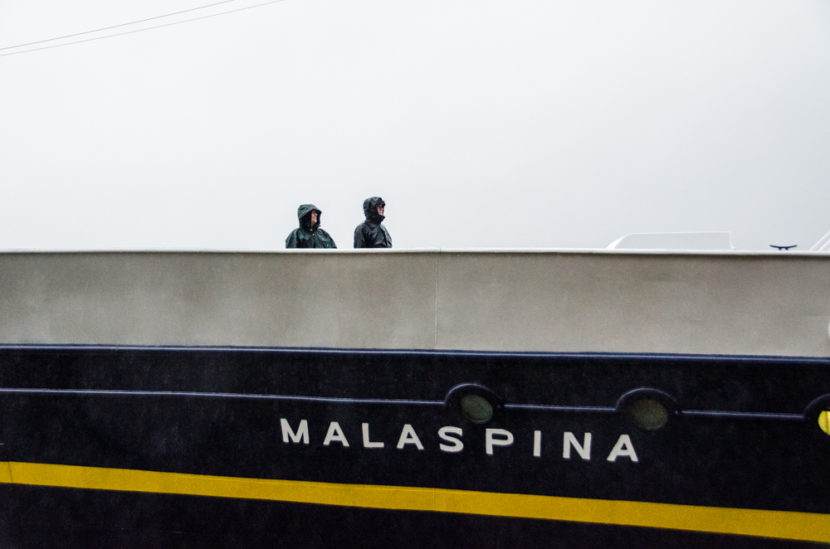
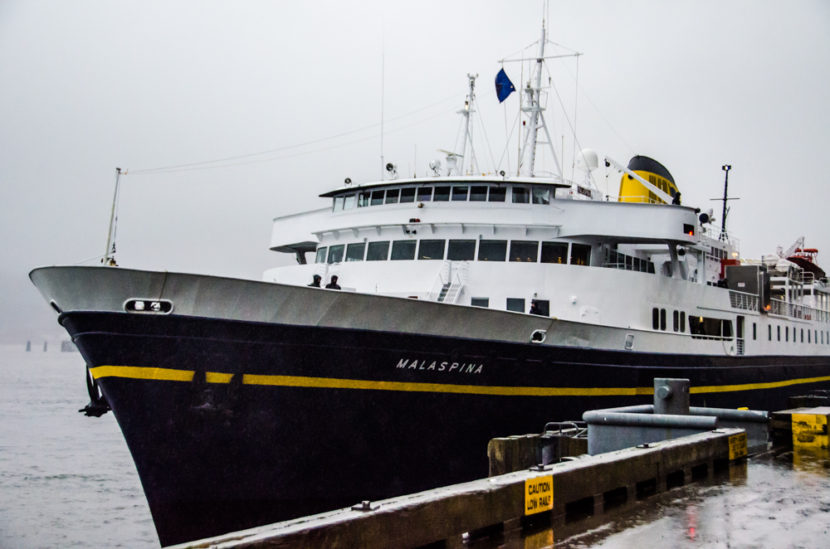
It was pouring rain when the Malaspina docked in Juneau.
The Malaspina docked in Juneau in 2013. (Photo by Heather Bryant/KTOO)

Outside experts in maritime maintenance say it’s not uncommon in the industry to temporarily shut down a ship that’s not needed.

“Essentially you are putting it on the side, and you are not so much forgetting about it but deferring any maintenance that’s required on it,” said David Satterwhite, a faculty member teaching marine engineering technology at the California State University Maritime Academy in Vallejo, California.

But Satterwhite said deferred maintenance has other costs in the long run. It’s one thing if the vessel is at the end of its service life.

“But if you’re in a situation where someday you’re going to put that back to work, then of course you’re going to want to put the manpower into — at the very minimum — keeping lights on or having a regular crew,” he said.

And then there are regulations to consider.

State ferries are inspected annually by the Coast Guard. The Malaspina’s current certificate of inspection expires in February.

If a ferry’s certificate lapses while it’s out of service, a simple renewal likely won’t be an option later on, Coast Guard Lt. Nicholas Capuzzi told CoastAlaska.

That means if and when the ship is brought back into service, the Malaspina would need to apply for a brand new certificate.

“Which is a deeper level of scrutiny,” Capuzzi said. “It includes stuff like operational tests of almost all the equipment on board. And also, depending on when the vessel was last out of the water for inspection, it could require the vessel to be dry-docked before being returned to service.”

The MV Malaspina docked in downtown Juneau on Saturday for the first time since the ferry terminal moved to Auke Bay.
The MV Malaspina docked in downtown Juneau on Saturday for the first time since the ferry terminal moved to Auke Bay. (Photo by Heather Bryant/KTOO)

Veterans of the marine highway like George Danner say the state shouldn’t make decisions over its dwindling fleet that it can’t take back.

“I’ve been on two or three ships on layup that, all of a sudden, something happens to another ship and they want your ship back on the line now,” Danner said. “Go ahead, lay up the Mal, but put a crew on it. So when you do need it, you at least have enough people there that know how to get it running and get it back in service.”

It’s not the first time in recent weeks that the state has decided to lay up a ferry rather than repair it.

The ferry LeConte was abruptly taken out service after the state balked at investing $4 million in repairs for that ship. That’s left Southeast Alaska communities with fewer ferries, or in some cases, no ferries at all.

All this is going on after Gov. Mike Dunleavy’s administration commissioned a $250,000 study on reshaping the marine highway. That report by Anchorage firm Northern Economics was delivered to the transportation agency last month.

The economic consultants were retained to work with the Dunleavy administration to “identify potential reductions of the state’s financial obligation and/or liability as they relate to (the ferries).”

In other words, it’ll recommend which vessels to keep, sell or scrap.

However, those recommendations are still under wraps. CoastAlaska filed a records request for a copy of the study and was denied. State officials say the report remains in draft and its findings won’t be public until mid-December.

By then, the Malaspina will have already delivered its last load of passengers, vehicles and freight.

The Malaspina was built in 1963 and is part of the original fleet of mainline ferries. Its final voyage is scheduled for Dec. 2.

Feds approve renaming Saginaw Bay over Kake War connections

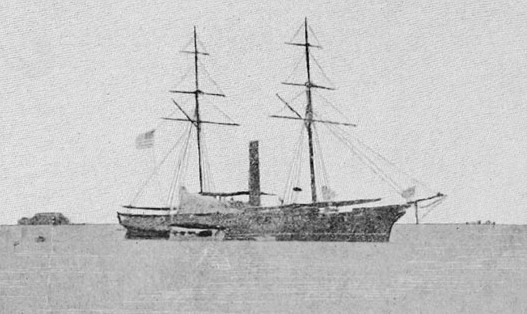
The U.S.S. Saginaw was built in 1859 at the U.S. Navy’s shipyard at Mare Island in California. A decade later, it shelled at least three Tlingit villages in Southeast Alaska. (Photo from George H. Read’s 1912 book “The Last Cruise of The Saginaw”/Public domain)

The U.S. Board on Geographic Names has approved changing the name of a bay in Southeast Alaska following a petition from tribal leaders complaining of its association with military aggression.

Saginaw Bay had been named after a U.S. warship that destroyed three communities in 1869.

Earlier this year, both the Alaska House of Representatives and Alaska Historical Commission endorsed changing the name to Skanax (skeh-NOCH) Bay.

The request came from the Organized Village of Kake, the local tribal government, and received unanimous approval on Thursday.

The three villages targeted by the U.S.S. Saginaw evacuated in advance of the attacks. But soldiers also burned winter food stores that, according to tribal oral accounts, led to the starvation and suffering of an untold number of people.

Other Southeast place names including Murder Cove, Surprise Harbor and Retaliation Point speak to a series of dark episodes more than 150 years ago that came to collectively be known as the Kake War.

The bay is off Kuiu Island, about equal distance between Petersburg and Sitka. In 2011, an unexploded 60-pound artillery shell from the bombardment was defused after being discovered in a house where it had been kept as a family heirloom.


Solutions sought to ease conflicts over Southeast Alaska’s rising sea otter populations

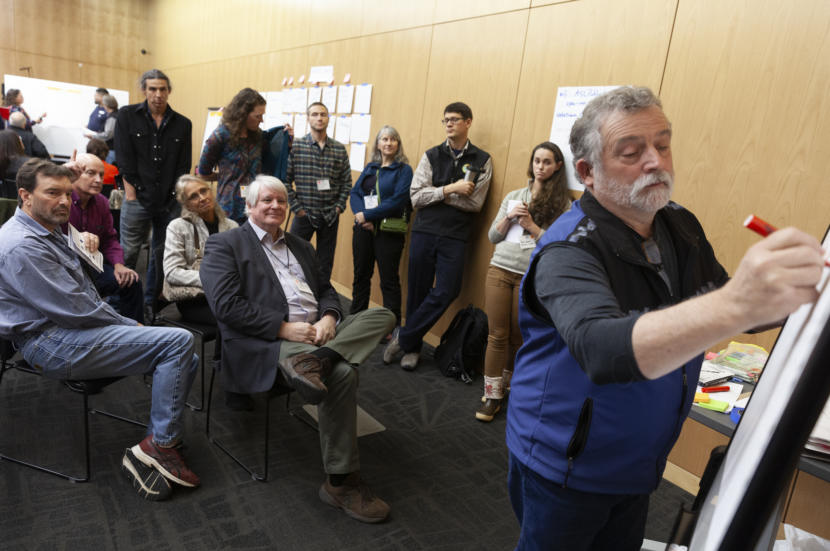
About 100 people from all over the state and Canada attended a Southeast Sea Otter Stakeholder Meeting hosted by the U.S. Fish and Wildlife Service held on Wednesday in Juneau, Alaska.
The idea is to discuss impacts from a population of sea otters that has reached at least 25,000 strong in the region. (Photos by Rashah McChesney/KTOO)

Efforts to ease conflicts over Southeast Alaska’s growing sea otter population are underway. Federal and state officials recently met with scientists, fishermen and tribal groups in Juneau to find solutions.

A hundred years ago, the fur trade wiped out sea otters in Southeast Alaska. They were reintroduced in the 1960s with 412 animals brought from Amchitka Island and Prince William Sound.

Since then, they’ve done really well. The last official estimate in 2012 shows that there are more than 25,000 of them.

But their success has changed their environment as they’re a keystone species.

That means they have a bigger effect than almost any other animal for their size on their ecosystems,” said USGS Western Ecological Research Center Research Biologist Tim Tinker. “Many of those effects are really disruptive to the existing, you know, commercial activities like shell fisheries that have developed.”

Their primary food source includes shellfish. Many of them are commercially harvested species like red sea urchin and geoduck clams. They also eat sea cucumbers.

Collectively these are known as Southeast Alaska’s dive fisheries and last year they brought in about $12.4 million. 

Phil Doherty, executive director of the Southeast Alaska Regional Dive Fisheries Association, said that when you add up all of divers, the deckhands, tenders and processors on the slime line, it’s significant for the winter economy.

I mean, we’re employing you know, five to six hundred people for four or five months,” Doherty told a room of about 100 interested stakeholders in Juneau. “So from an economic point of view, these dive fisheries are important.”

But even if federal and state managers wanted to curb the growing sea otter population, their options are limited. For one, they can’t just open a hunt on sea otters. The otters are covered by the Marine Mammal Protection Act. That means they can only be hunted by coastal Alaska Native people for subsistence or traditional crafts.

Mike Lockabey, of Wrangell, starts a discussion on solutions to sea otter management in Southeast Alaska on Wednesday in Juneau. About 100 people from all over the state and Canada attended a Southeast Sea Otter Stakeholder Meeting hosted by the U.S. Fish and Wildlife Service — the idea is to discuss impacts from a population of sea otters that has reached nearly 26,000 strong in the region.

Alaska Department of Fish and Game’s Fishery Biologist Kyle Hebert said state fisheries managers have a hard job managing commercial stocks depleted by foraging otters.

We feel pressure from industry to elevate harvest rates to try to take advantage of those species before they’re gone,” he said. “We also feel pressure and criticism for not reducing our harvests because of the sea otters.”

After a day-long meeting in Juneau, wildlife and fisheries managers, fishing industry and tribal representatives formed committee to recommend ways to manage the species.

A draft is expected by the end of the year.

But, that’s assuming the federal government isn’t shutdown later this month. U.S. Fish and Wildlife Service’s Chief of Marine Mammals Management in Alaska Patrick Lemons said a looming political impasse in Washington D.C. could set things back.

If we don’t have a government shutdown, we want to have a report available and produced on our website sometime early in the calendar year of 2020,” he told CoastAlaska.

The continuing conflict between fishermen and sea otters is not new. Nor is it limited to Alaska.

Tinker, the researcher who works out of the University of California in Santa Cruz, said it’s happening up and down the Pacific coast.

There’s no simple solution,” Tinker said. “But I think with all the stakeholders working together, you know, people with different interests and different understandings of these ecosystems, I think I think there are solutions, but it’s going to be it’ll be a long road.”

He recently published a paper estimating that Southeast Alaska’s carrying capacity could be three times the present population. That’d be around 75,000 sea otters over the next 30 to 40 years.

Abrupt Alaska ferry cancellations strand hundreds of people, vehicles

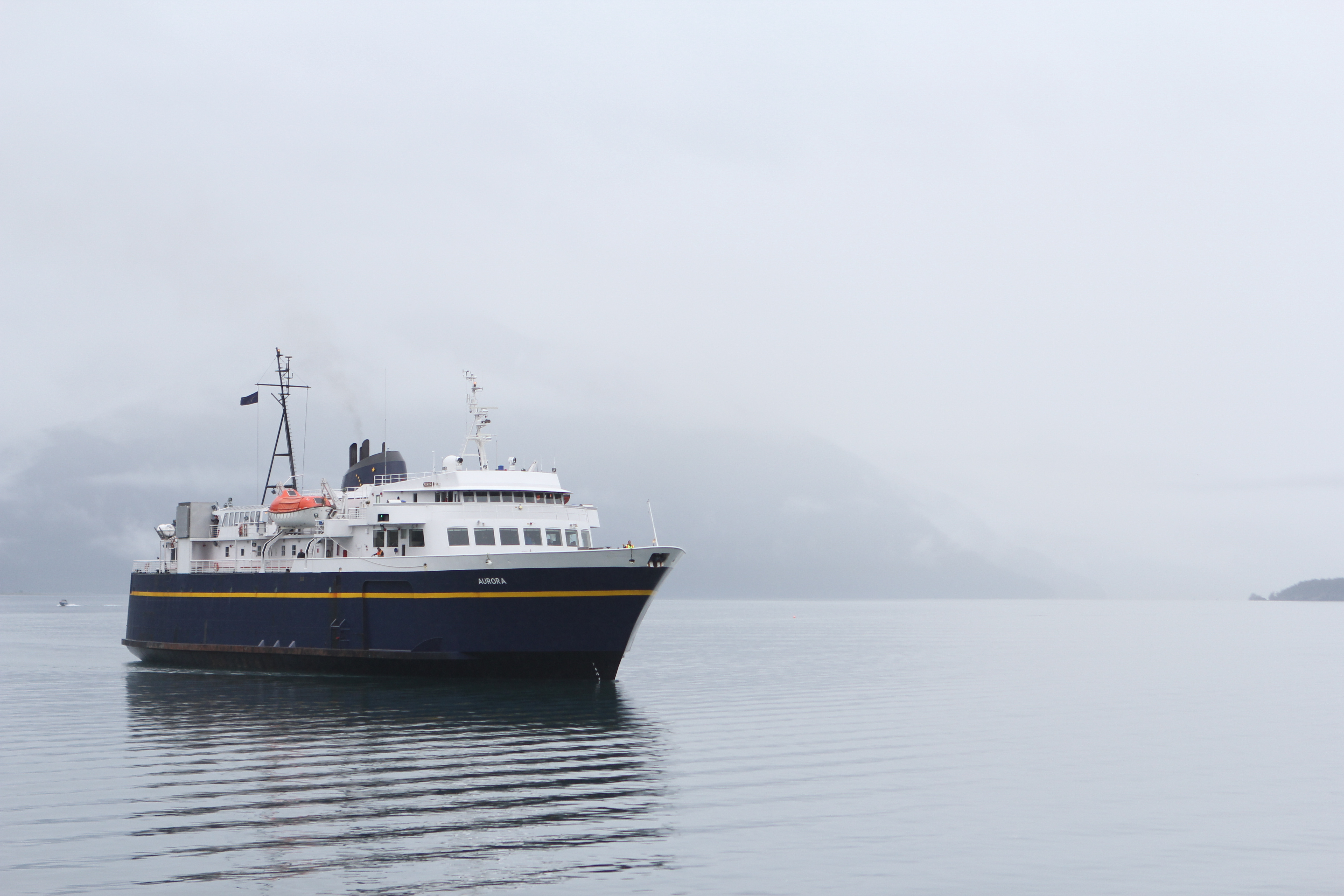
The Aurora, a 235-foot Alaska state ferry, approaches the dock in Whittier, its departure point for its trip across Prince William Sound to Cordova. (Photo by Nat Herz/Alaska’s Energy Desk)

Some 999 passengers with 526 vehicles were affected by the Alaska Marine Highway System’s abrupt cancellation of ferry service across much of Southeast Alaska. About 68% of passengers and 62% of vehicles canceled for a refund either because there was no alternative service or it was not feasible to travel.

That’s according to figures released Monday by the Alaska Department of Transportation.

Of the 682 passengers who canceled for a refund, 493 of them had little choice. That’s because the runs to Angoon, Tenakee Springs, Pelican and Gustavus are suspended until further notice.

Gustavus residents Steve and Deborah Hemenway had put off travel because of the ferry strike and then delay in a published winter schedule. But Steve Hemenway said the ferry’s reservation office assured the retired couple as late as Oct. 15 there would be service for their annual trip to the Lower 48.

“We tried to work with the Alaska Marine Highway System and just you know, we were just abandoned completely by it,” he said Monday from Tacoma, where they were visiting for annual medical and dental appointments.

After saying repairs to the ferry LeConte would be too costly to undertake, the Alaska Marine Highway System started calling passengers last week to break the news.

Steve Hemenway said he’s been a regular on the ferries since 1976. This is unlike anything he’s ever experienced.

“I’ve been stranded a couple times, but usually it was because of mechanical issues, and it was until the next ferry,” he said. “But I’ve contributed a lot of revenue to the ferry system and after all that time — this is what I get.”

There’s reduced service to Lynn Canal communities of Haines and Skagway. That’s allowed rebookings for most passengers and vehicles.

State transportation officials announced the LeConte needed $4 million more work than had been budgeted. State transportation officials said the plan is to compare the Aurora and LeConte, and to repair the vessel that needs the least amount of steel work.

“Repair estimates for the Aurora should be available by Nov. 15, which will give a more firm estimate for future service,” the DOT is telling ferry passengers.

Meanwhile, the two Alaska Class Ferries completed this year at a cost of $120 million are not sailing. They’re slated to have side doors installed this winter.

Regional state transportation spokesman Sam Dapcevich said his agency is negotiating with Vigor Alaska shipyard for this contract. He didn’t have a timeline of when the Tazlina or Hubbard ferries would be in service.

Correction: This story has been updated to correctly reflect that state officials say repair estimates for the ferry LeConte came back $4 million over budget, not $2.8 million.

Site notifications
Update notification options
Subscribe to notifications