Jacob Resneck, CoastAlaska

Jacob Resneck is CoastAlaska's regional news director based in Juneau. CoastAlaska is our partner in Southeast Alaska. KTOO collaborates with partners across the state to cover important news and to share stories with our audiences.

End of Alaska ferry strike nears as union asks members to ratify deal

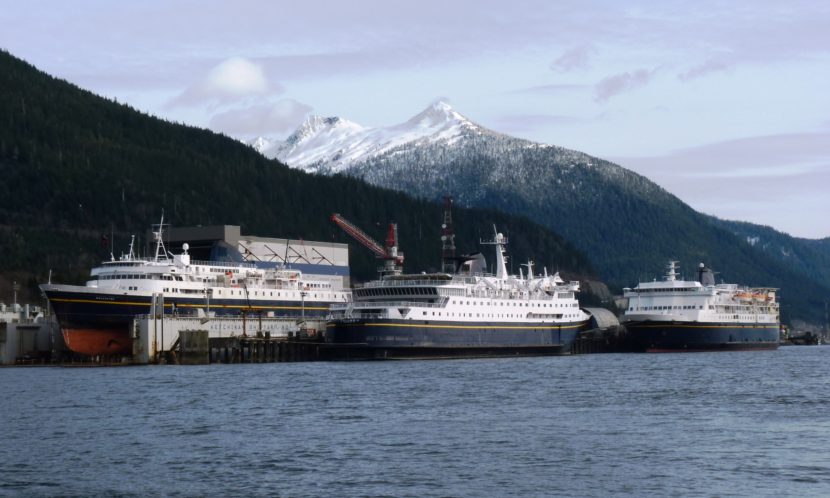
The Malaspina moored in Juneau during a strike by the Inlandboatmen’s Union of the Pacific on July 25, 2019 (Photo by David Purdy/KTOO)

Update: Alaska ferries resume sailing after striking workers ratify new contract

A tentative deal reached late Thursday between the state and a striking ferry union could get the Alaska Marine Highway System back up and running as early as this weekend.

Alaska Department of Transportation Commissioner John MacKinnon cautioned reporters Friday that the ferry shutdown – now in its tenth day – won’t be reversed overnight.

“I hope everyone understands that we can’t just flip a switch and get the ships running,” MacKinnon said. “They’ve got a schedule that they’ve got to get into, going the direction they need to go in order to get back on, on back in sync with everything.”

In a statement, the union praised the outcome.

“This new agreement addresses many of our members’ concerns,” Inlandboatmen’s Union of the Pacific President Marina Secchitano, the union’s chief negotiator, said in a statement. “We are very pleased with our new tentative agreement and we appreciate the efforts of the state’s bargaining team in helping to bridge our differences to reach a fair resolution.”

The long-running impasse over a contract deal turned into a systemwide shut down last Wednesday. The draft contract now goes before the IBU’s 430-odd members for ratification.

Alaska Department of Administration Commissioner Kelly Tshibaka says details of the agreement wouldn’t be public until that happens.

“But the areas that were subject for the greatest area of compromise were in terms of wages, health care and the duration of the contract,” she told reporters Friday.
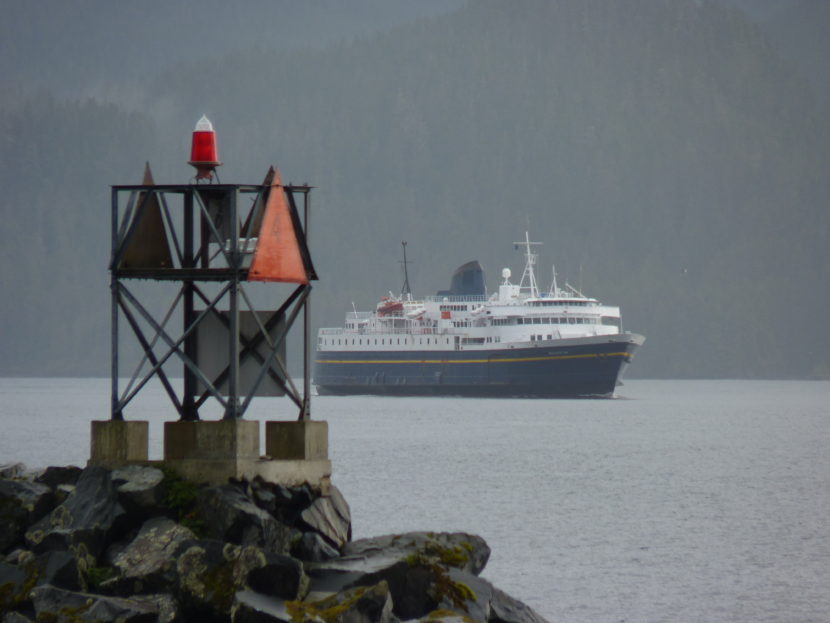
ferry Malaspina
The ferry Malaspina makes a rare visit to waters off downtown Sitka during the 2010 Alaska Day celebration. A state transportation plan would route ferries to a new terminal across Baranof Island at the end of a new road. (Ed Schoenfeld/CoastAlaska News)

The tentative contract is for three years, something the union had been pushing for. Earlier Friday, IBU members packed up their round-the-clock picket lines at ferry terminals in Juneau and Ketchikan.

The ferry strike forced the state to refund $3.2 million in fares for 8,300 passengers and 2,300 vehicles, Mackinnon said.

“That is a big revenue hit to the system and you know that loss of revenue will impact our ability to operate,” he added.

Negotiations through a federal mediator were held all week and often late into the night. State Sen. Jesse Kiehl (D-Juneau) says he and his staff did what they could to keep everyone at the table.

“We booked meeting rooms in legislative space so it was neutral ground and we made coffee and emptied wastebaskets and whatever we could do — without breaking the rules — to first get the parties talking, and then keep them talking,” Kiehl told CoastAlaska.

Kiehl says the strike heavily disrupted the flow of people, freight and vehicles.

“I am really, really excited at the prospect of getting that service moving again,” he said, “those vessels need to sail for the economy and the culture of coastal Alaska.”

The IBU has been seeking 3% raises annually for the next three years. That’s after two years of wage freezes. The cost of health care premiums to workers and a disparity in pay between Alaska residents and non-residents have also been sticking points.

State officials had alleged some of the union’s initial demands were unlawful and had threatened that striking workers could face suspension or termination, calling the strike illegal.

The Alaska Marine Highway System hadn’t previously been shut down by a strike since 1977.
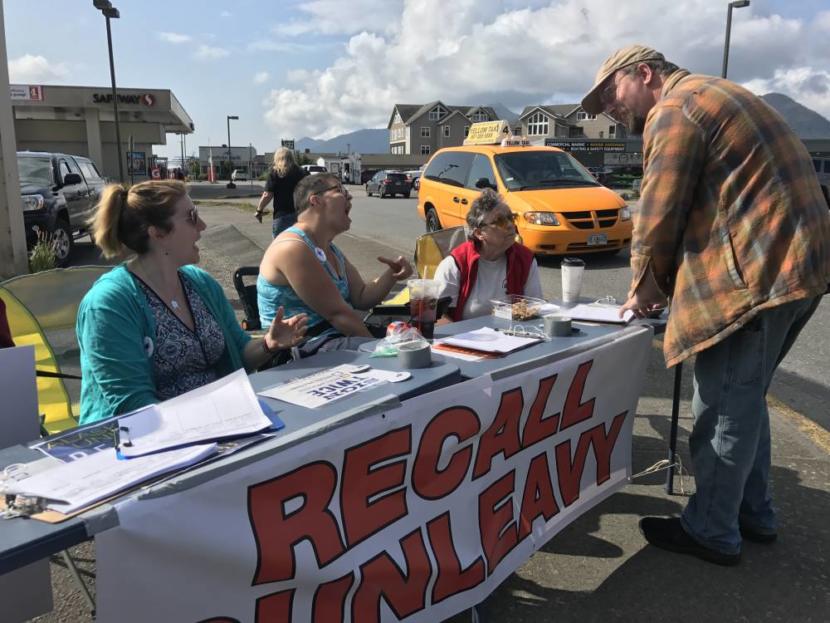
Across coastal Alaska, Recall Dunleavy campaign gets underway

Recall Dunleavy volunteers Frankie Urquhart, left, Jessie Chapman and Pat Chapman gather signatures on Aug. 1 in downtown Ketchikan for a petition to remove Gov. Mike Dunleavy from office. (Photo by Elizabeth Gabriel/KRBD)

A statewide effort got underway Thursday seeking to remove Gov. Mike Dunleavy from office. The first step for campaigners is to gather 28,501 signatures to start a recall petition.

Across coastal communities, campaigners say public anger is rising over line-item vetoes that eliminated about $400 million from the state’s budget and affecting everything from the university, health care, social services and more.

In downtown Ketchikan, Frankie Urquhart says the early birds were out in force. A dozen signatures came in during the first six minutes.

I’ve had texts this morning from people asking, ‘when are you going to be out there?'” she said. “So I anticipate that we’re going to be getting some folks coming in all day long at least.”

In Juneau, a downtown gallery was buzzing at 10 a.m. with dozens of people signing in the middle of a work day.

Gallery owner Vivian Mork says she’s not usually a political person, but she says anxiety about the governor’s cost-cutting is bringing people together to have “long, complicated conversations” about the state’s future.

“And I think that’s one of the things that’s lovely about Alaskans is that so many diverse people sit right next to each other,” she said.

Pat Race is a Juneau cartoonist volunteering to collect signatures. He says he hopes this recall effort puts pressure on the governor, who’s poised to wield another round of vetoes. Previous days and hours of public testimony haven’t appeared to sway the Dunleavy administration.

You know, many of the people who are signing these things today have taken time out of their lives in their work to go up and testify and they aren’t feeling heard and they aren’t feeling responded to,” Race said. “And so, they’re going to put their name down on this piece of paper and they’re going to apply pressure in this way.”

In the Yukon-Kuskokwim Delta, volunteers walked right up to cars caught in a Bethel traffic jam during the lunch hour to get signatures.

Kathleen Naneng took a moment to sign while her car idled. She says she’s not a fan of the governor focusing on paying out a large lump sum cash payment through the dividend checks at the expense of social services and other safety nets.

“I don’t want bigger dividends; I want people to be taken care of,” she said. “Because dividend time can be a really sad time in our area because people don’t spend it on the right things.”

In Kodiak, the local brewery doesn’t usually have a lot of people when it opens at noon. Thursday was different with 75 people signing in the first 90 minutes.

Donna Hurley came with her seven-year-old granddaughter. She’s angered that the governor vetoed $335,000 from the court’s budget to punish it for funding abortion services.

He’s not the king — he’s acting like the king — but he’s not,” Hurley said. “He just needs to go.”

Republican lawmakers are divided over the governor’s agenda. But the party’s leadership is urging people to stand by the governor they elected last year.

I think they ought to think twice about it before they sign any documents,” said Alaska Republican Party Chairman Glenn Clary.

Clary wouldn’t comment on whether the state GOP has plans for a campaign to counter the recall effort, which he said has a steep hill to climb.

If you remember the governor won by 20,000 votes against an opponent who was a U.S. Senator, was the mayor of Anchorage,” he said, referring to Mark Begich.

Meanwhile in Yakutat — a community of about 450 people — volunteers reported gathering 50 signatures in the first two hours.

That’s pretty good just for sitting in the local grocery store while people are working,” volunteer Mary Knutsen said.

Yakutat, she says, is bracing for the prospect of no state ferries for seven months, the elimination of cash assistance for low-income seniors, and cuts to pre-K and public education.

“Our school here has already faced massive budget cuts over the last decade, and the possibility of losing more funding, could you know just destroy our entire school district here,” she said by phone.

In a seven-page memo, the Recall Dunleavy group cited the grounds it intends to try and force the governor’s removal. They include: failure to appoint a state judge within 45 days, using state funds to promote a partisan agenda and misusing line-item veto power.

The campaign is grassroots and so far staffed by mostly volunteer signature gatherers.

Getting around 29,000 voters would only be the first step. A second petition gathering at least 71,000 signatures of registered voters will be needed in the second round. Then it would go to the Division of Elections overseen by Lt. Gov. Kevin Meyer.

Alaska’s last formal recall effort against a sitting governor was in 1992 against Wally Hickel. It was subsequently dropped.

If Gov. Dunleavy is recalled in a special election, he would be automatically succeeded by the lieutenant governor.

With additional reporting from Krysti Shallenberger in Bethel, Kavitha George in Kodiak and Elizabeth Gabriel in Ketchikan.

Ferry union, state of Alaska reach tentative agreement

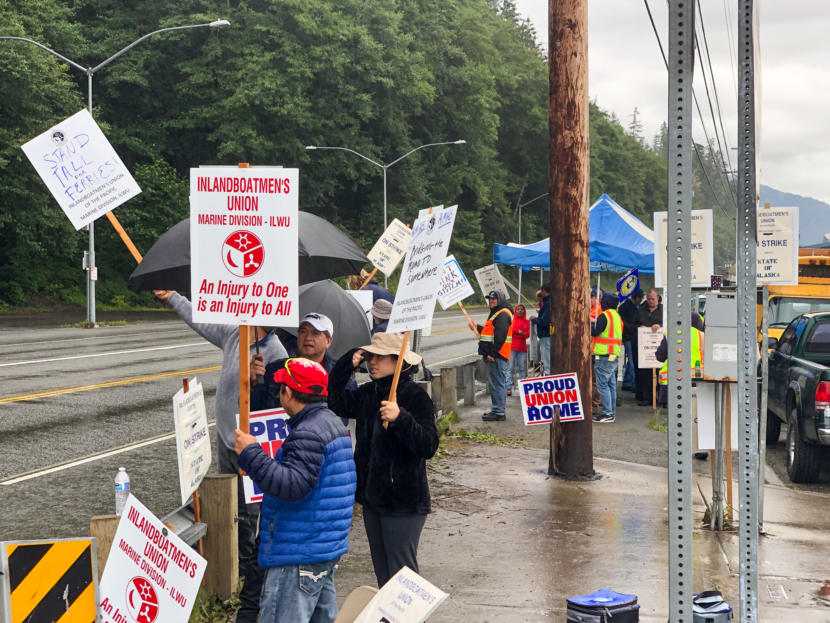
People hold picket signs at the Alaska Marine Highway System ferry facilities in Juneau during the Inlandboatmen’s Union of the Pacific strike on July 25, 2019. (Photo by David Purdy/KTOO)

Negotiators for the state of Alaska and the Inlandboatmen’s Union of the Pacific reached a tentative agreement late Thursday night, which could bring an end to Alaska’s ferry strike.

But IBU leaders say they’re waiting for a majority of their 400-odd members to ratify the deal before going back to work.

Alaska state Sen. Jesse Kiehl, D-Juneau, said he and his staff did what they could to help facilitate the talks, such as booking meeting rooms, but he was not privy to the details.

Negotiations had stalled after last weekend. Talks with a federal mediator resumed this week after a recess.

The Alaska Department of Administration commissioner has called a press conference scheduled for noon on Friday to brief reporters.

The strike was called last Wednesday by the ferry’s largest union, shutting down the Alaska Marine Highway System. That initially stranded hundreds of people and their vehicles and disrupted the flow of freight and goods.

The IBU has been seeking a three-year contract with 3% raises annually. That’s after two years of wage freezes. The cost of health care premiums and a disparity in pay between Alaska residents and non-residents have also been sticking points.

State officials had alleged some of the union’s initial demands were unlawful and threatened that striking workers could face suspension or termination because the strike was illegal.

In Ketchikan, stranded passengers and striking workers as Alaska’s ferry system shuts down

Crew members from the ferry Columbia erected a picket line in Ketchikan on July 24, 2019, after the Inlandboatmen’s Union of the Pacific called the first ferry strike in more than 40 years. (Photo by Maria Dudzak/KRBD)

The largest union representing ferry workers called a strike at 2 p.m. Wednesday, shutting down the Alaska Marine Highway System until further notice.

‘A little bit of a hassle’

In Ketchikan, approximately 30 picketing ferry workers stood on the sidewalk outside the AMHS terminal where the ferry Columbia was set to depart for Bellingham, Washington. They gripped signs and chanted slogans demanding a fair contract as cars passed by and honked.

About a dozen cars waited in the parking lot, some with 2-5 passengers, others with children — all wondering if they’ll be able to make their ferry connection to Bellingham.

It’s the busiest time of the year for the Alaska Marine Highway System, with vacationers and Alaskans alike headed to the Lower 48. (Photo by Maria Dudzak/KRBD)

As it turns out, probably not.

Monty Anderson just completed a fishing trip on Prince of Wales Island.

Well, we got 100 pounds of salmon in the back that might ruin, and we’re all going to be late for work,” he said. “So it’s going to be a little bit of a hassle.”

He’s headed back to start a new job but isn’t sure if he’ll make it in time.

“I’m supposed to be in San Diego on Monday,” he said. “And if I don’t make it there, they’re gonna hire another crane operator, so it’ll be a big inconvenience.”

Melanie Fehr lives in Craig on Prince of Wales Island. Her truck is loaded for a long drive to Arizona.

I’ve gotta get my kids down south for some school,” she said. “They start school on the seventh, so they’ve got a long way to go.”

Department of Transportation and Public Facilities Commissioner John MacKinnon said in a statement that shoreside support would be offered for rebooking or refunds for ticketed passengers.

The Alaska Marine Highway System shut down after a strike was called by the IBU at 2 p.m. Wednesday. (Photo by Maria Dudzak/KRBD)

Negotiations at an impasse

In Juneau, officers of the Inlandboatmen’s Union of the Pacific said a last-ditch effort at compromise with state labor negotiators failed Wednesday afternoon.

The union had warned the night before that a strike was imminent if it didn’t get a contract deal. It’s been negotiating for the past three years. An impasse last week led a majority of members to vote to authorize taking direct action.

“I’ve negotiated for 25 years and, you know, had probably two strikes in my life,” said Marina Secchitano, president of the union. “You know, it takes a special circumstance to get 86% of your membership voting for a strike.”

IBU has about 430 members who work on AMHS ferries.

Robb Arnold, vice chair of the union’s Alaska region executive board, acknowledged there are concerns that a strike could play into the hands of the state ferry system’s critics.

Maybe it is a trap,” he said. “Maybe they have set it for us. But you know what? I think that cooler minds in the (Alaska) Legislature do not want to see this system shut down.

IBU’s last Alaska ferry strike was in 1977.

KRBD’s Elizabeth Gabriel in Ketchikan contributed to this report.

Updated: Alaska Marine Highway faces shutdown after ferry union goes on strike

A strike by the largest union representing crew members would effectively tie up vessels indefinitely. (Ed Schoenfeld/CoastAlaska News)

Update (Thursday, 2:18 p.m.) — Jacob Resneck, CoastAlaska

There’s confusion and disappointment at Alaska’s marine terminals, in Ketchikan and elsewhere, after a strike shut down the state ferry system. (Read more.)

Update (Wednesday, 3:47 p.m.) — Jacob Resneck, CoastAlaska

Inlandboatmen’s Union of the Pacific called a strike for its 400-plus Alaska Marine Highway System ferry workers Wednesday afternoon. Crew and passengers are disembarking vessels.

This is a developing story.

Original story

A labor dispute involving the largest union representing state ferry workers is poised to paralyze the Alaska Marine Highway System.

Hundreds of ferry workers are threatening to strike as early as Wednesday afternoon after contract negotiations broke down and a majority of the Inlandboatmen’s Union of the Pacific’s Alaska chapter members voted to authorize direct action.

“We remain hopeful that the state will accept the union’s last compromise contract offer that will keep the state’s ferry system running smoothly for the residents of Alaska,” IBU President Marina Secchitano said in a statement.

A strike by more than 400 IBU members would immediately shut down sailings for at least a half dozen vessels.

“There’s 107,301 Alaskans who live in communities served by the ferry that will lose their regular service,” Trina Arnold, regional director of the IBU’s Alaska chapter said in a statement.

Alaska Department of Transportation & Public Facilities Commissioner John MacKinnon said a systemwide shut down would impact residents, visitors and commerce during the busiest time of year.

“We plan to return ships to safe harbor with adequate shoreside support and contact ticketed passengers to work with them to continue their journey, reschedule or offer refunds,” MacKinnon said in a statement.

The union put out its strike warning on Tuesday evening. It said 86% of its members voted to reject what it described as a “harsh package” that would rollback more than two dozen settlements that had been negotiated over the past three years and freeze wages for five years.

Hours later state officials declared an impasse over what is described as the union’s demand for a 9% pay increase over three years and letting its members choose vessel assignments.

The union and state labor relations team have been in meetings to hammer out a new contract that expired in May.

Mediation failed after talks broke down last week.

But Department of Administration Commissioner Kelly Tshibaka — who oversees labor relations — said in a statement that her team was committed to a good-faith resolution.

“We remain open to working with the IBU and to reaching an agreement that is fair to the employees, fair to the State of Alaska, and good for all Alaskans,” she said.

The other two ferry unions are not involved.

The AFL-CIO-affiliated International Organization of Masters, Mates & Pilots and the Marine Engineers’ Beneficial Association have both negotiated a one-year extension to their contracts.

Forest Service chief makes quiet visit to Tongass National Forest

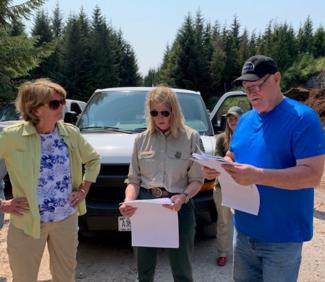
Sen. Lisa Murkowski and U.S. Forest Service Chief Vicki Christiansen visited Naukati July 6 on Prince of Wales Island where the forest service completed a land swap with the Alaska Mental Health Trust. (Photo courtesy of Senate Energy & Natural Resources Committee)

Sen. Lisa Murkowski recently hosted the U.S. Forest Service’s top official in a visit to Tongass National Forest. The delegation kept a low profile during its visit to Southeast Alaska.

Back in a mid-May budget hearing, Murkowski quizzed Forest Service Chief Vicki Christiansen. She wanted to know why recent timber sales in Tongass National Forest had no takers. And what was the Forest Service doing about it?

“It is a challenge and I’d be glad to work with you more even come up to Alaska that we can roll up our sleeves and really look at this,” Christiansen replied.

Murkowski — who chairs the powerful Senate Energy & Natural Resources Committee — acted on this opening.

“I welcome you up to this state any time summer, winter, spring fall,” she said.

Christiansen chose summer. She spent July 6 and 7 in Wrangell, Ketchikan and Prince Wales Island as part of a flying visit with Alaska’s senior senator.

At a Saturday morning meeting in Wrangell, the delegation heard from the timber industry and its boosters.

“There was discussion about making sure that we’re able to keep the one remaining mill in Southeast operational,” Wrangell Borough Manager Lisa Von Bargen told CoastAlaska on Friday.

That would be Viking Lumber Mill on Prince of Wales Island which employees a few dozen people.

“And they’re struggling to get enough wood to keep going,” said Frank Roppel, a veteran figure in Southeast Alaska’s logging industry who sat in on the meeting.

The octogenarian was a top Alaska Pulp Corporation executive. In its day, the company was a top regional employer, operating a sawmill in Wrangell and a pulp mill in Sitka from the 1950s until the ’90s.

Roppel told CoastAlaska that the forest service chief asked good questions and was receptive to concerns over timber supplies for commercial logging.

“We were encouraged that there’s some interest and willingness to try and help the industry,” he said.

The exclusive gathering in Wrangell included about 10 business people and civic leaders and discussed the Trump administration’s controversial effort at crafting an exemption from the 2001 Roadless rule that would allow logging in more undeveloped parts of the Tongass.

But at a roundtable of tribal leaders in Ketchikan the delegation heard a different perspective.

“We prefer that there is no change the forest plan and I think most of the tribes are going that way,” said Ronald Leighton, president of the Organized Village of Kasaan on Prince of Wales Island.

He says he used the audience with the Forest Service delegation to press for preferential access to old growth red cedar for traditional carvers.

“When we did our longhouse we were having trouble finding quality cultural logs for that,” he said. “So, in fact, we had to buy from Sealaska.”

None of the meetings were publicized in advance. The visit was only announced nearly a week later in a July 12 press release.

But if it had been, the delegation would likely have gotten an earful from opponents to old growth logging in the Tongass.

“We’re really sorry that Lisa Murkowski and chief Christiansen missed the Turnout for the Tongass Rally on June 22 in Juneau where 150 Alaskans turned out in support of the national roadless rule,” said Dan Cannon, Tongass Forest program manager for Southeast Alaska Conservation Council, an environmental group.

Past public hearings and written comments have been overwhelmingly supportive of keeping the roadless protections for approximately 9.2 million acres in place.

The Forest Service is expected to hold public hearings to a draft environmental impact statement for an Alaska-specific Roadless Rule later this year.

“I would hope that Chief Christensen comes back during the public comments and the public meetings to actually hear from Alaskans,” Cannon said, “and travel to places beyond Ketchikan and Wrangell and go to Juneau go to Sitka and hear from larger swath of Southeast Alaskans.”

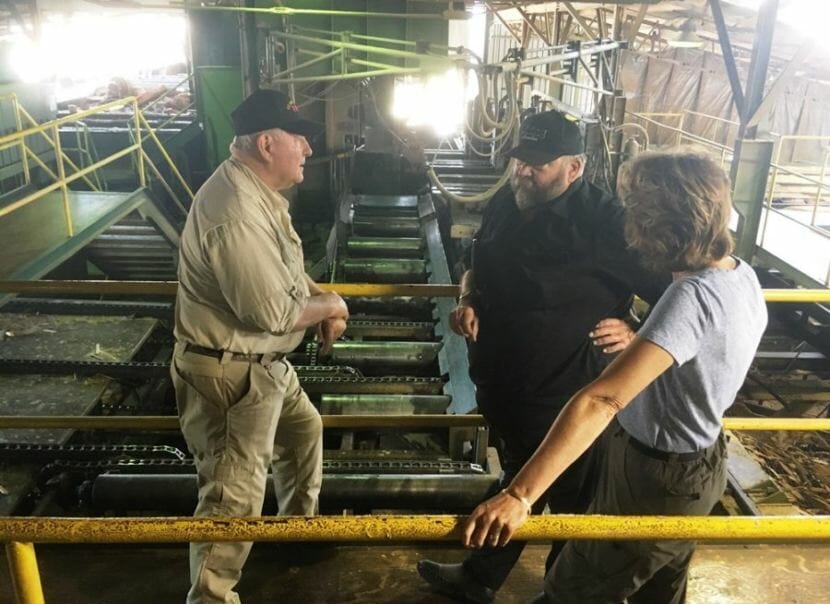
Secretary of Agriculture Sonny Perdue, left, and U.S. Sen. Lisa Murkowski talk July 5 with Kirk Dahlstrom at the Viking Lumber mill in Klawock. The mill is the largest private employer on Prince of Wales Island. (Photo by Leila Kheiry/KRBD)

The delegation also visited Naukati on Prince of Wales Island where the Forest Service completed a land swap with the Alaska Mental Health Trust.

There was a Saturday visit to Staney Creek where the delegation met with the local branch of The Nature Conservancy which has partnered with the agency to undertake watershed restoration.

“We talked about past work and collaboration between the Nature Conservancy in the Forest Service,” said Michael Kampnich, the nonprofit’s field representative on Prince of Wales Island.

Commercial logging didn’t come up in those discussions, he said.

The trip was almost exactly a year after Sen. Murkowski brought Agriculture Secretary Sonny Purdue to tour the Viking Lumber mill on Prince of Wales Island. That visit had the usual fanfare with media in tow.

This time around, the Forest Service chief opted to keep a low profile in Alaska. But why?

“This was a relationship building visit with Senator Murkowski in the State of Alaska,” Babete Anderson, a spokeswoman for the Forest Service in Washington, D.C. said in a statement in response to questions from CoastAlaska.

Tonya Parish, a spokeswoman for the Senate committee that organized the trip, said in a statement that current protocol is to almost never give advance notice of visiting high-ranking officials and that the itinerary didn’t allow for public meetings or media interviews.

She declined further comment.

With additional reporting from KFSK’s Joe Viechnicki in Petersburg.

Site notifications
Update notification options
Subscribe to notifications