KDLG - Dillingham

KDLG is our partner station in Dillingham. KTOO collaborates with partners across the state to cover important news and to share stories with our audiences.

Caribou were restored to the Nushagak Peninsula in the ’80s. Now there are so many, they’re depleting the food they depend on.

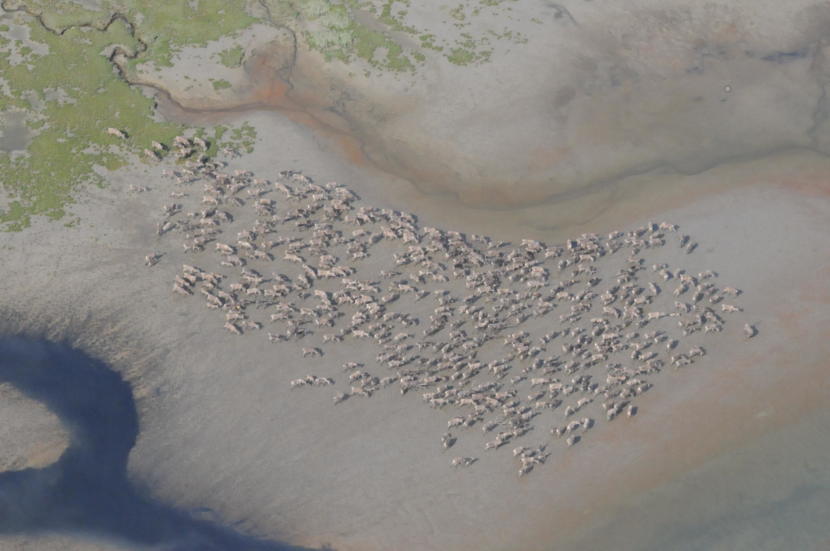
A group of 551 caribou on tidal flats of the Nushagak Peninsula seeking relief from biting insects, July 9, 2019. (Photo by Andy Aderman / USFWS)

Lichens cover the Nushagak Peninsula. They range from mottled green and gray, to yellow and brown, spreading in moss-like patches across the tundra. But as the peninsula caribou herd multiplies, that lichen cover, which used to be thick and lush, is shrinking. Surveys showed that lichen cover decreased by 18% since 2002, extending over just 32% of the peninsula’s tundra in 2017.

“It’s decreasing at an increasing rate. That has us concerned,” said Andy Aderman, a biologist with the Togiak Wildlife Refuge.

Aderman is holding a hefty textbook, “Lichens of North America” by Irwin Brodo, Sylvia Duran Sharnoff and Steven Sharnoff, and he starts by reading a few basic facts: Lichens can be found in almost every environment in the world, and on every kind of surface.
Andy Aderman reads from “Lichens of North America.” Jan. 24, 2020. (Photo by Isabelle Ross / KDLG)

“From soil, rocks and tree bark to the backs of living insects. A lot of people refer to the lichens, at least the lichens caribou like, as ‘caribou moss,’ but it’s not really a moss,” he said.

The scientific name is cladonia rangiferina, though caribou eat a number of lichen species. Lichens aren’t actually plants — they’re photosynthetic composites made up of algae and fungi. If overgrazed, they can take decades to regrow.

Nushagak lichens weren’t always fodder for the caribou. In fact, for much of the past two centuries there were almost no caribou on the peninsula at all. Biologists aren’t sure what happened to them, but in the 1980s, managers decided it was time to bring them back.

Aderman noted that one of the missions of the Togiak Wildlife Refuge is to conserve fish and wildlife populations and habitats, including their restoration to historic levels. When they transported caribou back to the peninsula in 1988, lichens were widespread and their cover was also taller and denser.

But as the Nushagak herd has thrived, that cover has thinned. The warm weather also means that hunting conditions are poor, so there’s less of a check on the population. Ideal hunting largely depends on two things: frozen rivers and enough snow cover for snowmachines to move easily across the tundra.

“That’s been a challenge,” he said. “And really, five of the last eight winters have not been very good. That was when the numbers were high, and there’s a lot of mouths down there eating lichens and other stuff. Our intentions were good, but it didn’t work out. I think that’s part of the reason.”

Locals hunt caribou on the peninsula, but in the past it’s been difficult for them to access the herd. Last winter, only three caribou were reported harvested, taken by hunters that flew into the area.
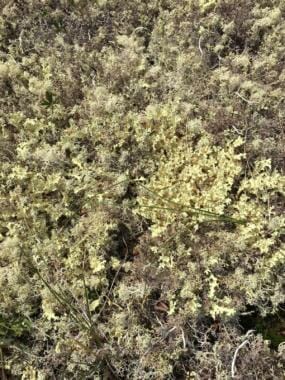
A mat of the gray cladonia rangiferina (commonly called ‘caribou moss’) and yellow lichens in the Cetraria genus, on the Nushagak Peninsula, July 12, 2017. (Photo by Andy Aderman / USFWS)

“It used to be good when there was lots of snow and colder weather,” said Moses Toyukuk, Sr., the mayor of Manokotak, one of the communities closest to the peninsula. “But currently we’ve been having mild winter and some places are pretty dangerous to go across. And I wouldn’t recommend going down if you don’t know the terrain down there.”

Warm winters are also changing the ecology of the peninsula, making it more difficult for lichens to replenish themselves.

“Snow acts as a protectant from wind abrasion and trampling,” said Kyle Joly, a wildlife biologist with the National Park Service. “So if there’s less snow on the ground lichens could be crushed by caribou. They’re also more accessible and can be eaten that way. When they dry out they become very brittle and fracture very easily.”

As the summers get hotter, lichens are also increasingly susceptible to wildfire. Unlike grazing, fires completely destroy the lichen structure. Those that don’t burn have to dispense spores and germinate, and it could take them more than a century to recover. Other vegetation — shrubs like crowberry, labrador tea, and dwarf birch — are more and more ubiquitous, competing for space on the ground.

The Nushagak herd, which doesn’t migrate in search of food, could remain on the peninsula for a time by shifting its diet to other plants. But as lichen cover dwindles, the question remains: what happens to the caribou if they are gone?

Record summer heat wiped out at least 100,000 fish in Bristol Bay, scientists say

Fish on the shores of the Ugashik, July 2019. (Photo courtesy of Birch Block).

The sun beat down relentlessly on Bristol Bay this summer, heating up the rivers and lakes where millions of sockeye salmon returned to spawn. July was the region’s hottest month on record, and in some rivers, that heat was lethal.

Tim Sands, a biologist for the Alaska Department of Fish and Game, estimates tens of thousands of fish died.

“Based on the catch rates we normally see and the escapement we normally see, well over 100,000 fish died in the river,” Sands said.

He’s talking about the Igushik River on the west side of Bristol Bay. It’s a long, winding, muddy river in the Nushagak District.

By early July, biologists were expecting an average of 15,000 fish to swim upriver every day.

Instead, “We saw 714 fish go up the Igushik by the tower on July 8,” Sands said. “The lack of fish moving up the Igushik River definitely was abnormal.”

Salmon won’t swim through water once it reaches a certain temperature. Water loses oxygen as it gets warmer, and the warmer it gets, the more oxygen fish need. As fish crowd on the bottom of a river waiting for the water to cool, they have less and less oxygen to breath.

Sands said about half a million fish should have escaped upriver to spawn. They only counted half that.

“The difference could have been all dead fish. That’s why I’m saying at least 100,000, ’cause truthfully I believe it could well have been over 200,000 fish. Cause that’s what we’re missing from the escapement,” he said.

Bristol Bay did have a huge harvest this summer — the second-largest on record. So when the heat broke toward the end of July and the fish pushed upriver, Igushik fishermen were actually able to catch more fish than usual. But that didn’t translate to a great season for everyone.

Set netter Steven Davis said the heat’s impact on the fish, and other related costs, made a big dent in his bottom line.

“It was really hot, so the fuel costs was more, cause we was constantly running to the tender, because we don’t have ice there. And it’s just — everything just culminated into a massive loss,” he said.

There were also signs of heat stress in Ugashik, on the east side of the bay. The fish weren’t swimming upriver. In July the fishermen had a lengthy closure, sitting on the beach for days as they waited for the heat to break. Birch Block has fished in the district for eight years, and he’s never seen a season like last summer.

“Seeing these fish not being able to swim correctly and just acting so lethargic,” he said. “When the tide went out, they just couldn’t even stay in the water, they would just end up, like, lying on the banks of the mud. I’ve never seen a salmon that is still ocean-bright acting in such a way.”

Biologist Tim Sands doesn’t expect last summer’s die-offs to have any long-term impacts to the run. His concern is that as the summers get hotter, there might be a year when the weather doesn’t break in time for fishing, and many more fish could die.

A star and exoplanet will be named ‘Nushagak’ and ‘Mulchatna’

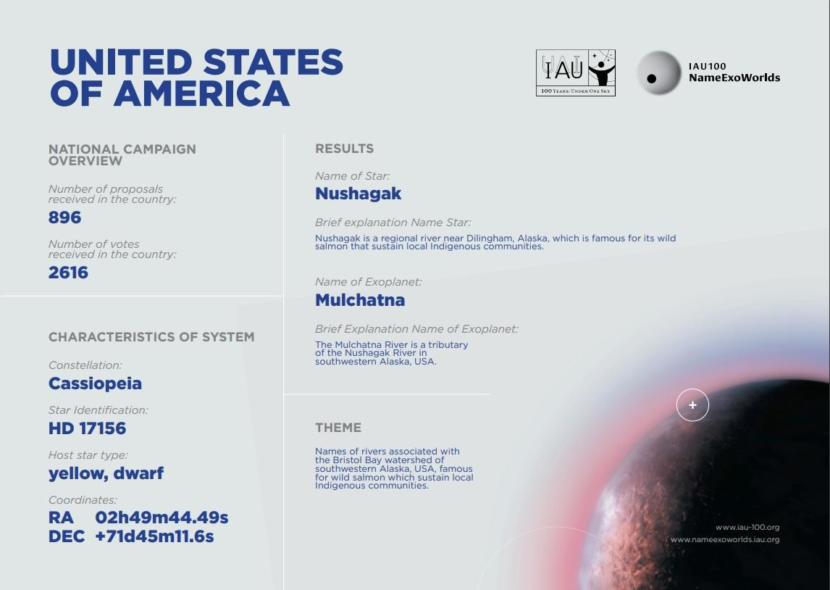
Exoplanet illustration is conceptual. (Graphic courtesy the International Astronomical Association)

Ivory Adajar couldn’t sleep early Tuesday morning. Months ago she had submitted two names in a competition to name a star and exoplanet for the United States. She tuned in to a press conference broadcasting from Paris, France, where the International Astronomical Union announced the winners.

“I was shocked, I was very excited,” Ivory Adajar said. “I broke down and cried and ultimately I was very honored.”

Adajar is a member of the Curyung Tribe. She grew up in Dillingham. Now she lives in North Carolina, working as a dental assistant.  She returns to Bristol Bay to commercial fish for salmon with her father each summer.

At Tuesday’s press conference, the International Astronomical Union showcased 13 of the 114 countries around the world that participated in the contest. The U.S was one of them.

“The United States has names of rivers associated with the Bristol Bay Watershed in Alaska which is famous for the wild salmon which sustain the local indigenous communities,” said IAU president-elect Debra Elmegreen. “The star is Nushagak which is a regional river near Dillingham, Alaska. And the exoplanet is Mulchatna, a tributary of the Nushagak river.”

Soon after the announcement, Adajar phoned her family in Dillingham around 2 a.m. with the news.

“The first thing I thought about was my grandma, my kids, my parents and my ancestors; all my friends and family who enjoy and live this way of life out there subsistence fishing and commercial.” She said. “Man, what a cool thing for us to have this legacy for our culture and our heritage.”

Around 900 names were submitted for the contest and a little over 2,600 votes were cast. Nushagak and Mulchatna received 25.7% of the votes, just edging out Yellowstone and Old Faithful at 25.3%. In third place was Cherokee and Sequoia, receiving 10% of the vote.

Derrick Pitts is the chief astronomer at the Franklin Institute Science Museum. He served as a member of the IAU’s U.S exoplanet naming team. Pitts and the team were happy with the results.

“It’s a really cool thing to be able to have the opportunity to be connected with the universe in this way,” Pitts said. “Both for Dillingham, but especially for Ivory, her family and her effort to want to recognize the significance of the two rivers in the region and what it does for the people there.”

For names to be eligible, they had to be of longstanding cultural, historical and geographical significance.

They also had to be broad enough to inspire names for additional objects discovered in the exoplanet’s system. Ivory Adajar took this into consideration when choosing the rivers.

“I came up with a bunch of different names but Nushagak and Mulchatna were obviously my first choice,” She said. “It might be cool to have names like Kvichak, Aleknagik and also names of the different types of salmon and resources that we have there can also reflect what they find out there in space.”

The scientific name of the star is HD17156. The newly-named star and exoplanet are 255 light-years away.

Find a list of all the winners at here.

There are plenty of herring to catch in Bristol Bay, but there’s nowhere to sell them

The F/V Wave Ryder and Capt. Frank Woods during the 2019 Togiak sac roe gillnet fishery. (Photo courtesy of KDLG)

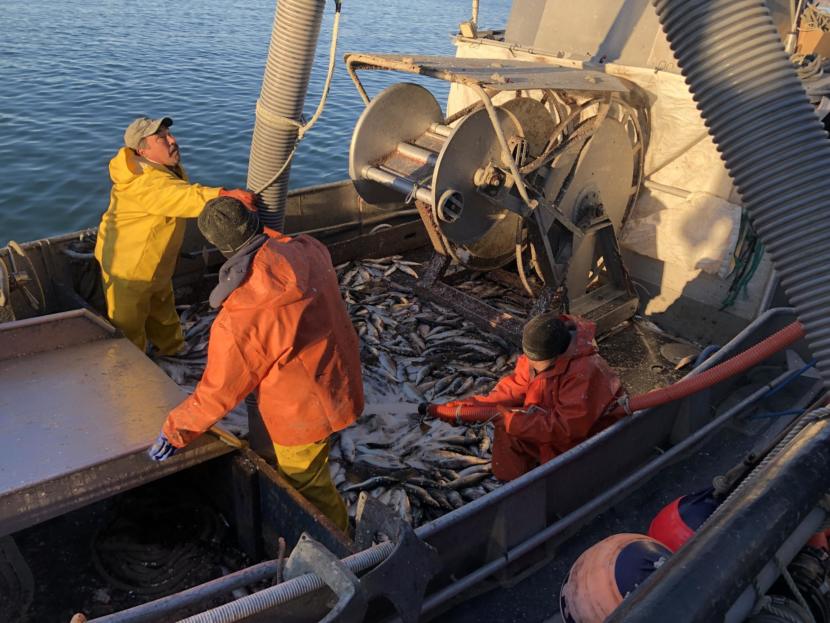
There are plenty of herring around in the fishery in Togiak, on the northwest side of Bristol Bay. This year’s quota is roughly 80 million pounds.

But herring fishermen, who come to Togiak from all over the state, still have a problem. They target herring for their tiny eggs, which once commanded steep prices in Japan. But not any more.

“I’m a recovering herring fisherman,” joked Bruce Schactler.

Schactler, who lives in Kodiak, has been fishing in Togiak off and on since 1985. But he won’t be returning this summer.

“The market is so bad that Trident will not be buying fish this year, so we’re not going. Every ton that is frozen and shipped off to Japan is a loser. There’s no money being made,” he said.

Trident is one of four companies that buy herring roe and sell it to Japan, the only customer. In the 1990s, that roe could sell for $1,000 a ton. But in 2019, that price was at $75. Fishermen’s total earnings last year were about $1.5 million, down from a high of more than $20 million in 1995. Fishermen like Schactler say that even at that low price, processors are still losing money on herring.

Sitka, the state’s other major herring fishery, has been struggling as well. The Alaska Department of Fish and Game said this season that the fish were too small to be commercially viable.

One reason for the decline of the Togiak herring fishery is that roe has become less popular in Japan. There’s also the country’s buying power: after the profitable 1980s, the Japanese economy crashed and in the nineties underwent a long recession, becoming the so-called “lost decade.”

One other event that jolted Japan’s roe market was a corporate gift-giving scandal, when bureaucrats were rebuked for accepting favors and expensive items from businesses. The Japanese Cabinet approved a set of ethics rules for public servants, which said, among other things, that they had to decline traditional bi-annual gifts. Once-popular gift packs of high-end herring roe had far fewer buyers.

“Maybe the most extreme example I’m aware of, of how a major Alaska industry could be dependent on an extremely specialized foreign market,” said Gunnar Knapp, a retired University of Alaska professor and an expert on fisheries economics. He pointed out that the narrow market for herring is a stark contrast to the diverse buyers of other Alaska species.

“Lots of other places you could take that, where they’d be happy to buy our salmon, or halibut, or cod,” he said. “But this was a market that was overwhelmingly dependent on just one buyer for one particular kind of product, and so it was very sensitive to a change in that.”

Togiak seiners still hauled in a record 23,000 tons last spring. Robert Heyano has fished there for four decades. And he says the industry has to start thinking about other ways to sell its herring — for example, as bait or food.

“If we’re going to try to increase the value of that fishery, gotta expand it from a single market to multiple markets, in a different product form,” he said.

Prices for bait can be much higher than for roe, but it costs a lot to transport the fish out of Bristol Bay.

Togiak’s spawning herring also have lower oil content, so they’re less appealing as food or bait. But the market for roe is saturated, according to Heyano and Frank Woods, another Dillingham herring fisherman.

“The market can’t bear that much product on the market. It couldn’t bear the last two or three years of excess fish on the market,” he said.

Part of the reason the 2020 quota is so large is because the Alaska Department of Fish and Game bumped it up to 20% of the spawning herring. That’s the norm, but heading into the previous year, the department didn’t have much confidence in their estimation of the number of fish, so they took the precaution of lowering the quota to 14% for a year.

To keep the fishery viable, Woods thinks that fishermen need to start exploring a different approach. But for now, he still plans to fish for roe in the spring.

After months of drought, Chignik Lagoon’s wells have finally filled with water

Chignik Lagoon, July 10, 2019. (Photo by Alex Hager/KDLG)

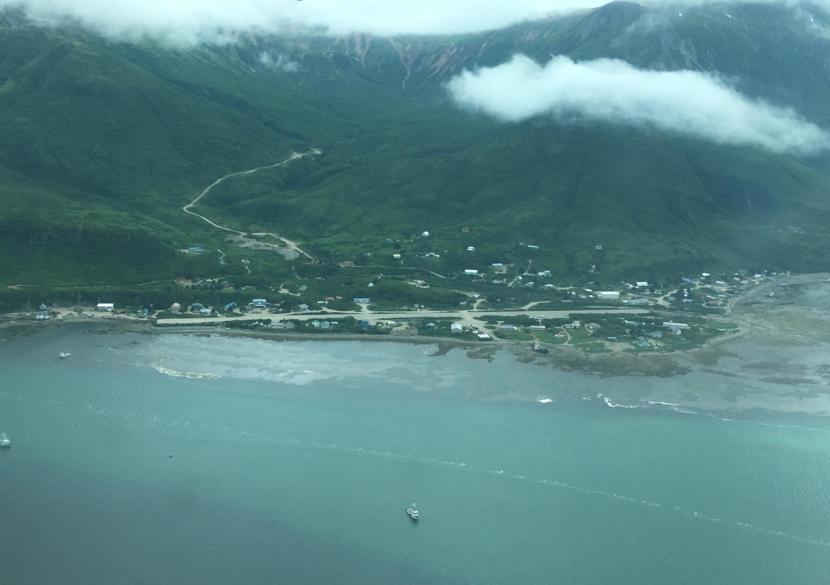
Over the summer, drought and damages to Chignik Lagoon’s water distribution system left the village without drinkable water. The state issued a boil water notice in July, and the wells were dry by August.

Residents relied on Packers Creek, which runs through the village, to supplement their needs through October. Now worries have subsided: At the end of October, the wells filled up and started producing water again.

“Things have calmed down a little bit,” said Village Administrator Michelle Anderson. We’ve been able to pump water from the wells again. We’ve had significant rainfall. It’s supporting our wells for the moment. Without snowfall and (snow)pack, we may run into an issue this winter, but we should make it through the summer.”

The village has bottled water left over in case the wells dry up again. Those were flown in during the summer and fall.

Chignik Lagoon is still on a boil water notice — the wells are cracked and the distribution system needs repairs. But the village council is working to address those issues.

The Bristol Bay Area Health Corp. flew out engineers to help repair parts of the distribution system in October. Anderson said the village council is exploring additional options.

“We are actively looking for funding to complete an engineering assessment and design. To either drill a new well, find a surface water source and/or fix or replace distribution systems,” Anderson said.

A mix of state and federal funds are available to finance drilling a backup well. Anderson wants that to coincide with the assessment and design of a new distribution system.

A former KDLG reporter shares her experience after finding a camera in her room

(Photo by Sage Smiley)

Former KDLG reporter Sage Smiley is speaking out about indecent and illegal behavior by a host she was staying with over the summer to cover the Bristol Bay fishery.

Smiley was staying with John and Maureen Knutsen at their home in Naknek. Maureen Knutsen was the chairperson of the station’s program community advisory board, Friends of KDLG. She invited Smiley to stay at their home.

In June, Smiley found a camera in the room she was staying in.

“It was incredibly traumatic to have my privacy violated in such an intimate and sickening way,” she said. “Privacy or a feeling of safety isn’t something I feel I can assume anymore. I check every single room I’m in — for cameras.”

The camera belonged to John Knutsen.

John Knutsen was found guilty for a felony charge of indecent viewing in 2004. In recent years, KDLG reporters have stayed with the Knutsens in Naknek. Board members were aware of John Knutsen’s past but did not inform the station of his previous conviction.

“While talking to some of the (Friends of KDLG) board this summer in Dillingham, I wrote down in my notes app quotes like, ‘I thought he had redeemed himself in the eyes of the community,’ and, ‘I was aware of it being (John Knutsen’s) history with cameras but thought things had smoothed over,’” Smiley said. “Turns out, they hadn’t.”

Maureen Knutsen resigned from her position on the advisory board in July after the incident. KDLG reached out to both Maureen and John Knutsen by email. Maureen Knutsen responded, but chose not to comment.

Board Chair Dan Dunaway, in a written statement, spoke on behalf of the advisory board.

“As a program advisory board, our authority is limited but we strongly support the KDLG staff and want to protect them and do whatever we are able to ensure they are protected by the law and avoid this in the future,” Dunaway wrote.

Smiley is hoping more people speak up about sexual misconduct and assault in Bristol Bay.

“There were so many points along this ordeal where someone could have said or done something,” she said. ”Things might have turned out entirely different. That’s why I want to speak out, because I don’t want anyone else to have to go through something I did.”

John Knutsen pleaded guilty to a class B misdemeanor for indecent view and photo without consent of an adult in July. Knutsen was in jail for 10 days. Five of those days were suspended. He paid $150 in fees and is on probation until July 2020.

If you need help, that help is available. The SAFE phone number is 907-842-2320. You can also email SAFE at outreach@safebristolbay.org. SAFE is in Dillingham and is Bristol Bay’s shelter, prevention and advocacy agency for domestic violence and sexual assault victims.

The National Sexual Assault Hotline number is 800-656-HOPE (4673) to be connected with a trained staff member from a sexual assault service provider in your area.


Correction: An earlier version of this story incorrectly stated that former KDLG reporter Sage Smiley found the camera in the room in which she was staying in July. She found the camera in June.

Site notifications
Update notification options
Subscribe to notifications