KDLL - Kenai

KDLL is our partner station in Kenai. KTOO collaborates with partners across the state to cover important news and to share stories with our audiences.
A melting glacier could mean a chance for Alaska’s biggest hydroelectric project to expand

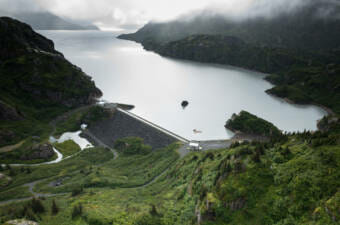
The Bradley Lake Dam in 2014 (Ian Dickson/KTOO)

The Dixon Glacier, on the other side of Kachemak Bay from Fitz Creek, is rapidly receding.

That’s true for glaciers around Alaska, and the world. But what’s special about Dixon is it sits just a few miles from Bradley Lake, a source of hydropower that supplies the railbelt with about 10% of its energy needs.

And as the glacier keeps retreating, the Alaska Energy Authority, which owns the project, says it can expand the project’s capacity using the water coming off the glacier.

“If you’re talking in terms of geologic time scales, it’s definitely rapidly retreating,” said Bretwood Higman, a Seldovia-based geologist. “I mean, it’s something that, if you went and visited the glacier two years in a row and stood right next to it, it’d be pretty obvious it was different.”

Dixon Glacier has receded enough in the last five years so that there’s now an exposed stream on state land. It’s appealing to the Alaska Energy Authority, which has been eyeing ways to expand the 120-megawatt Bradley Lake project.

Bradley Lake is the largest hydroelectric facility in Alaska and sends power to utilities across the railbelt. Its power is also cheaper than other sources, at 4 cents per kilowatt hour.

Alaska Energy Authority Executive Director Curtis Thayer said diverting water from Dixon could bolster the project’s capacity by 50%.
“If Bradley can produce — now it produces 10 — but if it could produce 15 or 16 percent of renewable on the Railbelt, that’s huge,” Thayer said.

The corporation recently wrapped up another expansion project, a three-year effort to divert runoff from Battle Creek into Bradley Lake. That project grew the production capacity of the facility by 10%.

Higman said, in a broad sense, energy providers can anticipate changes in the amount of water that becomes available for hydropower projects as glaciers continue to melt. And he said it could be valuable for them to anticipate how that changing landscape might affect their portfolios.

“Bradley’s already a critical part of our power infrastructure,” he said. “And it would be really nice to know how we might expect that to change as we’re doing things like developing wind that might be balanced against Bradley.”

An Alaska Energy Authority analysis from earlier this year places the Dixon project price tag at $125 million. Thayer said Alaska Energy Authority is considering a few ways to do the glacier project.

“We could divert it into Bradley Lake,” Thayer said. “Or maybe even do what we call a run-of-river, where we put a generator on the river that’s currently outflowing and create power and ship the power off and let the water still continue to go out into Kachemak Bay.”

He said it could be up to a decade before the Alaska Energy Authority brings the glacier project online. By then, there’s no telling how much more melted the Dixon Glacier will be.

Scientists are still following whales that swam through the Exxon Valdez oil spill

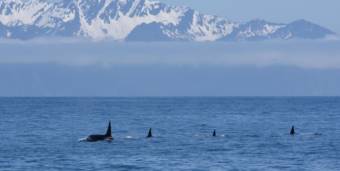
The Chugach Transients have not had a calf since the Exxon Valdez Oil Spill in 1989. And scientists aren’t exactly sure why. (courtesy of Dan Olsen/North Gulf Oceanic Society)

Scientists in Homer and Seward have spent the last several decades tracking a population of mammal-eating killer whales called the Chugach Transients in the Gulf of Alaska.

There used to be 22 whales in the pod. But the year after they swam through the Exxon Valdez oil spill in 1989, nine members died. Others went missing.

“And now there are seven of them remaining,” said Dan Olsen, a field biologist with the Homer-based North Gulf Oceanic Society.

Olsen and his team have been keeping track of all seven members of the Chugach Transient pod as they age. Late this summer, researchers were still waiting for a glimpse of the seventh transient — a 46-year-old lone male named Egagutak.

“It wasn’t until late in the season that one of the local tour companies here in Seward sent us a photograph, and we were able to confirm that this male was still alive,” Olsen said. “He’s 46 years old now, so we may not have him much longer. Males often live to be 45 to 50 years old. So every year that goes by, we’re crossing our fingers that he’s still alive.”

The North Gulf Oceanic Society identifies the transients photographically. It also tracks them acoustically because pods have distinct calls.

Olsen recorded that lone male’s call in 2019:

He said the distinct call is one call he’s hearing less and less as the population of whales dwindles.

The Chugach Transients have not had a calf since the oil spill, over 30 years ago. Olsen said scientists are not exactly sure why.

Other populations of killer whales are doing well. But two pods that swam through the spill are not.
“It’s difficult to know why, if the oil spill reduced their prey abundance such that they weren’t able to have enough nutrition to continue to have offspring, or if the contaminants directly impacted their reproductive systems,” he said. “But regardless, we’re seeing a population that is going extinct.”

Olsen said it’s important to keep tracking the whales because it helps researchers track the entire ecosystem.

“Killer whales are an apex predator and often are indicators of the health of the entire ecosystem,” he said. “And changes in their population, changes in their body condition, their body health, can help alert us to issues that we’re seeing in the ecosystems.”

The North Gulf Oceanic Society has been around since the 1980s and is based in Homer.

Historically, it has relied on funding from the Exxon Valdez Oil Spill Trustee Council, the group tasked with spending the $900 million civil settlement from the Exxon Valdez oil spill. This year, Olsen said, the council decided it will not continue funding the group’s research going forward.

Fat Bear Week sees record voter turnout

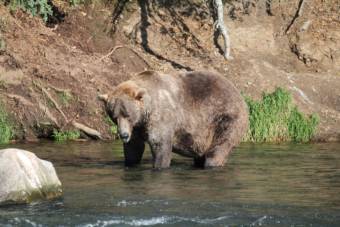
480 Otis photographed on Sept. 16, 2021. (C. Spencer/National Park Service)

Voter turnout in local Kenai Peninsula elections was really low this fall.

But there’s one competition in Alaska that saw its highest voter turnout ever this year — possible because its contestants were thousand-pound brown bears.

Mike Fitz is the resident naturalist with Explore.org, one of the organizations that puts on Fat Bear Week. He said almost 800,000 people voted this year as their favorite bears at Katmai National Park packed on the pounds for winter — over 100,000 more voters than last year.
“That means that more people are, at least for a day or a moment, considering the stories of some of the bears that use Brooks River,” Fitz said. “And hopefully they’re also taking another moment to think about why bears get fat to survive, how they do it, and thinking about the ecosystem that supports them.”

This year’s Fat Bear Week champion was 480 Otis.

Otis has won the competition before, but his is still a bit of an underdog story. Otis is older than a lot of his river-mates, and he’s missing two canines. This year, he came out to Brooks River late.

“But he stuck to his plan,” Fitz said. “His plan is to go to the waterfall and wait for his opportunities to fish in his preferred fishing spots, really try to avoid confrontation with the more dominant bears. And once those opportunities open, he goes to those spots, he sits, he waits for those fish to come to him. So he’s really a master of energy economics.”

Otis captured the hearts of viewers from all over the world.

Katmai National Park, on the Alaska Peninsula, is no quick trip for most. But the bear cams at Brooks Falls bring viewers right to the scene of the feast.

Fitz said beyond the bears, the week also broadens viewers’ awareness of the ecology of the region. He said he knows of some who have weighed in on the Pebble Mine project. And he said the success of bears like Otis is a testament to the great salmon returns in the Bristol Bay watershed.

“And the bears are, I think, maybe the most conspicuous benefactors of that,” Fitz said.

It’s a message Fitz hopes viewers take away long after Fat Bear Week has crowned its king.

You can still watch Otis and the other Katmai bears on a live webcam at Explore.org.

Jacoby makes splash in World Cup

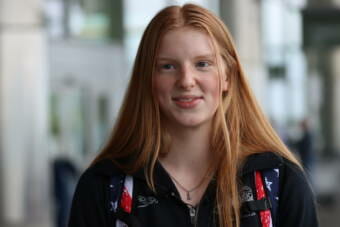
Seward swimmer Lydia Jacoby after returning home from the 2021 Olympic trials on June 23, 2021. (Valerie Kern/Alaska Public Media)

Seward Olympic champion Lydia Jacoby added to her medal collection in a FINA World Cup short-course meet in Germany this weekend. The 17-year-old won a bronze in the 100-meter breaststroke Saturday followed by silver in the 50-meter breaststroke Sunday. She was fifth in the 200-meter breaststroke Friday.

Jacoby’s silver time of 30.04 seconds in the 50-meter was a personal best and an unofficial record for Americans 18 or younger. Her bronze time of 1 minute, 5.20 seconds in the 100-meter set another unofficial record for junior Americans.

Jacoby won gold in the 100-meter breaststroke in the Summer Olympics this year, though that was in a 50-meter pool. World Cup races are in 25-meter pools.

Jacoby is scheduled to compete in the second leg of the FINA World Cup in Budapest, Hungary, later this week.

Diagnosed with end-stage cancer, Hobo Jim thanks his fans for their support

Hobo Jim in 2020. (Courtesy of Bend the Light Photography)

Alaska’s State Balladeer announced last week he’s been diagnosed with end-stage cancer.

James Varsos, best known to Alaska and the world as Hobo Jim, said his cancer is untreatable and that doctors told him he has three to six months to live.

The Soldotna singer is currently down in Tennessee with his wife, Cyndi. On Friday, he said he was doing alright.

“I’m in a bit of pain, but outside of that, I have a good attitude,” he said.

Varsos was raised in Wisconsin. Before he came to Alaska, Varsos said he was known to rove, hitchhiking all across the U.S., riding freight trains and singing folk songs — earning him the name Hobo Jim.

When he came to Homer in 1972, he put down roots.

“I knew when I crossed the Baycrest Trail that Alaska was home,” he said.

Varsos later moved to Soldotna. He’s always loved to fish the Kenai and at one time was getting sponsorships by local companies to take their boats out on the river.

“I’m addicted to fishing,” he said. “As soon as I get out of this pain, that’s the first thing I’m going to do, is go fishing for the rest of my life.”

For 25 years, Varsos sung out of BJ’s Lounge in Soldotna, until the bar closed. More recently, he was playing weekly shows at AJ’s OldTown Steakhouse in Homer.

He’s built up a strong fan following on the peninsula and around the state, always performing with his guitar and iconic cowboy hat.

Many of Varsos’s songs are love letters to Alaska, from from “I Am Alaska” to the famous “Iditarod Trail Song.”  In 1994, the Alaska State Legislature named him “Alaska’s Balladeer.”

Varsos performed at the Alaska State Fair last month, which is where he first noticed the pain from the cancer. He was later hospitalized in Tennessee, where he and Cyndi have a second home.

They took that home during Alaska’s oil crash, Varsos said, when many Alaska bars closed and there weren’t as many opportunities to perform live. Varsos took a job writing commercial country music, where he said he wrote five to six songs a week.

Next month is the anniversary of when he and Cyndi first met.

“We got married in May, but we met on Halloween weekend 42 years ago,” Varsos said.

Their only son died this spring. Even though this last year has been marked by tragedy, Varsos said in a Facebook post this weekend he’s had a blessed life.

https://www.facebook.com/permalink.php?story_fbid=1182457302164248&id=100011999689185

“I’d love to tell people, especially people of the Kenai Peninsula and of Soldotna: I love each and every one of you,” he said Friday. “And I appreciate that this is the 49th year of playing the 49th state. If it was going to happen, it couldn’t have come better. And I really appreciate each and every one of you. Thanks for all the love.”

There are over 2,000 comments from friends and fans on Varsos’s post, wishing him well and reminiscing about his talent and friendship.

Some of the messages come from Germany, where he has a fan club of several hundred listeners. He said they’re fascinated by his tales of Alaska. He performs there every year.

Several friends also started a GoFundMe to help Varsos and his wife. As of Friday, Almost 200 donors had raised over $35,000.

Charlie Weimer, of Soldotna, helped organize that fundraiser. He met Varsos 37 years ago, at a performance in Soldotna.

“If I have learned anything from Hobo, other than what it means to have a true friend, it is to live everyday to its fullest,” Weimer said. “Hobo has always done that.”

Varsos said he’s been reading the messages people have been posting.

“And it’s been overwhelming,” he said. “It’s been so warm and so touching. And to everybody out there that’s sent me a message, I try to read them all. There’s no way I could answer them all. But they really lift my heart, very, very much.”

While he said he’s not sure what these next months will look like, he said he hopes to come back to Alaska — and, of course, do some fishing.

Providers are still waiting for guidance on COVID boosters

A nurse prepares to administer a dose of the Johnson & Johnson COVID vaccine at a clinic in Anchorage. (Hannah Lies/Alaska Public Media)

Health providers are now administering COVID-19 shots to immunocompromised individuals who’ve already received their first and second doses of the COVID-19 vaccine.

Soldotna Professional Pharmacy co-owner Justin Ruffridge said his pharmacy administers multiple third shots, both Pfizer and Moderna, to immunocompromised individuals every day. Those third shots are meant to help them build more immunity to the virus.

But he said they’re still waiting on federal guidance on whether the general public should be receiving boosters.

“There is a question, I think, about what the overall goal of these vaccines is going to be,” Ruffridge said. “If the goal is prevention of hospitalization and death, potentially a booster shot for the wide variety of people that got vaccines isn’t necessary. If it is reduced transmission and keeping COVID at bay, then maybe a booster shot is warranted sooner rather than later.”

The Biden administration previously put a goal of Sept. 20 for booster shots to be available to the general public. But that date has been in flux as officials and scientists have debated the merits of getting the third shot.

The Centers for Disease Control and Prevention recommends immunocompromised people get an additional dose of the vaccine 28 days or more after getting their first two shots. The CDC has a list of conditions online that might warrant getting the booster.

In the meantime, flu season is approaching.

“There’s some talk about getting a combination COVID-flu vaccine here in the near future,” Ruffrdige said. “But that remains unsettled, as well.”

State officials say, with few hospital beds available in the state, there’s now more reason than ever to get the flu shot.

Providence Alaska Medical Center said this week it’s now rationing medical care as COVID-19 patients fill the hospital.

Central Peninsula Hospital spokesperson Bruce Richards said Wednesday that CPH is also over capacity. But at the moment, the hospital is not turning away patients or implementing crisis standards of care.

Site notifications
Update notification options
Subscribe to notifications