KDLL - Kenai

KDLL is our partner station in Kenai. KTOO collaborates with partners across the state to cover important news and to share stories with our audiences.

Kenai Borough mayor promotes virus misinformation, unproven treatments for COVID-19

Kenai Peninsula Borough Mayor Charlie Pierce in 2018. (Aaron Bolton/KBBI)

The Kenai Peninsula Borough spent the winter sharing updated information about the coronavirus and resources for getting vaccinated.

Now, Borough Mayor Charlie Pierce is using his platform to challenge local doctors and promote unproven COVID-19 treatments, on local talk radio and in public meetings.

“I’m going to ask some questions and I’m going to do it publicly,” Pierce said. “I’m going to do it with the community that I represent. Whether you agree or disagree, you can be on the right, you can be on the left. I think even those folks on the far left that think that the right way to do this is just to mask up, stay at home, social distance, get the vaccine — force vaccine, force vaccination on everybody — but you know what? America wasn’t built that way.”

At a Kenai Peninsula Borough Assembly meeting last week, Pierce slammed the borough-owned hospital for not offering drugs like ivermectin and hydroxychloroquine to cure COVID-19.

Ivermectin is a medicine used to treat parasitic worms and head lice in humans, and is also used in much higher doses for livestock. Hydroxychloroquine is a medication for some autoimmune disorders. Both have been tested for use for COVID-19, but results have not proven effectiveness. Neither has been approved or recommended by the FDA or CDC to treat COVID-19, but both have caught on nationally as speculative treatments, particularly in anti-vaccine circles.

Several local feed stores told the Peninsula Clarion they’re getting daily inquiries about ivermectin.

Ned Magen is an emergency department doctor at Central Peninsula Hospital. He said ivermectin is not a viable treatment for COVID-19 at this time.

“The best way to do a study is a double-blind study,” he said. “Neither the physician prescribing it nor the patient knows if they’re getting the real medicine or the fake medicine, a placebo. But so far in those studies, ivermectin has not been shown to be effective.”

Pierce doubled down on his comments this week on KSRM’s talk program Sound Off. And he told Sound Off host Duane Bannock that while N-95 masks are effective to slow transmission of COVID, “masks in general don’t work.”

This is not the first time Pierce has used talk radio to challenge scientifically proven COVID-19 mitigation measures. In April, he said on KSRM he wanted the school district to remove its mask mandate and likened the virus to the flu.

Pierce also pointed listeners to a website that recommends ivermectin and hydroxychloroquine and offers prescriptions for those drugs from a doctor in Texas.

Justin Ruffridge, a pharmacist with Soldotna Professional Pharmacy, said he’s received at least three prescription requests from the Texas doctor for ivermectin.

“People that are scared or people that are anxious about what’s happening, they want a fix,” Ruffridge said. “And that’s true of everyone. And the answer to that right now is there isnt a super great fix that’s not named a vaccine.”

Several local doctors wrote in letters to the editor last week that Pierce’s comments undermine the steps they’ve been taking to fight the pandemic.
Ruffridge, who worked with the borough for months to get people vaccinated, said it feels like an assault on his trustworthiness.

“When things like what we’ve seen happen in the last couple of weeks from leadership in our borough continue to happen, and our trust in those institutions is being questioned, that is the problem,” he said.

Magen said it’s not a bad thing to ask questions. But he said it’s important to turn to reputable sources, like the CDC.

“The best way to prevent someone from getting seriously ill is get vaccinated,” he said.

Ruffridge said he’s seen an uptick recently in people getting vaccinated. He said that’s likely because they’re seeing their own friends and family get seriously ill and even die.

As of Wednesday, 46% of eligible borough residents were fully vaccinated against COVID-19. Hospital spokesperson Bruce Richards said Wednesday the hospital currently has 20 patients admitted for coronavirus.

As streams warm, cold water inputs could be crucial for salmon

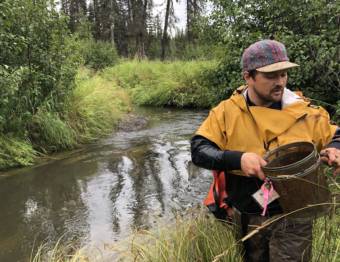
Ben Meyer with a fish trap on Beaver Creek in Kenai. (Sabine Poux/KDLL)

A pocket of Beaver Creek, just a short and muddy tromp away from a gravel parking lot between Kenai and Soldotna, is home to several cold water inputs that could be crucially important for young salmon as they swim from the Kenai River to Cook Inlet.

Cook Inletkeeper Executive Director Sue Mauger said the inputs are like cold water faucets.

“They’re a little place where there’s a constant pump of colder water,” she said. “And that really can help buffer when we have those really warm, sunny days to actually have some cold water coming into the creek.”

Inletkeeper is working with the Kenai Watershed Forum and the Kachemak Heritage Land Trust to diagram those cold water spots in four peninsula creeks. The goal is to keep those creeks, and the salmon that use them, protected.

Here’s the catch — the inputs fall over a mosaic of private and city land. The nonprofits are reaching out to landowners to let them know they have something special in their backyards.

“Everyone who owns riverfront property knows they have really special habitat,” Mauger said. “Like, they know that that’s important; that’s why they bought the property, probably, is to be on the river. But to then be told, ‘You have extra special property. You have something really unique on your property’ is very exciting for someone.”

On a rainy, cold day on Beaver Creek, environmental scientist Ben Meyer pulled a juvenile coho salmon out of a fish trap and placed it into a viewing container.

“This is an example of a creature that I hope will benefit from some of the conservation work we’re doing,” he said.

On warm days, there might be multiple temperature degrees difference between the creeks and their cold water inputs.

The inlet has some of the warmest measured streams in Alaska. Temperatures are expected to climb as climate change accelerates, which isn’t good for the salmon that traffic those areas.
The cold water inputs, Mauger said, are like buffers against rising temperatures. But they could be threatened by new roads or gravel pits in the area.

The nonprofits spent last summer diagramming cold water spots from the sky, using helicopters and thermal infrared imagery. Now, they’re measuring them from the ground to check that data.

“And so that’s honestly half of the fun of this project is we get to go out, we’ve got this little treasure map and we can just, like, run around, trying to find them,” Mauger said. “And it’s exciting ’cause we do find them.”

Those data points come up on a map on Meyer’s phone. It does look like a treasure map, with X’s marking the cold-water spots and lines where one person’s property becomes another’s.

Now, the nonprofits will reach out to landowners about conserving the cold water inputs on their land.

Lauren Rusin is the conservation manager for the Kachemak Heritage Land Trust. She said there’s grant money available for people who decide not to build on their streams or put in protective measures, like setbacks.

“And we have a unique opportunity, I think, in Alaska that we have the ability to sort of do it right the first time,” she said. “We’re not doing a lot of remediation work or anything here. We have the opportunity to reach out to these landowners who are often first or second in the chain of title, from the state becoming a state from a territory from Russia.”

Branden Bornemann, executive director of the Kenai Watershed Forum, said landowners are usually surprised to learn they live on such an important watershed.

“Maybe you have had this property your whole life and didn’t know that there was a tiny little feeder stream to Beaver Creek that’s incredibly important to the productivity of the Kenai River,” he said.

Mauger said it’s important to think about the downstream effects of stream health, especially as climate change makes waters warmer and salmon habitats less hospitable.

“This is what I can do — as a scientist who’s been studying how rivers are changing, this sense of, like, doom and gloom, you have to actively push it away,” she said. “And for me, this work does that. It helps me think about — how do I give that river its best chance in changing climate? And that’s those cold water faucets. Keeping them going. Keeping them on.”

She thinks Alaskans are up to the challenge of protecting those faucets. First, they need to know they’re there.

Editor’s note: Branden Bornemann is on the KDLL Board of Directors.

No longer able to make a living in Cook Inlet, young commercial fishermen head west to Bristol Bay

Taylor Evenson comes from a Cook Inlet fishing family. Last year, he made the difficult decision to bring his boat to the other side of the Alaska Peninsula in search of better fishing. (Sabine Poux/KDLL)

The F/V Nedra E is smaller than the other boats bobbing at the dock in Naknek in Southwest Alaska.

Thor Evenson didn’t have Bristol Bay in mind when he designed the boat for his parents, Nikiski homesteaders Jim and Nedra Evenson. Until last year, the Nedra E had been a Cook Inlet boat, captained first by Jim, then by his nephew, and now by his grandson, 32-year-old Taylor Evenson.

Taylor Evenson said he grew up hearing about the heyday of Cook Inlet fishing from his dad and his friends.

“And just getting up in the morning every day and hearing their voices on the radio, voices I grew up with from the first time I was on the boat, I was 3 months old,” he said. “And particularly hearing my dad’s voice, going out and fishing with my dad — that’s why I never left the inlet, even though I always knew what was coming.”

What came was a drop in salmon runs and a change in how fishing is managed in Cook Inlet.

The inlet’s salmon fishery, once an economic engine for Kenai, is no longer lucrative. Many fishermen with deep ties to the inlet are retiring or moving elsewhere because they can longer make a living.
Evenson said his breaking point came last year. He couldn’t pull off fishing in Cook Inlet any longer.

So with the help of the boat’s original builder, Kevin Morin of Kasilof, he gutted everything behind the cabin, chopped several inches off bow and stern and installed a brand new deck to bring the Nedra E in line with Bristol Bay standards.

Now, he said, it’s time to make his own glory days.

“And this is the only place really to do that, if it was going to be gillnetting in Alaska,” he said.

The Super Bowl of fishing

On a sunny day in mid-July, the crew of the Nedra E was casting what must be their 500th set this season. Their hands were sore from picking so many salmon off the net, sometimes as much as 28,000 pounds in 24 hours.

Taylor Evenson has been fishing with his dad, Thor, since he was a baby. His dad still fishes in Cook Inlet. (Taylor Evenson)

Deckhand Riley Randleas of Soldotna, 22, had never seen anything like it.

“You’re living off of naps and you never catch a break, ever,” he said. “Time just means nothing, at that point.”

He said it’s the Super Bowl of fishing — something you can’t get in Cook Inlet anymore.

Scientists haven’t been able to nail down one reason for the change in the inlet’s run. The fishery has become fraught with politics, as conflict between managers and user groups builds.

Meanwhile, business has dropped off in the inlet too. Thirty years ago, an average salmon drift permit for the Cook Inlet fishery was worth over $200,000. Last year, it was worth just $25,000, according to the Alaska Commercial Fisheries Entry Commission.

Why the Evensons fished

But fishing Cook Inlet has never been just about money for the Evensons.

Jim and Nedra, who both died in the last year, started fishing the inlet when they moved to Kenai in 1955. Jim was the first president of the local drift association, and he and his son are well-known Kenai artists who’ve made fishing a large theme in their work.

Taylor Evenson said he’s heartbroken to leave his family’s fishing heritage behind. But he’d be heartbroken to stay, too.

“As far as me moving west here, it’s what I have to do to make a living, what I have to do to feel good about fishing because I would stop,” he said. “It’s too depressing to fish in Kenai. It is depressing.”

It’s night and day from the energetic Bristol Bay, which is shattering salmon records. It hit its largest sockeye run on record this season —  almost 66 million fish so far.

“You come out here, and everyone’s young, everyone’s youthful, everyone’s happy, everyone’s spending money,” Evenson said. “It’s palatable, 100 percent.”

Making money, finally

There’s an exhausted exuberance about the fishermen in Naknek as they dock for one of the last times this season, flush with fish.

For a group of Cook Inlet fishermen gathered at a local bar, there’s also wistfulness in the mix.

William Olsen lives in Washington and fished Cook Inlet on his own permit for almost two decades.

He said he saw some of the fishery’s greatest years. It was fun to be a Cook Inlet fisherman: He remembers docking with friends at night and going into town to see Hobo Jim perform.

“When I was a deckhand for eight years, we saw the best of times,” he said. “And we thought there was going to be more of that.”

But that boom didn’t last. And three years ago, Olsen and his son bought into Bristol Bay.

“It was the first time we made money in Alaska fishing, finally,” he said.

It was hard on his uncle, who also fished the inlet for four decades.

“He really didn’t want to see me come over to Bristol Bay,” Olsen said. “He had a real deep love for Cook Inlet. And when I told him I was going to the bay, he was almost a little disappointed in me. And when I came back that first year and told him how we did, he changed his mind. And he knew it was a business decision.”

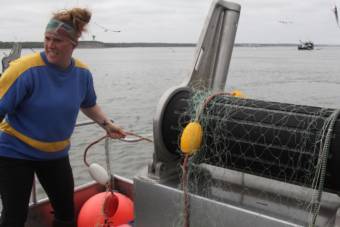
Bruno Rathke, Georgie Heaverley, Taylor Evenson and Riley Randleas all have roots in Cook Inlet. This summer, they fished Bristol Bay on the Nedra E during what was a record-setting harvest for the fishery. (Sabine Poux/KDLL)

I want them to be children of fishermen’

Those incredible catches make it hard for Georgie Heaverley, of Nikiski, to imagine only fishing Cook Inlet again. After almost three weeks deckhanding on the Nedra E, the 33-year-old fisherman flew back to Anchorage with a suitcase of dirty fishing clothes and a new perspective.

“This season, and seeing what Bristol Bay is about, and seeing what fishing actually looks like — I just don’t see how I could not be in Bristol Bay,” she said.

This was Heaverley’s first season without her dad since becoming a commercial fisherman. She and Evenson talked about their dads when they were on the boat.

“This is what he used to see when he fished,” she said. “He used to see fish hit the net like this. He used to fish like this. Like, dad saw this.”

Heaverley resisted heading to Bristol Bay for a while. She didn’t want to leave family behind, and between the permits and boat upgrades, she knew it would take a lot of investment to change over.

But last year in Cook Inlet was so bad it put a strain on her relationship with her dad. She felt it was time to follow other young fishermen west.

“And I will have children some day and I want them to be the children of fishermen,” she said. “And how do we do that? We come to Bristol Bay. Because that’s all that’s left. And I wish that we could be fishermen in Cook Inlet. Because that is home. But we just can’t.”

Georgie Heaverley has resisted fishing Bristol Bay for a while. But after deckhanding on the Nedra E this summer, she’s considering buying her own permit there. (Sabine Poux / KDLL)

Overcoming the fish wars

Still, she wants to fight for the fishing in Cook Inlet. It’s been a bitter one, through court cases and Board of Fish battles, with user group pitted against user group, each scrabbling for a slice of the resource.

Evenson said an us-versus-them mentality is partially what’s led to the decline of the Cook Inlet fishery — and local commercial fishing lifestyle.

“I think that our generation, people like Georgie and I, who have grown up in the heart of the fish wars,” he said, “have seen that it’s to the detriment of everyone. And, really, it’s to the detriment of the resource. That’s what it ultimately comes down to, in this whole thing.”

Both Evenson and Heaverley said they want the new generation to build bridges between user groups to find a better balance. Evenson is part of a group of Salmon Fellows through the Alaska Humanities Forum. Heaverley tunes into state fisheries policy and advocates for younger fishermen to join the conversation, too.

She’s also a poet. Her poem, “The One Cent Man,” is about Cook Inlet. She wrote it from the boat at the end of last year’s season.

“And there’s that one verse, and it sums it up,” she said. “It’s: ‘And now the children migrate west/to waters rich with gold/the nets they cast, now fill up fast/ Boats and permits sold.”

She’s considering buying into the bay, too, she said. But she’s not quite ready to give up on Cook Inlet. Not yet.

Judge orders EPA to update rules for dispersants used on oil spills

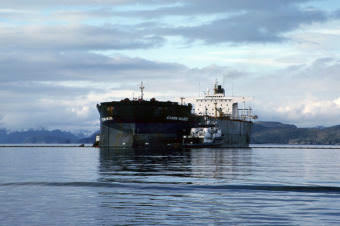
On March 24, 1989, the tanker Exxon Valdez ran aground on Bligh Reef in Prince William Sound, Alaska. Within six hours of the grounding, the Exxon Valdez spilled approximately 10.9 million gallons (259,500 barrels) of its 53 million gallon cargo of Prudhoe Bay crude oil. The oil would eventually impact more than 1,100 miles of non-continuous coastline in Alaska, making the Exxon Valdez the largest oil spill in U.S. waters at the time. (Creative Commons by NOAA Office of Response and Restoration/Wikimedia)
On March 24, 1989, the tanker Exxon Valdez ran aground on Bligh Reef in Prince William Sound, Alaska. The oil would eventually impact more than 1,100 miles of non-continuous coastline in Alaska, making the Exxon Valdez the largest oil spill in U.S. waters at the time. (Creative Commons by NOAA Office of Response and Restoration/Wikimedia)

A federal judge ordered the U.S. Environmental Protection Agency to revise its regulations on oil dispersants, siding with Cook Inletkeeper and other plaintiffs that the current regulations don’t reflect updated research on how toxic those chemicals can be.

Cleanup crews used dispersants in large quantities after the 1989 Exxon-Valdez spill and 2010 BP Deepwater Horizon oil spill in the Gulf of Mexico, but they haven’t been used in U.S. waters in over a decade, according to the National Oceanic and Atmospheric Administration.

Cook Inletkeeper Advocacy Director Bob Shavelson said he’s never seen them used in Cook Inlet. But he said it’s important to make sure it stays that way.

“I think if you have a large oil spill, that’s one of the tools in the tool kit that would come out rather quickly,” he said.

Dispersants break oil down into smaller parts that mix with water, which gets slicks off the surface of the ocean during spills. But research has since shown dispersants to be more damaging to humans and marine species than previously thought.

Meanwhile, the EPA has not updated its regulations on oil dispersants since 1994. U.S. District Judge William Orrick said the EPA’s failure to update that part of its contingency plan in the face of updated science violates the Clean Water Act.

Shavelson said the ruling could be especially significant to communities in the Arctic.

“The concern is that as climate change ensues, as we see more of an ice-free Arctic, we’re going to see more shipping in areas that are dark and rough weather,” Shavelson said. “And it’s going to be very difficult to use traditional tools to clean up spills. So the oil companies and shipping companies are going to prefer to spray dispersants and just disperse it.”

The EPA will have to finalize its new regulations on dispersants by May 31, 2023, per the agency’s own suggestion. The judge asked the EPA to file status reports on the process every 180 days until it is published.

‘An ecosystem in a single creature’: Alaskans celebrate Wild Salmon Day in Kenai Peninsula

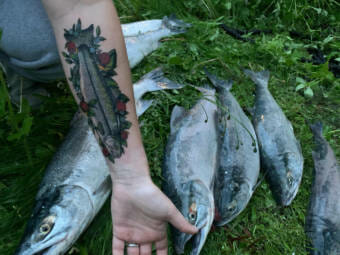
An arm with a salmon tattoo. The salmon is on a bed of roses. A pile of salmon in grass is in the background.
Hannah Etengoff with salmon she caught in the Kenai River. (Photo courtesy of Hannah Etengoff)

To most Alaskans, it’s food. To some, a livelihood. To others, a sport. No matter how you slice it or filet it, salmon is deeply important to Alaskans. And salmon lovers across the state, like Steve Schoonmaker, of Kasilof, celebrated the species on Tuesday.

“First of all, I’m waking up and I’m remembering what Alaska Salmon Day means,” he said. “And how lucky we are in Alaska to have wild salmon.”

Aug. 10 is Alaska Wild Salmon Day. Gov. Bill Walker set aside the day in 2016 to honor the iconic Alaska species.

“You’d be very hard-pressed to throw a little river rock in this community and not hit somebody who’s deeply connected to salmon,” said Branden Bornemann, executive director of the Kenai Watershed Forum.

He said it’s important to reflect on how much salmon means to the state.

“I came up from the middle of North America, grew up in North Dakota,” he said. “So, as far away from every coastline as you can get. And all of a sudden, professionally, I find myself 10 years ago in a salmon culture and trying to take everything in and learn about it and learn my place within that culture. And, again, I think we owe it to ourselves to slow down and remember that first interaction.”

For some, that first interaction was too far back to remember.

Salmon has been part of Sharon Isaak’s life forever. She’s a Kenaitze elder who grew up fishing in Kenai.

“And ever since I was old enough to hold a fishing pole — and then as I grew up and had children, we fished — fishing’s in my blood,” she said.

Now, Isaak and her family fish with the tribe’s educational fishery by the mouth of the river.

She said each species of salmon has its own distinct taste. And she said she uses almost every part of the fish. Her son, Joel Isaak, takes the skin off for salmon-skin boots.

As for the meat, they smoke, can and freeze it.

“Wild salmon means culture, food, clothing, history, heritage, and on and on it goes,” she said.

Hannah Etengoff of Kenai said processing salmon reminds her of learning to fish in Wrangell.

Hannah Etengoff says smoking fish makes her think about the family and fishermen who taught her back in Southeast. (Photo courtesy of Hannah Etengoff)

“To me, it really does feel spiritual,” she said. “Like, I’m connecting to the land and I’m connecting with the people who taught me how to fish and who taught me how to preserve fish. ‘Cause some of them have passed on now. And I feel like it’s just such an important way to keep them alive.”

She just started dip-netting and is learning how to cast for silvers. Her husband built a smokehouse and they have a filet table next to their garden.

“My husband is Tlingit, he’s from Southeast Alaska,” she said. “And salmon there is just such an important part of the culture. And it’s just so important in the communities and it’s a way to spend time with your families and it’s a way to share with others. Catching salmon and smoking salmon and jarring it up. All that — it’s a labor of love.”

To those in the business of salmon, the fish is economically important. And delicious.

“Wild Alaskan salmon, to me, is the freshest, best salmon in the world,” said Jason Tanner, who owns Tanner’s Alaskan Seafood, in Ninilchik. He processes sport and commercial catches.

“I mean, you can’t get anything that’s better for your body, better tasting,” he said.

Tanner certainly knows about taste. His company won the Smoked Salmon Superbowl at Salmonfest last weekend for the second year in a row.

He said the key is brining the salmon for 24 hours and using all-natural wood for the smoke.

“It’s not a super long process,” he said. “It doesn’t take 13, 14 days to do it. We’ve got it dialed.”

He said salmon is an important economic engine for the community of Ninilchik. That’s true for fishermen around the peninsula, as well.

Steve Schoonmaker stands, holding a packaged salmon filet in his hands. Schoonmaker was one of several peninsula fisher poets to perform at Salmonfest this weekend. Salmon is a recurring theme in his poems. (Photo by Sabine Poux/KDLL)

Schoonmaker grew up on salmon, eating it every day for lunch. He wrote a poem about salmon, and what he sees as a conflict between loving fish and killing fish. It’s called “The Gift.” As a commercial fisherman and activist, Schoonmaker now fights to keep salmon runs clean and wild.

“So I become more and more aware of how extra special and vulnerable these fish are,” he said. “We get one on a plate and we eat it and we enjoy it but it’s really a gift — to all of us, to this economy and this ecology. It’s an ecosystem in a single creature.”

Listen to “The Gift” by Steve Schoonmaker:

Editor’s note: Branden Bornemann is on the KDLL Board of Directors.

Seward’s Lydia Jacoby heads back to her hometown with 2 Olympic medals

Lydia Jacoby after finishing 2nd in her final heat in the women’s 100 meter breaststroke at the 2021 US Olympic trials (Photo courtesy of Jodi Cox McLaughlin)

Lydia Jacoby left Tokyo this weekend with another Olympic medal. The 17-year-old Seward swimmer won silver for her role in the women’s 400-meter medley relay Saturday, where she swam the second leg of the race and logged a time of 1 minute, 5.03 seconds.

It’s Jacoby’s second medal of the Olympics. She won gold for her surprise victory in the women’s 100-meter breaststroke last week, earning Alaska its very first Olympic swimming medal.

Jacoby also raced in the 400-meter mixed medley relay Friday night. The U.S. team came in fifth place and Jacoby swam her entire leg with goggles down around her mouth after they fell off her eyes when she jumped in the pool. She still made a time of 1 minute, 5.09 seconds.

The teen swimming phenom is scheduled to arrive back in Seward on Monday, where her dad, Rich Jacoby, said she’s excited to sleep in her own bed and eat a home-cooked meal.

Then it’s back to 12th grade and another year of Seward High School swimming. The team’s season starts this Wednesday.

“She’ll probably take a week or two off, whatever she feels is good,” said Solomon D’Amico, head coach for the Seward High swim team. “When she’s ready, she can come join us and we’ll get her back to the grind.”

Seward residents are also planning a parade for Jacoby. But first, they want to give her time to decompress at home with her family, said Seward Tsunami Swim Club parent Sarah Spanos. She said they haven’t yet decided on a date for a celebration.

Site notifications
Update notification options
Subscribe to notifications