
KDLL - Kenai

KDLL is our partner station in Kenai. KTOO collaborates with partners across the state to cover important news and to share stories with our audiences.

Seward swimming in hometown pride for Olympic champ Jacoby

Hundreds of Sewardites gathered at the Dale R Lindsay Alaska Railroad terminal Monday night to watch Seward sensation Lydia Jacoby swim for Olympic gold. (Sabine Poux/KDLL)

Seward’s Lydia Jacoby became an Olympic champion this week in Japan. The 17-year-old swimmer placed first in the 100-meter breaststroke, beating record holders and earning the state its very first Olympic swimming medal.

Back home, it felt like the whole town of Seward was watching.

Under a huge American flag in a railroad terminal on Port Avenue, between the harbor and cruise ship dock, hundreds of Sewardites watched one of their own get closer and closer and closer to becoming the world’s best.

And with each passing second, the crowd got closer and closer to losing their minds.

Then Jacoby tapped the wall first.

The shouting soon turned to crying and hugging. At the front of the crowd, Wren Dougherty, who has known 17-year-old Jacoby since they were infants, was watching through tears.

“I’m so excited, holy cow,” she said. “I just am so proud of her and I love her so much.”

Sarah Spanos has been watching Jacoby swim with her sons for years. She thought Jacoby had a good shot at a medal but never dreamed she’d win gold.

“Lydia, you’re the best, we love you,” she said. “The whole town will be waiting for open arms for you to come. You got gold, oh my gosh. GOLD!”

Friends of Jacoby were decked out in merch at Monday night’s celebration. (Sabine Poux/KDLL)

Spanos helped organize the watch party, where the community that’s known Jacoby all her life witnessed her become an Olympic champion.

Jacoby’s race is the 100-meter breaststroke, a quick event that sends swimmers to the other side of the pool and back in barely more than a minute.

For the first half of the race, Jacoby was in third place, trailing Olympic record-holder Tatjana Schoenmaker of South Africa and Lilly King, also of Team USA, who won the event in the last Olympics.

King and Schoenmaker were favorites, with faster times and years more experience. Jacoby’s coaches thought she might have a chance at medaling.

So when she pulled ahead in the last quarter of the race and hit the wall first, after a minute and 4.95 seconds, Jacoby herself looked stunned when she poked her head up and saw the scoreboard. The crowd in Seward shouted and jumped so hard the room seemed to shake.

“Her whole family, her, they’re just the perfect examples for U.S.A.,” said Hunter Hollingsworth, who grew up swimming with Jacoby. “Super nice, just — I wouldn’t want anyone else representing U.S.A.”

“She always rises up to the top of every competition she gets to,” said Connor Spanos, another Seward teammate. “And it was no different at the Olympics, clearly.”

Megan O’Leary, who coached Jacoby in Seward, said Jacoby had her eyes on the gold before she jumped in the pool.

“She texted me before her race and she said, ‘I want it,'” she said. “And I was like, ‘Then you got it.’”

There are a lot of elements that make Jacoby’s race remarkable — her last-second lead and her young age. Jacoby is entering her senior year at Seward High School and is committed to swim at the University of Texas at Austin when she graduates in 2022.

But there was one detail race announcers, and the internet, just could not get over:

“Not exactly your hotbed of swimming,” said one NBC announcer after the race. “Alaska.”

That may be so. Alaska’s never sent a swimmer to the Olympics before.

Jacoby became the athlete she is today with the Seward Tsunami Swim Club, which she joined when she was 6.

Dana Paperman, of Seward, remembered Jacoby at a swim meet called the Candy Cane Splash.

“Her first 50-meter race,” she said. “She looks confident, looks strong. She hits the black line into the deep end. She comes up coughing, spitting water and crying. And her dad automatically just got on a chair, reached [into] the pool, picked her up, and she just grabbed onto him and she might’ve even said, ‘I’m never swimming again!’”

Lydia Jacoby after winning second place at a 2014 race with the Seward Tsunami Swim Club. (Courtesy of Sarah Spanos)

Coaches say it’s Jacoby’s kick that separates her breaststroke from the pack. She honed that breaststroke with her coaches in Seward, and then in Anchorage when the pandemic hit and Seward’s pool closed. That’s where she got to train in the state’s only Olympic-sized pool, at Anchorage’s Bartlett High School.

On Monday night, the Seward swim club was front and center to watch the race. Dougherty said she gets so nervous watching her friend compete that it feels like she’s about to jump in the pool herself.

“It’s so crazy and exciting because she’s worked so hard for so long,” she said. “She’s a really humble person, so she really deserves all this recognition.”

Seward had its pride for Jacoby on display in the months before the race, from signs in store windows and along the highway, to red, white and blue “Go, Lydia, Go” t-shirts.

“It’s really exciting to see everywhere you go — every restaurant, every last business has support up for her,” said Matt Arnold, one of Seward’s many seasonal employees. He’s in town from Florida to work on a barge outside the terminal where the watch party is gathered.

“It was just electric to be here and see her win it,” he said.Now, all of Alaska is celebrating Jacoby. She’s only the 10th Summer Olympian to be born in Alaska.

For the rows of Seward kids watching Jacoby swim on the big screen Monday, O’Leary said she’s more than that. She’s a role model.

Jacoby’s fans say when she comes home, they’ll be ready to celebrate her Olympic victory together. (Sabine Poux/KDLL)

“She’s still part of the team, you know? Even here, in our small little community,” she said. “She’s racing on a world stage and she just won a gold medal and it’s amazing.”

Jacoby could swim in two Olympic relays, although teams won’t be announced until later this week.

When she gets back from Tokyo, Seward’s Olympian will be greeted by a community practiced up on gold medal-worthy levels of support.

The Pacific Northwest heat dome just skirted Southeast. What will Alaska’s own extreme heat waves look like?

Temperatures were in the mid-to-high 70s on the central peninsula this weekend. In Anchorage, they hit daily records. (Sabine Poux/KDLL)

A heat wave in the Lower 48 cooked shellfish alive on Pacific Northwest beaches and triggered excessive-heat warnings in several states. Climatologists say it’s because of a dome of heat that drove temperatures high above 100 degrees Fahrenheit and even skirted part of Southeast Alaska.

Southcentral Alaska hasn’t seen that kind of heat. But could scorching heat waves be in the region’s future?

Brian Brettschneider is a research physical scientist with the National Weather Service Alaska Region. He says it’s complicated.

“A very short answer is, in a warming world, we expect every place to have a higher probability of seeing record-high temperatures,” he said. “And the Arctic warms faster than everywhere else. So we expect those record highs to be even more likely in high latitude areas like Alaska.”

Brettschneider said heat waves are relative. What’s considered hot in Alaska is different from what’s considered hot Outside.

As of Tuesday, for example, there was still an excessive heat warning in place in parts of Montana. That means temperatures could climb past 105 degrees and stay that way for two hours or more.

“That can’t ever be issued for Alaska,” Brettschneider said. “It’s not in the toolbox of things that can even be issued in Alaska because it’s assumed that it can’t get hot enough here to issue a heat advisory.”

But while it hasn’t seen 100-plus-degree weather, Southcentral Alaska has seen its own extraordinary temperatures. Brettschneider is based in Anchorage, which saw daily records on Friday, Saturday and Sunday of 76, 79 and 81 degrees, respectively.

“I would say in the southern mainland — so, say, south of the Alaska Range — three days in a row where it’s 75 degrees … I would say that’s probably a heat wave,” he said.

Kenai temperatures were relatively high this weekend, too — in the low-to-mid 70s. But they didn’t set daily records.

Brettschneider said it’s important to look at long-term trends to get the full picture of how the climate is changing. This summer has been one of the colder summers the region has had in the last few years. But when compared with summers over the last several decades, it’s still among the hottest.

Climate experts took the long view in a study published this month, which found that the heat wave in the Pacific Northwest was a “thousand-year event.” That means there’s a 1-in-1,000 chance it could be that hot in a given year.

“So in a way, it might be better to say, ‘What would a 1-in-1,000 year event in today’s climate in Alaska look like?’ And the short answer is, I have no idea,” Brettschneider said.

Climatologists say that the 1-in-1,000 number is adjusted to today’s standards. In a pre-warmed climate, they say, the likelihood for such a heat wave would be 150 times lower.

Cold weather pushes back peony picking in Alaska

Alaska’s peony season is always later than the seasons in the Lower 48 and Europe. But this year it’s even later, giving some farmers the chance to pick and sell flowers well after their counterparts elsewhere. (Photo by Sabine Poux/KDLL)

Weather-wise, it has been a dreary summer. If you’re a peony farmer like Wayne Floyd, that’s not really a bad thing.

“They’re at stage one,” Floyd said, gesturing to a bunch of peony buds. “They’re hard as golf balls. We sometimes call them ‘golf balls on a stick.’”

The Floyds own Cool Cache Farms in Nikiski. Their peonies are usually ready to pick in early July.

But due to this year’s colder weather and the lack of sun, they’re still not ready in the middle of the month.
Floyd said it’s a good thing because it means there won’t be overlap with markets overseas and in the Lower 48. Those growers have largely stopped picking for the year, so there will be less competition with Alaska farmers for weddings.

“The Dutch tend to flood our market with a lot of cheap stems because they have the scalability,” Floyd said. “My farm will be producing maybe 15,000, 20,000 stems this year. A typical Dutch farm will produce a million-plus.”

Farmers outside of Alaska pick their flowers in May and June. Alaska’s season is always later, but this year has been especially late.

“We’re probably two or three weeks behind where our average harvest would occur,” said Brad Llewellyn of the Alaska Beauty Peony Cooperative, a group of 11 Homer peony farmers.

“Peonies prefer to open up at about 60 to 70 degrees, like springtime temperatures,” he said. “But if it remains in the 50s, that opening is going to be stymied and it’s just going to go very slowly.”

It’s hard for farmers to know what a summer will look like in advance.

Last year, Floyd started picking peonies on July 11. Two summers ago, when it was really hot, he started July 1.

At Cool Cache Farms Monday, there’s a crew weeding the peony field but no near-blossoming flowers in sight. Floyd said he has workers on deck to come pick when it’s time in the coming weeks.

“We’ve got some other people picking rhubarb, which is ready to pick,” he said. “Usually we pick rhubarb around the 20th of June.”

The cold can be a challenge when customers want flowers now. Floyd said he’s been directing customers who have called to farmers in the Interior, where temperatures are already in the mid to high 70s and farmers are already picking peonies.

The weather’s also impacted the second annual Homer Peony Celebration this month.

“And we are scrounging every little last flower that we possibly can,” Llewellyn said. “We’re really in a drought for flowers here.”

Without the flowers, Llewellyn said they’re taking festival-goers to learn about other parts of the peony growing process. There’s really not much else they can do now but wait for the warmer days ahead.

Kenai ​Peninsula parents join national outcry over critical race theory. School district says it’s not in the curriculum.

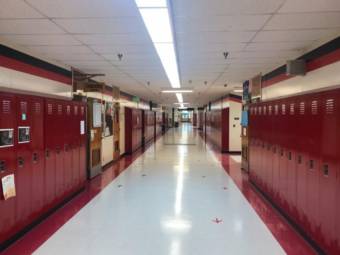
Lockers at Kenai Central High School. (Sabine Poux/KDLL)

Critical race theory was not on the agenda of the Kenai Peninsula Borough School District board meeting Monday night — or the meeting before it.

But it came up at both anyway, as parents shared concerns about their kids are being indoctrinated with a progressive agenda.

Meanwhile, the district said it doesn’t plan on teaching critical race theory at all.

School district administrators say they’ve been getting messages from a lot of parents about critical race theory.

Still, parent and retired teacher Susan Lockwood said Monday she worries about the values being taught in Kenai Peninsula schools.

“Now we have the CRT, critical race theory, being pushed on our children,” she said. “I ask myself, ‘Why?’”

Critical race theory originated in academia to explain how race and racism have impacted the country’s legal system. It became a popular conservative rallying cry last summer for parents who fear their kids’ students are becoming indoctrinated with a liberal curriculum in public schools.

Opponents of critical race theory, including former President Donald Trump, say they worry it would divide students based on race and teach kids to hate their country. Across the U.S., the topic is coming up at school board meetings.

But educators on the Kenai Peninsula said the debate over incorporating critical race theory into public schools is a red herring.
“CRT, or its tenets, are not part of the KPBSD curriculum, or what we do,” said Clayton Holland, the school district’s incoming superintendent.

What teachers will teach, he said, is the history of the country, including things like slavery and Jim Crow laws.

“What our teachers don’t do or will not do is teach their own personal ideology, personal politics, personal religion or their social bias,” Holland said. “We’re not going to teach students they are racist or victims because of their skin color. And they’re not going to separate students into groups based on the notion of suppressor groups or victim groups, or the oppressed.”

States like Texas have advanced bills to limit how race is taught in the classroom. There’s no such legislation being considered in Alaska.

Critical race theory did come up at a board meeting for the Anchorage School District last April, ahead of a vote over anti-racist education policies. None of the policies on the table explicitly mentioned critical race theory, and the policies ultimately passed.

Soldotna High School teacher Nathan Erfurth, who’s also the new teachers’ association president for the Kenai Peninsula Borough School District, said there is no part of the district’s social studies curriculum that encourages the teaching of critical race theory.

“Students in KPBSD are taught the following: What happened and who was involved,” Erfurth said. “Through inquiry, research, projects and activities that parents are encouraged to assist their students with, they are guided to expand their perspectives and build their critical thinking skills so that they are able to draw their own conclusions about what has happened in our past, and what it means for our present.”

Curriculum is just one of the issues that brought parents out to the school board meeting Monday night.

Several also said they were concerned about the district’s plan to revise its Title IX policies — a step to bring the district’s discrimination complaint process in line with federal standards implemented under the Trump Administration. The district plans to formalize the process for handling sexual misconduct and hire a Title IX coordinator to manage those complaints.

Some parents said they worry Title IX policies will be used to defend transgender students or suppress free speech.

Those concerns have recently emerged among an organized group of Kenai Peninsula parents that goes by the name “Kenai Peninsula Conservative Community Coalition,” as reported by the Peninsula Clarion. Group members say they want to push back against what they consider a “progressive agenda” in schools in favor of a conservative Christian one, the Clarion reported.

The group hosted an event at the same time as the school board meeting this week, featuring conservative website editor Joel Davidson. Davidson planned to speak about critical race theory, cancel culture and “Alaska LGBTQ Community in Education,” according to the event page.

Tsunami threat to Whittier less severe than early estimates, scientists say

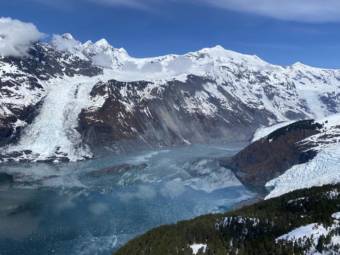
The Barry Arm fjord this May. (Alaska Division of Geological and Geophysical Surveys)

Geologists have been warning Alaskans for over a year about a tsunami that could hit Whittier following a potential landslide at Barry Arm in Prince William Sound.

They’re still ringing the alarm bells. But now, armed with more information about the area, they’re saying that the largest wave they would expect is smaller than earlier estimates.

The new data has allowed researchers to drop their worst-case estimates for Whittier from a 30-foot wave to a 7-foot wave.

“And get a little less concerning result,” said Jonathan Godt, who coordinates the landslide hazards program for the U.S. Geological Survey.

Barry Arm is part of a fjord northeast of Whittier. There are several glaciers there, and for years they’ve been rapidly retreating, leaving a steep slope of material behind. Until 2012, the water in the arm was still covered by the glacier.

That material left by the glacial retreat is very unstable. And scientists say if enough of it slides into the water at once, it could trigger a tsunami in Whittier.

Godt said they’re still trying to learn more so that they can better anticipate a catastrophe.

“This report is just one of what is likely to be many others coming out in the next few years to really provide the people who live, work and play in Prince William Sound a better understanding of the risk,” Godt said.

Last year, researchers mapped the floor by the toe of the glacier and the landslide itself. Through a system of equations, they were able to simulate the resulting wave and come up with that 7-foot estimate.

This is the first time researchers have done a simulation like that, Godt said.

Scientists are still still concerned about the threat of a landslide and tsunami. As for what exactly that threat would look like to the people of Whittier, Godt said that’s still a big question mark.

“What isn’t in this report is a description of what the water does once it reaches the shore, in Whittier in particular,” he said. “And that’s a piece of work that remains to be done.”

Researchers are conducting additional studies in the area this summer. Godt said they’ll install equipment that will help them figure out how the landslide is moving, for example, and how it is impacted by the environment.

Librarians worry for future of statewide library catalog after governor’s funding veto

The Soldotna Public Library is a net borrower from the Alaska Library Catalog. That means it borrows more books than it lends to other Alaska libraries. (Sabine Poux/KDLL)

Go to most libraries in Alaska, and you can ask for just about any book, movie or magazine. And 99% of the time, it’ll get to you, said Rachel Nash, librarian at the Soldotna Public Library.

“This system allows us to say yes every time,” she said.

That system is the Alaska Library Catalog. Gov. Mike Dunleavy vetoed $635,900 in funding for the program and others as part of a slew of budget vetoes earlier this month.

The Soldotna and Kenai libraries are among the 85 Alaska libraries in the Alaska Library Catalog. Members can borrow and lend materials to one another, like videos and magazines.

“And of course, what everyone thinks of are books,” Nash said. “There are 3.2 million titles.”

The Dunleavy administration said libraries can operate sufficiently without the funding.

But the Alaska Library Catalog may have to cut back services if it can’t get a stable source of funding into the Legislature’s budget, said Steve Rollins. He’s a dean at the University of Alaska Anchorage Library, which oversees the consortium and contributes half its funding. The other half comes from subscriber libraries.

“But the reason that money is needed is that over the last seven years, libraries in Alaska have had very significant budget reductions,” he said.

Like the UAA library. Several years ago, it contributed $600,000 to the program, Rollins said. This year, he thinks they can eke out $100,000 to put into the statewide resources.

“So our ability to collectively put money into these programs are being put in jeopardy,” he said.

Nash, the Soldotna librarian, also said the need for statewide material sharing has gone up as the program grows, which has made it more expensive to meet costs like shipping fees.

It’s caused some libraries to drop out. The Haines Borough Library left the consortium last year after it became too costly for it to mail materials to other libraries. Rollins said he’d like the library catalog to put more toward subsidizing those shipping costs.

Nash said the program is important for smaller libraries like hers. The Soldotna library is a net borrower, so it borrows more books from other libraries than it loans out.

She said without the funding, the Alaska Library Catalog will have to cut two of its administrative positions.

“And those are the two positions that keep it going,” Nash said. “They’re the ones that make sure that we can share a catalog and keep it up and running and are able to make deals with vendors to save us time and money over the course of the life of the catalog.”

Dunleavy also vetoed funding for the Statewide Library Electronic Doorway program, or SLED. That system connects Alaska library users with digital archives and databases, and saw 22 million searches in the 2020 fiscal year, Rollins said.

Some resources within SLED are safe from the veto, like Live Homework Help and Online with Libraries, a system primarily used for remote training and videoconferencing. Both were added as line items in previous budget cycles.

This year, Nash said, the Alaska Library Catalog and SLED will be OK, thanks in part to federal COVID-19 relief funds. But she says the current system of funding is not sustainable long term.

“And if that funding continues to not be available, I would predict that we would see more smaller libraries dropping out of the system,” she said.

This is the second time this has been in the Legislature’s budget and vetoed by the Governor. Rollins said they’ll put forward a similar request for funding next year.

Site notifications
Update notification options
Subscribe to notifications