KDLL - Kenai

KDLL is our partner station in Kenai. KTOO collaborates with partners across the state to cover important news and to share stories with our audiences.
Massive algae bloom in the Gulf of Alaska could be good for marine life

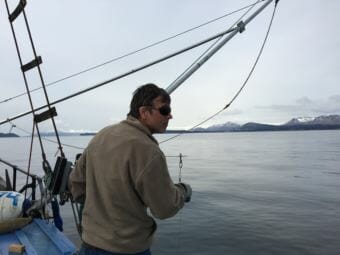
Fishing for cod in the Gulf of Alaska. (Annie Feidt/Alaska’s Energy Desk)

Tiny but mighty phytoplankton live at the base of the food chain in the Gulf of Alaska. They’re a food source for small crustaceans, which in turn feed small fish, then bigger fish, then seabirds and marine mammals.

Each spring and summer, a large concentration of phytoplankton blooms in the gulf. This year, researchers recorded the biggest bloom they’ve ever seen.
“Which theoretically means we should have a very productive year at a whole bunch of other steps in the food chain,” said Russ Hopcroft, a professor with the University of Alaska Fairbanks.

He said the phytoplankton bloom in itself is nothing out of the ordinary.

“Part of the natural cycle in the Gulf of Alaska is that when the light starts coming back in the spring and the storms start to subside a little bit, we get a big explosion of life in the phytoplankton,” he said.

Hopcroft said people on passing ships might not register the large amounts of phytoplankton, besides more activity from birds or fish in the area. But researchers keeping tabs on the blooms have noticed. They monitor the area each May, both with satellites and samples taken on a research vessel.

Chlorophyll levels in the Gulf of Alaska as measured by a satellite in April. (University of Alaska Fairbanks)

This year, the bloom spanned from Kayak Island near Cordova to Kodiak, dropping off where the gulf shelf plummets into deeper waters.

“I think we just had the right combination of some prolonged light and just enough storminess to keep things mixing a little bit, but not so much that they diluted and spread everything out,” Hopcroft said.

Climate may also play a role. The Gulf of Alaska saw a heat wave between 2014 and 2017, nicknamed “the Blob,” which decimated some commercial fish populations and changed the marine makeup of the gulf.

“There wasn’t much of a bloom during the Blob,” Hopcroft said.

But he said the gulf has seen more normal temperatures this year, at times even trending slightly cold.

Hopcroft said the hope is the energy from the phytoplankton make it up the food chain, from the fish that swim in the gulf’s waters all the way up to the Alaskans who eat them.

Advocates of unproven COVID treatment dominate Kenai Borough Assembly meeting

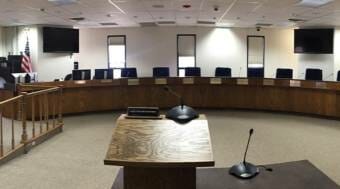
The Kenai Peninsula Borough Assembly chamber (Photo from Kenai Peninsula Borough website)

A Kenai Peninsula Borough Assembly meeting turned into a debate about the coronavirus this week when a resolution condemning vaccine mandates generated hours of conversation about unproven COVID-19 treatments and took the meeting right up to its 11:30 p.m. automatic end time.

Nearly 20 commenters took to the podium to talk about their own experiences with COVID-19 and ivermectin — a drug that’s most commonly used in the U.S. as a dewormer for animals and is sometimes used as an anti-parasitic drug in humans.

“People are screaming at you that there is a treatment,” said April Orth, of Kenai. “It is an effective treatment and it should be available to everyone.”

Ivermectin has become popular among anti-vaccine circles, in particular, as more people claim it could be a treatment for COVID-19. Federal agencies said there is not enough evidence to show that’s the case and are cautioning against using it as a COVID cure while clinical trials are underway.

Borough Mayor Charlie Pierce stoked the conversation about ivermectin at the last Assembly meeting and again on local talk radio, alleging Central Peninsula Hospital isn’t doing everything in its power to help coronavirus-infected patients because it’s not using alternative treatments.

Orth said at the meeting she had just finished recovering from COVID-19 and self-medicated with ivermectin. Ray Southwell of Nikiski said he was delighted when the mayor mentioned the drug at the last meeting.

“We need encouragement from you,” he said. “I was encouraged a couple weeks ago when the mayor mentioned ivermectin. I exploded. I contacted him. I wanted to talk to him, I encouraged him because we need to have this dialogue.”

Several physicians, including Matthew Puckett, of Homer, warned there isn’t enough evidence to prove ivermectin is safe for COVID-19 patients.
“As much as people would say there are other doctors saying this is working in their clinics, in their practice, there is not a large enough body of evidence to establish policies,” he said.

COVID-19 came up during nearly every opportunity for public comment at Tuesday’s meeting.

But most of the conversation was in response to a resolution introduced by Pierce against what he called “vaccine segregation” from the government.

Pierce’s resolution said the Assembly has previously encouraged people to get vaccinated against coronavirus. But, it said, the Assembly opposes any mandates from the government that would exclude unvaccinated people in any case.

Some private businesses have required proof of vaccination as a condition for entry into buildings or events. Vaccines are also now required for students of the University of Alaska living in on-campus dorms, and the Biden Administration is considering requiring vaccines for employees of federally funded nursing homes. The state of Alaska and local governments have not taken a step toward any mask mandates.

As a second-class borough, the Kenai Peninsula Borough does not have policing or health powers.

But Richard Derkevorkian, one of the Assembly members who co-sponsored the resolution, said it was important for the borough to take a stand.

“This is a simple decision for me,” he said. “You’re either on Team America, the land of the free, and you can join me on the record opposing government mandates, or you can align with the tyrants and governments like Australia.”

Over 20 comments sent to the Assembly in advance of the meeting condemned the resolution. Few were in favor.

But the reverse was true for the commenters that showed up at Tuesday’s meeting. Most said they supported it, including Taylor Jackson, of Soldotna, who said he sees mandates as a moral wrong.

“How is it any different from what Nazis did by taking a group of people, segregating them, and then making everybody else think they’re dangerous? Explain the difference to me, please,” he said.

Margaret Gilman, of Kenai, said she worried the resolution was too negative coming from public officials.

“There are those that are not able to be vaccinated because of their health concerns,” she said. “But the vaccine hesitant may be swayed by your public actions.”

Some Assembly members were frustrated by the resolution’s lack of teeth. In a moment of irony, the legal department asked the Assembly to change some of its wording because cities were concerned they were being required to mandate anti-mandate policies.

Assembly President Brent Hibbert said he agreed with the notion of the resolution. But he said it was political and toothless.

“We do three things: We fund schools, we take care of solid waste and we do end-to-end roads,” Hibbert said. “We can’t do this. This resolution has no teeth. It’s just words on a piece of paper that cause division.”

When it became clear the resolution did not have the votes it needed to pass, Assembly member and resolution sponsor Jesse Bjorkman successfully moved to table it. That means it can come up again at a future Assembly meeting.

Pierce said he was grateful for the hours of debate and doubled down on his support for other treatments. The meeting adjourned before all business was completed — which Assembly member Willy Dunne said has only happened a handful of times in his tenure on the Assembly, mostly during debates about commercial marijuana regulations.

Kenai homeowners tackle bluff erosion, one recycled pipe at a time

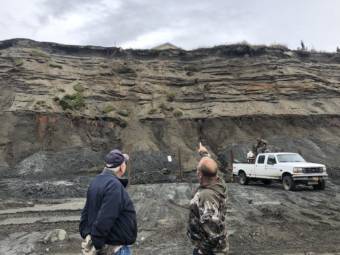
Dave Salter and Robert Peterkin in front of Salter’s house on Toyon Way. Erosion has taken feet off the bluff since Salter bought the property in 2010. (Sabine Poux/KDLL)

Dave Salter’s yard is, quite literally, falling into the ocean. He didn’t know it was going to happen so fast when he bought the place on Toyon Way in Kenai.

“The agent that showed us the property said, ‘Oh, a few inches a year,’” Salter recalled. “And being from Texas, I didn’t know any better.”

Fast forward 11 years.

“We’ve lost probably 15 feet,” he said. “And we’ve had to set back our fence. We used to have a fence that went all the way across. We had to take that down.”

This summer, contractors are building a wall in front of Salter’s 87-foot stretch of bluff, just north of where the city of Kenai is planning its own stabilization project.

Robert Peterkin co-owns Triangle Recycling and is working with Salter and his neighbors on the wall.

He said the $30,000 project isn’t a cure-all. But it could slow the erosion.

“Dave will still lose 10 more feet in the next 10 years,” Peterkin said. “I mean, he’ll still lose that. Now, eventually, our hope is to stop it, when the slope gets to be not so steep. But we’re slowing it way down.”

Homeowners on the bluff have taken their own approaches — or no approach at all — to bluff erosion.

The south beach, parallel to Kalifornsky Beach Road, boasts a patchwork of metal, wood and rock solutions to a problem that’s grown as winds and storms have intensified.

“The last couple years have been some really extreme storms,” Peterkin said. “We even had one early this spring.”

But there’s little protecting the bluff along the north beach. And it’s a part of the bluff that really could use protection. In some places, fences hang precariously over the edge.

Construction on the wall in front of Salter’s property began this week. He said he’s relieved to finally be getting it done. (Sabine Poux/KDLL)

Peterkin’s walls are made from layers of vertical and horizontal recycled drill pipe, which stick 20 feet into the ground. Pipes closer to the bluff are welded into place to keep them from moving.

There’s enough space so water can drain from behind the wall, and there will be rocks in front to act as a wave break.

He said the project will also make the slope less steep — and, therefore, more stable — because dirt from the bluff will fill in the space between the wall and the existing bluff.

Peterkin said he was inspired by Royce Roberts, a Kenai man who died last month. Roberts owned a pipe supplier company and built his own pipe wall, which withstood decades of storms.

Peterkin hopes his walls could last 50 years or more.

Last year, he built his first two on K-Beach Road. This summer, he’s going back and making adjustments as he fine-tunes the design.

“A lot of this, we’ll learn,” he said. “You know, we’ll come here next year and look at it and make sure it’s working. And we may have to make some adjustments. But we think it’s going to work well.”

As weather’s been worse, Peterkin said, he’s received more inquiries. Earlier this summer, he put other projects on hold to help a woman who lost part of her cabin over the edge.

Kenai is working on its own stabilization project, an effort decades in the making along 5,000 feet of quickly eroding bluff.

Peterkin used to be on the Kenai City Council. He said his project is on an entirely different scale from Kenai’s project

“They’re doing the million-dollar project and we’re doing the thousand-dollar project,” Peterkin said.

Kenai’s working with an engineering firm to design a berm to line the bottom of the bluff, between Cemetery Creek and Pacific Star Seafoods. That berm will likely be made from a combination of gravel and rock.

Salter’s project didn’t need any special permission from the city.

But, he said, it’s been a process. He had to buy the beachfront property because the owner didn’t want to deal with the construction. That took a while.

Now, it’s up to his neighbors to decide whether they want to build on their stretches of bluff, too. He said many are getting on board.

“My two neighbors on that side have already signed off,” he said. “The one here is in a transition stage of owners and the new owner says he’s going to do it. Which means the next one will probably do it. And then, farther down, most of those are probably going to do it.”

Peterkin estimates construction will be done in two weeks. After that, the only thing left to do is watch and wait.

COVID is surging in Kenai Peninsula schools, but district won’t require masks

Lockers at Kenai Central High School. (Sabine Poux/KDLL)

In the week since the Kenai Peninsula Borough School District started tracking COVID-19 cases, 130 students and staff have tested positive for COVID-19 while 930 others were identified as close contacts of cases.

“We are seeing, compared to last year, far more positive cases and people needing to quarantine,” district spokesperson Pegge Erkeneff said. “It’s completely different this school year than it was last year. And that’s because delta is completely different.”

The school district is reintroducing some of the mitigation measures it abandoned this summer, Erkeneff said, like seating charts in classrooms and on school buses, staggered lunch periods and a stricter emphasis on keeping students in pods.

But it’s still not adopting a universal mask mandate for district schools. Universal masking has been controversial among parents and borough officials, despite guidance from the CDC that students and staff should wear masks inside classrooms as the highly-contagious delta variant spreads. In the district’s mitigation plan, masking is a suggestion, not a rule.

However, a handful of the district’s schools do have mask mandates in place.

The district is deferring to tribal authorities that have mask mandates, Erkeneff said. As of Monday, that included the Tebughna, Susan B. English and Port Graham schools.

The Nanwalek School is currently 100% remote due to a hunker-down policy in the village.

Also, Seward Middle School, Seward High School and Moose Pass School and Seward Elementary School recently started requiring masking because of coronavirus cases. The universal mask rules last until at least the end of next week.

Per district policy, students exposed to COVID-19 do not have to quarantine when all students linked to an exposure were wearing masks.

Contacts who are vaccinated and asymptomatic also don’t have to isolate or quarantine. In most other cases, students are required to take classes remotely until they’re allowed back in the classroom.

Erkeneff said the district is not adopting a universal masking policy at this time. She said it’s too soon to tell whether universal masking is stopping the spread of COVID-19 at individual schools because the policies are new.

But, she said, the district is encouraging more masking amid high levels of community spread.

“You will be starting to hear a stronger ask from the school district and from our different trusted school leaders to please, please, please consider wearing a face covering,” Erkeneff said. “It’s not going to be forever. But we need to really protect ourselves and protect each other as COVID is just rapidly spreading in our communities.”

Erkeneff said Superintendent Clayton Holland is meeting with district leadership daily to talk about COVID-19 numbers. A new medical advisory board is also advising the district on its mitigation policy.

New research prompts Alaska Fish and Game to regulate kelp harvest

Kelp on the beach on the Homer Spit. (Sabine Poux/KDLL)

Biologists with the Alaska Department of Fish and Game didn’t always pay much mind to how people used the kelp that washed up on Cook Inlet beaches.

“We assumed that it was like somebody going to the beach and picking up driftwood, or picking up pretty rocks or things like that,” said Glenn Hollowell, the area management biologist for lower Cook Inlet.

He said in the last four years, the department has learned more about those detached kelp populations.

He said he was surprised to learn there are live germ cells in detached kelp that allow it to reproduce.

“We didn’t realize the extent to which this stuff does have biological value,” he said. “And so it caused us to take a step back and say, ‘Maybe we shouldn’t allow people to take whatever quantity they want from wherever.’”

Fish and Game got the OK to issue commercial kelp permits from the Alaska Board of Fish in 2019. It issued its first four last year.

Hollowell said he sees the permitting process as precautionary. The department is still learning about how those kelp populations impact the local ecosystem, including how they provide shelter and food for creatures like sand fleas. In the meantime, it wants to make sure kelp isn’t overharvested in a way that hurts those other species.

The department already allows subsistence and personal-use kelp harvest without a permit. But harvesters cannot take more than 10 gallons of kelp per day.

Hollowell said the department has mostly issued commercial permits to gardeners who want to turn it into fertilizer, plus one person who’s interested in using the kelp as food.

Some harvest with commercial use in mind. Others, Hollowell said, just want to harvest many yards of kelp at a time.

“So you don’t have to have a business permit or something,” Hollowell said. “It’s more a function of volume than anything else. And they can go to Anchor Point and take pretty much as much as they want for this.”

Hollowell is also trying to spread out the harvest. Most people take kelp from the beaches in Homer.

But he said there’s a lot more that washes up in Anchor Point, particularly in the winter. He’s sending permittees that way.

“Often there’s 10 times the quantity at Anchor Point than there is on Homer beaches,” he said.

Permit holders can only take kelp that’s detached. It must be harvested from the highest tide line.

If you’re interested in harvesting kelp for commercial use, you can call the Fish and Game office in Homer.

Feds to resume work on possible Cook Inlet lease sales

Cook Inlet oil platforms are visible from shore near Kenai, Alaska. (Rashah McChesney/Alaska’s Energy Desk)

The federal government said it will continue taking steps toward a potential oil and gas lease sale in Cook Inlet after a Louisiana district court judge ordered the Biden administration to resume its lease programs there and in the Gulf of Mexico.

The U.S. Department of the Interior has been at odds with several Republican states over the federal leasing program since Biden halted the two auctions and promised to review the program earlier this year. It was part of a larger executive order aimed at fighting climate change.

The state of Alaska and 12 other states then sued the Biden administration in March, arguing the decision was bad for economic development and that the federal government bypassed the public process when they hit pause on the sales.

The area of the proposed Cook Inlet lease sale, covering just over 1 million acres, is outlined in yellow. Blocks outlined in green were purchased by Hilcorp Alaska in the last sale. (Bureau of Ocean Energy Management)

This June, U.S. District Court Judge Terry Doughty of Louisiana sided with the states.

The Interior Department said it appealed that order last week. But while the appeal is pending, the department said it will continue with the lease sale processes in the inlet and the gulf.

At the time of Biden’s executive order in January, the federal government was gearing up to sell leases for one million acres in Cook Inlet, from the southern end of Kalgin Island down to Augustine Island.

The Bureau of Ocean Energy Management had already released an environmental impact statement on their plans for that sale. Now, the agency will issue a revised statement with a new public comment period, a spokesperson for the Interior Department said.

The department said in a press release that it’s expecting the assessment to come out this fall. It also said it “continues to review the programs’ noted shortcomings, including completing a report.”

The department can still decide to cancel a lease sale after an environmental impact statement is filed. The Bureau of Ocean Energy Management canceled lease sales in 2006, 2008 and 2010 in Cook Inlet due to lack of industry interest.

A date has not yet been set for a potential sale in Cook Inlet.

Site notifications
Update notification options
Subscribe to notifications