KDLL - Kenai

KDLL is our partner station in Kenai. KTOO collaborates with partners across the state to cover important news and to share stories with our audiences.
State looks for small teams to salvage roadkill

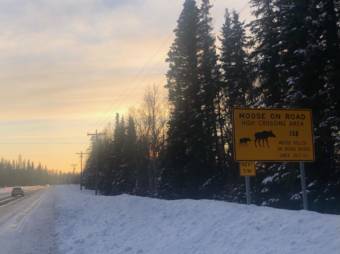
Salvage teams across the state receive and deliver roadkill moose to people in need. On the peninsula, that work has largely been falling on charities. Laurie Speakman hopes that will change under the troopers’ new system. (Sabine Poux/KDLL)

Since the Alaska Moose Federation closed up shop in November, Kenai Peninsula charities and organizations have had to get roadkill moose off the highway and into freezers themselves.

It’s been a challenge without AMF’s fleet of trucks and volunteers. And charities say they’ve struggled to get meat to the families and individuals on their lists.

Now, Alaska Wildlife Troopers are looking for small teams of volunteers to sign up online for their roadkill lists.
When there’s moose roadkill in the area, dispatchers will call those teams, who will have 30 minutes to respond. Teams can keep the meat they salvage.

Charities will still be able to retrieve moose and distribute meat to families and individuals. But Soldotna’s Laurie Speakman said the team system takes some of the pressure off the organizations to be the middlemen.

“This is something I’ve wanted to see for a long time, is the individualized program,” said Speakman, who was the AMF truck driver on the Kenai Peninsula. She’s known locally as Laurie the Moose Lady.

“And I think it will lighten the burden on the charities because they won’t have as many people on their lists needing meat,” she added.

Back when AMF was still in business, drivers like Speakman would pick up moose and coordinate with Alaska State Troopers to drop them off to AMF members.

At one time, AMF had a contract with Alaska Department of Transportation to deliver to anyone on the salvage list. In its most recent iteration, AMF was sustained by memberships.

But the nonprofit closed last year, facing a lack of funds from legal troubles and a decline in membership.

That’s put member organizations in a tough spot.

Max Pitts received moose at the Funny River Chamber of Commerce. He said it’s dangerous work without the lights, winch and other equipment AMF had. He’d sometimes field calls in the middle of the night.

“I won’t do it anymore,” he said. “And that’s been the problem, just trying to find people that have the ability to go get it.”

He said AMF’s program was valuable. Last year, he said the chamber served 120 people with the moose they received. A lot are elderly individuals and couples in Funny River.

“The other thing is, you can’t leave a dead moose lying alongside the road,” Pitts said. “Because it’s going to bring in bears and wolves and then you’re going to have more accidents.”

He thinks the new system will be better than nothing. But said he wishes AMF was still running.

Don Dyer, the most recent executive director for AMF, is trying to sell his fleet of four trucks. He said the organization plans to reimburse charities for their memberships — $500 apiece for peninsula charities. But he can’t do that until he makes the sale.

That doesn’t bother Pitts.

“I wouldn’t ask for it,” he said. “I know they gave you more value than we paid for. At $500 a year, they’re dropping off 10 to 12 moose. That’s going to be somewhere from $40 to $50 a moose, to have it dropped off.”

You can register to be a salvage team on the Department of Public Safety website. The new system goes into effect July 1.

Observers count over 200 Cook Inlet belugas in rivers this spring

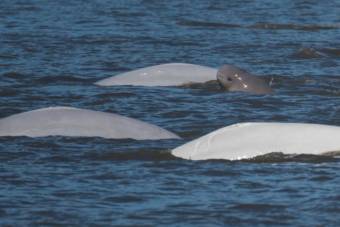
Cook Inlet belugas have been declining as a population for over two decades. Researchers hope to learn more about why through studies and observations like the ones made this spring. (NOAA photo)

Those who live close to the Kenai and Kasilof rivers know belugas sometimes feed there. But it’s been a mystery how many whales actually travel through those waterways, particularly in the spring.

This year, a large team of volunteer observers counted for the first time how many Cook Inlet belugas passed through the rivers between March and May. They counted just over 220 belugas.

“They are absolutely amazing. Absolutely amazing,” said Teresa Becher, a coordinator for the Alaska Beluga Monitoring Partnership. She was among a team of nearly 30 observers that scanned the Kenai and Kasilof rivers this spring for Cook Inlet belugas — a population that’s considered critically endangered and has been declining for over two decades.

Researchers are tracking Cook Inlet belugas to learn more about why they aren’t rebounding.

They’ve relied in part on volunteers like Becher who count and report beluga sightings in Cook Inlet and its watershed. For a few years, they’ve watched whales in the fall, when they come into the rivers for silvers.

But they haven’t been tracking as closely what happens when belugas return to the rivers in the spring, until this year.

“One of the biggest things that we learned is that the belugas use the Kenai River in particular much more often than even NOAA understood in terms of coming in and foraging for food in the spring,” Becher said.

She said they saw the first belugas in the rivers on March 25 and the last on April 30.

“And to discover that they use the Kenai River so much during the spring is very important information,” she said. “It just means that we really have to pay attention to what’s going on in the river and kind of find out what it is they’re eating.”

Becher counted from the river bluff in Kenai. Up at Turnagain Arm, Suzanne Steinert was counting by the Twentymile River and near the Mile 95 pullout in Girdwood.

“We call that stretch there Beluga Alley,” she said.

Monitors in the inlet saw fewer whales than in the rivers. But Steinert said they got to observe some interesting beluga behaviors — like when a pod of belugas swam up to a stranded humpback whale in Turnagain Arm.

“It was really fascinating. Personally, I had never seen belugas interacting with a whale like that in Turnagain Arm,” Steinert said.

Monitors at all the locations submitted their observations electronically and they’ll be compiled by a coordinator. That data is cross-referenced with data from aerial surveys from the National Oceanic and Atmospheric Administration.

It’s one part of a large puzzle about the endangered animals. And there are still lots of pieces researchers don’t know, like why the belugas travel through the rivers in the spring. They’re trying to learn more about the belugas’ food sources through an environmental DNA project this year.

Becher said she wants to learn more about what’s threatening the beluga population as a whole.

“One of the big problems that NOAA talks about is they have not been able to pinpoint why they aren’t coming back,” she said. “Is it pollution? Is it warming temperatures? No one seems to know.”

Belugas do sometimes come into contact with boats and fishermen — something Becher said they can better avoid if they know where belugas are. The Alaska Wildlife Alliance has a text alert system so people know when there’s been a sighting.

“That’s probably the single most important, immediate thing that everyone can help with,” she said.

It’s hard to say if the large number of whales in the rivers are a sign that the population is rebounding, since there’s little data for comparison. It’s also possible observers counted some whales twice. Scientists know of about 280 Cook Inlet belugas in existence.

But Becher said they’ll use this year’s counts as a benchmark going forward.

To get text alerts about belugas in the Kenai and Kasilof Rivers text BELUGA to 833-541-0408.

‘The bigger the meet, the better she does’: Locals react to Jacoby’s Olympic-qualifying swim

Seward’s Lydia Jacoby at the TYR Pro Meet this April in Mission Viejo, Calif. Jacoby’s performance in the 100-meter breaststroke at that meet makes her the 14th fastest U.S. woman of all time. (Photo courtesy of Lydia Jacoby)

Lydia Jacoby is about to become the second Alaskan to compete in the Summer Olympics.

The 17-year-old Seward swimmer placed second in the 100-meter breaststroke Tuesday at the Olympic Trials in Omaha, Neb. She broke the national age-group record and her personal record two days in a row.

Jacoby’s Olympic qualification isn’t official yet — that gets finalized later this week.

But by all accounts, she has won a spot on the U.S. women’s team. She finished with a time of 1 minute 5.28 seconds, falling behind only Lilly King, reigning Olympic champion and world record-holder.

“The bigger the meet, the better she does. And that’s held true, all the way up to last night,” said Jacoby’s longtime coach, Solomon D’Amico, who is now in Omaha for the trials.

“It’s pretty special,” he said. “You walk into the venue, especially when it’s finals and semi-finals, and you can just feel it, you know?”

The mood has been celebratory over 3,000 miles away, too. Jacoby’s cheerleaders back home in Alaska have been following her every stroke.

Sarah Spanos, of Seward, has been keeping other Sewardites updated about Jacoby’s races on Facebook.

“Just as a bleacher mom, I’m just fighting back the tears every time I watch her swim,” Spanos said. Her sons grew up swimming with Jacoby in Seward, with the Seward Tsunami Swim Club.

A few years back, the swim club raised enough money to get Olympian swimmer Jessica Hardy to Seward. Jacoby wears the pink goggles Hardy gave to her in her meets.

The Seward swim community is small. Spanos said there’s also a sense of community across the Kenai Peninsula and Alaska.

“Homer, Kenai, Soldotna. It’s really really a tight-knit group,” Spanos said. “And I think that’s what makes it special, that even though she is just from Seward, Alaska, there are a ton of people that are cheering her on.”

Jacoby and her Seward teammates swim in a 25-meter pool — half the size of an Olympic pool. D’Amico knows of just one Olympic-sized swimming pool in Alaska, in Anchorage. But it’s divided in half most of the year.

While juggling her junior year at Seward High School, Jacoby’s been swimming in Anchorage. That’s where Cliff Murray, coach of the Northern Lights Swim Club, has been working with her.

He said she’s always been a strong swimmer. But she’s also a delight to work with.

“She’s just always the most gregarious, fun and kind person,” Murray said. “I honestly think that she’s going to be great for Team USA because she’s going to be like that with the team.”

Murray said it means a lot for kids to see one of their own make it to the big leagues. He thinks that’s especially impactful in professional sports, which he said can be very image-driven.

“It shows those kids that you can be a really sweet, kind person and still achieve greatness in a sport,” Murray said. “You don’t have to be a cocky superstar or anything like that. You can be kind and sweet and still just be a rockstar.”

The 2021 Olympics and Olympic Trials were both pushed back amid the pandemic. The Olympics are now scheduled for this July in Tokyo, Japan.

Until then, Jacoby and other members of the U.S. women’s team will be training, at a camp this summer and then in Tokyo.

Jacoby’s fans will be following from home. Murray said the swim club plans on having a watch party for the Olympics.

“I think I might just cancel everything on the day that she’s supposed to be swimming and make it all about getting to experience that with her while she’s doing it,” Murray said.

He thinks she has a legitimate shot at a medal.

Jacoby swims once more later this week, the women’s 200-meter breaststroke, in which she’s ranked 15 out of 54 swimmers.

Ravn Alaska to purchase fleet of electric aircraft

Airflow’s rendering of a Ravn electric aircraft. (Courtesy of Airflow)

Ravn Alaska said it will buy 50 electric planes from the California-based company Airflow when they come onto the market. Airflow’s planes will use batteries instead of gas to power their engines.

But the company first has to finalize its aircraft design. Airflow CEO Marc Ausman said he hopes to have Airflow’s planes ready for service by 2025.

“My feeling is, if we can build an aircraft that’s successful in Alaska, it can be successful anywhere in the world,” he said.

Airflow’s planes are electric versions of short takeoff and landing aircraft — the kind of small planes you might see private pilots flying around Alaska.

Ausman said they will be able to fit nine passengers each. They’re not meant to replace Ravn’s existing airplanes, which are larger, Dash-8 planes. Ravn has service to Kenai and 12 other airports around Alaska.

Instead, Ausman said these planes are designed for smaller airports and towns.

That’s partly because electric aircraft technology is more scalable. The internal combustion engines that planes currently use don’t scale down to smaller aircraft well, Ausman said.

“Whereas electric motors scale down very nicely,” he said. “So we can put small electric motors, small propellers, all around the aircraft to accomplish certain things.”

Ausman also said the planes will need half the length of a typical runway for taking off, which could make them optimal for more rugged runways.
The batteries in Airflow’s planes are not unlike electric vehicle batteries. But Ausman said their battery packs are designed differently, to fortify them even more against fires.

Early electric planes will have ranges of 100 miles. Some of Airflow’s planes will be hybrids. Those will be able to fly for 500 miles.

“Sort of think of it as a Prius, as a first step to an all-electric car,” Ausman said.

Ravn CEO Rob McKinney said Airflow approached Ravn a few months ago to talk about their plan. He said he was excited to sign on, in part because the smaller planes could allow Ravn to serve new destinations in Alaska.

“I’ve been a big supporter of electric aviation for over a decade now,” he said. “I just truly believe that that is the future of smaller aircraft, especially in the beginning.”

He also said the electric planes could save Ravn money. It takes a lot of gas to turn combustion engines on and off. That can add up for short flights.

The technology still has a ways to go. And Airflow isn’t the only company developing electric plane technology or signing agreements with airlines. American Airlines just said it plans to buy electric aircraft from UK-based Vertical Aerospace.

Ausman said Airflow has signed agreements with other flight companies that operate in Alaska, too, though he wouldn’t say which ones.

Airflow is currently working on simulations and smaller model aircraft. The next step is to build a proof of concept from an existing aircraft, Ausman said.

When the aircraft are ready, Ravn will get them piecemeal, not all at once. McKinney envisions using the planes as a launching pad for pilots’ careers.

“It’s part of our larger scheme, whereas there’s going to be a nationwide pilot shortage,” McKinney said. “So it’s part of our plan to trade our own flow of pilots into our Dash-8 fleet by having a fleet of smaller aircraft as a launching point for pilot careers.”

At the same time, Ausman said the battery technology will be getting better and cheaper. That, he said, could make plane tickets more affordable in the long run.

A previous version of this story included the word “aircrafts” as the plural form of “aircraft.” It has been corrected.

Injured campers paddle 6 miles to safety after bear mauling near Skilak Lake

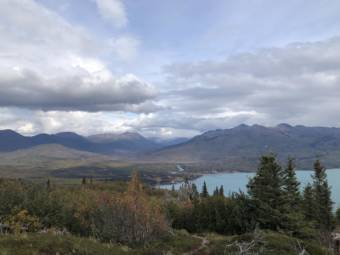
Skilak Lake in the Kenai National Wildlife Refuge. (Sabine Poux/KDLL)

Two kayakers paddled six miles to safety across Skilak Lake after they were mauled by a bear early Saturday morning.

Jamie Nelson, of Kenai, was at the Upper Skilak Lake Campground when the kayakers pulled up around 2 a.m..

“Six miles for two hours after being mauled by bears. That’s the part of the story I just can’t wrap my head around,” he said.

Officials aren’t releasing the names of the victims. But Nelson said last he heard, they were both in stable condition.

The kayakers were tent camping on the shores of Skilak Lake on Friday night, where the lake meets Hidden Creek. They had kayaked there earlier that day from the car-accessible Upper Skilak Campground.

Close to midnight, a bear charged them in their tent while they were sleeping. They had bear spray, but the bear charged too quickly for them to use it.

Both were injured, the male victim more severely than the female. Nelson said he’s unsure how the victims got away from the bear. But when they did, they were able to treat the lacerations to their arms and legs.

“And luckily, they were so prepared and had a nice first aid kit with them, that they had a product called Quick Clot,” he said. “Which apparently slows bleeding very well.”

The victims’ campsite was accessible via Hidden Creek Trail. But even if they knew about that entry point, the male victim’s injuries were so bad he couldn’t walk.

Instead, they paddled for nearly two hours back to the Upper Skilak Lake Campground.

Skilak Lake is large and can get pretty windy and wavy. But that night, Nelson said, it was glassy calm.

“Had the winds picked up that night and the water been choppy, I just don’t know if they could’ve made the voyage,” he said.

Nelson and his family had a campsite along the shore and heard the kayakers scream for help as they pulled in. So did several other campers and the campsite host. They called an ambulance and helped the female victim get something from her car while they waited.

The male victim stayed in the kayak on the beach. He was cold and didn’t think he could support himself with his leg.

“I think adrenaline was still playing a pretty big role,” Nelson said. “Because for everything they had been through, they were very calm. They were very matter-of-fact about what happened and about what needed to happen from that point forward.”

Less than a half hour after the campers made the call, the ambulance arrived. A few minutes later, a medevac showed up to take the male victim away.

Nelson met one of the victims’ friends the next day, when he came by with wildlife troopers.

“I’ll never forget what he told me, when he looked me in the eyes and thanked me,” Nelson said. “He said, ‘You know, we have living friends.’”

Nelson’s kids slept through the whole thing. But he said it was really moving to see campers at the site jump into action.

“It’s just a very life-affirming story,” he said. That when people are in danger, Alaskans come together and rally around people in need of help. And even though there may be concerns for their own safety, they will come running to help neighbors in need.”

Meanwhile, officials from the Alaska Department of Fish and Game have sent DNA samples from the scene up to Anchorage to learn more about the bear involved in the attack. Though they’re not sure what kind of bear it was, Nelson said the victims thought it was a brown bear. Officials said the animal was likely unprovoked.

Fish and Game Regional Management Coordinator Jeff Selinger said it’s important to remember attacks like these are rare. But he said it’s also important to be prepared in bear country, as these victims were.

The refuge closed Hidden Creek Trail after the attack to give investigators some space. The trail reopened Sunday.

Fire crews respond with force to fire in Kenai National Wildlife Refuge

The Loon Lake fire after retardants were dropped on it on June 13. (Jason Jordet/Division of Forestry)

Fire crews are working to contain a lightning-caused wildfire that started a half-mile from Swan Lake near Sterling this weekend.

The Division of Forestry said it intends to fully suppress the fire and is attacking it with water drops and fire retardant. As of Monday afternoon, it had built 15% of a containment line around the fire’s perimeter.

Officials got reports of the fire Saturday night and immediately sent in crews, said division spokesperson Tim Mowry. The fire grew to less than a quarter square mile amid wind and dry conditions Sunday but has since been reduced to just over a tenth of a square mile.

The fire is burning 10 miles from Sterling and isn’t threatening any lives or property. Mowry said the division is not evacuating anyone and is not closing any trails.

Officials are calling it the Loon Lake fire.

“It’s actually burning closer to Swan Lake than it is to Loon Lake,” Mowry said. “But we did not want to name it the Swan Lake fire again. For obvious reasons.”

The Swan Lake fire burned 266 square miles in 2019. But Mowry said the division’s not worried about history repeating itself.

Last time, he said, fire crews were attacking other fires in more high-trafficked areas before attacking the Swan Lake Fire.

“It was a week before we put any resources on that fire,” Mowry said. “By that time, it had grown to several thousand acres. The big difference with the Loon Lake Fire is we coordinated with the refuge. They instructed us to take suppression action on this fire almost immediately.”

The Loon Lake fire before the Division of Forestry dropped retardants on it on June 13. (Jason Jordet/Division of Forestry)

The Kenai National Wildlife Refuge manages the area. It also gave permission to use fire retardant — something crews usually don’t do there.

“It’s very much a nonstandard response for the refuge, but one that wasn’t taken lightly,” said Leah Eskelin, a ranger for the refuge.

She said there were a few factors that went into the decision, like the dryness and heat.

“And just the location,” she added. “That was a decision our managers made that gave some tools to Division of Forestry to be quickly responsive.”

Fuel type is also a concern. The area’s filled with dense black spruce, one of the most flammable forests in the state.

Typically, the refuge encourages natural burns. But the division got the green light to use fire retardant in the area.

Mowry said it’s proven effective so far. He said crews are careful to not get any retardant in water ways.

Crews are also scooping and dumping water from Swan Lake. A crew from Fairbanks is arriving today, bringing personnel at the scene to 80.

Mowry said the fire is burning four to six inches deep, meaning it’s not too deep in the forest floor. The deeper a fire burns, the harder it is to put out.

“And that is another difference between the Swan Lake fire and the Loon Lake fire,” he said. “We have a few days of hot, dry weather coming up that will probably dry things out a little bit. But conditions aren’t nearly as dry right now.”

Mowry said it’s not the biggest wildfire of the season statewide. But it is the biggest the Kenai Peninsula has seen so far.

The Division of Forestry instituted a burn suspension on the Kenai Peninsula and in Fairbanks because of dry conditions and short staffing.

“This fire and some others we’ve had up in the Fairbanks area have stretched our resources pretty thin on a statewide level,” he said. “And we’re now into the lightning season. So we’re trying to do everything we can to reduce the human-caused element in this.”

Mowry also said he’s not worried about the fire impacting air quality at this time. But there is a temporary flight restriction in the area, since there are aircraft there fighting the fire.

Site notifications
Update notification options
Subscribe to notifications