KDLL - Kenai

KDLL is our partner station in Kenai. KTOO collaborates with partners across the state to cover important news and to share stories with our audiences.

Ammo shortage leaves Alaska businesses shooting blanks

KOMU News via Creative Commons

There’s no doubt about it — Alaskans like their guns.

But there’s only so much you can do with a gun without bullets. And this past year, those have been harder than ever to come by.

Alaska and the rest of the U.S. are deep in an ammunition shortage, likely due to a confluence of current events and production setbacks.

It’s impacted businesses like Brenda Trefren’s. She runs the firearms training company Majority Arms in Sterling.

“If we don’t have ammo, we don’t have students,” she said. “So it’s pretty serious for us.”

People following the firearm industry, like Michael Modrell, said the shortage has a lot to do with the unrest of the last year.

Modrell manages Soldotna Ammo Supply on Kalifornsky Beach Road. He said gun stores saw spikes in gun and ammo sales when COVID-19 first came to the U.S. last March.

But that uptick was pretty minor in Alaska. He said more people came in to get guns and ammunition during the Black Lives Matter protests in the Lower 48. That happened again before the November election.

There’s always an uptick in firearm and ammo sales around elections. But this one was next level.

“I knew people who got into guns because they assumed Trump was going to win and they felt their side was going to be further marginalized,” Modrell said. “And then other people bought guns because they thought Trump might not win, and if a Democrat won it would be harder for them to get guns and ammo.”

Modrell said the rush slowed after the election. But smaller political changes, too, can trigger sales.

Like this spring, when President Joe Biden nominated a gun control advocate to the top role in the Bureau of Alcohol, Tobacco, Firearms and Explosives. Even a law change in another state, like California, might send people in.

“We hear a lot of conversations here,” Modrell said. “This place kind of works like someone coming in to talk to a bartender. It’s almost always political.”

It’s a vicious cycle, too, since people are more likely to go buy more ammo when shelves are short.

“The toilet paper thing all over again,” he said.

Another snag has come from the chain of production. That was especially true in the early days of the pandemic, as manufacturers shut down or adjusted their operations to be COVID-safe.

Now, a lot of the bigger companies are back to business as usual. But there are still other parts of the process that may be on hold — including something as benign as the plastic inserts that go inside the ammunition boxes.

“Everything kind of gets backed up to wherever the slowest producer is,” Modrell said.

Trefren said she’s seen more ammunition malfunctions than usual. That makes her think companies are trying to churn out as much ammo as they can as quickly as they can.

The whole thing has made things harder on her business. She said she’s had to pare down her classes.

“We’ve taken our ladies class from 350 rounds to 200 rounds,” she said. “Which has been a challenge because you really need to shoot those rounds to get comfortable and confident with your firearm.”

Soldotna Ammo has limited sales to five boxes per customer.

“I think at this point, we have about $2 million on backorder,” Modrell said. “We have orders we’ve had in place since the beginning of the year, or last year. And then we’ve had some vendors that have completely canceled our order. They stopped selling to vendors. They’re only selling on the consumer sites, because they can’t keep up with their own demand.”

He said that’s especially hard up here, since a lot of companies don’t ship to Alaska.

It’s impossible to know when the shortage will cease. Modrell said the closest he’s seen to a shortage like this was after 9/11.

“But for the most part, everybody who was panic buying then were people who already owned guns or who were already kind of into that lifestyle,” he said.

This time, a lot of customers are new gun owners, who mostly say they’re buying firearms for self defense.

Treffen said she’s heard things are supposed to level out by November or December.

For now, students are bringing their own ammo to her classes. They might have to get to the store early in the morning or camp outside to get it.

“With me living in Nikiski, it’s hard for me to get to town all the time,” she said. “So my students are really taking good care of me and grabbing me ammo when they can.”

That ammo will have to do for now. There’s not much shooting that can happen without it.

State sells 8 oil and gas leases in Cook Inlet

Cook Inlet oil platforms are visible from shore near Kenai, Alaska. (Rashah McChesney/Alaska’s Energy Desk)

Two companies successfully bid on nearly 21,000 acres of oil and gas tracts in Cook Inlet this week.

HEX Group and Strong Energy Resources both purchased leases in the state’s spring sale, for a combined total of $450,000. This is the first time a company other than Hilcorp Alaska has won leases in a state sale since 2015.

Anchorage-based HEX Group bought leases under two entities — HEX LLC and Furie Operating Alaska. HEX acquired Furie after it went bankrupt in 2019.

HEX Group bought almost 20,000 acres in leases, most of which are across the inlet from Tyonek, according to a state report. It also bought one lease in the North Fork field, down by Anchor Point.

HEX owns almost 10,000 acres in leases in Cook Inlet and operates the Kitchen Lights Unit there.

Strong Energy Resources, a company based in Texas, bought just under 1,500 acres in the sale, near Anchor Point. The company also owns acreage on the North Slope.

The sale was for state-owned leases only.  This year’s federal oil and gas sale in Cook Inlet was put on pause this February, after the Biden administration hit the brakes on federal leasing programs nationwide.

About 3.3 million acres were up for bid in this sale.

For small Kenai Peninsula towns, Pride Month is about visibility

The Pride in the Park march in 2019 drew around 100 people. Organizer Audre Hickey said the event has grown every year. (Jenny Neyman/KDLL)

June is Pride Month — a time for members of the LGBTQ+ community to celebrate love and identity and commemorate the 1969 Stonewall uprising, which helped catalyzed the gay liberation movement.

One of the cornerstones of Pride Month today is visibility. In a small town like Soldotna, that can mean a lot.
“Even just for kids to know they’re not alone,” said Joe Spady, who was born and raised on the Kenai Peninsula.

“Kids in a home that’s not safe for them to come out, at least they can look out and see that there is a community, both locally and globally, that will love and support them,” he said. “Because that’s exactly what I needed as a kid and I didn’t have.”

There are several Pride Month events planned on the peninsula this month and next. Audre Hickey is one of the organizers of Soldotna Pride in the Park, now in its fourth year.

“Each year our participation really increases,” she said.

She said this year’s event is scaled down because of COVID-19: There won’t be a drag show or a fair with booths.

Instead, people will walk together from the Soldotna Regional Sports Complex to Soldotna Creek Park this Saturday at noon.

“It is about showing our community members that we do have LBGTQ members here in our community, and that we are proud of them,” Hickey said. “And then it’s also a good way to show people that maybe don’t feel safe or comfortable coming out yet that they will be accepted when they do, and that our community will wrap their arms around them.”

Spady is also hosting a pride-themed supper club and picnic on that day.

Homer is having its own pride celebration on June 19. It’s overlapping with Juneteeth, the holiday celebrating the emancipation of enslaved people in the U.S.

Organizers said it’s important to connect conversations about race and sexuality. The Stonewall uprising in Manhattan was in large part an effort of Black trans women, a demographic that sees a high rate of fatal violence in the U.S. today.

Seward, too, is hosting a slew of events the last weekend of July. The Seward Pride Alliance moved its celebration after Pride Month in hopes it would be more COVID safe at a later date.

“We have all the different spectrums of the letters and the rainbow represented here and that’s really what we wanted to celebrate,” said Tony Baclaan, vice president of the Seward Pride Alliance.

This is Seward’s third year doing pride. They’re hosting several events, like a barbecue and a lip sync battle.

And in true Seward fashion, there will be a wildlife cruise. Baclaan said the 2019 pride cruise was really fun.

“We would listen to Beyonce, and we had a DJ on there, and it would be Beyonce, Beyonce, and then they would turn the music down and then they would see a whale or an otter,” he said, laughing.

He said visitors to Seward pride in 2019 told him they liked celebrating in a small town. A lot of pride events take place in large cities.

“Rather than a huge, large celebration, it was a really nice, quaint party,” he said.

All organizers agree — pride is about visibility. Spady said the queer community on the central Kenai Peninsula is much more visible today than when he was a kid.

“Everyone knows someone,” Spady said. “There are gay families raising their kids here. This is the community they’ve chosen to live in. It’s really exciting just to see how far our little community has come.”

Which is not to say it’s not without its obstacles. At the last in-person Pride in the Park, in 2019, marchers were met with a group of protesters.

Later that year, a gay Sterling woman reported being attacked at her home. That catalyzed a community reckoning about how the central peninsula can support members of its queer community.

“That was perpetrated by one hateful person,” Hickey said. “And the support that our community showed after that happened at our town hall was moving. There were hundreds of people there.”

Spady said he sees backlash coming from the Christian community. That’s one thing he’d like to see change.

“I always challenge all of my friends who claim the title of Christian to actively stand up against people who are un-Christ-like,” he said. “And I think it will really take people from within the church to make this change.”

Several pride events in Anchorage were canceled this year, after organizers chose a theme people deemed offensive. But there will still be a Pride Block Party and several other events in Anchorage later this month.

You can find information on a slate of statewide events at https://anchoragepride.org/events.

Seward considers using $1M donation from Norwegian Cruise Line for child care, affordable housing

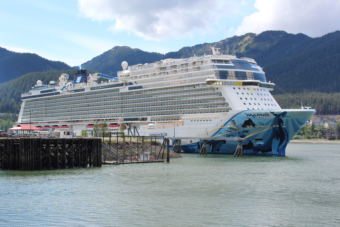
The Norwegian Bliss prepares to leave Juneau on June 5, 2018.
The Norwegian Bliss prepares to leave Juneau on June 5, 2018. (Photo by Adelyn Baxter/KTOO)

What would you do if you suddenly came into $1 million?

It’s a question Seward’s asked itself after getting a hefty donation from Norwegian Cruise Line Holdings to make up for some of its economic losses related to the pandemic. In May, the cruise line announced it was donating $10 million across six Alaska port towns: Ketchikan, Juneau, Hoonah, Sitka, Skagway and Seward.

The donation doesn’t come with any strings or a timeline. Chamber of Commerce Director Jason Bickling said that’s created a unique opportunity for the city to reflect on what it needs.

“It’s kind of an interesting thing,” he said. “Like, what do you do with $1 million?”

The city council brainstormed where it might send the money at a work session Monday night. Ultimately, it asked the administration to look into splitting the money in two — half for a developer reimbursement program to create more affordable housing locally, and half for creating more child care in the area.

Child care came up a lot at the meeting. There are few licensed child care operators in the city.

One operator told the council she’s been at full capacity from the day she opened in 2012. The director of AVTEC said the lack of child care is a barrier for students with kids.

“Every business in town, almost, is hurting for employees,” said council member Sharyl Seese. “There are so many of them that have to stay home with their children. That is why we in Seward do not have things open.”

It’s a problem statewide, too. Economists say insufficient child care is part of what’s keeping the workforce from rebounding in Alaska.

The portion of the donation that would go to childcare would support Happy Youth Programs and Educational Resources, or HYPER, a local group that’s looking to fill the childcare gap in Seward. HYPER said Seward has a childcare center that’s stood vacant for years but could be functioning in no time if it had money to open it up.

Some council members said they worried about putting a one-time donation toward childcare and not following up on recurring expenses, like utilities. Terry said HYPER could leverage the $500,000 as it looks for more funding elsewhere.

Assistant City Manager Stephen Sowell said businesses report a lack of child care and affordable housing as the biggest barriers to staffing. And he said that’s the kind of problem Norwegian’s donation was supposed to address.

“The goal was to do something big and impactful,” he said.

The council also considered putting money toward beautification projects and sidewalk repairs. Terry said the idea to split the money in two is not a final decision — the city administration and council both will have more discussions on the matter.

Bioengineered salmon available for the the first time in US

A genetically modified salmon dwarfs a non-modified salmon of the same age in an undated handout photo distributed in 2010. (Photo via AquaBounty Technologies)

A Massachusetts company is sending genetically modified salmon to dinner tables in the U.S. for the first time. AquaBounty Technologies said it’s shipping five tons of bioengineered salmon to distributors this month.

It’s marketed as a sustainable alternative to other kinds of salmon. But AquaBounty’s fish hasn’t received the warmest reception in Alaska, where it’s often called “Frankenfish.”

Tim Bristol of Homer is the director of Salmon State, an Alaska organization defending wild salmon populations.

“It’s going to be a real challenge for us moving forward to make sure we do everything we possibly can to educate the American and the international consumer that if you want the salmon that’s best for you and supports communities and small family businesses, you need to choose wild Alaska salmon,” he said.

AquaBounty’s salmon is a genetic mixture of three different fish — Atlantic salmon, chinook salmon and the eel-like ocean pout. It grows twice as fast as its non-engineered counterparts, reaching full market size in 18 months.

This is the first time a company has sold genetically engineered salmon in the U.S.

Federal regulators ruled the salmon safe to eat and sell in 2015. But for a while, AquaBounty still didn’t have permission to grow its salmon in the U.S. Instead, it was working out of facilities in Canada and Panama.

That was until 2019. The latest batch of salmon headed to market in the U.S. comes from a facility in Albany, Indiana.

The Food and Drug Administration said AquaBounty’s fish are similar nutritionally to non-engineered, farm-raised Atlantic salmon. AquaBounty says their fish could help mitigate overfishing and create less pollution than farmed fish.

Not everyone’s convinced.

“It’s just a faster way of doing business and making money,” said Sara Erickson, who owns AlaSkins in Soldotna. She’s a vocal opponent of fish farming and a former commercial fisherman.

“They have a picture of a regular farmed salmon and their farmed salmon. And it looks just like a giant. I mean, what’s the point of that?” she said.

A big concern for environmental groups has been whether fish can escape from the facility and mate with wild salmon. Late last year, a federal judge ordered the FDA to look into what would happen if that occurred.

AquaBounty said there’s no risk of that happening, since it grows sterile salmon in inland-based tanks, with multiple barriers to prevent fish and eggs from escaping.

Erickson said that’s one good thing that sets AquaBounty’s salmon apart from other farmed salmon.

“And I appreciate that. In fact, all fish farming should really go to that place. But it’s a lot more expensive to do,” she said.

Erickson said salmon should be clearly labeled in stores so people know what they’re buying.

Federal law currently requires GMOs to be labeled as such. But that doesn’t just have to be through wording — a QR code, scanned with a smartphone, also suffices.

There are some exceptions to the Department of Agriculture’s current labeling law. Food served in restaurants, for example, doesn’t have to be labeled.

Labeling is voluntary in Canada, where AquaBounty previously sold its salmon.

Sen. Lisa Murkowski has been a vocal opponent of genetically engineered salmon. Legislation she introduced this month would require the words “genetically engineered” to appear on bioengineered salmon in stores.

It’s called the Genetically Engineered Salmon Labeling Act. Sen. Dan Sullivan is a co-sponsor.

“It would be a level of consumer awareness,” Murkowski told KDLG Friday. “Because it is only when we are aware of what is being sold, what is being put in front of us, that we can say firmly and clearly, ‘Nope. Don’t want this on my table.’”

A spokesperson from AquaBounty said the company will use the phrase “genetically engineered” on grocery store packaging.

Several grocery chains have pledged not to sell genetically modified salmon, including Safeway and Kroger, which owns Fred Meyer.

Bristol said he hasn’t heard of any Alaska businesses interested in buying the product.

“We have seen Alaskan stores carry farm-raised Atlantic salmon in the past, and usually the blowback is pretty significant and comes pretty quickly,” he said.

An AquaBounty spokesperson said the company isn’t shipping any salmon to Alaska yet.

Izzy Ross in Dillingham contributed reporting to this story.

Grant program helps Alaska summer camps restart after lost year

Children draw at the Kindergarten Boot Camp at Harborview Elementary School in summer 2018. It was the first year the Juneau School District put together the school-readiness camp.
Children draw at the Kindergarten Boot Camp at Harborview Elementary School in summer 2018. It was the first year the Juneau School District put together the school-readiness camp. (Molly Hillis/Juneau School District)

Summer camps are getting a little help this year from the Alaska Department of Health and Social Services in the form of one-time grants. The Alaska Community Foundation and the Rasmuson Foundation are helping to administer the program, which sent out about $1.26 million in aid last week to various camp programs all over the state.

There was enough need that the grant program is now open again through June 22, this time with help from the Municipality of Anchorage. Eleanor Huffines is the vice president of programs and grants with the Alaska Community Foundation.

“We started to receive a number of calls from people who just missed the opportunity and were still looking for support,” she said. “And that’s why the state, the Municipality of Anchorage, Rasmuson, and the ACF got together said, ‘Let’s open up another grant cycle. It’ll be smaller, we won’t have as much funding, but there’s still some need and people who missed the first opportunity, so we’re going to do our best to get the word out and get it out the door quickly.”

The first round of funding went quickly, and some people who were eligible didn’t hear in time to apply. Huffines said this round of funding is open until June 22, with plans to get it out to applicants by July 1.

The Rasmuson Foundation originally pitched the idea to support summer camps and quickly got about $1.5 million in requests. Summer camps came up as a major need, with last year’s loss in revenue leading to staff layoffs and lower revenues. The state chipped in with about $1 million from its leftover CARES federal aid. This second round comes from the same partnership, but the Municipality of Anchorage is bringing in some of its funds from the American Rescue Plan. Huffines said it’s a smaller amount of money for the grants this time, but the administrators hope it will help meet some of the need.

“I think there’s a general support for youth,” she said. “I think there was a recognition that as the pandemic is ongoing there continue to be needs as parents are getting out of work and youth are out of school. I think the summer was really  about looking at the needs across the state and the timeline for youth being out of school and parents going back to work, and kids also needing more engagement and fun now that people are getting vaccinated and there is more ability to get together.”

Last summer left many parents at a loose ends with their kids. School had been out since March, but the annual flood of summer camps, festivals, fun runs and other activities were all cancelled because of the COVID-19 pandemic. This year, it looks like there won’t be any shortage of things to do again.

With reported COVID-19 cases dipping below 100 statewide each day, most of the state is reopening. And many of the organizations that cancelled their programs last year are able to come back this summer.

Huffines said anyone interested in applying for the summer camp grants can find more information about them online or can call the Alaska Community Foundation.

Site notifications
Update notification options
Subscribe to notifications