KDLL - Kenai

KDLL is our partner station in Kenai. KTOO collaborates with partners across the state to cover important news and to share stories with our audiences.
Cooper Landing School celebrates its first-ever high school graduate

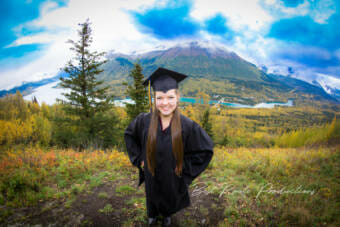
Linnaea Gossard on the Slaughter Gulch trail in Cooper Landing. (Kristine Route/Best Route Productions)

Graduations are milestones for every family. In Cooper Landing, this year’s graduation was also a milestone for the community.

Linnaea Gossard became the Cooper Landing School’s first high school graduate Monday night, almost a decade after the K-12 school opened to high schoolers.

It’s one of the smaller schools in the Kenai Peninsula Borough School District.

Most kids who grow up in the area go to high school at one of the bigger schools, in Soldotna or Seward. Not Linnaea.

“Well, with my dad as the teacher, it was kind of a given that I was going to stay,” she said.

Also, “I didn’t want to get up early and travel an hour,” she added.

The Cooper Landing School has just one teacher — Linnaea’s dad, Tom Gossard. He teaches all 11 students including Linnaea’s younger brother, Cooper. The building itself, which is nestled at the foot of the Kenai Mountains, has two classrooms and a gym.

Soldotna teacher Rob Sparks spoke at the ceremony Monday night.

“She’s going to be the first high school graduate from Cooper Landing High School, she’s not going to be the last one,” Gossard said.

Linnaea’s trailblazing is more than just symbolic. In early high school, she became interested in video telecommunications and co-created a VTC program for the district, making it possible for remote students like herself to take synchronous courses not offered at their own schools.

Linnaea has taken classes with 16 teachers from eight different schools, all without leaving Cooper Landing.

That wasn’t always possible. And for a while, Cooper Landing didn’t have a local option for high schoolers.

Before the late 80s, high schoolers from the area boarded in Seward. Then, some parents pushed for a bus that took students to Soldotna.

That’s when Linnaea’s mom, Virginia Morgan, was in school.

“In those days, we did not have so many second home families,” Morgan said. “This was not a vacation place like it is now. So in those days, we had about 40, usually between 20 and 40 kids, K-8.”

As Cooper Landing became more of a seasonal community, there were fewer families who lived there year-round. At some point, there weren’t enough kids to justify a bus to Soldotna.

Morgan says parents started pushing again for a local option when a Cooper Landing family with a high-school-age kid was reluctantly considering moving to a bigger community.

“It was 2012 when it became a K-12 school,” she said.

She said it was initially challenging to connect kids with classes in other schools since remote learning was still relatively new. A lot of educators became more proficient in that style of teaching when Linnaea was in school, and more still honed those capabilities during the pandemic.

For Linnaea, remote learning meant she could stay in school in the place she loves.

“I really like the community involvement in Cooper Landing,” she said. “But then having the classes at a bigger school, like Soldotna High School and Kenai High School and Seward High School, I was able to have classes with other teachers other than my dad. And then also meet students my age, because I’m the only one my age here.”

Besides the Gossards, there are two other high-schoolers who live in Cooper Landing. They both go to Soldotna High School.

Linnaea says it was sometimes hard as friends moved away. But she doesn’t think she would have had the flexibility at a larger school to build the VTC program or volunteer in town in a myriad ways.

Now Linnaea’s leaving Cooper Landing with certifications in VTC skills, statewide recognition for her VTC work and several awards and scholarships under her belt. She’s likely going to work with the district to train a new director for the VTC program, and this summer, she’ll be in Fairbanks for the Rural Alaska Honors Institute — an introduction to college for kids from rural Alaska and Alaska Native students.

And, of course, Linnaea was the school’s valedictorian.

Principal Doug Hayman acknowledged it was a bit tongue-in-cheek.

“But as you have heard this evening, she would have stacked up anywhere in the world,” Hayman said.

Linnaea’s headed up to Anchorage next year. She plans to study communications at the University of Alaska Anchorage, though she’s not dead set on any major yet.

Seward 17-year-old Lydia Jacoby prepares for Olympic trials

Seward’s Lydia Jacoby at the TYR Pro Meet this April in Mission Viejo, Calif. Jacoby’s performance in the 100-meter breaststroke at that meet makes her the 14th fastest U.S. woman of all time. (Courtesy of Lydia Jacoby)

In exactly one month, star Seward swimmer Lydia Jacoby will be in the pool in Omaha, Nebraska for the U.S. Olympic trials.

But first, she’s finishing her junior year at Seward High School.

At just 17, Jacoby has the world’s sixth-fastest time for the 100-meter breaststroke this year. She’s qualified for the Olympic trials since she was 14.
“Basically my entire swimming career up to that point has kind of been building up to that meet,” Jacoby said. “So it’s definitely a lot of pressure, I suppose. And in some ways, it doesn’t really feel real.”

Jacoby is ranked third all-time in the U.S. in her age group and 14th all-time among all U.S. women.

“I do kind of like to impress upon her that she can’t really lose at this point,” said Solomon D’Amico, who’s coached Jacoby in Seward for the last several years. “She’s already done so much.”

Jacoby has been part of the Seward Tsunami Swim Club since she was six.

Over the past year, the pandemic has posed unique challenges for training, she said.

The Olympic trials were pushed back last year, along with the 2020 Olympics in Tokyo. And at the beginning of the pandemic, pools were closed.

“I was out of the water,” Jacoby said.

Even after others opened, the Seward pool stayed closed, in part due to maintenance on the facility. So Jacoby stayed with family in Anchorage over the summer and trained with the Northern Lights Swim Club.

“There’s a lot more kids my age, so it’s just been a lot of fun and motivating training up there,” she said.

Jacoby said Alaska swimming is a great community. Even as her Seward swim friends started picking up other activities and leaving the sport behind, she’d meet swimmers from all over Alaska at statewide meets.

“That was very motivating at that time,” Jacoby said. “Both those things were happening at once. I was meeting new friends around the state while my friends at home moved on to other things.”

Jacoby’s swimming career will continue after she graduates high school. This year, she committed to the University of Texas at Austin — one of several Division I schools that was recruiting her.

“I just felt a really strong connection with the coaches, and I feel like they really care about me as a person and a team member and not just a number,” she said.

In college, Jacoby plans to study textile and apparel management and design. She said she’s always loved clothes.

Clothes are one, but not the only, manifestation of Jacoby’s artistic spirit. Right before the pandemic, she had an exhibit of her film photography up in Seward. She also sings and plays guitar, piano and upright bass.

D’Amico said Jacoby’s extremely self-motivated across all of her interests. When it comes to swimming, he said, she’s focused more on process than outcome.

“Which, as a coach, looking at the sport psychology side of things, that’s really the way you want your athletes to approach things,” he said.

That mentality manifests itself in how she thinks about her Olympic prospects. She has a good shot at making the Olympic team — she came in second at a recent meet behind world-record holder and reigning Olympic champ Lilly King.

But Jacoby said she won’t feel unaccomplished if she doesn’t make the team.

“Where I was a year ago going into trials before it was postponed — I was nowhere near making the team,” she said. “And I just have so much further to go with my swimming career. This is just the beginning.”

D’Amico agrees. He said at this point, she’s playing with house money.

Watch Lydia Jacoby swim in Mission Viejo here.

Listen to Jacoby and her band, Snow River String Band, here.

Energy companies eyeing Cook Inlet’s Mount Spurr volcano for geothermal project

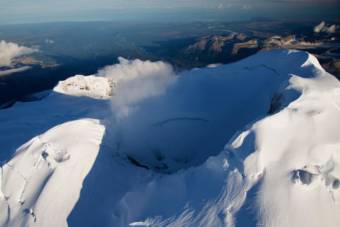
Mount Spurr is an active volcano in the Aleutian Arc of Alaska. (Cyrus Reed/Alaska Volcano Observatory & U.S. Geological Survey)

Two companies are looking at the geothermal energy potential of Mount Spurr, an active volcano across Cook Inlet from Anchorage.

Once they have the final go-ahead from the state, GeoAlaska and Raser Power Systems can explore adjacent leases on Mount Spurr’s south side.

It’s the latest push to harness and develop geothermal energy from the 11,100-foot volcano, a feat no company has accomplished — at least not yet. The state has held geothermal lease sales for Mount Spurr since the 1980s.

Part of the challenge has been just locating the resource, said Steve Masterman, director of the state’s Division of Geological and Geophysical Surveys.

“Understanding the geology is really a key part to that,” Masterman said.

The basic idea of geothermal is to harness heat contained below the earth’s surface in the form of steam and water. Geothermal is a renewable resource, and like other renewables, can be used to heat homes or generate electricity.

But Mount Spurr poses a challenge for developers, according to Gwen Holdmann, director of the Alaska Center for Energy and Power in Fairbanks.

While it’s an active volcano, with a lot of trapped, simmering heat, “that system doesn’t have a lot of clear surface expression in terms of where you might want to drill, for example, to confirm a resource,” she said.

Gov. Mike Dunleavy’s administration wants to make geothermal exploration in Alaska easier for interested companies, whether it’s at Mount Spurr or elsewhere.

He’s proposed legislation that would, in part, allow companies to lease and explore nearly double the acreage they’re currently allowed.

Masterman said that would be helpful because surface hot springs often indicate the presence of reservoirs. But the hottest water isn’t always right beneath those springs.

“That might be a number of miles away from the place where it comes out of the ground,” he said.

Dunleavy’s legislation would also extend the maximum exploration period, from two years to five.

“It might take a number of summers in order to do the background work, the geology, the geophysics before you do the drawing,” Masterman said. “And then it might take a number of rounds of drilling before you’re successful with finding a viable resource.”

There are other geothermal projects in motion in the state. Chena Hot Springs has its own geothermal plant. And in Unalaska, two companies plan to start constructing a geothermal energy plant this summer for the city’s power grid.

Those plans, and the ones for Mount Spurr, are subject to the state’s current regulations, since Dunleavy’s legislation hasn’t yet passed, and may not before the Legislature adjourns next week.

According to Petroleum News, GeoAlaska, one of the companies looking for a permit, started in 2020 and is based in Anchorage. The other, Raser Power, is based in Utah. Raser Power filed for bankruptcy in 2011 in relation to a geothermal plant there.

Surveyors tried and failed to find hot water reservoirs at Mount Spurr a decade ago. Ormat Technologies did surveys and some exploratory drilling there between 2008 and 2011 but later relinquished their leases when it couldn’t locate the resource.

“They took a little bit of a conservative approach from the standpoint of drilling in a location that would be more optimal to develop a power plant, and staying a little bit away from any areas that might be close to hazards,” Holdmann said.

But she said there is much more land to explore on the volcano. And data from the prior surveys are publicly available and could still be helpful for GeoAlaska and Raser.

“I am certain that they have looked closely at that data and are using that to rethink the program that they’re developing,” she said.

The up-front costs are expensive. But Holdmann said there are also regulatory hurdles to development, including restrictions from the Alaska Oil and Gas Conservation Commission.

“I think one that one thing that we want to be thinking about in addition to encouraging and promoting exploration is really thinking about what development might look like,” she said.

Then, there’s the question of a market, and whether a geothermal project at Mount Spurr is cost-competitive with existing energy sources.

But that’s all years down the road. First, the interested companies need to prove the resource is there — and that they can find it.

Great American Outdoors Act to fund maintenance projects on public lands in Alaska

Sabine Poux/KDLL

When U.S. Sen. Lisa Murkowski came to the Kenai Chamber of Commerce last week, she was excited to talk about legislation she said has flown under the radar in this busy year.

“We passed what is probably the most consequential measure when it comes to how we deal with the deferred maintenance on our public lands,” she said. “This is the Great American Outdoors Act.”

Congress passed the Great American Outdoors Act in 2020. Among other things, it set aside revenue from energy development to fund maintenance projects on federal lands.

Almost $285 million was set aside in March for the U.S. Forest Service. Alaska is now starting to see those funds — a $12.5 million slice of the pie for fiscal year 2021. About a quarter of that is headed to the Chugach National Forest.

Tyler Glenn is recreation program manager for the Chugach. He said the main objective of the funds is to address deferred maintenance.

“It’s kind of a growing beast, if you will, for the Forest Service,” he said.

Several projects up for funding this fiscal year fall on the Kenai Peninsula, including two at the Russian River Campground.
“It’s the highest used campground on our forest, on the Chugach Forest,” he said. “So being able to put some good use to that area — I mean, it’s like if you don’t have your reservations now, you’re not getting in for the summer.”

The service plans to replace a retaining wall there along with several campground kiosks. Over at Devil’s Creek, they’ll do some trail brushing and open up clearings and sight lines.

The service also identified projects to complete later down the road, like the replacement of a viewing platform at Tern Lake and upgrades to the Iditarod National Historic Trail.

“We had a lot of projects that were kind of in our back pocket, just as funding hasn’t been available through the years to address,” Glenn said. “But now we have the opportunity. And it did also kind of spark some, ‘Aha! Because we can do this now, we can also do this.’”

The act saw support from legislators on both sides of the aisle, including Murkowski, when it passed last year.

Some conservationists questioned the sustainability of using oil and gas revenue as a funding source. But Murkowski said it’s a chance to recognize what the industry brings in for the federal government.

“It’s legislation that you might not have heard a lot about because people are focused on a lot of other things,” she said Wednesday. “But you’re going to be seeing the benefits of that going forward.”

The Forest Service has submitted a list of projects for fiscal year 2022 and expects to announce which projects were approved for that round this summer. You can see a map of all the projects it has in the works on the Alaska Region website.

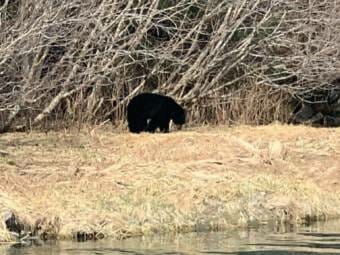
Park rangers shoot aggressive black bear near Seward

The black bear after the standoff (Photo courtesy Regina Green)

Park officials killed and salvaged an aggressive black bear at Tonsina Creek Tuesday night after it bothered several groups of hikers late last week.

Alaska State Parks Ranger Jack Ransom said his department and the Department of Fish & Game were worried about the safety of hikers. Tonsina Creek is a busy trail.

“In this case, the bear wasn’t going anywhere, and it continued to threaten public safety,” he said.

Hikers said the bear wasn’t afraid of dogs or humans. A trio passing through the area last Thursday said the bear didn’t leave them alone until they maced it on a bridge near the trailhead.

It’s not uncommon to get reports of aggressive bears. But Ransom says it is uncommon to have to shoot one.

“In this particular park we have not had to do this in a long time,” he said. “At least 10 years.”

He says they salvaged the bear and donated it to charity. The Alaska State Troopers keep a list of organizations they can call to salvage and harvest wildlife meat when a situation like this one arises.

NOAA’s new climate ‘normals’ highlight warming trend

Map showing differences between the last and current 30-year averages. (National Weather Service Alaska Region)

Every 10 years, the National Oceanic Atmospheric Administration analyzes data from its thousands of weather stations and releases new climate “normals,” providing temperature touchstones for any given day or month of the year.

NOAA’s latest batch of data came out Tuesday. The data shows how Southcentral Alaska, and the country as a whole, is heating up.

Brian Brettschneider is a research physical scientist with the National Weather Service Alaska Region. He’s been looking at the new data for a while. It’s a lot of information.

“My computer is — basically, smoke is coming out of it. I’m trying to crunch some numbers,” Brettschneider said.

The agency comes up with what are, in a sense, 30-year averages. And the data comes from 250 weather stations in Alaska that collect daily observations.

Some stations are managed by the Federal Aviation Administration, like the one near the Kenai Municipal Airport. But most data around the state is collected by citizen observers.

Taken together, that data provides a sort of climatic census. The last one covered the three decades between 1981 and 2010. This one spans 1991 to 2020. That means there’s 20 years of overlap between the data sets.

“In a sense, what we’re doing is we’re dropping out the 1980s and we’re adding in the 2010s,” Brettschneider said.

The new numbers highlight a trend of rising temperatures in Alaska and the U.S. as a whole.

For much of Southcentral Alaska, including the Kenai, Homer and Anchorage areas, the change in annual normal temperature is between a half degree to a degree.

Brettschneider said disparities between new and old average temperatures are smaller in Southeast Alaska. In Western Alaska and above the Arctic Circle, they’re larger.

This data from the station at the Kenai Municipal Airport shows averages from data collected between 1991 and 2020. The top line show’s the maximum temperature for each month, the middle line shows the average temperature and the bottom line shows the minimum temperature. (1991-2020 U.S. climate normals)

In Fairbanks, a change in average temperature during one month of the year will trigger a change in how the region’s classified. As climate specialist Rick Thoman pointed out on Twitter, the average temperature for May changed from a hair below 50 degrees by the last measure to a hair over this time around. That means the region is technically reclassified from a “sub-Arctic climate” to a “warm summer continental” climate under what’s known as the Köppen classification.

https://twitter.com/AlaskaWx/status/1389422944024100866

It’s in part a semantic change, but Brettschneider said it’s noteworthy.

“We would expect that there’s going to be any number of stations that incrementally move from one climate zone to the next,” he said. “And again, you don’t necessarily feel incremental changes. But incremental changes are changes nonetheless. And the next time around, more stations will have that incremental change.”

He said even seemingly small differences in temperature are significant because many parts of Alaska teeter on the edge of freezing for much of the year.

“And major things happen once we move from one side of that line to another,” Brettschneider said.

The new data accounts for changes in precipitation, too. But that change is more difficult to gauge, Brettschneider said, because there’s so much variability year to year.

But he said there does seem to be an overall increase in precipitation. That’s generally expected with a warming climate because warmer air can hold more moisture.

You can find the new normals here.

Site notifications
Update notification options
Subscribe to notifications