KDLL - Kenai

KDLL is our partner station in Kenai. KTOO collaborates with partners across the state to cover important news and to share stories with our audiences.

Kenai Borough mayor attacks school district’s mask policy

The Kenai Peninsula Borough School District reopened school buildings to students in January, though some grades were attending on rotating schedules. All students were allowed to return full-time in February. (Sabine Poux/KDLL)

With five weeks remaining before summer break, the Kenai Peninsula Borough mayor is publicly challenging the school district on its COVID-19 mitigation protocols.

Mayor Charlie Pierce has long been an advocate of keeping mask-wearing a personal choice and opening the peninsula to business as usual amid coronavirus-induced closures.

He turned his focus to the school district last week, saying in a Facebook post: “The time has come for us to get rid of all Mask Mandates in schools.”

Screenshot of Kenai Peninsula Borough Mayor Charlie Pierce’s Facebook post. Screenshot taken April 14, 2020.

Pierce, who works in the same building as District Superintendent John O’Brien, repeated those sentiments on local talk radio the next day, where he likened the virus to the flu and said he wants the peninsula back to normal.

Pierce’s appearance initiated a talk radio dispute with O’Brien.

In a public letter and on KSRM on Monday, O’Brien said he was surprised the mayor didn’t first come to him with concerns. O’Brien reiterated that the district is setting its protocol based on guidelines from the federal Centers for Disease Control and Prevention. The district currently requires all students and staff to wear face masks indoors.

The masking dispute isn’t the first time district and borough administrations have butted heads over the district’s COVID-19 mitigation protocols.

Late last year, James Baisden, Pierce’s outgoing chief of staff, led parents in demanding a full reopening of schools.

The district and borough are currently in the middle of negotiating a budget for fiscal year 2022. The process has been tense, with the mayor and district disagreeing on how much money the borough should provide.

Reached by phone on Tuesday, Pierce said he was traveling and was not available for an interview for this article. But Baisden said this back-and-forth won’t interfere with the budget process.

“We can have opposite views,” he said. “We’re viewing one group of people who think that they’re completely off balance, they’re going to say they’re on the other side of it. But the budget process doesn’t have anything to do with that.”

Baisden doubled down on his position Monday on KSRM. He and Pierce have no direct authority over district protocol. But co-host Jesse Bjorkman, who’s also a teacher in the school district and a member of the borough assembly, said on the show that he thinks a public disagreement “doesn’t help the education environment at all, when kids are confused about what they’re supposed to be doing.”

Bjorkman said he’s grateful to have students back in the classroom and that, for the most part, the classroom learning environment is not greatly impacted by the presence of masks.

“As a teacher, I was disappointed to see that the mayor choose social media to continue to attack the actions of the school district leadership, when many other avenues remain open,” Bjorkman said. “They have been productive in the past.”

Baisden said he’s heard mask-wearing has been hard on students and sees a requirement as a matter of control.

“We’ve still got another four to six weeks of our children being in classrooms, let’s make this last six weeks as best as we can and give them the environment they deserve,” he said.

The district has been gradually loosening requirements, though not as much as some advocates would like. Most recently, it relaxed its mask protocol for outdoor activities, like recess.

It’s all happening while COVID-19 case rates on the Kenai Peninsula are creeping up. The borough is currently at the “high-risk” level, according to the state’s coronavirus dashboard, though its case rate is lower than Anchorage and the Mat-Su.

State data shows the borough’s vaccination rate is trailing behind the rest of Alaska, with just over 30% of eligible residents fully vaccinated.

“We have had a rise in cases on the peninsula in some of the areas and definitely in some of our schools,” said District Communications Director Pegge Erkeneff. “We have one school, for example, that has three positives in the last week. But it’s not in-school transmission. So we know the mitigation plans are working and we will be keeping schools open until the end of the school year, which is going to be in five weeks.”

Erkeneff said the district is gearing up to do an in-person graduation and hopes to re-evaluate its mask policy next school year.

“Hopefully by the time school begins in August, enough people will be vaccinated and we’ll be able to open up the schools without any face coverings,” she said. “I know that we have the survey out right now and Mr. Holland, who will be our new superintendent, has the intent to do so if it’s safe to do so.”

Pierce has said he hopes to find common ground with the new superintendent, Clayton Holland.

All big school districts in the state, including the Anchorage School District, require face coverings in buildings. In the Matanuska-Susitna Borough School District, face coverings are required for students in third grade or older.

Pacific heat wave had lasting impacts on Gulf of Alaska marine species

John Moran of NOAA and Jan Straley of the University of Alaska Southeast study whales in Prince William Sound. (courtesy Rob Suryan)

When a heat wave swept through the northeast Pacific Ocean between 2014 and 2016, it changed the marine makeup of the Gulf of Alaska. The warm water decimated some commercial fish populations.

Some species bounced back right away. But a recent study from NOAA finds others are rebounding more slowly.

NOAA’s study charted the impacts of the heat wave — also known as “the blob” —  on gulf marine species over time, through 2019.

Some of the blob’s impacts on local marine life were immediate. Rob Suryan is a program manager for NOAA in Juneau and the lead author on the study. He said in 2015 and 2016, thousands of common murres were found dead.

“Especially noticeable in the Prince William Sound, near Whittier, actually, a beach was just littered with thousands of carcasses,” he said.

NOAA focused on longer-term trends in this study using data from Gulf Watch Alaska, a group that monitors species recovery in Alaska waters and is funded by the Exxon-Valdez Oil Spill Trustee Council.

Suryan said there were three different types of long-term impacts on the abundance of those species they observed. Some species did well.

Those tended to be the species that do better in warmer water, like sablefish and some varieties of zooplankton.

Other species saw no change, or change that only lasted a year.

“And then a negative response, of course, is something that declines and is persistently in a lower state than what it was before the heat wave,” Suryan said.

Among those species are several popular varieties of fish, like sockeye salmon and Pacific cod.

Suryan said it’s important information to have, and continue to study, because scientists are anticipating more heat waves in the future.

“Part of it has to do with feedback loops as the conditions that are causing these warming events begin to magnify and build and are additive over time,” he said.

The data isn’t uniform across species or geography. Some fish, like certain populations of herring, are rebounding more rapidly. But taken altogether, the data paints the picture of an ecosystem that is still reeling from a warming ocean.

Suryan said the study will be included in an assessment sent from NOAA Fisheries to the North Pacific Fisheries Management Council, the agency that sets policy in Alaska’s federal waters.

Declines in cod population already prompted the council to close Alaska’s cod fishery in 2020.

Cook Inlet slated to have one of the first tidal power generators in the country

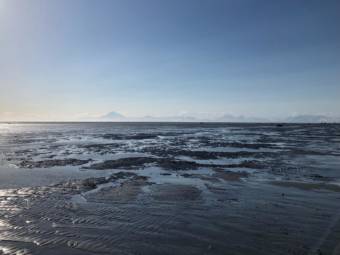
Low tide at Kenai Beach. (Sabine Poux/KDLL)

Cook Inlet has long been a hotbed of oil and gas development in Alaska. But for years, renewable energy advocates have been eyeing another Cook Inlet resource — tides. The inlet has some of the largest tides in the world but their energy potential has remained untapped.

One company is trying to change that, and says it could have a generator in the water in the next three years.

Ocean Renewable Power Company, of Maine, is filing a permit later this spring for a pilot project in Nikiski. Merrick Jackinsky is one of two employees in Anchorage.

“Where we’re looking at, the East Foreland site, is mainly just because the extreme velocity that it has there to kind of get that bigger bang for our buck right off the bat,” he said.

Anyone who’s fished in the area knows the tides can really rip. That’s important because the company’s tidal tech relies on the movement of the tides to spin turbines connected to an underwater generator.

The turbines work when the tide is going in and out.

“So we’re always able to generate power, except during slack tide,” Jackinsky said.

ORPC currently has another hydrokinetic generator in Igiugig, on the Alaska Peninsula. That device sits in freshwater, in the Kvichak River, and is helping Igiugig ween off its dependence from diesel.

The potential power in Cook Inlet’s tides is much more vast. Studies estimate the inlet holds over a third of all tidal energy potential in the U.S.

But that power has proven elusive. Multiple companies, including ORPC, have filed permits with the federal government that haven’t come to fruition.

One challenge has been finding a market.

“Tidal power’s biggest concern right now, I’d say, is solar and wind power,” said Chris Rose. He’s executive director of Renewable Energy Alaska Project, a non-profit that advocates for renewable energy statewide. ORPC is a member.

“Solar and wind power have come down so quickly in price over the last decade,” Rose said. “It used to be that tidal power 20 years ago was competing against fossil fuels. But now, really, the biggest competitor is solar and wind. And so more investment has gone into those renewable technologies and less has gone into tidal.”

The Cook Inlet project would be one of the first tidal power generators in the country. Jackinsky estimates tidal is 10 years behind its wind and solar counterparts.

Tidal energy, however, could be more dependable than solar and wind. It’s predictable hundreds of years in advance.

“If you were to put tidal power stations up and down Cook Inlet, they would produce power at different times of the day,” Rose said. “Which could make the resource what the utilities call a ‘base load resource’ — something that they can manipulate and count on.”

Initially, the company hopes to produce a megawatt of power from the device, eventually increasing that load into the hundreds of megawatts. The Railbelt as a whole has an average annual load of 600 megawatts, according to REAP.

But that’s all far down the road. First, ORPC has to file a preliminary permit with the federal government, including an environmental assessment. Any project in Cook Inlet has to avoid damage to the fish and whales that call the region home.

Jackinsky said salmon have been able to avoid the turbine in Igiugig because the device is free floating and doesn’t dam up the water.

In three years, he said, ORPC could have a pilot device in the water. That first device wouldn’t send power to the grid , but would be in place as a sort of test — to gauge the impact of the salty water on the machine, for example. A permanent device could take a decade.

“It’s more like a marathon, it’s not like a sprint,” he said.

As for the all-important market, ORPC thinks it has one. The company signed a joint development agreement with Homer Electric Association, the local utility, and HEA said it will purchase power generated by ORPC for its grid.

Currently, HEA gets most of its power from natural gas also produced in Cook Inlet. The oil and gas industry in Cook Inlet has slowed in recent years, with lackluster industry interest in offshore exploration and a declining supply of natural gas that shuttered the once-bustling Kenai liquefied natural gas plant.

Renewable advocates like Rose see tidal as a more enduring resource.

“When you invest in the technology like that, you’re investing in perpetuity,” he said.

He said with tides like the ones in Cook Inlet, Alaska could be at the center of tidal energy production.

Hilcorp ordered to replace gas pipeline with history of leaks

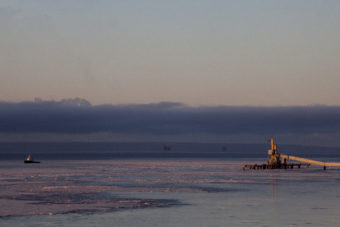
Cook Inlet oil platforms are visible from shore near Kenai, Alaska. (Photo by Rashah McChesney/Alaska’s Energy Desk)

Energy company Hilcorp has been ordered to replace an undersea pipeline in Cook Inlet after it leaked gas last week, for the fifth time in the last several years.

In a corrective order dated April 6, the Pipeline and Hazardous Materials Safety Administration told Hilcorp it must temporarily repair the 55-year-old pipeline by April 17, permanently repair it by May 1 and submit a plan for the pipeline’s replacement within 45 days.

The last time the pipe leaked, in 2017, Hilcorp didn’t complete repairs for three months, citing danger from ice in the inlet.
Sea ice is again a problem.

Crystal Smith, an environmental program manager with the Alaska Department of Environmental Conservation, said Hilcorp is waiting for the weather to improve before sending divers down to inspect the pipeline.

She said Hilcorp has both temporary and permanent clamps and will determine which will work best. The line is seven miles long, eight inches wide and carries fuel gas, mostly containing methane, to two Hilcorp platforms in Cook Inlet.

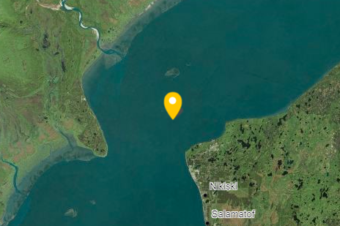
The spill site, near Nikiski in Cook Inlet. (Graphic courtesy of the Alaska Department of Environmental Conservation)
The leak site, near Nikiski in Cook Inlet. (Graphic courtesy of the Alaska Department of Environmental Conservation)

A pipeline administrator said in the order he thinks it’s dangerous to continue to operate the pipeline due to its history of leaks and the its age, plus the fact that the pipeline is under a critical habitat for endangered species, including the Cook Inlet beluga.

Smith said DEC has deployed state and federal agencies to provide input on resources that might be at risk.

“Hilcorp has actually had folks out there doing wildlife observations,” she said. “They have not seen any impacts to the wildlife at this time.”

The leak occurred a mile from one of Hilcorp’s platforms and six miles offshore from Nikiski. It was first reported last Thursday by a helicopter pilot who spotted bubbles on the water’s surface.

Hilcorp reported the leak to state and federal authorities an hour later and immediately reduced pressure on the pipeline. When it could not sustain that amount of pressure, it changed course and shut in the line, the order said.

Hilcorp estimates the leak initially let out between 75,000 and 150,000 cubic feet of natural gas per day.

Authorities still don’t know what caused the leak. But the order gives Hilcorp four months to find out. Before restarting operations there, Hilcorp has to submit a plan to federal regulators.

The pipe was built in 1965 and had two reported leaks in 2014, a year before Hilcorp bought it. Leaks occurred again in 2017 and 2019, and all were repaired with clamps, the order said.

Hilcorp is known for buying and reinvigorating old infrastructure and is currently Cook Inlet’s biggest oil and gas producer.

Hilcorp gas pipeline springs another leak in Cook Inlet

Hilcorp’s Anna Platform in Upper Cook Inlet. The company is looking to further expand its operations in the Inlet after buying up additional acreage at federal and state lease sales. (Photo courtesy Cook Inletkeeper)

Oil company Hilcorp is reporting another undersea natural gas leak near one of its platforms in Cook Inlet, about six miles offshore from Nikiski.

Authorities said they don’t yet know how much gas has leaked into the ocean or what caused the leak from the eight-inch-wide pipeline, located 80 feet underwater. Hilcorp said the leak was first reported Thursday evening by a company helicopter pilot who spotted bubbles on the water’s surface.

Hilcorp reported the leak to state and federal authorities an hour later and immediately reduced pressure on the line, according to a report issued late this afternoon by the Alaska Department of Environmental Conservation.

A map of the spill site, near Nikiski in Cook Inlet. (Alaska Department of Environmental Conservation)

It said Hilcorp activated valves to control the leak on Saturday afternoon, and officials said there’s no longer gas running through it.

This is not the first time the same pipeline has sprung a leak, according to local watchdogs. Four years ago, a rock on the ocean floor punctured the line and caused the loss of as much as 310,000 cubic feet of natural gas per day.

The pipe also leaked twice in 2014, according to Bob Shavelson, the advocacy director of Homer-based watchdog group Cook Inletkeeper.

Ice in the inlet blocked Hilcorp from repairing the 2017 leak for three months. Cook Inletkeeper threatened to sue the privately owned company over damage to the environment and local marine life.

The leaking pipeline is more than 55 years old, according to Cook Inletkeeper. Hilcorp is known for buying and reinvigorating old infrastructure and is currently Cook Inlet’s biggest oil and gas producer.

The gas that leaked isn’t produced from the platform. Instead, it’s dry natural gas that fuels nearby Hilcorp platforms. It’s almost entirely composed of methane.

Hilcorp will assess damage when ice conditions allow, the company said. A representative from the company also said divers will install a temporary clamp on the pipeline later this week.

The spill area is within the designated habitat for endangered Cook Inlet belugas. It’s also an essential fish habitat for several Pacific salmon species.

Study says Alaska is underfunding maintenance of schools

Lockers at Kenai Central High School. (Sabine Poux/KDLL)

The state of Alaska should be spending more on building maintenance for its K-12 schools, according to a recent study from the Institute of Social and Economic Research.

Institute research professor Bob Loeffler authored the study. He said it’s part of the institute’s ongoing analysis of Alaska’s revenue and fiscal issues.

“Right now, our level of funding is not sustainable,” he said. “And our schools will degrade if we spend the money we’re spending now. We need to spend more.”

Loeffler looked at capital projects across Alaska districts between fiscal years 2000 and 2020. Whereas many district expenses fall under a district’s operating budget, large capital projects are funded by a combination of bonds and state grants.

The National Council on School Facilities recommends spending 4% of a state’s schools’ current replacement value on capital projects.

Alaska’s current replacement value for its almost 500 K-12 schools is $9.4 billion. Under the National Council’s guidelines, Alaska should invest $374 million each year on school capital projects.

What Alaska actually spends, Loeffler found, is $249 million — 2.6% of its current replacement value.

Spending was higher before the state’s budget crisis. Since 2015, when the budget crisis first hit, capital spending has dropped from an average of $300 million per year to $124 million.

In 2015, the state stopped reimbursing school bond debt. Before, the state promised reimbursement between 60% and 70%.

The moratorium has raised the costs for school districts, which now have to fully fund bonds with their own tax revenue. Since 2015, only two districts approved school bonds — Anchorage and the North Slope. Capital spending from those districts currently accounts for almost two-thirds of the total spending for Alaska’s municipal schools.

“The most poignant finding is really how much our school districts, most of our school districts, the municipal ones, have relied on the bond reimbursement program,” Loeffler said. “And how much both the moratorium on new bonds, and some government vetoes of the reimbursement, have affected how much we spend on maintaining our schools. I didn’t know that going into the study.”

The Kenai Peninsula Borough is considering a $30 million bond for a litany of district projects. The biggest is the construction of a new school for Kachemak Selo, since the current building has fallen into disrepair. The state has appropriated $10 million toward the project if the district can come up with a 35% match, as part of a Department of Education grant.

Loeffler says the funding problem is even more stark for municipal school districts.

“Our boroughs and cities with taxing authority spend some of their own money, and yet they split how much money they spend on capital projects with the Legislature,” he said. “But the rural areas don’t have any taxing authority. And so they’re wholly dependent on the Legislature.”

The Legislature is mandated to spend a certain amount on funding in rural areas, so those schools are guaranteed a minimum amount of capital funding. Municipal schools aren’t.

Loeffler does say the guidelines from the National Council are just guidelines and won’t account perfectly for Alaska’s situation. But, he said, the difference between what the National Council proposes and what Alaska is actually spending is startling.

He says a potential fix might be to rescind the moratorium on bond debt reimbursement. The moratorium is in place until 2025.

Site notifications
Update notification options
Subscribe to notifications