
KDLL - Kenai

KDLL is our partner station in Kenai. KTOO collaborates with partners across the state to cover important news and to share stories with our audiences.
Hilcorp seeks permit for offshore survey

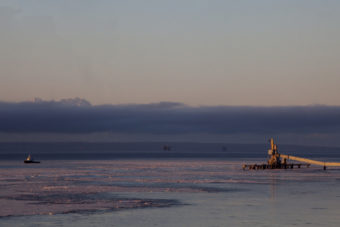
Cook Inlet oil platforms are visible from shore on Dec. 13, 2016 near Kenai, Alaska.
Cook Inlet oil platforms are visible from shore on Dec. 13, 2016 near Kenai, Alaska. (Photo by Rashah McChesney/Alaska’s Energy Desk)

Hilcorp purchased several blocks of federal leases in Cook Inlet in 2017.

Before it can even think about exploring for oil and gas there, the company has to do a geohazard survey to gauge potential geological hazards in the area.
The company planned to survey four lease blocks last year but was delayed because of the pandemic. It estimates the survey will take about a month and will happen during fishing season in Lower Cook Inlet.

Hilcorp bought several federal leases in a 2017 sale. The company’s now seeking a permit to conduct geohazard surveys on some of those leases. (Bureau of Ocean Energy Management)

Currently, the federal Bureau of Ocean Energy Management is asking for input on an environmental assessment of Hilcorp’s survey plan, and is taking comment until March 22. It wants to hear from fishermen and others who might be affected by the survey.

The agency estimates the federal waters of Cook Inlet, which stretch down to the southern tip of Kodiak, contain 1 billion barrels of oil and 1.2 trillion cubic feet of gas. With 14 tracts, Hilcorp is the sole owner of federal leases in the inlet.

There has never been a production well drilled in Cook Inlet’s federal waters. All the platforms in the inlet are in state waters, within three miles of shore.

Earlier this year, the federal government planned to hold another lease sale in Cook Inlet, but that sale was put on pause when President Joe Biden indefinitely halted all new leases. Earlier federal lease sales in the inlet have been canceled due to lack of industry interest.

Soldotna moves in on beetle kill fire hazard

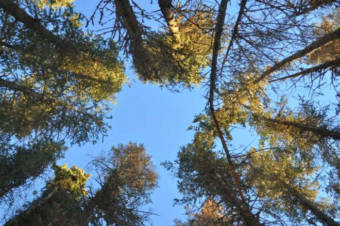
Dead spruce behind Kenai Peninsula College. (courtesy of Mitch Michaud)

Soldotna is waiting on a federal grant to remove beetle kill trees that could fall and pose a fire risk. But the beetles themselves aren’t so patient.
“Needless to say, the wheels of government don’t work as fast as the beetles do,” said local forester Mitch Michaud, who’s helping Soldotna forge a path forward among a persisting spruce bark beetle problem.

When spruce bark beetles eat away at trees, they make them weaker and more prone to toppling over.

What concerns Soldotna is that the brush from dead trees could become a fire hazard. The city successfully applied for a grant last year from FEMA to mitigate that risk, totalling around $300,000.

But between hurricanes, wildfires and the pandemic, FEMA’s been busy. The agency also has to do an environmental assessment before sending funds over.

Michaud’s helping the city scout trees that need attention now. He identified some at Aspen Park that the city should remove using its own funds while it waits for FEMA.

In the meantime, the Parks and Recreation Department will keep tabs on other trees in other parks that could be high risk.

“We’re generally waiting,” said John Czarnezki, Soldotna’s director of economic development and planning. “Unless we get these situations, like at Aspen Park, where we’ve got some higher-risk trees that could damage neighboring properties, could damage our city infrastructure.”

“And we’ve got a wellhouse there, we’ve got fences, we’ve got a building, we’ve got a significant investment in that park that we’re trying to protect,” he added.

Spruce bark beetles are tiny and lay eggs in host trees between May and July. Beetle outbreaks are cyclical and typically track with the life cycles of spruce trees.

But outbreaks become more likely when trees are unhealthy. And lately, both drought and fire have ramped up in Southcentral Alaska.

“And that was something that we had to show the folks at FEMA in our grant,” Michaud said. “Was that we’re looking at beetle intervals occurring every 10 years.”

Beetles typically stick to forests, since city trees are well tended. But Michaud said drought has made it so even the hearty trees in city parks are vulnerable.

“The ones at my home, I lost five,” he said. “And I had survived every beetle attack.”

Michaud’s looking at Aspen Park because of how quickly trees have been dying there.

Not all the trees at the park are at risk of falling. The area is relatively sheltered from the wind.

But those with advanced decay are making him nervous. They could topple tomorrow.

“I have to guard any answer I give, saying any of these trees could fall down at any time,” Michaud said. “So there is no insurance of that. Likewise, in a natural forest, you’ll have beetle kill trees that will stay up for, like, almost 10 years.

Tree removal is one part of the project FEMA will fund. The city is also looking at trimming trees to reduce risk of fire spread.

Soldotna’s plan will probably change before the grant is finalized.

“FEMA’s aware that our trees are continuing to die and that there will need to be some adjustments to our plan,” Michaud said.

The plan also doesn’t account for private property. Czarnezki said they’ve been looking for separate funding for that.

“And that has been much harder to come by,” he said.

Soldotna heard from FEMA last week that grant funds could take 12 to 18 months to arrive. Once the project is underway, the city will look for ways to revegetate parks that have been affected.

Without the Alaska Moose Federation, roadkill salvage falls to charities

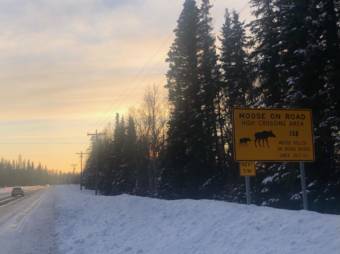
Salvage teams across the state retrieve and deliver roadkill moose to people in need. On the peninsula, that work falls directly on local organizations and charities. (Sabine Poux/KDLL)

Moose didn’t stop crossing the road when the Alaska Moose Federation closed up shop late last year. And there are still hungry families that can use the roadkill meat.
Without the Moose Federation, the salvage work is largely up to charities. It’s hard work.

“And if they can’t do it, then they’re denying the moose,” said Laurie Speakman, known as Laurie the Moose Lady.

Speakman was the Moose Federation truck driver on the Kenai for years. The federation shut down in November due to a lack of funds, from legal troubles and a decline in memberships.

Previously, charities on the peninsula took out memberships with the Moose Federation. Volunteer drivers, like Speakman, would pick up moose roadkill in AMF trucks and bring the meat to members, who then distributed it to people who could use it.

Now, law enforcement calls charities directly. Speakman said that without the organized support from AMF volunteers, moose often end up sitting on the road for longer.

“I do feel that there is a need to have some sort of general program, ’cause some of the charities just aren’t doing it, but they still want the meat,” she said.

Not all charities on the list have the bandwidth to send someone to a site. Speakman said the local branch of Veterans Affairs, for example, has had a hard time responding to moose calls and has had to pass on collecting carcasses.

It’s something she thinks could be fixed with an individual salvage team — a model used in other parts of the state.

“In order to set up a salvage team, like let’s say I would run it, as an example, under Laurie the Moose Lady, or figure out a different name,” she said. “My high hopes would be to completely be able to work with Fish and Game, Wildlife Troopers, State Troopers and local PD.”

Speakman and a friend are trying to develop a plan to create their own team, but she said funding is a huge barrier. Between trucks, insurance and fuel, costs are steep. Speakman considered buying a truck from Moose Federation Executive Director Don Dyer but said it was too expensive.

“’Cause I do. I really miss picking up moose right now,” she said.

Invasive mollusks hitch ride to Alaska on aquarium algae

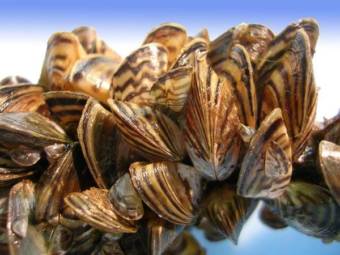
Invasive species managers consider zebra mussels to be one of the most detrimental invasive species in North America. (Alaska Department of Fish and Game)

There’s a new species on Alaska’s most wanted list.

Invasive Zebra mussels have made their way up north from the Lower 48, hitching rides on aquarium moss balls to pet stores.

Biologists in Alaska and more than 30 other states are concerned. For a creature the size of a fingernail, zebra mussels pack a lot of punch.

Maura Schumacher is the invasive species specialist for the Kenai Watershed Forum. She said zebra mussels, named for their striped shells, can thrive in both rivers and lakes.

“They are filter feeders, so basically they pull in water through their systems and they pull out nutrients,” she said. “And the waste that they are producing is highly acidic and drops the oxygen levels in water systems.”

That creates an inhospitable environment for the other plants and animals living there.

Zebra mussels are native to Eastern Europe and likely came over to the U.S. on ships in the 1980s. They infested all five Great Lakes and traveled to connected freshwater systems through canals.

It’s still a mystery how they glommed onto moss balls — small clumps of green algae that help filter water in household aquariums. But that’s allowed them to spread across the country.

“Because these moss balls are being sold by these major pet suppliers, they’re getting shipped to places like Alaska,” Schumacher said. “Which normally — it’s not impossible, but it’s very difficult for a zebra mussel to travel from the Great Lakes region to Alaska.”

The mussels could infiltrate local ecosystems if people dump their aquariums into lakes and rivers. They can wreak havoc on personal property, too.
“Some of the other impacts that they have is that they reproduce so quickly, they can clog storm drains,” she said. “They can cause incredible damage to boats and other recreational equipment. They just clog up any space available.”

State and federal agencies are coordinating to warn people who may have purchased moss balls. Major pet stores like Petco have also put out advisories asking customers to toss their moss balls.

“If you have recently purchased these moss balls, destroy them immediately,” Schumacher said.

She said acting on the defensive is important. Alaska has previously been able to intercept boats carrying zebra mussels.

“And when you’re on the offensive, like they are in the midwest and the Great Lakes region, it’s costing those states and economies millions and millions of dollars on a yearly basis,” she said.

The U.S. Fish and Wildlife Service is asking people to destroy their moss balls. They’ve released official guidelines for doing so.

Moss balls can either be freezed, boiled or bleached and then tossed in the trash in a sealed plastic bag. Aquariums that contained moss balls should be drained and cleaned.

The agency is also asking people to report zebra mussels they find. You can do that here.

NTSB: Rep. Gary Knopp, who piloted plane involved in fatal crash, had impaired vision

Rep. Gary Knopp, R-Soldotna, speaks during a House Minority press availability, April 6, 2017. (Photo by Skip Gray/360 North)
Rep. Gary Knopp, R-Soldotna, speaks during a House Minority press availability in April 2017. (Photo by Skip Gray/360 North)

Rep. Gary Knopp had impaired vision caused by glaucoma when the private plane he was flying collided with a charter plane last summer, according to a medical report released this week by the National Transportation Safety Board.

The report is among hundreds of pages of documents released by the board on the mid-air crash that killed Knopp and six others July 31. It’s an interim step — the board’s final report is still likely months away.

In its preliminary report last year, NTSB said Knopp was flying illegally because he had been denied a medical certification eight years prior, due to vision problems. The Federal Aviation Administration requires a medical certification to fly.

The updated medical report said Knopp was denied that certification because he had glaucoma in both eyes that led to a reduced field of vision. Glaucoma is caused by a buildup of fluid in the eye and can lead to blindness, starting with a loss of peripheral sight.

It can be treated with surgery but surgery doesn’t restore vision that’s already been lost.

Knopp had laser surgery to treat glaucoma in both eyes in 2010. By then, his glaucoma had caused irreversible damage to his optic nerves, particularly in the right eye, according to the report.

Pilots with glaucoma can qualify for medical certification on a case-by-case basis or if they meet certain criteria. But the FAA denied Knopp’s medical certification in June 2012 because of his vision problems. Knopp appealed that decision and was again denied certification in July 2012.

At his last optometry visit in May 2020, Knopp said his vision seemed “fine.” But his optometrist noted he still had severe glaucoma and made a plan to refer him back to his ophthalmologist for re-evaluation, according to the report.

Greg Bell, who was flying the charter plane from High Adventure Air, received his most recent aviation medical certification a month before the crash. The report found no significant issues with his exam.

Other documents in the report include interviews with eyewitnesses, photos of logbooks and systems data from both planes. But NTSB’s investigation is still far from completed, said Clint Johnson, the board’s Alaska chief.

“The investigation has gotten to a point where we’ve reached 51% of those reports from those different specialists, and they’ve been reviewed, they’re ready for release,” he said.

He said the board is waiting to do a visibility study to see whether the pilots would have seen each other before crashing.

To do that, specialists will lay out the wreckage of both planes to see how they collided. They’ll also use scans from similar planes to determine whether there were any visual obstructions inside the aircrafts.

That part of the process has been delayed by the pandemic. The planes are sitting in a hangar in the Mat-Su but restrictions have made it hard to get specialists up from Washington, D.C.

Johnson said once they’ve done the study, they can work backward to determine the probable cause of the accident.

“This is not the final report by any stretch of the imagination,” he said. “But it allows the public a chance to see what has been done to date and, again, allows them a chance to digest the work that has been done.”

Brice Banning, who’s leading the investigation, said he hopes to have a final report between 18 to 24 months after the crash.

Also released in the report is an interview with Matthew Dahl, an FAA investigator.

Dahl had accompanied Bell on a checkride two weeks before the crash. He said the Bell family, who owns High Adventure Air Charters, were meticulous about safety and didn’t cut corners when it came to taking precautions.

But he does note that the charter plane involved in the crash did not have an Automatic Dependent Surveillance-Broadcast, or ADS-B.

That technology allows aircrafts to send and receive three-dimensional data about where planes are in the airspace. It was not a requirement for either plane involved in the crash. But analysis from the NTSB’s systems report did say that it could have helped the planes be aware of each other before crashing.

Dahl said in the interview that he suggested Bell look into purchasing ADS-B technology. He said Bell was concerned about the cost, since ADS-B can run thousands of dollars. Knopp’s plane had a system with ADS-B capabilities, the report said.

There are three lawsuits in process from the families of the crash victims, against Knopp’s estate and his widow, Helen Knopp. Two of those lawsuits also target charter pilot Bell and High Adventure Air Charters.

Researchers try to quantify COVID-19’s impact on seafood industry

In 2015, a fishing boat passes in front of the French mega-yacht L’Austral, anchored in front of Petersburg in the Wrangell Narrows. (Angela Denning/KFSK)

The Alaska Seafood Marketing Institute has been diving into the effects of COVID-19 on the seafood industry for a while now.

Mainly, it’s been using interviews, anecdotal evidence and market research to compile briefings about how fishermen and others involved in the seafood industry have fared.

Now, the association is looking for more quantitative data about the effects of the pandemic. It’s sending out two surveys — one for fishermen and one for processors.

“We wanted to conduct this survey to really, fully measure the scale and breadth of the pandemic impacts on Alaska’s commercial fishermen, as well as processors,” said communications director Ashley Heimbigner. “Which hasn’t really been done yet, on a broad scale.”

It’s hard to get substantive data on the effects of the pandemic because the pandemic isn’t over. Most of the survey questions ask about the costs of the 2020 season.

“Not only in terms of direct costs,” she said, “like investments in PPE and vessel modifications to safely operate during the pandemic, but also, what were some of the more indirect costs? Including quotas potentially left in the water or the decision to hire fewer crew members. We want to make sure we’re really understanding the scope of the impact for Alaska’s commercial harvesters.”

The survey also asks fishermen and processors to anticipate how their 2021 seasons will be affected. Another set of questions asks whether industry members received any monetary relief and whether that relief covered their costs.

“Cause we’re hearing mixed stories in that regard,” Heimbigner said.

The federal government just approved Alaska’s plan to divvy up $50 million in coronavirus relief to the fishing sector. About 35 percent of that relief will go to commercial fishermen and 32 percent will go to the seafood processing industry.

Surveys are due March 18. You can find the survey for fishermen here and the survey for processors here.

Site notifications
Update notification options
Subscribe to notifications