KDLL - Kenai

KDLL is our partner station in Kenai. KTOO collaborates with partners across the state to cover important news and to share stories with our audiences.
Court rejects Hilcorp permit over possible harm to Cook Inlet belugas

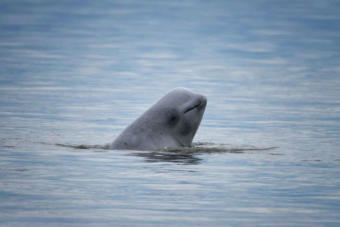
Cook Inlet belugas are the smallest of five beluga stocks in Alaska. The population has been declining for over two decades. (NOAA photo)

A federal permit allowing Hilcorp to drill in Cook Inlet does not account for the harm vessel noise could pose to endangered belugas there, according to a decision yesterday from a District Court judge.
Cook Inletkeeper and the Center for Biological Diversity challenged the permit in a 2019 lawsuit. This week, Judge Sharon Gleason sided with them, ruling NOAA Fisheries did not account for how noise from Hilcorp’s tug boats would cause harm to belugas when it authorized the company to work there.

Bob Shavelson, advocacy director at Cook Inletkeeper, said the decision touches on one of many impacts Hilcorp’s activities have on local wildlife.

“This decision clearly shows that the National Marine Fisheries Service is not doing an adequate job at protecting our marine resources,” he said.

The Marine Mammal Protection Act requires those involved in offshore oil and gas production to obtain special authorization for harming local marine life, known as “incidental take,” as long as its impact on wildlife is negligible.

Hilcorp received that authorization from NOAA Fisheries in 2019 for its five-year plan to explore and develop Cook Inlet.

But in its own recovery plan for the endangered species, NOAA says noise from tug boats is a threat to beluga whales. That’s partly because belugas rely on echolocation to find food and communicate with each other. Whale researchers have also previously voiced concern over Hilcorp’s use of air guns in Cook Inlet when exploring there.

The judge’s decision requires the parties involved to propose remedies to the noise problem from tug boats within 14 days of the March 30 order. Shavelson said Inletleeper will be in touch with its lawyers to decide what to propose.

“There’s so many different impacts affecting the Cook Inlet beluga whale,” he said. “It really is that death by a thousand cuts. And some things, like climate change, are a lot more difficult to get a handle on. But we know that pervasive ship noise, seismic air guns, toxic dumping — we know those things are having a negative effect on beluga whales, so we should reduce and eliminate them where we can.”

The court did uphold part of NOAA’s ruling, regarding mitigation measures for seismic surveying around belugas.

Representatives from NOAA Fisheries and Hilcorp declined requests for comment.

Hilcorp is currently the biggest producer of oil and gas in Cook Inlet. The Texas-based company owns several federal lease blocks in the inlet and is planning for a geohazard survey on some of those tracts this summer.

Monday avalanche buries the only road to the Kenai Peninsula

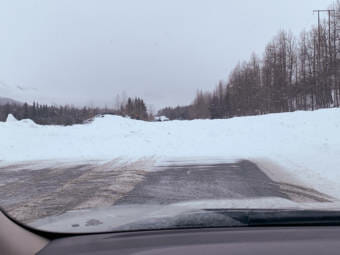
Avalanches on state highways are relatively rare. The Department of Transportation blasts sites to set off controlled avalanches and prevent larger, uncontrolled avalanches from hitting the highway.
(courtesy Hannah Etengoff)

For four and a half hours Monday night, the only road to the Kenai Peninsula was blocked in both directions by an avalanche near Summit Lake.

The avalanche hit around 4:20. Hannah Etengoff was driving back home to Kenai with her husband and dogs.

“Maybe about a mile ahead of me I see what at first I thought were clouds moving down the mountain,” she said. “And then I thought, ‘Well, actually that kind of looks like an avalanche.’ Then I was like, ‘No, it’s clouds.’”

It was an avalanche, between 4 and 6 feet deep and 200 feet wide. Etengoff and the cars ahead stopped. A truck ahead was swept up.

“I saw the driver get out and he was giving everyone thumbs up,” she said.

No one was hurt. Etengoff and her family had just done a Costco run, so they were good on snacks while they waited for help to arrive. A person in one of the parked cars brought around pizza for others who were waiting.

Avalanches on Southcentral highways aren’t very common. Department of Transportation Spokesperson Shannon McCarthy said this incident was one of just a few that’s led DOT to close the road in recent years.

She said it’s partly because DOT’s avalanche team, based in Girdwood, sets off controlled avalanches with a howitzer to prevent larger, uncontrolled avalanches from hitting the highway.

“There’s a reason why we have a team of avalanche specialists, because avalanches used to hit the roads frequently, and it would really be disruptive,” McCarthy said.

The Summit Lake area is a less common avalanche area and isn’t blasted as frequently as others, McCarthy said.

The Seward Highway incident was one of several high-profile avalanches in Southcentral this week. On Friday, a small avalanche blocked the road to Hatcher Pass, near the Gold Mint trailhead. Separately, a Fairbanks skier died in an avalanche while heli-skiing near Matanuska Glacier this weekend.

Forecaster Andrew Schauer from the Chugach National Forest Avalanche Information Center said it’s a coincidence.

“That was something that I was thinking about immediately but really the snowpack between what’s going on at Summit Lake and where the avalanche fatality was, it’s two completely different things,” he said.

He said the information on this avalanche is limited since the center hasn’t been down to investigate the area yet.

“It was a little bit surprising that that happened yesterday,” Schauer said. “What we do know is for the past few months, we’ve had these weak layers, persistent weak layers, we call ’em, buried in the snowpack that have been sort of alternating between being reactive and dormant, off and on.”

As the weather is getting warmer, those weak layers can become reactive again.

Another potential factor is there were strong winds Saturday near Summit Lake.

“So that may have played a role, too,” he said.

Schauer said he thinks people can expect more avalanches as the temperature warms and the snowpack continues to change.

Before DOT opened the highway again Monday night, it blasted the area to bring loose material down. McCarthy said the team from the Silvertip Maintenance Station, which was brought back online last month, cleared the roads.

“They’re the ones that did all the cleanup,” she said.

Around 9 p.m. Monday, the cars waiting were waved through. Etengoff and her family got home around 11:30.

“All in all, everyone was safe,” she said. “Everyone got to go home safe. We got to experience an avalanche, which is now something I guess I can tell stories about.”

They were tired, but OK.

Hilcorp gas wells near Anchor Point get green light

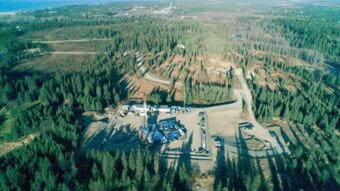
Hilcorp’s Seaview drill site in Anchor Point. (Photo courtesy of Willy Dunne)

The state has approved Hilcorp’s plans to drill two gas exploration wells near Anchor Point.

As early as Thursday, the company could start construction on a gravel exploration pad for the company’s Whiskey Gulch prospect. Hilcorp plans to drill two exploration wells there — an oil-gas combination well and gas-only well. An ENSTAR Natural Gas line runs by the site.
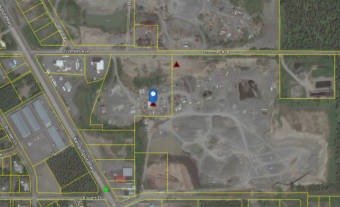
Hilcorp’s proposal for an access road and pad in Whiskey Gulch. (Department of Natural Resources, Division of Oil and Gas)

Hilcorp proposes drilling the first well in May, testing it in June and suspending and securing it in July. It would drill the second well in July and secure it in September.

Hilcorp also wants to improve the access road to the pad, which begins at the intersection of Cape Ninilchik Avenue and Opportunity Lane.

Plans for Whiskey Gulch are still in the exploration stage. But Hilcorp is slated to begin production soon on another well on the southern Kenai Peninsula — Seaview 8, south of Anchor Point. Hilcorp plans to start production there later this year after construction delays in 2020.

At federal forum, Alaskans weigh in on future of oil and gas

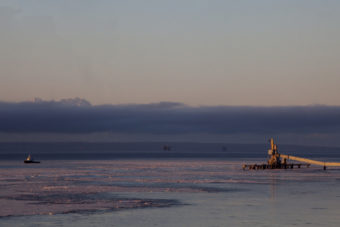
Cook Inlet oil platforms are visible from shore near Kenai, Alaska. (Photo by Rashah McChesney/Alaska’s Energy Desk)

Oil and gas leasing on federal lands and waters is on pause. That includes a sale in Alaska’s Cook Inlet that was originally slated for later this year and is now suspended indefinitely.

At the same time, the federal government is reviewing its energy program and gathering input from industry experts, environmental advocates and tribal leaders across the country. Several representatives from those groups, including two from Alaska, weighed in on the program at an Interior Department forum Thursday.

Nicole Borromeo, executive vice president and general counsel of the Alaska Federation of Natives, said that while Alaska Native communities are on the front lines of climate change, the federation also acknowledges the oil and gas industry is a boon for the Alaska Native workers it employs.

“Alaska natives do not operate in an either/or space when it comes to the nation’s energy policy,” Borromeo said. “We favor both traditional and emerging forms because a combination of both best serves our state and our people.”

In Alaska, the National Petroleum Reserve and a large swath of Cook Inlet are both part of the federal oil and gas program.

Earlier this year, the federal government halted an upcoming lease sale in the inlet in response to an executive order from the Biden administration, geared toward addressing climate change. Alaska and 12 other states are suing the Biden administration for that decision, while some environmental advocates are petitioning the government to block offshore leasing for five years.

Interior Secretary Deb Haaland said the government needs to take a long view at its management of public lands and waters.

“The pause on new oil and gas lease sales give us space to look at the federal fossil fuel programs that haven’t been meaningfully examined or modernized in decades,” she said.

Michael LeVine is a Juneau-based Arctic fellow with Ocean Conservancy, an environmental advocacy nonprofit. He said the pause was a good first step but further reforms and legislation are needed.

“If we could make one change in the legislation about offshore oil and gas, it would be to prioritize the health and viability of ocean ecosystems, rather than the way it’s stated now, a priority for extraction,” LeVine said.

He said offshore leasing in Alaska jeopardizes ocean ecosystems and the people who rely on them, including coastal communities and members of the fishing industry.

Representatives from trade unions and oil and gas industry associations said cutting federal oil and gas production would be bad for jobs.

Borromeo said AFN is also concerned about maintaining energy jobs for Alaska Native people. She said the department should actively consult Native communities in its decision-making on energy policy.

“Let us show you our lands,” she said. “Don’t necessarily just rely on what private industry or environmental groups are saying. We want to be the ones to take you and to show you.”

She encouraged Interior Department officials to visit Alaska to see it for themselves.

“That means you’re going to have to stay probably a week or so,” she said. “Because it’s going to take you a day to get here, a day to adjust up in Anchorage, and then we’ve gotta get out to the bush. We need to travel.”

The Interior Department said it will complete an interim report on its federal conventional energy programs this summer. It’s soliciting additional feedback until April 15.

Soldotna construction company reaches $130K settlement with EPA over unauthorized well, contaminated groundwater

An aerial view of the contaminated site at North Star Paving and Construction in Soldotna. (Alaska Department of Environmental Conservation)

A Soldotna construction company has settled with the U.S. Environmental Protection Agency for $130,000 after an unauthorized injection well was discovered on the property.

North Star Paving and Construction had a well at its maintenance shop near Knight Drive that drained vehicle waste from the shop into an oil-water separator, then leach field in the ground.

It was likely on the property for several decades. But those types of wells were banned in 2000 since the chemicals can impact groundwater. Alaska required all wells of that type to be removed by 2005.

A consulting firm found the well over a year ago when it was hired by a potential property buyer to do an environmental assessment there.

“Actually, a pretty common way that things are found,” said Suzanne Skadowski, the public affairs manager for the region of the EPA that includes Alaska. She said the consultant then sent its findings to the state.

Peter Cambpell, project manager for the state’s contaminated sites program, said they discovered contaminated groundwater near the well. The floor drain was connected to a tank that was supposed to separate water from oils and greases.

“But it was, from what I understand, never used properly in that there wasn’t any water in it on a regular basis,” he said.

As a result, more chemicals seeped into the ground.

The well is above a community water supply for Soldotna. But Campbell said that supply is 163 feet deep and is in a confined aquifer.

“I don’t think there’s any chance that that’s been impacted, and it is sampled regularly,” he said.

There are also several business wells nearby. Campbell doesn’t think those would have been impacted, either. He also said it would be virtually impossible for the Kenai River — located less than a mile away — to be impacted by the contamination.

North Star didn’t respond to requests for comment. But Campbell said the owner did have knowledge of the well since they had floor drains in the shop. It’s not clear why they didn’t remove it, or whether they knew it was illegal.

EPA inspector Donna Ortiz said the prospective property buyers have gone through with the sale but are avoiding the area around the contaminated site until it’s fully cleaned up. North Star has already removed the well and a few hundred yards of soil.

“They’re very interested in getting this done as soon as possible because they wanted to sell the property and then go into a retirement,” she said.

Campbell said the state is continually testing the groundwater in the area.

Senior aide to Alaska Senate president recovering from severe case of COVID-19

A mostly empty hospital hallway
The critical care unit at Bartlett Hospital on April 7, 2020, in Juneau. Konrad Jackson was sent here on March 8, 2021 with severe COVID-19. (Photo by Rashah McChesney/KTOO)

Legislative staff in Juneau get tested for coronavirus every five days.

“It’s not an abnormal thing, we just go get tested,” said Mary Jackson, a legislative staffer from Kenai.

“There’s a pokey-okey, long Q-Tip that they put up your nose and it’s a rapid test,” she said. “And you pop negative. Except sometimes you pop a positive.”

Mary’s husband, Konrad Jackson, tested positive for COVID-19 earlier this month along with several other Capitol staff. Konrad is a senior aide to Soldotna Republican Sen. Peter Micciche.

Konrad’s case was particularly bad. It started with a scratchy throat, but soon he could hardly breathe. He was sent to the critical care unit at Juneau’s Bartlett Hospital on March 8.

“They immediately put him on high pressure oxygen,” Mary said. “He was still breathing, he never went into the ventilator. That’s the ‘critical.’ Konrad has ‘severe’ COVID. I didn’t even know what that was, had to Google it to find out what that was.”

He spent a week in critical care. Finally, on Sunday, he moved to a regular hospital room where hospital staff can monitor his oxygen.

Mary said he’s on the mend.

“He came pretty close there. He came very close,” she added.

Nine staff and lawmakers in Juneau have tested positive for COVID-19 so far this year, including two yesterday. At the same time, two Republican lawmakers from the Mat-Su are rebuking Capitol mitigation protocols, which mandate temperature screenings and mask wearing for all who enter the building.

Mary doesn’t want to say how they think Konrad got infected, for privacy reasons. But Micciche said Konrad’s case was linked to a legislator who tested positive.

Mary, miraculously, didn’t get sick when her husband did. Now, she’s just days away from being fully immunized after receiving both doses of the vaccine.

She hasn’t been able to be with Konrad face-to-face because he still could be contagious. But they’re thrilled he’s out of critical care.

“For us, we’re blessed, I’m blessed,” she said. “My husband is alive. He’s doing very well. And we have had such an outpouring, of, as I’ve said, family. And the family includes the legislative family.”

Micciche said seeing Konrad get so sick made him realize how severe the virus is. Mary said she didn’t know anyone who got so ill before Konrad.

“I’ve always said it was the flu on steroids, kind of jokingly,” she said. “Well, it’s not a joke anymore. It is a flu, on steroids. It just hit us.”

She hopes others don’t have to endure what Konrad did.

“Please, please be safe. Take this seriously. Really take this seriously,” she said.

The Jacksons have gone through this away from home. Outside of the session, they live in Kenai, on K-Beach Road. Konrad has worked for Micciche for years and was born and raised in Homer. Mary is quasi-retired from politics but recently ran Mayor Charlie Pierce’s campaign and is now working with Anchorage freshman Rep. Tom McKay.

They’ve gotten a lot of support from friends at the Capitol. Mary said they fundraised to cover some of their medical expenses, though she wasn’t sure how much those expenses will end up costing or how much they’ve raised so far. She said they do have medical insurance, and that her heart breaks for those who have had COVID-19 who aren’t insured.

Friends from the Kenai, too, have sent prayers their way.

“My phone was blowing up,” she said. “Konrad’s phone was blowing up and he’s having, obviously, a difficult time responding. He’s doing much better. But he can’t walk for very long without coughing. And you can hear the oxygen blowing in the background. So it’s not exactly convenient to jabber away.”

Konrad’s still in quarantine for another week, though he could be released from the hospital before then. Some people have experienced long-haul COVID-19 — marked by a persistence of symptoms like shortness of breath and fatigue.

Mary said those long-term effects are in the back of her mind but she was confident that the care he received at Bartlett has made him stronger.

“And that will go a long way for his long-term recovery,” she said.

She said they’re both looking forward to getting back to the budget talks in the Legislature. Konrad is also working with Micciche on getting his set-net buyback bill through the Senate.

Site notifications
Update notification options
Subscribe to notifications