KDLL - Kenai

KDLL is our partner station in Kenai. KTOO collaborates with partners across the state to cover important news and to share stories with our audiences.
Hikers have standoff with black bear near Seward

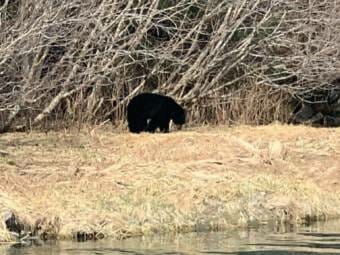
The black bear after the standoff (Photo courtesy Regina Green)

The odds of getting attacked by a bear are one in over two million. That’s why Sarah Wallner, who was mauled by a grizzly in 2007, could not believe her misfortune when she and two friends ended up in a standoff with a black bear at Tonsina Creek, near Seward, on Thursday.

“Oh, not again. This is not happening,” Wallner remembers thinking. “Like, this is not supposed to happen again.”

All three were OK, as was the bear, who just suffered from some mace in the face. But the hikers said for the about two minutes the standoff lasted, they weren’t so sure what was going to happen.

It wasn’t an isolated incident. Alaska State Parks Ranger Jack Ransom said his department got three separate reports Thursday and Friday about a large, aggressive black bear on the Tonsina Creek Trail.
Regina Green, Niels Green and Wallner, who have a cabin at Lowell Point, said they’ve heard of more bear encounters in that area in the last two years than ever before.

They’ve been hesitant about hiking there for that reason. But on Thursday, they decided to try the Tonsina Creek Trail anyway.

Regina said they were crossing the Tonsina Bridge on their way back when their dog came running toward them.

“I was turned back around and I heard this super loud thundering,” she said. “And I thought Niels was playing around.”

That’s when Wallner saw a black bear had followed the dog onto the bridge. She and Regina jumped away, to the other side of the railing. But Niels, who was standing in the middle of the bridge, was facing the other way and didn’t see it.

“And I’m like, ‘Niels! Bear!’” Regina said.

But ‘Bear’ has also been Wallner’s nickname, since she was attacked.

“So he was like, ‘What?’”

When Niels turned around, he was just two feet away from the bear. He had a beach ball he’d picked up on the beach and stuck it between him and the bear as a buffer.

Every time Niels tried to back away, the bear came closer. He thinks they stood like that for two minutes.

“And I was talking to it, going, ‘Bear, don’t try nothing, you need to go, bear,’” he said.

“And I thought in that situation I’d be more helpful, but I jumped away over the bridge,” Regina said. “And our bear spray was in the backpack in the side pocket.”

Regina grabbed the bear spray out of her backpack and handed it to Niels, who sprayed the bear.

“And then it just walked away,” Regina said. ‘But if we didn’t have the spray — it wasn’t leaving.”

Wallner said she wishes she and Regina had gotten big behind Niels.

“You know all of what you’re supposed to do but it’s very hard to do it in those moments,” she said.

They didn’t report it to the Alaska Department of Fish & Game but did immediately post about the incident in Seward community groups on Facebook to warn others who were thinking of hiking in the area.

Ransom, the park ranger, said he’s posted signs at the trailhead, and his department will consider closing the trail if the bear keeps bothering hikers. He said one couple reported being chased by the bear. Another group had to throw rocks at it to scare it away.

He said run-ins of that sort are not entirely rare for this time of year. Nick Fowler, area wildlife biologist for Fish & Game, said recreationists should be bear aware as bears start emerging from their dens.

“The best thing that we can do is to stop conflicts from happening in the first place,” he said. “And our best tool against that is to manage our attractants that are going to potentially bring bears into close proximity with people.”

He said that means securing trash and any other attractants. He also said people should make sure they have control of their pets.

“And that’s a concern for pet safety as well as animal safety,” he said. “We don’t want wildlife being attracted to an area because pets are off-leash and we also don’t want dogs chasing wildlife, as well.”

Wallner and the Greens said they recommend keeping dogs on leashes in the area because their dog seemed to bring the bear to them. They also said having bear spray is a lifesaver.

Though they’re physically fine, the three are a rattled after their run-in.

“So now we’re just sitting in front of the cabin painting rocks,” Regina said.

“’Cause we don’t want to go hiking today,” Wallner added. “We’re going to take up more kayaking this year.”

You can report wildlife encounters on the Fish & Game website or through the Soldotna office, at 907-262-9368.

Dunleavy proposes opening part of Kachemak Bay to subsurface gas leasing

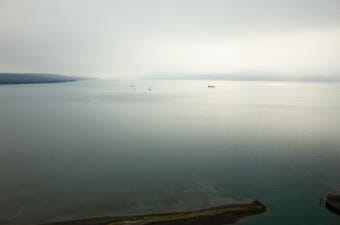
Kachemak Bay in 2014 (courtesy Ian Dickson)

Oil and gas leasing isn’t allowed in Kachemak Bay. The state blocked development there after an oil rig got stuck and leaked oil into the bay in 1976.

But legislation proposed by Gov. Mike Dunleavy would allow the state to sell subsurface gas-only leases in part of Kachemak Bay so oil and gas companies could drill into undersea reservoirs from miles away.
More broadly, the bill would permit subsurface leasing and drilling where surface drilling is currently prohibited. And the bill’s opponents say that would unravel state restrictions meant to protect wildlife.

Haley Paine, deputy director of the Alaska Division of Oil and Gas, told the House Fisheries Committee the point of the legislation is to capture royalties for the state.

“The primary benefit of this bill would be increased revenue,” she said.

Traditionally, oil and gas companies have reached undersea gas reserves with vertical wells from platforms on the ocean’s surface. But recent drilling technology allows companies to tap into reservoirs in the ocean floor from onshore pads, miles away. Locally, it’s a method BlueCrest Energy already practices to reach offshore oil reservoirs from its Cosmopolitan Unit.

But the state can’t currently profit off subsurface leases in Kachemak Bay, where leasing is prohibited.

The area in blue is where the state proposes a program for subsurface leases. The red shaded area is where the bay is currently closed to oil and gas leasing. (Alaska Department of Natural Resources Division of Oil and Gas)

The legislation allows for subsurface leasing on a chunk of the bay near Anchor Point. It’s adjacent to the Seaview Unit, where oil company Hilcorp has prospects.

Hilcorp hasn’t yet made plans for any subsea expansion there. But the state wants to establish a lease program to collect royalties in the event that they do, said Sean Clifton from the Alaska Division of Oil and Gas. In Cook Inlet, those royalties hover around 12.5%.

“We’ve seen a lot of new lease activity in this area as Hilcorp has been looking for new places to develop gas in order to keep our homes warm and the electricity running,” Clifton said.

The area was closed to drilling in the first place in part because of fears about harming local fish and fishermen. The state says subsurface drilling won’t hurt local fisheries and that surface development will still be prohibited.

But Penelope Haas, a member of the Kachemak Bay Conservation Society’s board, worries activity in the bay could still adversely impact local wildlife.

“This lateral drilling technology and the fracking that goes along with it can go six miles or more into areas that are currently closed,” she said.

Not all directional drilling is fracking. But the two often go hand and hand.

Haas said that brings concerns about large-scale water withdrawals, impact to local watershed and potential flowback at fracking sites. The state, for its part, said fracking can be done safely and is already practiced in Cook Inlet, with oversight from the Oil and Gas Conservation Commission.

Haas is also concerned about the larger-scale impacts of the legislation.

“We on the second level are very much concerned about an effort by the Dunleavy administration to rewrite the playbook on areas protected from oil and gas drilling around the state,” she said.

Beyond its impact on Kachemak Bay, the legislation allows for subsurface drilling around the state where surface drilling is restricted. Clifton, with the state, said he doesn’t have other examples in mind of where it might apply. But he said the state wants to be ready in case a situation like the one in Kachemak Bay arises elsewhere.

The legislation is among a slate of bills from the governor’s office allowing the Department of Natural Resources to lease and sell land for development. Committees in both the House and Senate are reviewing versions of the bill.

Kenai Peninsula Borough to buy ADA-compliant voting machines

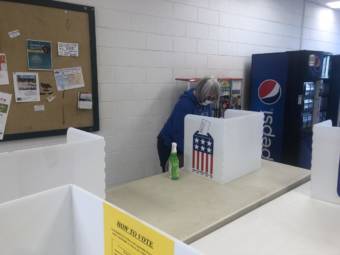
Carol Freas sanitized tables between voters during municipal elections in Kenai last November. (Sabine Poux/KDLL)

The Kenai Peninsula Borough will go through with purchasing and leasing several ADA-compliant voting machines, six years after a complaint from a vision-impaired Homer man triggered a reassessment of voting accessibility on the peninsula.

The plan to buy several Dominion Voting Systems machines and lease over two dozen others was primarily a response to that complaint. But it became controversial when former President Donald Trump and his followers made Dominion a target late last year, claiming without evidence that the 2020 election was rigged.

Rigorous audits across the U.S. have found Dominion machines to be accurate. And the borough already uses Dominion machines — they’re just not ADA compliant.

Borough IT manager Ben Hanson said the new machines are largely the same on the backend.

“The biggest difference, as far as what we’re looking to implement, is the ADA-compliant piece,” he said. “The ADA-compliant machine — which the vast majority of people will not use, the vast majority of people will likely still fill out a paper ballot — that ADA-compliant machine allows for the multiple methods of access.”

That includes a screen reader that dictates ballots aloud and a “sip and puff device,” allowing voters to send signals to the machine by inhaling and exhaling.

Those technologies weren’t available in 2015, when Richard Malley lodged his complaint with the Alaska State Commission for Human Rights. Malley, a former Homer resident with impaired vision, alleged there was not an accessible voting machine available for him when he went to vote in the borough.

The commission agreed and told the borough to fix the problem. The borough convened a stakeholder group, which made several recommendations to make voting more accessible.

One recommendation was the borough provide accessible voting machines at every voting location on the peninsula. The borough got quotes from both Dominion and Election Systems and Software before going with Dominion.

Several people at Tuesday’s assembly meeting asked the borough to hold off on approving the purchase from Dominion. Annette Pankoski said she’s been reading about the machines.

“I’ve tried to read over it myself and to get a handle on it because it’s a lot,” she said. “But the whole intention of it was to show that there are fraudulent issues with the Dominion voting machines.”

Assembly member Bill Elam said he originally was worried, too, but not after doing his research.

“I’m an IT professional,” he said. “That’s what I spend my career doing and I have spent a ton of time researching this, going through all the details. I want our election to be beyond reproach. I will personally vote for the Dominion system even though I’ve read the same articles you guys have.”

Borough staff also tried to assuage fears by walking people through the voting process. Clerk Johni Blankenship said they check for discrepancies after an election.

“The following day, the canvass review board will perform an audit on each and every individual polling location to ensure that the ballots that went through that machine, and the people who signed the registers, and the ballots that were destroyed, match up with the ballots that they were given at the beginning,” she said.

Assembly member Jesse Bjorkman reminded listeners that machines leave a paper trail.

“It’s not as if anyone is voting and those votes are kind of going off into the ether and that they can somehow be changed,” he said.

The only assembly member to vote against the purchase was Richard Derkevorkian, who said he heard too many concerns from his constituents.

The ordinance authorized the borough to purchase 10 machines for its in-person absentee voting locations. Those machines would cost just over $100,000.

The borough will lease 26 machines for its remaining polling locations, for almost $149,000 annually. Blankenship said that’s so the borough can first make sure it likes the machines before making a big purchase.

Separately, Elam and Bjorkman successfully sponsored the adoption of new pre-election policy, including a “security risk and vulnerability assessment” by an independent IT provider. Bjorkman said he wants to ensure there’s confidence in the system ahead of the October election.

A look at Alaska’s cannabis industry, 6 years in

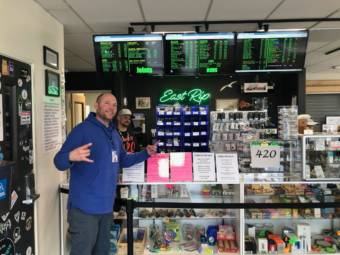
Ryan Tunseth opened East Rip in downtown Kenai in 2018. He sources his product locally, from Kenai Peninsula cultivators. (Sabine Poux/KDLL)

The Kenai Peninsula has been a key player in Alaska’s budding cannabis industry since the state legalized recreational marijuana use six years ago, with over 70 licenses in play for cultivators and retailers.

One of those licenses belongs to East Rip, off the Kenai Spur Highway. Ryan Tunseth opened the shop in 2018 and is treasurer of the Alaska Marijuana Industry Association.

KDLL’s Sabine Poux spoke to Tunseth about how the industry has changed since 2015 and where he thinks it’s going. He says what cannabis businesses need most now is access to normal banking.
“The industry needs a responsible and safe way to bank,” Tunseth said. “Everything’s in cash. We pay our employees in cash. We pay vendors in cash. We pay our taxes in cash. And because of that, it’s quite dangerous.”

Listen to the full interview here:

Peninsula lawmakers introduce bill to block vaccination requirements

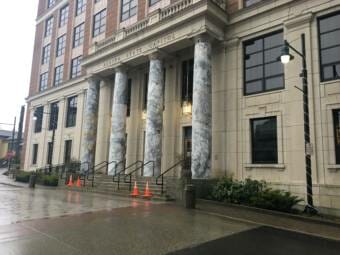
The entrance to Alaska's Capitol in Juneau on Sunday, Jan. 17, 2021. Four safety cones are at the bottom of the stairs.
The entrance to Alaska’s Capitol in Juneau on Sunday, Jan. 17, 2021. (Photo by Andrew Kitchenman/KTOO & Alaska Public Media)

Several Alaska Republican legislators have signed on to a bill defending what they call “COVID-19 immunization rights.”

Representatives Ben Carpenter of Nikiski, Sarah Vance of Homer and Chris Kurka of Wasilla are sponsoring House Bill 175.

The legislation would bar private businesses and public entities from requiring vaccinations as a condition of employment unless the requirements are authorized by federal law.

A few employers in the state are requiring vaccines among their employees, though they’re in the minority. Attorneys say vaccine mandates are a legal gray area, particularly given that the shots are only authorized on an emergency basis.

But no lawsuits have popped up, yet.

The legislation fits into a national campaign by conservative lawmakers to push back, often preemptively, against vaccine mandates. Republican legislators in Ohio introduced a similar bill last week, and several states are considering so-called “Vaccine Bill of Rights” legislation.

Alaska’s proposed bill would also block businesses and public entities from requiring proof of COVID-19 vaccination to access public areas, services or benefits. That includes public schools and University of Alaska campuses.

The legislation would not be effective any time the governor declares a state of emergency.

Widow of Gary Knopp files cross complaint against charter company

Rep. Gary Knopp, R-Soldotna, speaks during a House Minority press availability, April 6, 2017. (Photo by Skip Gray/360 North)
Rep. Gary Knopp, R-Soldotna, speaks during a House Minority press availability in April 2017. (Photo by Skip Gray/360 North)

Rep. Gary Knopp’s widow, Helen Knopp, has filed a counter complaint against High Adventure Air Charters, the Soldotna company whose plane collided with Knopp’s last summer. Seven people died in the crash.

Representatives of four of the charter passengers filed lawsuits last month against Helen Knopp and the Knopp estate, alleging Knopp was negligent because he was flying his private plane without a valid medical certificate.

The cross complaint, filed today, counters the claims made against Knopp in the lawsuit. It also alleges High Adventure Air Charters and Gregory Bell, who was piloting the charter plane, were negligent and caused the crash.

Knopp’s plane and the charter plane collided above Soldotna last July, killing Knopp and Bell. The crash also killed passengers Kristen Wright, Caleb Hulsey, MacKay Hulsey and Heather Hulsey, all of South Carolina. David Rogers, a Kansas guide, also died in the crash.

There are multiple lawsuits in motion against Knopp, Bell and High Adventure Air Charters on behalf of the victims, including one that was already settled in court. But this is the first complaint naming Gary Knopp as a victim of negligence.

Alaska law allows a jury to rule multiple parties partially responsible and distribute harms and losses accordingly.

The National Transportation Safety Board is still investigating the cause of the crash. The board found that Knopp had a history of vision problems, which barred him from receiving a medical certification in 2012.

A recent report from the board also found the charter plane involved in the crash did not have an Automatic Dependent Surveillance-Broadcast, a technology that allows planes to send and receive three-dimensional data about where they are in the airspace. It was not a requirement for either plane involved in the crash but the board says in its analysis it could have helped the planes avoid the crash.

Site notifications
Update notification options
Subscribe to notifications