KDLL - Kenai

KDLL is our partner station in Kenai. KTOO collaborates with partners across the state to cover important news and to share stories with our audiences.

Families of Soldotna plane crash victims sue estate, widow of former Alaska Rep. Gary Knopp

Rep. Gary Knopp, R-Soldotna, speaks during a House Minority press availability, April 6, 2017. (Photo by Skip Gray/360 North)
Former Soldotna GOP Rep. Gary Knopp is the subject of two new federal lawsuits. (Skip Gray/360 North)

The families of four passengers killed in a mid-air crash last summer are suing the estate of Gary Knopp, the former Alaska state representative who was piloting the plane that collided with theirs.

Representatives for Kristen Wright, Caleb Hulsey, MacKay Hulsey and Heather Hulsey, all of South Carolina, filed two separate federal lawsuits Thursday against Knopp’s estate and his wife, Helen Knopp.

Both suits also target the estate of Gregory Bell, the charter pilot who also died in the crash, and the two companies that owned and operated the charter plane, High Adventure Air Charters and Soldotna Aircraft & Equipment Leasing.

Knopp’s private plane collided with the charter plane carrying Wright and the Hulseys above Soldotna last July, killing Knopp and all six on board the charter. Caleb and MacKay were brothers; Wright and Heather Hulsey were their partners.

The National Transportation Safety Board later found that Knopp was denied a medical certification from the Federal Aviation Administration in 2012 because of vision problems. Federal regulations require a medical certificate to fly.

That’s outlined in the complaint attached to one of the lawsuits, filed by William Hulsey, who’s the father of the two brothers, according to an online obituary. The other lawsuit was filed by Wright’s parents.

William Hulsey’s complaint alleges that Knopp was negligent in his operation of the aircraft because he was flying without a valid medical certificate. It also alleges negligence against Helen Knopp, saying she knew or should have known about her husband’s vision problems.

High Adventure Air guide David Rogers also died in the crash. He is not mentioned in the complaint.

Biologists look at environmental DNA for clues about endangered Cook Inlet belugas

KPC student Teresa Becher (middle) and Semester by the Bay students Kaitlyn Roberts (left) and Abigail Stephens take samples from the Warren Ames Memorial Bridge this February. (Photo courtesy of Debbie Boege-Tobin)

Cook Inlet belugas used to follow salmon through the Kenai River in the summer. Now, they’re mostly just spotted in the winter.

Researchers from National Oceanic and Atmospheric Administration aren’t sure why. It’s one of many questions they’re asking about the endangered population to better understand why the belugas aren’t rebounding and how the agency can support their recovery.

A study featuring a relatively new DNA sampling technique might help them find answers.

NOAA Fisheries geneticist Kim Parsons, who’s leading the project, said it’s like getting clues from a crime scene.

“All organisms are continually shedding genetic material into our environment,” she said. “So in the soil, in the air and in the water there are all these cells floating around that represent the community of organisms that are in the water at that time.”

It’s called environmental DNA, or eDNA. As they swim through the Kenai River, fish shed tiny bits of eDNA — in skin cells, feces, even mucous. Researchers are collecting this eDNA from the river to understand which species of fish are there.
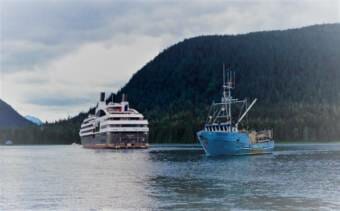
They’re looking at fish because that’s what belugas eat. Scientists say knowing more about the belugas’ diet will help them understand how they’re sustaining themselves in the winter and what’s keeping their population from rebounding.

“So that we can try to learn a little bit more about how the beluga movements are responding to changes in the prey base,” she said.

Environmental DNA is a relatively new concept. Alaska researchers have previously collected and sequenced samples of eDNA to study Pacific salmon and harbor porpoise.

To collect samples from the Kenai River, NOAA partnered with a field team from the Kachemak Bay Campus of Kenai Peninsula College.

KPC biology professor Debbie Boege-Tobin is leading that team. Boege-Tobin said on one hand, the fact that the whales are in the river at all could be a promising sign that there’s enough prey there to support them through the winter.

“But it also makes me nervous because we know that at times of the year when there’s lots of potential prey there, like in the summertime, they don’t seem to be using it. And that question puzzles me,” she said.

Once or twice a month, Boege-Tobin and a team of students take water samples from two spots on the Kenai River, at the city docks and Warren Ames Bridge. They collect samples both at the river’s surface and a few meters down, so they can capture a wide range of genetic signatures.

The river water, containing low levels of eDNA, is emptied into something as simple as a sterile Nalgene.

“It’s low tech, it’s accessible, and we can collect a lot of samples that way,” Parsons said. “We just require a hearty field team who’s willing to go out there in kinds of conditions to lower the bottle for us off the dock or boat or bridge, wherever we’re sampling from.”

Boege-Tobin and her team started collecting samples in November. They’ll keep collecting until May.

Once they’ve filled their vials, the team runs the water it’s collected through a filter in a lab in Homer. The remaining material goes to Parsons in Seattle for sequencing. There, they can use it to identify and quantify the prey species in the river.

It’s a pilot study, so it’s relatively preliminary. eDNA is not a perfect science yet.

“The tricky thing about eDNA is that we’re still in the early stages of understanding how that signal moves in the environment,” Parsons said.

In a river, researchers can capture genetic signals as they move downstream. In a marine environment, that material is moved by wind and currents and could settle and sink.

If researchers find the eDNA methodology successful, they can take what they’ve learned and apply it to other sites in Cook Inlet. Boege-Tobin also said they can use the data they collect to set some measures to protect the belugas.

“So hopefully, if we find out when they’re relying on the river, on the Kenai River in this case, we could potentially put in place some sort of management policies or measures to set aside some of that habitat for them,” she said.

 Researchers said they’ll have a preliminary analysis by the end of the year.

A second push for more solar on the Kenai Peninsula

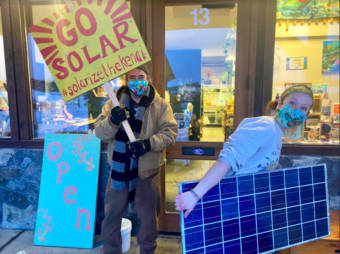
Timm Johnson and Ana Scollon cheer on Solarize the Kenai outside of the Cook Inletkeeper Community Action Studio in Soldotna. (Courtesy of Kaitlin Vadla)

A cooperative buying campaign is pushing again to get discounted solar panels on more Kenai Peninsula roofs.

Volunteers from Solarize the Kenai mobilized 82 property owners last year to outfit their homes and businesses with panels. It’s a collective effort, so interested homeowners sign up in groups to get group rates.

Timm Johnson is a volunteer with the group. At an informational meeting Wednesday, he said solar panel technology became cost effective for Alaskans a few years ago. But with the industry still growing, he said some of the associated soft costs, like installation, are still high.

“So what we try to do is we buy in bulk in regional areas so that we can reduce those soft costs so that we can provide the solar installers a group of interested people within specific zip codes, and/or regional areas, and help them reduce their overhead and logistical costs of getting their people out,” he said.

In 2020, Solarize the Kenai cut costs from $3 per watt to $2.70 per watt for users on the central and lower peninsula. This year, they’re looping in homeowners from Seward and Moose Pass, too.

There’s also a Solarize campaign in Anchorage, which installed panels in 75 homes last year, in its third year. Solarize Fairbanks, in its second year in 2020, installed panels in 77 homes.

Organizers said it’s a good deal for Alaskans because energy is so expensive in the state. Homer Electric Association members can also engage in net metering.

“So what that means is that the utility — in this case, Homer Electric — takes the energy that you produce at your house, anything above and beyond what you don’t use there directly, and you’re actually supplying it to the utility and they distribute it elsewhere,” said Steven Trimble, CEO of Alaska Arctic Solar Ventures. “And you get compensated for that.”

Even with support from local energy cooperatives, prices are contingent on state and federal policies. Alaska doesn’t have a state tax credit program to incentivize solar users. But the federal government does. This year, it’s offering a 26 percent tax credit to users to help with installation costs.

Solarize estimated the average homeowner could cover half of their home’s energy needs with 12 panels and save over $10,000 in the next 15 years. The environmental impact could be equivalent to keeping a car off the road for 12 years, according to the campaign.
River City Books outfitted its buildings with solar panels during last year’s Solarize the Kenai push. (Courtesy of Kaitlin Vadla)

Businesses, too, can put panels on their buildings. The Grog Shop in Homer has 79 panels. Solarize estimated that will save the owner nearly $200,000 long-term.

That’s partly because the building has a flat roof that faces west. The orientation of the solar array plays a big role in maximizing savings.

Solarize the Kenai hopes to have a list of interested homeowners by March 8.

Kaitlin Vadla, the regional director of Cook Inletkeeper, said getting neighbors to spread the word is key to get more people signed up.

“My dad, Bruce Vadla, got very excited about this. And he is a very quiet guy,” she said. “She is a general contractor in Soldotna. And he doesn’t go out and talk to his neighbors. But he did, last year. And multiple folks in his neighborhood solarized because he went out and talked to them.”

After a group gets together, it will then send out a request for proposals to solar installers. A committee of volunteers chooses an installer from the applicants.

Solarize hopes vendors will start negotiating contracts and installing panels by April.

For Alaska’s railbelt, electric vehicle charging corridor may be on road to reality

Photo of Sterling Highway. (Wikimedia Commons)
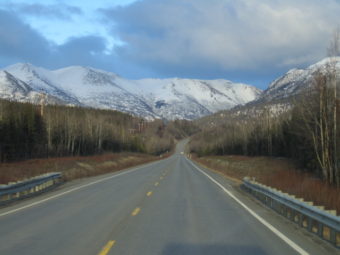
The Sterling Highway on the Kenai Peninsula. (Wikimedia Commons)

The Alaska Energy Authority plans to install between 10 and 14 electric chargers along the railbelt, from Homer and Seward to Fairbanks. Right now, sparsely distributed charging stations make electric vehicles impractical for long drives in Alaska.

AEA is looking for companies to make those charging stations and sites to host them. It has about $1 million to put toward the project, part of Alaska’s share of a 2017 settlement with Volkswagen over a diesel emissions scandal.

Other states have pledged to use their shares of the settlement money to create corridors, too. The idea is people might be more willing to buy and use electric cars if they know they’ll be able to charge them on long roads, like the Seward and Parks highways.

It’s one thing if you’re driving around town, says AEA Executive Director Curtis Thayer.

“But if you’re driving from Homer and you want to go to Anchorage, you’re going to want to know where those charging stations are, especially the one in Anchorage to recharge in order to get you back home,” he said.

An electric vehicle charging station at the Homer Electric building on Airport Way in Kenai. (Sabine Poux/KDLL)

The state plans to install level-three chargers. They’re more expensive than other charger types, but they can charge some cars in under an hour, while others might need an entire night.

Thayer said they plan to place stations within five miles of the highway, every 50 to 100 miles. The federally suggested distance is 50 miles, but that won’t always work in Alaska.

“Obviously, getting from the Girdwood gas station to Moose Pass or Cooper Landing, you’ve exceeded the 50 miles,” Thayer said.

Henry Krull of Kenai drives an older model Tesla that has a range of 250 miles.

“We’re basically limited right now to whatever power our vehicle’s range is,” he said. “Which means if your vehicle has a range of 200 miles, you can basically travel 100 miles in one direction and 100 miles in the other direction. And throughout Alaska, it’s often difficult to find publicly accessible charging even within several hundred miles.”

Thayer said recent estimates place Alaska at 1,000 electric vehicle users. The number of electric vehicles on the road has grown significantly in the last few years, thanks in part to incentives like reduced registration fees.

“And I truly believe that once you get in the pickup market, with electric vehicles — which is just right now beginning — you’re going to see a large increase in the state,” he said

They’re particularly popular in Southeast, where range is less of a concern. Some electric vehicles can go as far as 300 miles without a charge.

Krull said newer Tesla models can go up to 350 miles at a time.

“But in Alaska, you’re still very limited,” he said. “If you want to travel from Anchorage to Fairbanks, it’s very difficult, if not impossible, to do that.”

Cold weather can also reduce battery life. That may not be a problem on the Kenai Peninsula, but could be up in Fairbanks.

Another hurdle, Thayer said, is power.

“Because that’s going to affect the cost depending on the demand charges and the location,” he said.

A business may spend a couple hundred dollars a month maintaining a station. AEA hopes to cover up to 80% of the cost for stations.

Bruce Shelley, director of member relations for Homer Electric Association, said the energy co-op is working with AEA to see how hosts can incorporate charging stations without increasing demand charges for members.

Shelley said there are eight public charger stations in the association’s service area. None of those are level three chargers.

Bids for charger manufacturers are due March 8. The request for bids is available through the AEA site.

Thayer said they haven’t decided whether they’ll work with one or multiple manufacturers, but they’re not aware of any charger manufacturers in Alaska.

The bid for potential charger sites will go out later, on March 12. AEA put out a request for information for interested hosts today.

Fire razes Triumvirate Theatre building in Nikiski

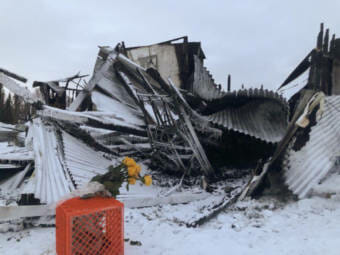
A bouquet of roses at the Triumvirate Theatre space Sunday, Feb. 21, 2021. (Sabine Poux/KDLL)

A fire decimated a beloved community theater in Nikiski this weekend.

Triumvirate North, the primary theater space for the nonprofit Triumvirate Theatre, burned to the ground early Saturday morning.

No one was hurt, but the fire completely razed the space. Investigators are still working out what caused it. But one thing’s for certain: Come time to rebuild, there will be no shortage of helping hands.

“It’s really kind of hard to describe what that feels like,” said Triumvirate executive director Joe Rizzo. “To get this tremendous amount of support from not only people that are in our little theater family and people that have had kids on our stage, but also people we don’t even know, have been reaching out to us.”

“It’s really overwhelming in the backdrop of such an emotional thing in watching this building go up that we’ve worked on for 10 years,” he added.

Triumvirate Theatre put on shows from that Nikiski space for seven years. Before it was a theater, it was North Road Motors, an old mechanic’s shop.

Refurbishing the space was a multi-year labor of love from a crew of volunteers, including Nikiski High School students in a Kenai Peninsula Construction Academy class.

Renovations didn’t stop then. Triumvirate had just put new siding on the building earlier this month. Last year, it built a two-story addition, which included a green room space dedicated to Rosie Reeder, who ran the used bookstore that supported the theater for over a decade.

Firefighters think the fire originated from that addition. The Alaska State Troopers received a call around 3:15 a.m. Saturday from a passerby who spotted the fire. Two minutes later, they dispatched the Nikiski Fire Department, said Nikiski Fire Chief Bryan Crisp.

When they arrived, fire engine and three water tankers in tow, the fire had already engulfed most of the building. The roof and siding collapsed, which made it difficult to get under and put out the hot spots.

“That’s why we were there until like 1:00, 2:00 that afternoon, because there were little pockets that were covered up by that siding and that sheeting from the roof,” Crisp said.

He said they knew then that most of the building would be a total loss. They were able to keep the front part of the building from collapsing, but the fire still destroyed the ticket counter and lobby space there.

With backup from Kenai and Central Emergency Services, Nikiski Fire set up a water shuttle to bring thousands of gallons of water to the fire. Nikiski doesn’t have fire hydrants because it doesn’t have a municipal water system. The closest hydrant is at the Baker Hughes Building in Kenai, about a mile south of the theater.

To set up the water shuttle, Crisp filled tankers elsewhere and dumped them into swimming pool-like tanks at the site. Then the tankers drove back to fill up and do it all over again.

“And basically it’s just a round-robin thing,” he said.

When a fire causes a death or destruction of a high-dollar amount, the state sends in someone from its fire marshal office to help investigate.

Fire Marshal Office Supervisor Jeff Morton said the cause and origin investigation will likely take a month or more to finalize. He said his office is working with the building insurance company, which is doing its own investigation, and anticipates they’ll have a final report by April.

The building is covered by a $700,000 insurance policy. It’s owned by North Road Properties, a company members of Triumvirate board set up in its early days.

“Originally, when that building came up for sale, Triumvirate Theatre, which was a relatively new organization, they didn’t have the collateral or the history or anything to be able to buy that building,” Rizzo said. “And so myself and a couple of the board members said, ‘OK, well, we’ll mortgage our house and buy this building so the theater will have some place to be.’ And so what we did is we purchased the building and then we were renting it to the theater operations.”

They’re still figuring out how much insurance will cover. Rizzo guessed it’s worth about $500,000, but he won’t know until assessors come.

Triumvirate doesn’t have insurance on the assets inside the building, including the stained glass chandelier that exploded in the fire or the set pieces from years of shows.

They’re hoping the community can help spot those costs, though they’re asking those who want to help to wait to pitch in until they have more information. Rizzo said his board is in the process of setting up an account with the Kenai Peninsula Foundation so people can donate directly.

Scott Wilburn is ready to help rebuild when he can. His entire family has been involved with Triumvirate since they moved to the area a few years back.

“So we need to let the dust settle and just be ready to go when the Rizzos call us,” he said.

Thirteen-year-old Alisha Wilburn played Anna in Triumvirate’s 2019 production of “Frozen.”  She says she’s been watching their website since COVID-19 started for announcements.

“I really want to get into another play. I love acting,” she said.

Scott Wilburn is an aircraft mechanic who pitched in on the set, both for “Frozen” and “Pirates Past Noon” a year later. He said meant a lot to them that the Rizzos were so inviting when they had just moved from out of town.

“It was definitely a warm theater,” he said. “I liked the size, it really did keep it a lot smaller and intimate and more personable. And it let younger stars come to shine versus being swallowed up by a large theater.”

On top of the theater, there was a lobby with couches and a fireplace around which castmates would gather during rehearsals.

“Our hearts are bleeding with them right now,” said Lara McGinnis, manager of the Kenai Peninsula Fair for 14 years. “Joe Rizzo poured his heart and soul into that with so many children to build it. I know it’s a lot of adult volunteers but when kids pour their hearts into something like that and you see it disintegrate, it just hurts in ways that can’t be put into words.”

She said she spoke with Jim Stearns, executive producer of SalmonFest, who reached out to ask what they can do to help.

“They are so loved and acknowledged by the entire entertainment community on the peninsula. We will all be there,” McGinnis said.

Kenai Performers, who put on T.S. Eliot’s “Murder in the Cathedral” last weekend and this upcoming weekend, is sending donations from the production to Triumvirate. Donations can be made in person at the shows, now sold out, or through the ticketing website for those attending the livestream.

Those gestures and an outpouring of support on Facebook show there’s an entire community ready to help.

“They’ll get it back and it’s going to be better,” said Scott Wilburn. “Bigger and better than before.”

At least one person, Rosie Reeder’s daughter Rhonda McCormick, is already taking steps to beautify the spot. Driving past the ruin, you might see it —  propped up on a red crate, backset against a heap of ash, a bouquet of yellow roses.

Elders, linguists teach Dena’ina language through original Native children’s stories

Joel Isaak speaks at a symposium. Others spoke about sewing as a way to learn Ahtna, an online Tugtun language learning tool and a project about the experiences of Alaska Native students in the university system. (UAA Alaska Native Studies Symposia)

When it comes to stories, it’s not just what you say — it’s how you say it.

Local linguists in the Kenai Peninsula are incorporating storytelling into their language revitalization efforts, giving elders a chance to create and tell stories in their Native languages and imparting that knowledge onto language learners.

Joel Isaak, an artist and Dena’ina language professor with Kenai Peninsula College, spoke about that project at Tuesday’s Alaska Native Studies Symposia, put on by the University of Alaska Anchorage.

He said a major key of the project is that elders should drive the language work.

“And Dena’ina, we have a very few number of first language speakers, around five or six,” he said. “And so what we’ve striven to do is surround the elder we’re working with with the support she needs and we need her to be able to be speaking every day. And for us as language learners that aren’t as proficient, this gives her a way to talk with us and for us to listen, and also a structure for how to teach students who want to learn language, as well.”

Dena’ina is a highly endangered language. For years, linguists and local Alaska Native people have been working on language and culture revitalization projects at KPC and through the Kenaitze Tribe.

Isaak apprentices with Helen Dick, a Dena’ina elder. Since COVID-19 hit, they’ve been Zooming daily to record Dena’ina stories.

At first, they were translating other work from English to Dena’ina.

“When we were first starting off the project, we were trying to figure out, ‘How do we develop resources?’ And so we started out with the Dr. Suess, ‘One Fish, Two Fish, Red Fish, Blue Fish,’” Isaak said.

“And when we were doing this, I came across the verb, ‘to hop,’ which is, ‘nik’unu’inedltlet,'” he added. “And that led us into a series of books that we would do,”

They ended up creating a series of stories about a fictional Dena’ina girl, whose name is Niku because she loves to hop. Some of their early stories had to do with animals.

“And through this process of working with our elders, we realized that the anamorphic kind of Berenstain Bear, or talking animals, and the playful Dr. Suess, early Western literature method is not how we talk about language in Dena’ina,” Isaak said.

Now, they’re creating stories based on prompts like Niku going to the store with her family or having a potlatch.

“For example, the berry picking story,” he said. “You would tell that story when you’re out berry picking. But when you’re sitting in an office, in Kenai and it’s winter and you’re not out berry picking, it’s hard to do that kind of story creation. And so when we’re telling the story about berry picking, then Helen’s able to tell the traditional story that you would say in that context.”

Some of the stories are ones Dick will tell about her own experiences.

“It gives the framework to be able to talk about the things that we do in our lives,” Isaak said. “So every day, we’re recording these stories based around what’s happening in our lives.”

They’ve amassed hundreds of stories and keep track of them in a table of contents, accompanied by detailed notes. They also work on breaking the pieces down and analyzing their grammar.

“We’re trying to not just take English syntax structure and put it into Dena’ina. We want it to be Dena’ina,” Isaak said.

He said those cultural components are instrumental to their revitalization effort.

“A big part of our language work is, ‘Where does language come from?’ Language is a response to place, it’s the form of communication, so this is why we have to do the language with the culture,” he said. “They’re not separate.”

Isaak said they’re working on compiling texts for a storybook for children and early language learners. They’re also compiling pieces on an interactive website.

You can watch the symposium in its entirety on the Alaska Native Studies Facebook page.

Site notifications
Update notification options
Subscribe to notifications