KDLL - Kenai

KDLL is our partner station in Kenai. KTOO collaborates with partners across the state to cover important news and to share stories with our audiences.

SeaLife Center seals deal on spill response partnership

The new program will send SeaLife Center staff to oil spill sites in western Alaska. (courtesy Alaska SeaLife Center)

The Alaska SeaLife Center in Seward is partnering with an oil spill response organization to rehabilitate oiled marine mammals in Western Alaska.

Through an agreement with nonprofit Alaska Chadux̂ Network, the center will treat marine mammals affected by spill pollution in a large chunk of Alaska waters.

The idea is to get wildlife experts to the scene of a spill as quickly as possible — like an oiled wildlife SWAT team, said Chip Arnold, chief operating officer for the SeaLife Center.

“The exciting thing about the contract with Chadux̂ is that their whole paradigm of oiled wildlife response is rapid response,” he said.

Locals know the Alaska SeaLife Center as an aquarium. But it’s also the state’s only permanent rescue and rehabilitation facility for marine mammals.

Arnold said they never intended to get involved in oil spill response. But a decade ago, the center decided to build up its capacity.

“We knew that if some big spill, some spill of national significance happened again in Alaska, we are the marine mammal stranding center for the entire state,” he said. “And we are going to be called. And we’re also animal lovers, and so we are going to respond.”

The center is on contract with two other oil spill response organizations, including Cook Inlet Spill Response and Prevention in Nikiski. But this is the first time it will be available as a first responder, Arnold said.

It’s a first for Chadux̂, too. The organization also partners with a bird rescue group, but has never teamed up with marine mammal experts before.

When there’s a spill, Chadux̂ will first send in its team.

“Once we’ve discerned that wildlife has been impacted, or wildlife may be impacted, we would then reach out to the Alaska SeaLife Center and ask them to deploy immediately,” said Chadux̂ general manager Buddy Custard.

The center has a team of 23 animal care professionals, along with mobile vet clinics, staff support units, and other infrastructure and supplies. That way, teams can rehabilitate affected animals on-site, without taking them out of their habitats.

The SeaLife Center has also trained volunteers from the Lower 48 to staff the center while its own employees are in the field.

Chadux̂’s oil response programs are funded by the industry. To be part of the Chadux̂ Network, companies pay dues to the nonprofit in exchange for services.

“Everybody that’s enrolled in our program gets this service, if they need it,” Custard said.

Chadux̂ covers a large part of Alaska’s waters, from the North Slope down to the Aleutian Islands, and throughout Prince William Sound.

But Arnold said the development of this infrastructure will also allow the center to respond to spills closer to home. If there’s a spill in Resurrection Bay, for example, it can set up units in the center’s parking lot.

It wouldn’t be the first time the site is used to rehabilitate oiled wildlife. Arnold said after the Exxon Valdez spill, nearly 10 years before the SeaLife Center opened its doors, the property on which the center sits was used to house a temporary sea otter treatment facility.

Seward demolishes building where Alaska flag first flew, plans for memorial in its place

The Jesse Lee Home in Seward (Photo by Casey Grove/Alaska Public Media)

The historic Jesse Lee Home is mostly demolished. Now, the Seward property will be rezoned as a park, following a unanimous vote by the Seward City Council last week.

It’s the beginning of the end of a heated, years-long battle over the future of the abandoned historical building and the 2.66 acres on which it sits. Multiple attempts to keep it intact failed and the city began demolition in November.

The city plans on building a memorial on the property. To do so, it had to first rezone the land as a “park,” said community development director Jackie Wilde.

“My goal is that, come June, we’ve got grass planted, we’ve got an area to park and we are building a memorial,” she said.

It’s been a controversial process. For years, advocates fought hard to preserve the building. Others said its dilapidated exterior was a blight on the area.

From 1926 to 1964, the Jesse Lee Home was a residential school for children, many of whom were orphans or had parents with tuberculosis. It’s where Benny Benson lived when he designed the Alaska state flag, as a seventh-grader.
The home was abandoned when the 1964 earthquake damaged it beyond use.

The nonprofit Friends of the Jesse Lee Home took over the building more than a decade ago and worked with the state to turn it into a new school. But when the organization could not produce on its promises, the building was reverted back to city ownership.

The Friends’ final attempt to save the house was in September. The Kenai court gave them a week to raise half a million dollars, but they couldn’t do so by the deadline.

That effort did delay demolition, however, as did inclement winter weather. While most of the building is now gone, there are still parts of the foundation, stairs and a concrete boiler room left.

Wilde said the city hopes to have the demolition work done by the beginning of March. That will give them a sense of how much money they have left to build a memorial.

Dorene Lorenz, chair of the Friends of the Jesse Lee Home, said seeing the demolition was painful.

“What I did receive are a lot of really painful phone calls and hurtful letters from children of the Jesse Lee, expressing their anguish, their pain and their sadness with losing what to them was a sacred spot, a place of hope, a place of family and a place that was very meaningful to them,” she said.

Council member Sue McClure said she agrees with the sentiment that the home and its history must be memorialized. But like the other council members, she wants to see a new tribute.

“And so if we had lots of money, it would be wonderful to do some interactive, wonderful memorial, chronicling the history and experiences,” she said. “At this point, I’m not sure what we can do. But at least the rezone was the simple act of making it possible to do something.”

The city is currently using a $1.07 million grant from the state to demolish the building. It will use the funds leftover — an estimated $200,000 — to build whatever comes next.

It’s not certain what that will be. Wilde said the city can apply for grants to build other parts of a park or community center.

“I just want to see it be an area that we’re honoring everything that happened there and also providing a really great usable space, regardless if it’s a community center,” she said. “Those are all things that are allowed in a park.”

She said they’ve saved some parts of the building, like its arch windows, to hopefully repurpose in a park.

The city will solicit community feedback before coming up with a design for the new property. In a recent survey by the city, over half of 360 respondents agreed with turning the entire property into a park and memorial. Others said at least part of the property should be sold.

The city has to spend the funds appropriated by the state for a memorial by June 30, per the terms of the grant.

Iditarod mushers train for a radically different route

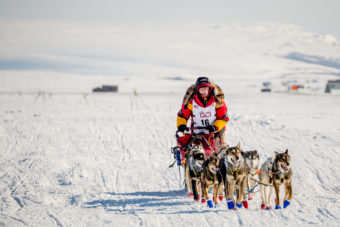
Mitch Seavey mushes on the outskirts of Nome on Tuesday afternoon. The elder Seavey finished the 2017 Iditarod in record time Tuesday, March 14, 2017. (Photo by David Dodman/ KNOM)
Three-time champion Mitch Seavey mushes on the outskirts of Nome in March, 2017. This year, Seavey will skip the Iditarod for the first time since 1994. (David Dodman/ KNOM)

There are some advantages to running an unfamiliar Iditarod route.

“I’m kind of a shoot-from-the-hips style of guy. So I kind of like that everybody’s having to think on their feet, cause I think that’s my strong point out there,” said Travis Beals, of Seward.

Beals is returning for his eighth year on the trail. He runs a kennel with his partner, Sarah Stokey — also an Iditarod veteran. Last year, he finished in 10th place.

But this year’s trail isn’t the one he’s used to. Instead of racing up to Nome and stopping in towns and villages along the way, teams are traveling just halfway up the traditional route, through the Alaska Range and Dalzell Gorge.

And then they’re turning around to do it all again.

“Normally, some of these challenging sections of the trail, we only hit once,” he said. “And when we get through it, we can kind of take a breath and go, ‘Alright, we’re through that.’ Whereas this year, we’re going to turn around and go back through some of the sections that break sleds and cause a little bit of trouble.”

Iditarod officials changed the route to keep people in the surrounding villages safe — including Shaktoolik, which closed its checkpoint to racers last March as the arrival of the coronavirus intersected with the end of the Iditarod. Mushers will make checkpoints out of abandoned mining towns and other unpopulated areas on the route.

Iditarod champion Mitch Seavey, of Sterling, is inspired that the race is continuing against the odds. But he won’t be racing this year. It wasn’t about coronavirus.

“I just felt like I wanted a break,” he said. “I wanted to see maybe what else is out there in the world beside the Iditarod. You know what I’m saying?”

This is Seavey’s first time not racing since 1994. He’s won three times and holds the fastest race time in Iditarod history.

When he won in 2017, he was the oldest musher to win, at 57.

Mitch Seavey’s son, Dallas Seavey, came in second that year. The two mushers have been neck and neck in several races.

Dallas Seavey, of Talkeetna, took a few years off from the race and is returning this year with a team of both his own dogs and his dad’s dogs.

It’s a chance for the two mushers to work with each other, rather than against each other.

“When we’re both racing, we sort of keep all of our cards close to the vest because we know that each other is our biggest competitor,” Mitch Seavey said. “And now that I’m not racing, we talk about things and share things and information that, boy, I wish I had known years ago how he was doing that.”

Hal Hanson with his team last weekend during the Copper Basin 300. (courtesy Hal Hanson)

Hal Hanson, also of Sterling, has been working with the Seaveys for several years. He’s racing the Iditarod for the first time this March, fulfilling a dream he’s had since he was a kid in Oklahoma.

He’ll be running a “puppy team” of 2-year-old dogs.

“I’m most excited to see how these guys grow and mature,” he said.”What I’m probably most fearful of is turning around and coming back. Of all the experienced mushers, nobody’s ever done this before. Come back over the Alaska Range. Of anything, that will be what makes me nervous. Is just the unknown.”

Hanson ran with his team last weekend at the Copper Basin 300. He placed 20th.

He’s thrilled he’ll still get to race. For mushers on the peninsula, the starting and endpoint is just a drive away.

For last year’s champion, Thomas Waerner of Norway, it’s a flight overseas. Waerner said he won’t make a return this year since he can’t figure out how to get his dogs to Alaska amid the pandemic.

It’s going to be an Iditarod like no other. But for the 53 mushers signed up, from the experienced veterans to the rookies, there’s excitement in the novelty of it all.

“There’s part of me — I regret missing it,” Mitch Seavey said. “It’s a unique race. It’s going to be fun for those guys, it’s going to be different.”

The 2021 Iditarod ceremonial start is March 6 in Anchorage, with the restart a day later at Deshka Landing.

Federal government moves toward Cook Inlet oil lease sale

Cook Inlet oil platforms are visible from shore near Kenai, Alaska. (Photo by Rashah McChesney/Alaska’s Energy Desk)

The federal government has released a draft environmental impact statement on an oil and gas lease sale in Cook Inlet, tentatively scheduled for late 2021.

The Bureau of Ocean Energy Management is planning to solicit bids on over 1 million acres in the inlet’s federal waters, which includes anything more than three miles offshore. The agency first published its notice of intent in September and released the EIS draft Wednesday.
Some fishermen and conservationists say that wasn’t enough time.

“We’ve never before seen an environmental impact statement rammed through in such a short time,” said Bob Shavelson, advocacy director of Cook Inletkeeper. “When you look at something like a three month time period, it’s not going to be adequate to understand really what the impacts are.”

The area of the proposed Cook Inlet sale, covering just over 1 million acres, is outlined in yellow. Blocks outlined in green were purchased by Hilcorp Alaska LLC in the last sale. (via Bureau of Ocean Energy Management)

The bureau spent almost two years drafting a statement prior to the last federal lease sale, in 2017.

But since that sale, the Trump administration has set both time and page limits on federal environmental impact statements. An August 2017 order from the Secretary of the Interior requires bureaus to complete final statements within a year of issuing a notice of intent.

Still, Alaska Region spokesperson John Callahan said the bureau completed the draft EIS with due diligence.

“Of course we’re always hoping for input, that’s the whole purpose for producing a draft,” he said. “And we’d like to have the Cook Inlet communities look at it, or view it, and let us know what they think.”

Callahan said the process could also move faster because the bureau was able to work off of the 2017 draft. While each environmental impact statement is different, he said it helped to have that framework.

The bureau hasn’t decided for certain whether it will hold the sale. It canceled lease sales in 2006, 2008 and 2010 due to lack of interest. Hilcorp Alaska LLC has been the sole bidder in both state and federal lease sales in the inlet for several years, including in 2017, when the company picked up 14 tracts for over $3 million. The company currently owns all the federal leases in the inlet.

The bureau will hold public hearings in February before drawing up the final environmental impact statement. To submit public comments, visit boem.gov/CookInlet2021.

Editor’s note: This story has been corrected to fix a transcription error in a quote from John Callahan.

Kenai Peninsula lawmakers join millions of conservatives on unmoderated social media platforms

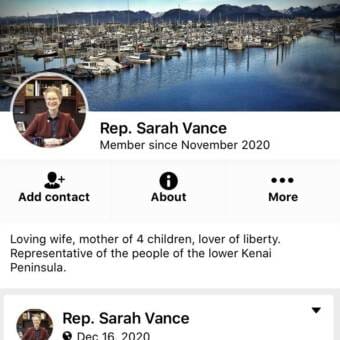
Homer Rep. Sarah Vance’s MeWe profile. MeWe is currently the 11th most popular free app in the Apple App Store. (Source: MeWe)

Local lawmakers in the Kenai Peninsula are among the millions of conservatives flocking to Parler and MeWe, unmoderated social media sites that have become increasingly popular as mainstream social media companies crack down on election misinformation and extremism.

Nikiski Republican Ben Carpenter said that regulation is partly why he migrated to those platforms and deleted his personal and professional Facebook accounts. He said he’s on Parler or MeWe in his capacity as an individual, not as an elected official.

“Why that platform over another platform? The answer’s obvious,” he said. “The owners of Facebook and Twitter are censoring conservative voices and I don’t condone that. I don’t believe it’s American, but they have a right to do it as it’s their private business.”

Facebook and Twitter banned President Trump and his allies for propagating falsehoods about election integrity and instigating violence after the attack on the Capitol on Jan. 6.

Parler and MeWe are unmoderated. So users can post whatever they want — including hate speech and conspiracy theories.

Carpenter said another reason he switched is that he doesn’t think Facebook is conducive to conversations with constituents. He doesn’t think Parler and MeWe are, either, which is why he said he probably won’t be posting on them in an “official capacity.”

Rep. Sarah Vance, of Homer and Ron Gillham, of Soldotna, both Republicans, also have presences on MeWe. Both also maintain active Facebook pages.

Parler is currently offline since it was booted by app stores and Amazon Web Services for not removing content that “encourages or incites violence against others.”

Experts say websites like Parler helped Pro-Trump extremists organize for the Jan. 6 insurrection.

“What they advertise themselves as is that they presume themselves as completely unregulated, free speech-first platforms,” said Alex Newhouse, research lead at the Center on Terrorism, Extremism and Counterterrorism at the Middlebury Institute of International Studies. He’s been paying attention to apps like Parler in his studies on far-right extremism.

“In theory, that sounds pretty great for people who are concerned about freedom of speech and First Amendment issues,” he added. “But in practice, what that means is a lot of groups and individuals who have been kicked off for very important and valid reasons, like inciting violence and organizing terrorist attacks, also end up on those platforms, as well.”

Politicians have been using alternative social media to converse with voters and appeal to their more conservative base, Newhouse said. He said it’s a worrying trend since more mainstream conservatives and overt extremists are all syphoned through the same channels.

“These politicians are becoming lightning rods where that sort of mish-mash merging of different strains of the conservative movement broadly are occurring,” he said. “Without acknowledging how their presence affects that and how it draws people from all different parts of the spectrum, it is very dangerous. And it does contribute to radicalization of normal people. So I’m very concerned about the presence of politicians on unregulated platforms like that.”

Carpenter said he doesn’t think getting rid of these sites will eliminate the threat of violence. And he said regulation of social media is a violation of free speech.

Soldotna Republican Sen. Peter Micciche said he doesn’t have plans to move to any of those alternative sites. He said right now, Facebook is a good way for him to communicate with the people in his district.

“I’m going to be relying more on newsletters so that not every issue is politicized. But I’ll be evaluating the most effective way to reach my constituents,” he said. “I don’t know what my long-term decision will be.”

Neither Gillham nor Vance would respond to requests for comment by airtime. Representatives are arriving in Juneau this week for the start of the legislative session.

Safari Club International appeals ruling on Kenai National Wildlife Refuge

Safari Club International, a hunting advocacy group with 180 local chapters, filed a notice of appeal Friday. (Sabine Poux/KDLL)

Safari Club International is appealing a decision from a federal judge to uphold hunting and trapping restrictions in the Kenai National Wildlife Refuge.

The hunting advocacy group hopes the court will reconsider the November ruling, said Regina Lennox, litigation counsel for SCI.

It’s part of an ongoing debate about jurisdiction of the refuge, a 2 million-acre swath of land managed by the U.S. Department of Interior. In 2016, the U.S. government under President Barack Obama introduced the “Kenai Rule,” which placed restrictions on hunting and trapping in the refuge, including limits to brown-bear baiting and hunting in the Skilak Wildlife Recreation Area.

Shortly after that “Kenai Rule” was passed, SCI and the state of Alaska filed a lawsuit against the department, arguing the restrictions precluded state management of those lands. Conservationist groups, on the other hand, argue that the federal government has primacy over regulation.

A federal judge in November agreed with the conservation groups’ interpretation. SCI filed its challenge to that decision Friday.

“We made certain claims in our complaint, we argued those in our briefing,” Lennox said. “The court didn’t agree with us on some of those arguments, so we’ll take all of that to the Ninth Circuit and try to explain why we think the district court misinterpreted both the law and the application of law to the record.”

Nicole Schmitt is executive director for Alaska Wildlife Alliance, one of the intervening defendants in the original case. She said she’s confident that the court will uphold its ruling.

“We feel really confident in our legal arguments and in the strength of that district court decision,” she said. “We are confident that the Ninth Circuit will affirm the agency, being the Fish and Wildlife Service, and the lower court in this case. And while it does create more work, it creates an opportunity for us to create a clear Ninth Circuit precedent on these important issues. So, we’re looking forward to that.”

The Ninth Circuit court is the federal court of appeals for Alaska and several other states.

The state has until Jan. 15 to also appeal the decision. Alaska Department of Fish and Game Commissioner Doug Vincent-Lang has said he was worried about the legal precedent the November decision could set.

Rick Green, special assistant to Vincent-Lang, said the department is consulting with its attorneys and considering its options.

“We’re cognizant of the 15th deadline, meaning we should have a decision on whether we’re going to move forward or not by close of business Friday,” he said.

SCI is not appealing the decision the court made in its favor, Lennox said. Part of the court’s November ruling said that the portion of the Kenai Rule regarding firearm restrictions along the Kenai and Russian Rivers required further analysis from the Fish and Wildlife Service.

Site notifications
Update notification options
Subscribe to notifications