KDLL - Kenai

KDLL is our partner station in Kenai. KTOO collaborates with partners across the state to cover important news and to share stories with our audiences.
Genetic technique brings biologists closer to solving beluga mystery

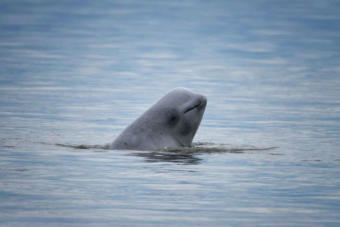
Cook Inlet belugas are the smallest of five beluga stocks in Alaska. The population has been declining for over two decades. (NOAA photo)

The beluga population in Cook Inlet is not bouncing back, and scientists are trying to figure out why. First, they need to know more about the population. A key part of that is knowing how old the whales are.

“Up until this point, the only way we’ve been able to age animals is through their teeth,” said Verena Gill, a branch chief with NOAA Fisheries.

“You count the rings in your teeth, kind of like you count tree rings,” she said. “We can’t exactly go run around the inlet, jump on top of a beluga, yank one of its teeth out and count the rings on the living animal and go, ‘OK, well, Betty Beluga out there is 10.’ So the only way we’ve been able to get teeth are from animals that have died.”

But now, researchers have found a way to determine the ages of living Cook Inlet belugas using skin samples. That technique is outlined in a paper published last month by researchers from NOAA Fisheries, Oregon State University and University of California Los Angeles.
It’s a big deal for researchers who study these whales. NOAA lists Cook Inlet belugas as one of its nine “Species in the Spotlight,” meaning they’re at high risk for extinction.

The technique relies on epigenetics. While genetics concerns DNA, epigenetics is about how that DNA is modified.

“So the term itself is a little bit of a catchall, because it actually includes a lot of different processes,” said Ellie Bors, a postdoctoral researcher on the study. “But I like to think of epigenetics as all these other ways that DNA is modified or packaged within a cell that affects the way DNA turns into genes and proteins.”

In particular, researchers looked at a specific epigenetic process called DNA methylation. That means organic compounds, called methyl groups, are being added to DNA.

“And it turns out that as a lot of mammals age, the way that DNA is methylated changes, or the amount of methylation changes with age,” Bors said.

Scientists can tell how old a beluga is based on how its DNA is methylated. And they can get that DNA through tiny skin samples of living whales.

Other species, like humpbacks, have patterns on their bodies that indicate age. Not belugas.

Paul Wade works for NOAA Fisheries’ Alaska Fisheries Science Center and was a co-author of the paper.

“Being able to estimate the age of a living animal just can be so important for us,” he said. “I’ve always been jealous of colleagues that study different species where they can know the age of their animals just ’cause they know so much about their population.”

He said this technique will help with a lot of research in the works about Cook Inlet belugas.

A lab in San Diego is studying pregnancy rates in belugas using hormones found in their blubber. Researchers knew what percentage of these whales were getting pregnant, but they couldn’t tell the age of the pregnant whales.

“But as soon as we got the ages and plotted pregnancy or not versus age, we noticed that it was only the older whales in our study that showed a fairly high pregnancy rate,” he said.

It was a small sample size, Wade said. But when scientists compare those findings with that of healthy beluga populations, they show reproduction among Cook Inlet belugas could be delayed. That might be a sign the population is struggling due to external factors, like a lack of food.

Findings are preliminary. But Wade said scientists feel they’re getting closer to knowing why Cook Inlet belugas aren’t rebounding.

Kenai Peninsula residents who are excited about beluga research can participate in local efforts, like the Cook Inlet Belugas Count, a one-day event that uses volunteers in Homer and Kenai to count whales.

There’s also the Alaska Beluga Monitoring Partnership, a program that takes place in the spring and involves training. Visit akbmp.org for more information.

Cook Inlet oil lease sale process on pause

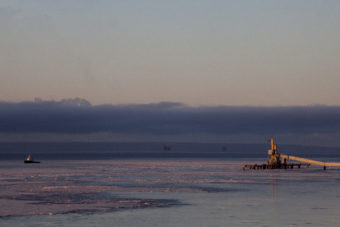
Cook Inlet oil platforms are visible from shore near Kenai, Alaska. (Photo by Rashah McChesney/Alaska’s Energy Desk)

The federal government has hit pause on preparations for an oil lease sale in Cook Inlet after President Joe Biden signed an executive order indefinitely halting new leases.
The Bureau of Ocean Energy Management was gearing up to solicit bids on 1 million acres in Cook Inlet’s federal waters later this year. But Biden said on Jan. 27 his administration wants to review the federal leasing program — one part of a broader order geared at combating climate change.

Before the lease sale stalled, the bureau had already released a draft environmental impact statement. The comment period for that impact statement and all February meetings are now canceled.

Kara Moriarty is the president and CEO of Alaska Oil and Gas Association. She said it wasn’t surprising that the Cook Inlet lease sale was paused after Biden’s order.

“What we don’t know is, is this indicative of all lease sales into the future? I mean, we certainly would hope not,” she said.

Even without presidential intervention, it’s not clear that the federal bureau would have held the lease sale. The agency canceled lease sales in 2006, 2008 and 2010 due to lack of industry interest. Hilcorp was the only bidder in state and federal lease sales in Cook Inlet for several years.

Environmental groups say the moratorium is a good thing. Cook Inletkeeper Advocacy Director Bob Shavelson said it’s refreshing to see the new administration take action.

“And there has been strong opposition over the decades to industrializing lower Cook Inlet, and we’ve got strong commercial fishing and sport fishing and tourism and subsistence economies here that would directly conflict with heavy industry and oil and gas development,” he said. “So it doesn’t make sense to throw all that away so Hilcorp can make a few more dollars.”

Tim Dillon is the executive director of the Kenai Peninsula Economic Development District. He said even without widespread industry interest, it’s important for Alaska that the opportunity is there.

“Our governor has said over and over again that here in Alaska, we do it the safest way possible,” he said. “And people know that. And to just put a stop on everything, really hurts an industry in a big, big way.”

If the Biden administration does let leasing proceed, the federal government will open a new comment period.

Hilcorp eyes gas exploration near Anchor Point

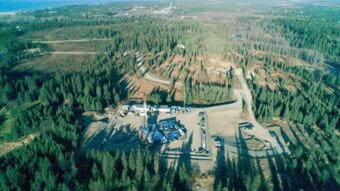
Hilcorp’s Seaview drill site located in Anchor Point. (Photo courtesy of Willy Dunne)

Hilcorp, Alaska is looking to build two gas exploration wells near Anchor Point later this year.

The Texas-based company has requested approval from the Alaska Department of Natural Resources to build an oil-gas combination well and gas-only well in Whiskey Gulch, three miles northeast of Anchor Point. It also wants to build a gravel pad and access road on the privately owned property above the lease.

The proposal is for a gas prospect. An ENSTAR Natural Gas line runs by the site down to the southern part of the Kenai Peninsula.

Hilcorp’s proposal for an access road and pad in Whiskey Gulch. (Department of Natural Resources, Division of Oil and Gas)

Hilcorp is the biggest oil and gas producer in Cook Inlet. The Texas-based company owns several onshore gas wells, including the Seaview Unit south of Anchor Point, and operates most of the inlet’s offshore platforms.

Hilcorp drilled five stratigraphic wells in Whiskey Gulch last summer, including two on the lease involved in its current proposal. All were plugged and abandoned in July, according to data from the Alaska Oil and Gas Conservation Commission.

In its application, the company proposed constructing the gravel access road and pad in April. DNR says the company could start drilling June 1. Any future production would need to be approved in a separate permitting process.

You can find Hilcorp’s application here. Send comments to DNR by March 4 at dog.permitting@alaska.gov.

Bernie Sanders got memed at the Inauguration. Now it’s mitten madness.

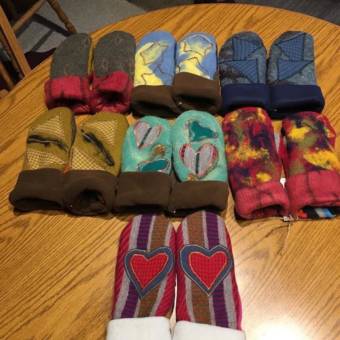
Claudette Barber makes mittens and other fabric items from her workshop in Soldotna. They’re made of upcycled wool and lined with fleece. (Courtesy Claudette Barber)

An unexpected outcome of President Joe Biden’s inauguration last month was the rise of a new meme.

You’ve definitely seen it: Vermont Sen. Bernie Sanders sitting cross-legged in a folding chair, looking slightly disgruntled but also incredibly warm in a puffy coat and woolen mittens.

Sanders got his pair from Jen Ellis, a school teacher in his home state. The internet went crazy over them.

“Well, I thought it was really funny. I won’t lie, for being a businesswoman, I thought it was a great business opportunity,” said Claudette Barber, of Claudette’s Traveling Boutique in Soldotna.

Barber makes upcycled wool mittens herself, lined with polar fleece and decorated with appliques.

Her sales didn’t really change when the memes were doing the rounds. Mittens have always been a steady seller for her. Like Vermonters, Alaskans were already attuned to the mitten hype, she said.

“The mittens up here are perfect because they really, besides from being cute, they’re really probably the warmest mittens you could ever wear,” she said.

Barber is one of several Alaska mitten makers. Jennifer Bidwell owns Alaskan Mittens in Fairbanks.

“I sold quite a few pairs that day, or that weekend,” Bidwell said. “Usually it slows down in January, February. But this year it’s kind of staying steady.”

She thinks that has something to do with Sanders, though she’s not entirely sure. Her shop posted a photo of the senator the day after the inauguration, with the caption, “Bernie has the right idea.” Blue Door Antiques, a Fairbanks store that carries her products, made a similar post.

Wool sweaters are hard to come by at Alaska second-hand stores. Bidwell stocks up when she’s in the Lower 48.

“Every time I go Outside, I bring back two duffle bags of sweaters,” she said.

Kristal Achenbach makes wool mittens for her business Always Stitchen in Wasilla. Like the Sanders meme makers, her customers seem to love mittens because of how they look.

“I think a lot of people buy them from me because they’re cute,” she said. “And then the second thing would be, ‘Oh these are so warm.’”

What makes a good mitten, she said, is layering the felted wool and fleece to create more warmth and block the wind. Her mittens also have small pockets.

All three mitten makers said Alaskans already love their mittens. Are they having their moment everywhere else, too?
“Once people, if they decide they want to try a pair, they’ll love ’em,” Barber said. “So it may become a fad. I hope so.”

As for the memes, there doesn’t seem to be an end in sight.

Kenai natural gas plant unlikely to harm endangered belugas, report says

The Kenai liquefied natural gas facility (Photo by Sabine Poux/KDLL)

Marathon Petroleum’s plan for the Kenai liquefied natural gas plant will not likely harm endangered Cook Inlet belugas, according to a Jan. 25 letter from the National Marine Fisheries Service.

That brings Marathon one step closer to reopening the Nikiski plant as an import facility. Marathon subsidiary Trans-Foreland Pipeline got the green light from the Federal Energy Regulatory Commission to reopen the plant in December.

In the letter, the National Marine Fisheries Service said Marathon’s plan will probably not adversely affect endangered Cook Inlet beluga whales or their habitat, which extends past Kalgin Island. Nor is the project likely to impact several other species, including local populations of Steller sea lions or gray whales.

That’s because the proposed upgrades to the facility will occur on land, the letter said. The project also doesn’t propose any changes to current vessel operations.

But the plant would emit greenhouse gases, through the venting of excess boil-off gas during ship unloading. The report said the effects of those emissions on the listed marine species would be insignificant and the facility emitted more greenhouse gases in the past.

The Kenai LNG facility ran for years as a natural gas exporter, under ConocoPhillips. At one point, it was the country’s sole exporter of LNG and Japan’s only source for the commodity.

As the market became more competitive, ConocoPhillips mothballed the facility in 2017. Marathon bought the plant in 2018.

The company is still not certain it will act on its proposal to reopen the plant and flip it from exports to imports. If it did, Marathon could use the imported gas to power its refinery down the street.

Another poor sockeye season predicted for Cook Inlet

Dipnetters crowd the water on the north shore of the Kenai River in 2014. (Annie Feidt/AKPM)

Upper Cook Inlet fishermen should expect another below-average sockeye run this year.

The Alaska Department of Fish and Game forecasts a return of 4,370,000 sockeye to Upper Cook Inlet in 2021, according to a report released Friday. Brian Marston, Fish and Game’s area manager for Upper Cook Inlet commercial fisheries, says the projections aren’t surprising.

“We have seen lower-than-average runs, or right around the 4.3 million mark, which is what we’re predicting this year,” he said. “So it’s not too different from recent numbers, but it is below average.”

The inlet’s 20-year average is nearly 6 million sockeye. But runs over the last few years have been lower. Last year’s sockeye run was the lowest since 1971, at 4.36 million fish. Commercial fishermen saw a harvest of 700,000 salmon in 2020, over 1 million short of the preseason projections.

The Kenai Peninsula Borough Assembly asked state and federal governments to declare a fisheries failure and economic disaster.

Assemblyman Brent Johnson, himself a set-netter, laid out the factors contributing to the bad harvest at the assembly’s Jan. 19 meeting.

“These fishermen were getting hammered in three ways right there,” he said. “One, they didn’t catch very many of the primary target species: sockeye. Of those sockeye that they did catch, they were smaller than they normally are. And then the price went to pot.”

The borough says it hasn’t gotten a response from the state since sending a request in October. It sent its request to federal officials this week.

The 2021 forecast projects a Kenai River run of 2,325,000 sockeye. That’s over a million fewer than the 20-year average. The Kasilof River run is projected at 881,000. That’s down from the 20-year average of 986,000.

For the Susitna River, the forecast is looking up: 436,000 compared to a 20-year average of 377,000. Same with Fish Creek, up to 92,000 fish from 86,000.

Fishermen are waiting on the chinook preseason forecast for more insight on how the upcoming season will go. Low king runs last year added insult to injury for Cook Inlet anglers.

Site notifications
Update notification options
Subscribe to notifications